
Most people who want to build a travel booking app spend the first three months asking the wrong question. They ask "how much will it cost" before they have answered "what problem am I actually solving and for whom." The result is a budget that looks right on paper and a product that goes nowhere in the market.
This guide is going to flip that order for you.
Yes, we are going to get into the real numbers behind the cost to build travel booking app in 2026. Detailed ones. Broken down by features, by team structure, by geography, by platform. But we are also going to give you the context that makes those numbers mean something, because a $80,000 app built with the right decisions is worth ten times more than a $300,000 app built without them.
The travel booking industry in 2026 is not looking for another copy of Booking.com. It is looking for products that serve the gaps Booking.com and its competitors have left wide open. If you know where those gaps are and you build smart, the investment you make today has a very real return waiting on the other side.
Let us get into it.
Why Is Everyone Trying to Build the Next Booking.com?
The travel tech market in 2026 is absolutely massive. Global online travel bookings are expected to cross $1.2 trillion this year, and a huge chunk of that is happening through mobile apps. People are not calling hotels anymore. They are tapping through apps, comparing prices in seconds, and booking flights during their lunch breaks.
Booking.com alone processes over 1.5 million room nights every single day. That kind of scale does not happen by accident. It happens because the app is built smart, with features that feel effortless but are actually incredibly complex under the hood.
So if you are thinking about entering this space, you are thinking about the right market. But you also need to think clearly about the investment involved.
What Kind of Travel Booking App Are You Building?
Before we talk numbers, we need to talk about scope. Not all travel apps are the same, and the cost to build travel booking app depends heavily on what type you are going after.
- Hotel and Accommodation Booking App
This is what Booking.com primarily does. It connects travelers with hotels, hostels, apartments, and other stays. Core features include search with filters, property listings, reviews, booking management, and payments. - Flight Booking App
Think Skyscanner or Google Flights. These pull data from multiple airlines via APIs, show real-time pricing, and handle ticketing. The technical complexity here is higher because of live data feeds. - All-in-One Travel Platform
This is the big one. Flights, hotels, car rentals, activities, visa assistance, all under one roof. Think Expedia or MakeMyTrip. More features mean more cost and more time. - Niche Travel App
Maybe you are building for adventure travelers, budget backpackers, luxury seekers, or a specific region. Niche apps can actually be built leaner and faster, and they often perform better in their segment.
Knowing which category you are in will shape every single cost decision you make. A basic hotel booking MVP and a full travel super app are worlds apart in budget.
More like - How Much Does It Cost to Build an App Like BlaBlaCar?
Core Features That Drive the Cost to Build Travel Booking App
Here is where things get interesting. Every feature you add is time. And time is money. Let us walk through what a travel booking app actually needs and what each part means for your budget.
- User Registration and Profiles
This seems simple but it is the foundation. Email and social login, profile management, travel preferences, saved addresses, document storage like passports or visas. Getting this right can take two to three weeks of development. - Search and Filter Engine
This is the heart of any booking app. Users need to search by location, date, price, rating, and dozens of other filters. For a hotel app, that is manageable. For a multi-category platform, building a fast and accurate search engine is one of the most expensive parts of the project. - Real-Time Availability and Pricing
No one wants to book a room and then get a call saying it is unavailable. Real-time syncing with property management systems and third-party APIs is essential, and it requires solid backend architecture. - Maps and Location Features
Google Maps integration, nearby attractions, distance from the city center, these are expected by users today. Licensing costs and implementation time both add up here. - Reviews and Ratings System
Booking.com is famous for its review culture. Building a genuine, moderated review system with verified guest reviews takes thought and development time. Fake review filtering and reply features add more complexity. - Booking Management
Users need to see their upcoming trips, modify bookings, request cancellations, and get instant confirmations. This backend logic is more involved than most people realize. - Payment Gateway Integration
This is non-negotiable and one of the most sensitive parts. You need to support multiple payment methods like credit cards, UPI, wallets, and buy now pay later options. PCI compliance, currency conversion, and refund flows all add to the development cost. - Notifications and Alerts
Price drop alerts, booking confirmations, check-in reminders. Push notifications seem simple but building a smart notification system that does not annoy users is an art in itself. - Multi-Language and Multi-Currency Support
If you are targeting international travelers, and you probably should be, localization is a real investment. Booking.com supports over 40 languages. Even a basic version with five or six languages takes meaningful effort. - AI-Powered Recommendations
In 2026, users expect personalization. Showing recommendations based on past bookings, browsing behavior, and user preferences is now almost a standard expectation rather than a premium feature.
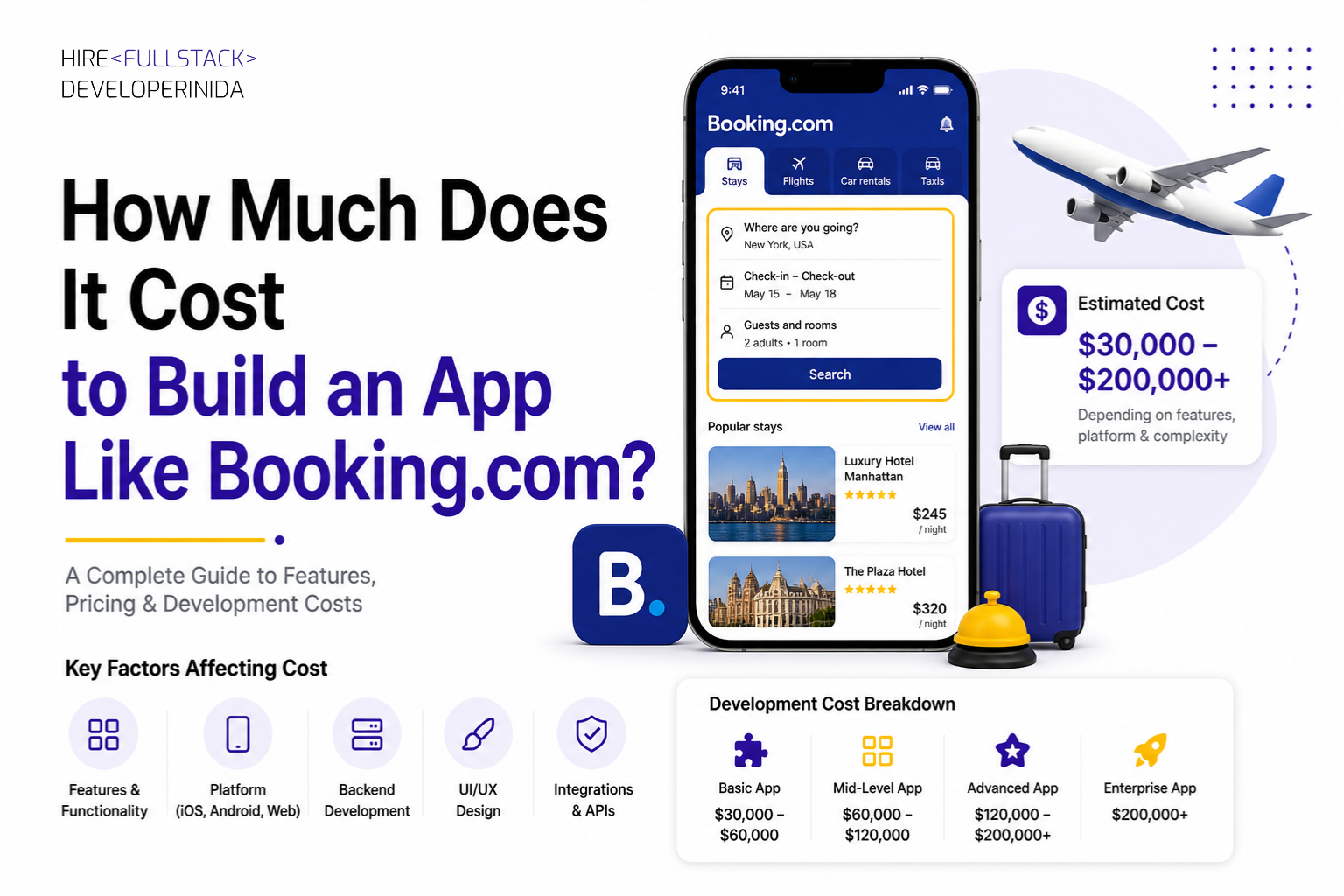
The Real Cost to Build Travel Booking App in 2026
Alright, the part everyone is waiting for. Here is an honest breakdown based on real market rates and project scopes in 2026.
- MVP (Minimum Viable Product
If you are just starting out and want to test your idea in the market, an MVP with core booking features, basic search, payment integration, and user accounts will typically cost between $25,000 and $60,000. Timeline is usually four to six months. - Mid-Level App
A fully featured app with smooth UX, solid backend, third-party integrations, admin panel, and multi-platform support for iOS and Android together will run between $80,000 and $180,000. Expect six to twelve months of development. - Booking.com Scale App
A full-scale platform with AI recommendations, multi-language support, complex search, partner/property management, and enterprise-grade infrastructure will cost anywhere from $250,000 to $500,000 or more. This is a twelve to twenty-four month project with a dedicated team.
These numbers can shift quite a bit based on where your development team is located, which we will get to in a moment.
Read More - How Much Does It Cost to Build an App Like Deliveroo?
Who You Hire Changes Everything
The biggest variable in the cost to build travel booking app is not the features. It is the people. Here is how hourly rates compare across regions in 2026.
- North America and Western Europe: $100 to $200 per hour
- Eastern Europe: $45 to $90 per hour
- India: $20 to $55 per hour
- Southeast Asia: $25 to $60 per hour
- Latin America: $35 to $75 per hour
A project that costs $200,000 with a US-based team might cost $60,000 to $80,000 with an equally skilled team in India or Eastern Europe. The key is not just finding the cheapest option but finding the team that can actually deliver at your scale.
You also need to decide between hiring a full product development agency, building an in-house team, or going with a hybrid model. Each has trade-offs in cost, speed, and long-term ownership.
Third-Party APIs and Their Cost Impact
Building a travel booking app from scratch without any third-party integrations is basically impossible in 2026. You need data, and that data comes from APIs. But APIs are not free.
- GDS (Global Distribution System) Access
If you are building a flight booking feature, you need access to GDS systems like Amadeus, Sabre, or Travelport. These give you real-time flight data, availability, and pricing. Licensing and setup fees can range from a few thousand dollars to tens of thousands annually, depending on your deal - Hotel Data APIs
Providers like Expedia Partner Solutions, Hotelbeds, or Booking.com's own affiliate API let you pull hotel inventory. They usually work on a commission model, but integration complexity adds development cost. - Payment APIs
Stripe, Razorpay, PayPal, Adyen. Each has different pricing structures. Most charge a percentage per transaction plus a flat fee. This is an ongoing cost, not a one-time expense. - Maps and Geolocation
Google Maps API is the standard but it is not cheap at scale. Depending on your usage volume, you could be spending anywhere from a few hundred to thousands of dollars per month on mapping alone.
When budgeting, make sure to account for both initial integration costs and ongoing API fees. Many founders forget the second part.
Tech Stack: What Powers an App Like Booking.com
You do not need to pick every technology right now, but understanding the stack helps you have smarter conversations with your development team and understand cost drivers.
- Frontend (Mobile): React Native or Flutter for cross-platform, Swift for iOS, Kotlin for Android
- Frontend (Web): React.js or Next.js for fast, SEO-friendly interfaces
- Backend: Node.js, Python Django, or Go for handling high traffic
- Database: PostgreSQL for relational data, Redis for caching, Elasticsearch for search
- Cloud Infrastructure: AWS, Google Cloud, or Azure for hosting and scaling
- AI and ML: TensorFlow or PyTorch for recommendation engines
The choice of stack affects how quickly you can build, how easily you can scale, and how much you pay for cloud infrastructure each month. React Native, for example, lets you build one codebase for both iOS and Android, which meaningfully reduces your initial development cost.
More Like - How Much Does It Cost to Build an App Like Revolut?
Hidden Costs That Catch People Off Guard
Here is a section that most blogs skip, but it is probably the most important one for someone actually planning a budget.
- Quality Assurance and Testing
A travel booking app handles real money and real trips. You cannot afford bugs. Budget around 15 to 20 percent of your development cost for proper QA and testing across devices, networks, and edge cases. - App Store Fees and Compliance
Apple takes 30 percent of in-app purchases. Both Apple and Google have annual developer fees. Getting through their review processes takes time and sometimes requires code changes. - Security and Compliance
GDPR compliance if you are serving European users, PCI DSS for payment security, SSL certificates, data encryption. This is not optional, and the cost of not doing it properly is way higher than doing it right the first time. - Maintenance and Updates
Your app will need ongoing updates. OS updates from Apple and Google break things regularly. New features, bug fixes, performance improvements. Budget at least 15 to 20 percent of your initial development cost annually for maintenance. - Marketing and User Acquisition
Building the app is step one. Getting people to use it is step two, and it has its own budget entirely. SEO, paid ads, influencer partnerships, referral programs. This often costs as much as the app itself in the first year.
How to Cut Costs Without Cutting Corners
You do not have to build everything at once. In fact, the smartest founders do not.
- Start With an MVP
Launch with the three or four features that make your app genuinely useful. Get real user feedback. Then build from there. This approach has saved countless startups from spending half a million dollars on features no one wanted. - Use White-Label Solutions for Some Features
For things like payment processing, customer support chat, or email marketing, use existing tools rather than building from scratch. There are excellent solutions out there that plug in quickly. - Choose the Right Development Model
Nearshore or offshore development done well can give you excellent quality at 40 to 60 percent of US rates. The key is finding teams with strong communication skills and a portfolio in travel tech or similar domains. - Build for One Platform First
If your target audience is primarily iOS users, launch on iOS first. You can add Android later. This can cut your initial development time almost in half.
Timeline: How Long Will It Actually Take?
Cost and timeline go hand in hand. Here is a realistic breakdown for 2026.
- Discovery and Planning: 2 to 4 weeks
- UI/UX Design: 4 to 8 weeks
- MVP Development: 3 to 5 months
- Testing and QA: 4 to 6 weeks
- App Store Submission and Launch: 2 to 4 weeks
- Post-launch iteration: Ongoing
Total time from idea to launch for an MVP is typically four to seven months if you have your requirements clear and a good team in place. Full-scale platforms take twelve to twenty-four months.
Revenue Models: How Will Your App Make Money?
Understanding how you will earn from the app also affects how you build it. The most common models for travel booking apps are:
- Commission per booking: You earn a percentage of each transaction, typically 10 to 25 percent for hotels
- Subscription for property owners: Charge hotels or hosts a monthly fee to list on your platform
- Advertising: Featured listings, banner placements, or sponsored search results
- Freemium model: Basic features free, premium features like price alerts or loyalty rewards paid
- Affiliate partnerships: Earn commissions by referring users to partner services like insurance or car rentals
Your monetization model also affects your technical architecture. A subscription model needs billing and plan management. An advertising model needs ad serving infrastructure. Factor this into your initial planning.
CONCLUSION
If you have read this far, you are not just casually curious. You are seriously thinking about building something. So here is the last piece of advice this guide will give you, and it is probably the most practical one.
Do not start by asking a development agency for a quote. Start by writing a one-page document that answers three things. Who is your user, what is the one thing your app does better than anything else out there, and how does the app make money from day one. Once those three things are clear, every cost conversation becomes sharper and every vendor you talk to will take you more seriously.
The cost to build travel booking app is a wide range for a reason. It depends entirely on how well you have defined what you are building before the first line of code is written. Vague briefs produce bloated budgets. Clear product vision produces focused builds that ship faster and perform better.
The travel market is not going to slow down. People will always want to explore, and they will always want the easiest, most trustworthy way to book that experience. Your job is just to be that for the right audience.
Now go build something worth booking.