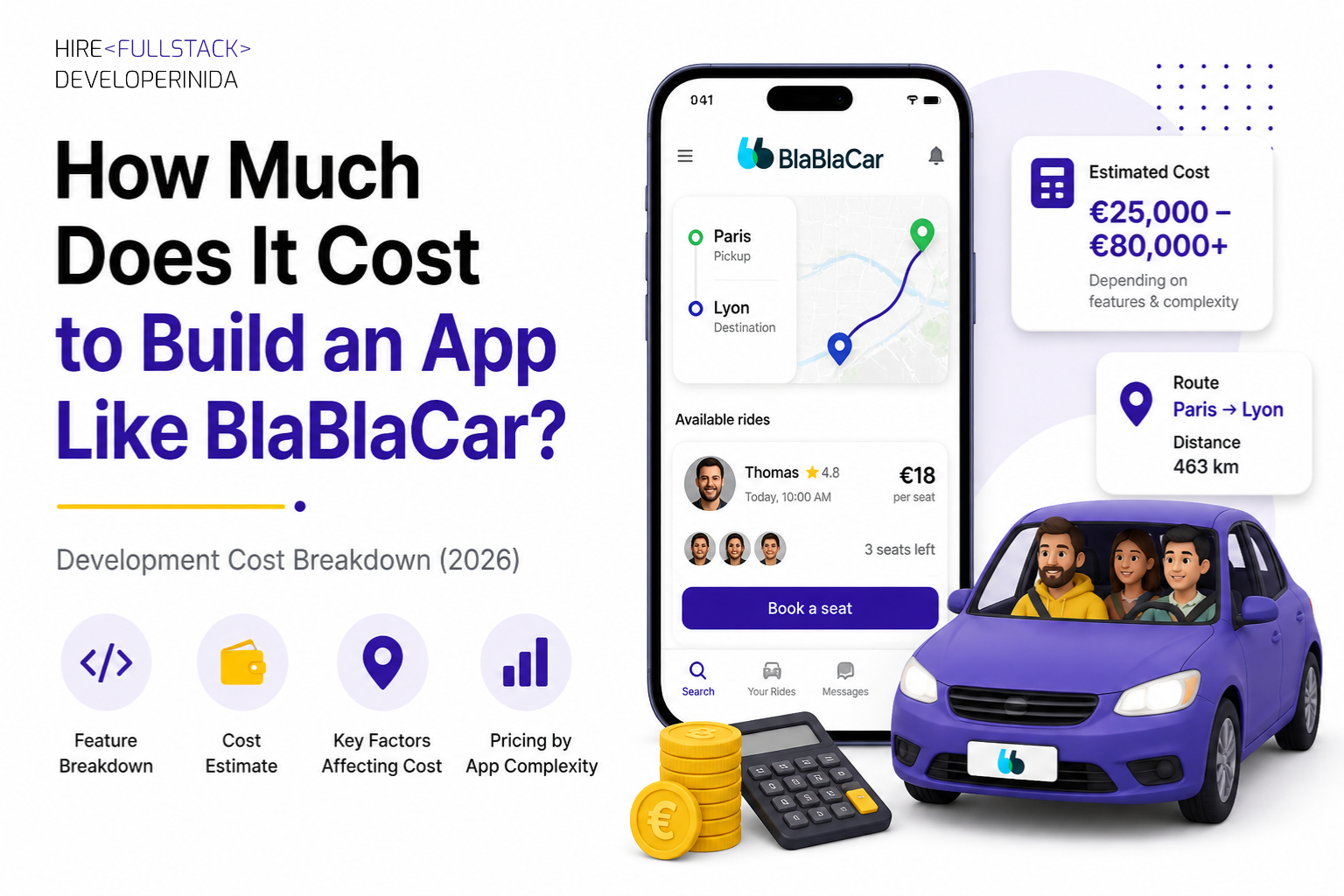

Somewhere between USD 25,000 and USD 300,000.
That is the honest range for what it costs to build a ride sharing app like BlaBlaCar in 2026. And yes, that is a wide range. But here is the thing, both numbers are correct. It just depends on which product you are actually building.
The USD 25,000 version is a focused MVP that tests whether your market wants what you are offering. The USD 300,000 version is a fully armed platform with AI pricing, multi-country support, fraud detection, and the kind of trust architecture that took BlaBlaCar years to get right.
Most guides will make you read 2,000 words before they give you even a rough number. We are doing it the other way. You already have the range. Now let us go deeper into what actually sits inside those numbers, what inflates them fast, what keeps them lean, and what decisions you need to make before you write a single line of code.
Because the cost to build ride sharing app is not really about features. It is about choices. And this guide is going to walk you through every one of them.
What Exactly Makes BlaBlaCar Work? Know Before You Build
Before we talk about money, we need to talk about products. Because the cost to build ride sharing app is directly tied to how many features you want on day one.
BlaBlaCar is not just a basic ride booking app. It is a trust platform. The whole product is built around matching drivers who have empty seats on long distance trips with passengers looking for affordable travel. What makes it smart is the combination of features underneath that simple premise.
Here is what the core of BlaBlaCar actually includes:
- Two sided user profiles (both drivers and passengers have verified accounts)
- Real time ride search and filtering by date, route, and price
- In app messaging between users before a booking is confirmed
- A booking and payment system that holds funds until the ride is complete
- Review and rating system for both sides of the transaction
- Identity verification with phone number, email, and optional ID checks
- Push notifications for booking updates, new messages, and reminders
- GPS based route tracking and estimated pickup mapping
Every single one of these features adds development hours. And development hours mean money. This is the lens through which we will look at costs.
The Core Features and What They Cost to Build
1. User Registration and Profiles
This sounds simple but it is actually one of the more involved parts. You need to support email and social login, profile photo uploads, phone verification via OTP, and a structured profile that captures driving preferences, travel history, and reviews. On both Android and iOS, this module alone can take three to four weeks for a mid level team. Budget roughly USD 3,000 to USD 6,000 for this piece.
2. Ride Posting and Search
Drivers need to post rides with route details, price per seat, departure time, and available seats. Passengers need to search by origin, destination, and date. The search function needs to be smart enough to handle partial route matches (someone going from Delhi to Jaipur might pick up someone going Delhi to Ajmer). This is where Google Maps API integration comes in. Expect USD 5,000 to USD 10,000 here depending on how sophisticated your matching algorithm needs to be.
3. In App Messaging
Real time chat between driver and passenger is non negotiable in a product like this. Users need to confirm details, share exact locations, and build that trust before they get in a car together. Building a lightweight chat system using Firebase or a similar real time database backend typically runs USD 4,000 to USD 7,000.
4. Booking and Payment Integration
This is the most technically complex part and also one of the costliest. You need to build a booking flow that holds funds in escrow, releases payment after a successful ride, handles cancellations with different refund rules, and supports multiple payment methods. Stripe and Razorpay are common choices for this. Depending on the payment gateway, region, and complexity of your escrow logic, this module can cost USD 8,000 to USD 18,000.
5. Ratings and Reviews
Both drivers and passengers rate each other after a trip. These ratings power the trust system. Building a proper two sided review module with moderation logic and display on profiles costs around USD 2,500 to USD 5,000.
6. Admin Dashboard
You need a backend panel to manage users, flag suspicious activity, review disputes, issue refunds, and look at platform analytics. This is often underbudgeted. A functional admin dashboard for a platform like this costs USD 5,000 to USD 12,000 depending on the depth of reporting you need.
7. Notifications System
Push notifications, SMS alerts, and email triggers are the connective tissue of the user experience. They keep users engaged and informed. Setting up a notifications service using Firebase Cloud Messaging with custom event triggers costs around USD 2,000 to USD 4,000.
8. AI Integration
This is where 2026 separates the smart builds from the average ones. AI is no longer a premium add-on that only well funded startups can afford. It is becoming a core expectation in ride sharing products, and if you are building now, leaving it out of your planning is a mistake.
Here is what AI actually does inside a ride sharing app like BlaBlaCar and what each piece costs to build:
Dynamic Pricing Engine Instead of fixed per seat prices set by drivers, an AI model can suggest optimal prices based on demand patterns, day of week, fuel cost trends, and route popularity. Drivers get better earnings on high demand routes. Passengers get fairer prices on less popular ones. Building a basic dynamic pricing model using historical ride data costs around USD 8,000 to USD 15,000. A more sophisticated real time model with demand forecasting pushes that to USD 20,000 to USD 35,000.
Smart Ride Matching Basic search shows all available rides between two points. AI powered matching goes further. It ranks results based on a passenger's past preferences, driver ratings, review patterns, and predicted compatibility. This is what keeps users coming back because the app feels like it understands them. Integration of a recommendation engine here adds roughly USD 10,000 to USD 20,000 depending on the depth of personalization.
Fraud and Trust Detection This one is often the most underappreciated feature in a two sided marketplace. AI can flag suspicious account behavior, detect fake reviews, identify unusual booking patterns, and surface potentially risky users before they cause problems. A basic anomaly detection layer costs USD 6,000 to USD 12,000. Enterprise grade trust scoring with continuous learning adds more.
Chatbot and Support Automation An AI powered in app assistant can handle common support queries, help users understand cancellation policies, assist with booking issues, and escalate to human support only when needed. This reduces your customer support overhead significantly as you scale. Building a functional support chatbot using an LLM API integration costs USD 5,000 to USD 10,000.
Route Optimization Suggestions For drivers posting multi stop routes, AI can suggest smarter paths that pick up more passengers without significantly adding travel time. This improves driver earnings and platform efficiency at the same time. This feature typically costs USD 7,000 to USD 14,000 to build depending on the complexity of your routing logic.
Total estimated cost for a solid AI integration layer: USD 25,000 to USD 70,000 depending on which modules you prioritize.
The smart move for most founders is to start with fraud detection and smart matching in phase one since these directly protect the platform and improve the core experience. Dynamic pricing and the chatbot can come in phase two once you have real usage data to train on.
Here is a quick cost overview table for all the major features:
The Total Cost to Build Ride Sharing App: Breaking It Down by Tier
Now let us put it all together. The final number depends on three main factors: the scope of features you build, where your development team is located, and whether you go native or cross platform.
Tier 1: MVP (Minimum Viable Product)
This is the lean version. Core ride posting, search, booking, basic chat, and payment. No fancy AI features, no premium verification layers. Just enough to test the market and get real user feedback. This approach is smart for first time founders because it limits risk.
Estimated cost for MVP: USD 25,000 to USD 45,000. Timeline: 4 to 6 months.
Tier 1: Full Featured App (BlaBlaCar Level)
This is the version with complete two sided profiles, real time GPS tracking, multi payment support, review systems, admin dashboards, and a solid notifications engine. Essentially a market ready product that can compete.
Estimated cost: USD 60,000 to USD 120,000. Timeline: 8 to 14 months.
Tire 3: Premium Product with Advanced Features
This version adds AI powered route optimization, dynamic pricing algorithms, identity verification with document scanning, advanced fraud detection, multi language support, and a deeply customized user experience. This is what you build when you already have funding and a validated market.
Estimated cost: USD 150,000 to USD 300,000 or more. Timeline: 14 to 24 months.
How Geography Affects Your Development Budget
This is one of the most misunderstood parts of the cost conversation. The exact same app built by a team in different regions will have very different price tags.
If you are working with a mid sized Indian development agency, a full featured BlaBlaCar like app might cost you USD 60,000 to USD 90,000. The same spec with a US agency could easily land at USD 180,000 to USD 250,000. Neither is wrong. It depends on your budget, your timeline, and how much hands-on control you want over the process.
Tech Stack: What Powers an App Like BlaBlaCar
The technology choices you make will directly affect your development costs and long term maintenance bills. Here is what a modern ride sharing app typically runs on in 2026:
- Frontend (Mobile): React Native or Flutter for cross platform builds, or Swift for iOS and Kotlin for Android if you go native
- Backend: Node.js or Python with Django or FastAPI are both solid choices for handling high concurrency and real time data
- Database: PostgreSQL for structured ride and user data, Redis for real time caching and session management
- Maps and Location: Google Maps Platform or Mapbox for routing, distance calculation, and live map views
- Payments: Stripe for global deployments, Razorpay for India focused apps, or Braintree for complex escrow flows
- Real Time Features: Firebase or Socket.io for in app chat and live notifications
- Cloud Infrastructure: AWS, Google Cloud, or Azure depending on your DevOps preference and regional needs
Choosing React Native or Flutter over native development can cut your frontend costs by 30 to 40 percent since you are building one codebase that runs on both platforms. For an early stage product, this is almost always the smarter financial call.
The Team You Actually Need
A lot of founders underestimate the team required to ship a product like this. Here is a realistic breakdown of the roles involved:
- 1 to 2 Mobile Developers (React Native or Flutter)
- 1 to 2 Backend Developers (Node.js or Python)
- 1 UI and UX Designer
- 1 QA Engineer
- 1 Project Manager or Tech Lead
- 1 DevOps or Cloud Engineer (can be part time initially)
If you are working with an outsourced agency, this team is usually bundled into hourly or monthly rates. If you are building an in house team, factor in salaries, benefits, equipment, and a much longer hiring timeline.
Hidden Costs That Most Guides Skip
Here is where real budgets get surprised. There are several costs that do not show up in the feature list but will absolutely show up in your bank statement.
- Third Party API Costs
Google Maps API is not free at scale. Once you cross 28,500 map loads per month on the free tier, you start paying. For a growing ride sharing app with real time tracking, this bill can reach USD 500 to USD 3,000 per month depending on traffic. SMS verification via Twilio or AWS SNS is another recurring cost. - App Store Fees
Apple charges USD 99 per year for the Apple Developer Program. Google Play charges a one time USD 25 registration fee. Not expensive, but required before you can publish. - Compliance and Legal
If you are handling payments, you need to think about PCI DSS compliance. If you are in Europe, GDPR is non-negotiable. Privacy policy, terms of service, and legal review can cost USD 1,500 to USD 5,000 upfront. Do not skip this. - Marketing and Launch
Building the app is step one. Getting your first 1,000 users is step two and it costs money too. Performance marketing, SEO, social content, and influencer campaigns can easily require a USD 10,000 to USD 30,000 launch budget if you want meaningful early traction. - Ongoing Maintenance
After launch, plan for 15 to 20 percent of your initial development cost per year for maintenance. Bug fixes, OS updates, new device support, security patches, and small feature improvements add up. An app in the USD 80,000 range needs roughly USD 12,000 to USD 16,000 per year just to stay healthy.
Monetization: How Will You Make Money?
BlaBlaCar charges a booking fee to passengers, typically 10 to 20 percent of the ride price. That service fee is their primary revenue model. But there are other options worth considering when you are planning your product:
- Commission based model: Take a percentage of every transaction processed on your platform
- Subscription plans: Offer drivers a monthly plan with benefits like higher visibility or reduced fees
- Premium verification badges: Charge for faster or more thorough ID verification
- Corporate travel partnerships: Partner with companies to offer employee travel credits
- In app advertising: Relevant for larger user bases but can hurt the user experience if not done well
Knowing your monetization strategy before you build helps you make smarter feature decisions. If you are going commission based, your payment integration needs to be especially robust. If you plan to offer subscriptions, you need a billing and account management layer from day one.
Should You Build From Scratch or Use a White Label Solution?
This is a question that comes up often and the honest answer is that it depends on your goals. White label ride sharing solutions exist and they can get you to market faster and cheaper in the short term. A white label product might cost USD 10,000 to USD 25,000 to set up and customize.
But here is the trade off. You are constrained by someone else's architecture. Scaling, customizing, and adding unique features becomes progressively harder. If you have a specific vision for your product or plan to raise investment, custom development gives you ownership and flexibility that white label never can.
For most founders who want to build something serious and scalable, custom development is the right call. The higher upfront cost to build ride sharing app from scratch pays for itself in the long run through better user experience, faster iteration, and real ownership of your platform.
Timeline: How Long Does It Actually Take?
A common pattern for a well managed development process looks like this:
- Week 1 to 2: Requirements gathering, wireframing, and project scoping
- Week 3 to 6: UI and UX design, design system creation
- Week 7 to 20: Backend and frontend development in parallel sprints
- Week 21 to 24: QA testing, bug fixing, performance optimization
- Week 25 to 26: App store submission, final review, soft launch
For an MVP this process takes roughly 4 to 6 months. For a fully featured product, 10 to 14 months is realistic with a team of 5 to 7 people working consistently.
Five Years From Now, Which Founder Do You Want to Be?
Think about where you want to be five years from now.
Not in terms of revenue or user numbers, though those matter. But in terms of the conversation you want to be having. Do you want to be the founder who spent three years watching someone else build what you thought of first? Or do you want to be the person sitting in a room explaining to investors how you saw the gap, moved fast, and built something that people in five cities cannot imagine their travel life without?
That gap between those two versions of yourself is not talent. It is not even funding. It is the decision to start.
The cost to build ride sharing app is real and it is significant. But so is the cost of waiting. Every month you do not build is a month someone else might. Every week you spend overthinking the budget is a week you could be learning from actual users.
The numbers in this guide are your map. They tell you what things cost, where to be careful, and how to stage your investment so you are not betting everything on day one. Use them that way.
Build the MVP. Validate the idea. Then scale with confidence because you have data behind your decisions, not just hope.
The ride sharing space in 2026 still has room for the right product in the right market with the right founder behind it. The question is whether that founder is going to be you.