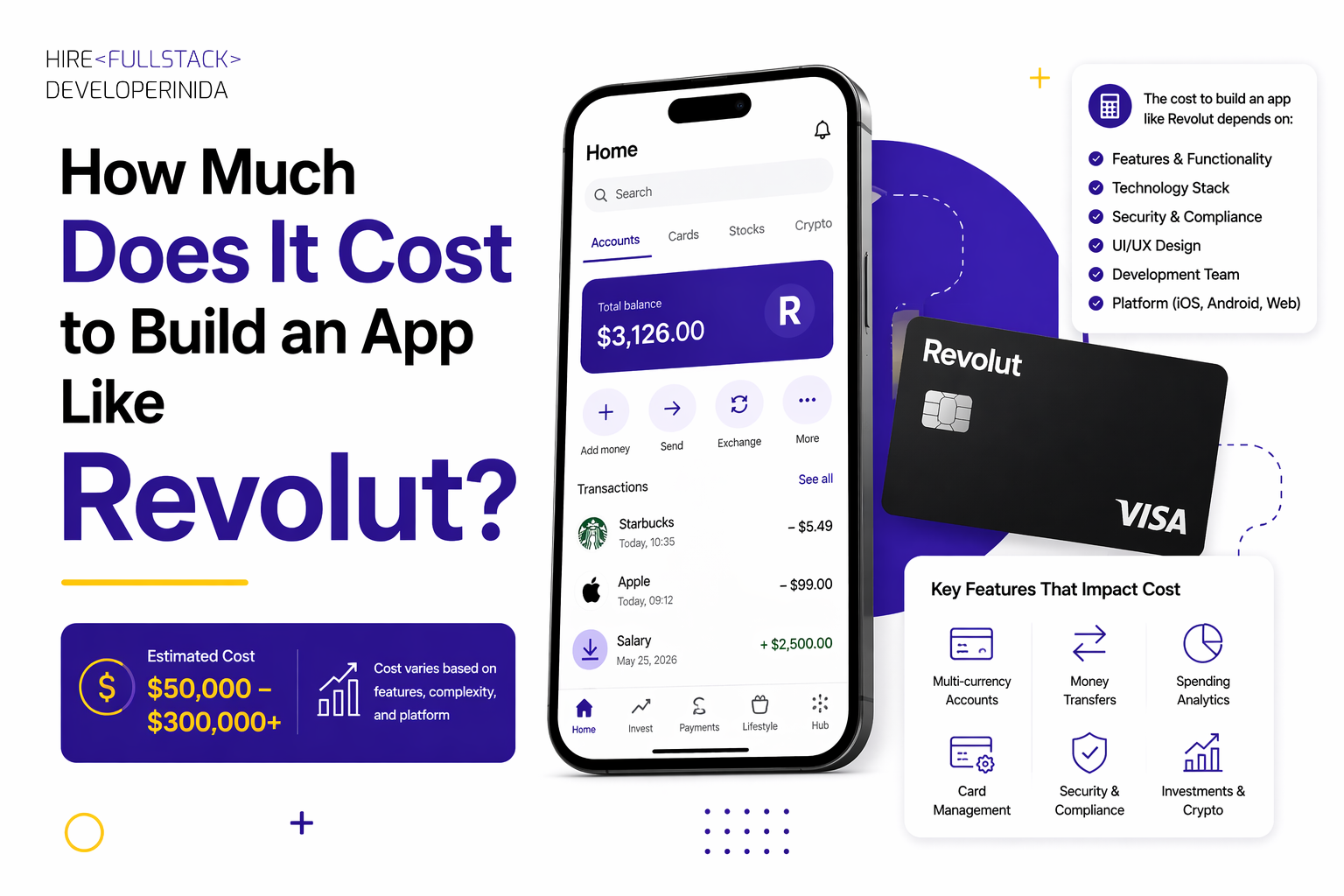

If you have ever sent money abroad without paying outrageous fees, split a restaurant bill with friends in seconds, or checked your spending in multiple currencies from one screen, chances are you have already experienced what a neobanking app like Revolut can do. Revolut today serves over 50 million customers worldwide and has completely changed how people think about money management. So it is no surprise that entrepreneurs, fintech startups, and even traditional banks are asking the same question in 2026: how much does it actually cost to build fintech app like Revolut?
The honest answer is that it depends on a lot of factors. But that answer alone does not help you plan a budget, pitch investors, or make a decision. So in this guide, we are going to break it all down for you clearly and in plain language. No technical jargon, no confusing estimates without context. Just a real, detailed look at what goes into building a fintech app like Revolut and what it will cost you in 2026.
What Exactly Is Revolut and Why Do People Want to Clone It?
Revolut is a digital banking platform founded in 2015 in the UK. It started as a prepaid card with no foreign transaction fees and has since grown into a full financial super app. Today, it offers personal and business accounts, multi currency wallets, international money transfers, stock and crypto trading, insurance, savings vaults, budget tracking, and even hotel bookings.
What makes Revolut special is not just the features. It is the way everything works together inside a single app that feels fast, clean, and easy to use. That combination of wide functionality and smooth user experience is what entrepreneurs want to replicate when they talk about building an app like Revolut.
In 2026, the demand for neobanking and digital wallet apps has only grown. With traditional banking still feeling slow and outdated for millions of users across Asia, Africa, Latin America, and Eastern Europe, there is a genuine market gap that fintech startups are eager to fill. Building an app like Revolut means entering a competitive but high reward space where getting the product right from the start is critical.
Key Features That Define the Cost to Build an App Like Revolut
Before we talk numbers, you need to understand that the cost to build fintech app like Revolut is directly tied to what features you include. More features mean more development time, more compliance work, and more testing. Let us walk through the core features that make up an app like Revolut and what each one means for your budget.
1. User Registration and KYC Verification
Every fintech app must verify who its users are. This is called Know Your Customer or KYC. It involves collecting government issued ID documents, taking selfies, and sometimes doing liveness checks to confirm the person is real. In 2026, KYC is handled using AI powered tools from third party providers like Jumio, Onfido, or Sum and Substance. Integrating these tools into your app costs money both in development time and ongoing subscription fees. Expect KYC integration alone to add anywhere from $15,000 to $40,000 to your development budget depending on the provider and how deep the integration goes.
2. Multi Currency Wallets and Accounts
One of Revolut's most loved features is the ability to hold money in over 30 currencies and switch between them with a tap. Building this requires integrating with currency exchange APIs, setting up a ledger system that tracks balances per currency, and handling real time exchange rate updates. This is one of the more technically complex features in any fintech app. The development cost for a solid multi currency wallet system typically ranges from $20,000 to $50,000 depending on how many currencies you support and the level of real time accuracy you need.
3. Money Transfers and Payments
Sending money to friends or paying businesses is at the heart of what Revolut does. This means integrating with payment rails like SWIFT for international transfers, SEPA for Europe, and local faster payment systems in whatever regions you operate. You also need to handle peer to peer transfers within the app. Payment integration is not cheap. You are dealing with regulatory requirements, partner bank relationships, and complex technical implementation. Budget between $30,000 and $80,000 for a full payments module.
4. Debit Card Issuance and Management
Revolut gives users both physical and virtual debit cards. To do this yourself, you need a card issuing partner like Marqeta, Galileo, or a licensed card program manager. They handle the actual card infrastructure while your app handles the user facing controls like freezing cards, setting spending limits, and managing virtual card numbers for online shopping. Card issuing integration adds roughly $20,000 to $45,000 to your project depending on the partner and the features you want to offer.
5. In App Notifications and Spending Insights
Real time push notifications for every transaction, monthly spending reports broken down by category, and smart budgeting tools are features users now expect from any serious fintech app. These require a robust backend that can process transactions in real time, categorize spending using machine learning or rule based systems, and push alerts instantly. Developing a solid notifications and insights engine adds around $15,000 to $35,000 to the total budget.
6. Crypto and Stock Trading
Revolut allows users to buy and sell cryptocurrencies and fractional shares of stocks directly inside the app. Adding trading functionality requires integrating with broker APIs or crypto exchange APIs and dealing with an additional layer of regulatory complexity. This is optional for a basic Revolut clone but is a significant differentiator if you want to build a super app. Trading features can add $40,000 to $100,000 to your budget depending on how many asset classes you support.
7. Security Features
In fintech, security is not optional. You need biometric login using fingerprint or face ID, two factor authentication, device binding, fraud detection algorithms, and end to end encryption for sensitive data. A weak security setup means regulatory trouble and user distrust. Budget $20,000 to $50,000 for a proper security architecture.
8. Admin Dashboard
You will need a backend dashboard where your operations team can manage users, review transactions, handle disputes, and monitor system health. This is a separate development effort from the mobile app. A solid admin panel typically adds $15,000 to $30,000 to your budget.
Full Cost Breakdown Table: Building an App Like Revolut in 2026
Developer Hourly Rates by Region: What Are You Actually Paying Per Hour?
When you see a cost estimate like $200,000 to $595,000 for building an app like Revolut, a lot of people ask: where does that money go? The largest chunk goes directly to the people building your product. Developer hourly rates vary enormously depending on where your team is based, and understanding this is one of the most important things you can do before you start any fintech project.
Here is a clear and honest look at what developers charge per hour across different regions in 2026. These are market rates for experienced developers who know what they are doing. Very cheap rates often signal inexperience, which in fintech is a risk you cannot afford.
These rates apply to individual freelancers or agency billing rates. When you hire through a software development agency, you are typically paying the agency rate which covers not just the developer's salary but also project management, overhead, HR, and profit margin. That is why agency quotes can feel higher than individual freelancer rates, but they also come with accountability, structure, and a team that has worked together before.
For a project the size of a Revolut style fintech app, most good agencies will estimate 3,000 to 7,000 total development hours depending on scope. If you multiply those hours by the regional rates above, you can quickly see how the total project cost takes shape. For example, 5,000 hours at an Eastern European mid level rate of $65 per hour gives you $325,000. The same 5,000 hours at a US senior rate of $200 per hour gives you $1,000,000.
What Roles Are on a Fintech App Development Team and What Does Each Role Cost?
Building an app like Revolut is not a one person job. It requires a full team of specialists, each with a different responsibility and a different price tag. Here is a breakdown of every role you will need, what they do, and what they cost on an hourly basis.
If you add up the minimum hours across all these roles, you are already looking at 3,800 hours as a baseline. A fully featured app with crypto trading, multi currency support, and multiple market compliance would push that to 6,000 hours or more. This is why fintech apps are not cheap to build properly, and why cutting corners on the development team tends to create very expensive problems later.
In House Developer Salaries: What If You Hire Your Own Team?
Some founders prefer to build an in house engineering team rather than outsource to an agency. This gives you more control, faster communication, and a team that lives and breathes your product. But it comes at a significantly higher cost, especially when you factor in salaries, benefits, equipment, and the time it takes to hire the right people.
Here is what you can expect to pay annually for key in house roles in different markets in 2026.
These are base salaries only. In the US and UK, you also need to factor in payroll taxes, health insurance, pension contributions, paid leave, equipment, and software tools, which typically add 25 to 35 percent on top of the base salary. That means a US based team of eight mid level developers could cost you $1.3 million to $2 million per year in total employment costs before you have written a single line of production code.
In contrast, a team in Eastern Europe at the same seniority level might cost $460,000 to $760,000 per year all in. A team in India could be $180,000 to $390,000. This is why so many funded fintech startups in 2026 choose to keep their product and leadership in their home country but run engineering operations from Eastern Europe or Asia.
One important note: Cheaper does not always mean better value. In fintech specifically, a developer who does not understand regulatory requirements, PCI DSS compliance, or financial security standards can create vulnerabilities that cost tens of thousands of dollars to fix and could expose you to regulatory fines. Always prioritize fintech experience over simply finding the lowest hourly rate.
Agency vs Freelancer vs In House: A Side by Side Cost Comparison
To make the developer cost picture as clear as possible, here is a direct comparison of what a complete development team costs under each hiring model for a full scale Revolut type app.
The hybrid model is increasingly the most popular choice among serious fintech founders in 2026. It lets you keep strategic control in house while keeping development costs competitive. A typical hybrid setup might look like a product manager and CTO in your home country paired with a 6 to 8 person engineering team from a trusted agency in Eastern Europe or India.
How Does the Development Team Structure Affect Cost?
One of the biggest variables in the cost to build fintech app like Revolut is where your development team is based and how you structure it. In 2026, most fintech startups use one of three models.
Option 1: In House Team
Hiring developers, designers, QA engineers, and a project manager directly onto your payroll gives you the most control. But it is also the most expensive option. In the United States or Western Europe, a senior mobile developer alone costs $100,000 to $160,000 per year in salary. A full in-house team of eight to twelve people for a project like this could easily cost $800,000 to $1.5 million in salaries alone in the first year, before you even factor in equipment, office space, or benefits.
Option 2: Outsourcing to a Development Agency
Many fintech startups choose to outsource the entire project to a software development agency. Agencies in Eastern Europe, particularly in Ukraine, Poland, and Romania, charge $45 to $80 per hour on average. Agencies in India and Southeast Asia typically charge $25 to $50 per hour. A US or UK based agency charges $100 to $200 per hour. For a project of this scope requiring around 3,000 to 6,000 hours of work, outsourcing to Eastern Europe might cost $150,000 to $400,000 while the same scope with a US agency could run $350,000 to $900,000.
Option 3: Hybrid Model
Many companies in 2026 use a hybrid approach where they hire a small in house product and leadership team but outsource development to an agency. This gives them oversight and product control without the full cost of an in house engineering team. This is often the most cost effective path for a startup that wants quality without burning through the runway too fast.
What Ongoing Costs Should You Plan For After Launch?
Building the app is just the beginning. Once your fintech app is live, there are ongoing costs that many first time founders forget to plan for. These can significantly affect your financial projections.
- Cloud infrastructure costs: Hosting your app on AWS, Google Cloud, or Azure will cost $3,000 to $15,000 per month depending on your user volume and the services you use.
- Third party API fees: Services like KYC providers, payment processors, card issuers, and exchange rate APIs all charge ongoing fees either per transaction, per verified user, or on a monthly subscription basis. Budget $2,000 to $20,000 per month depending on your transaction volume.
- Compliance and legal: Maintaining regulatory compliance in one or more jurisdictions requires ongoing legal support, periodic audits, and compliance officer salaries. This can run $5,000 to $30,000 per month for a growing neobank.
- Customer support: A fintech app dealing with people's money needs responsive customer support. Plan for at least a small dedicated team here.
- App updates and new features: No app stays static. Budget at least 15 to 20 percent of your initial development cost per year for ongoing updates, security patches, and new feature development.
What About Regulatory and Licensing Costs?
This is one area that catches many first time fintech founders off guard. Building a fintech app like Revolut is not the same as building a social media app. You are dealing with people's money, which means regulators take it very seriously.
Depending on where you launch and what services you offer, you may need an e money institution license, a payment institution license, a banking license, a money services business registration, or all of the above. In the UK, getting an EMI license from the FCA typically takes 12 to 18 months and costs $50,000 to $150,000 in legal and application fees alone. In the EU under PSD2, you will need a similar license from your home country regulator. In the US, you may need to register as a Money Services Business with FinCEN and obtain money transmitter licenses in each state you operate in, which can collectively cost $200,000 to $500,000.
Some startups avoid the licensing burden in the early stages by partnering with a licensed financial institution and operating under their regulatory umbrella through a banking as a service model. This is faster and cheaper upfront but comes with revenue sharing and constraints on what you can offer. It is a popular path in 2026 and companies like Railsbank, Solarisbank, and Synapse offer these kinds of partnerships.
How Long Does It Take to Build an App Like Revolut?
- Timeline and cost are closely linked. Here is a realistic estimate for different scope levels.
- MVP with core features only (account creation, KYC, single currency wallet, transfers, card): 6 to 9 months.
- Mid tier product with multi currency support, spending insights, and basic savings: 9 to 14 months.
- Full featured super app with trading, insurance, premium tiers, and multiple markets: 18 to 30 months.
Working with an experienced fintech development agency versus a generalist one can shorten timelines significantly because they already understand compliance requirements, fintech integrations, and security standards. A fintech specialist agency might complete in 8 months what takes a generalist 12.
Cheaper Alternatives: Can You Build a Revolut Clone for Less?
If your budget is limited, there are ways to reduce the initial cost without sacrificing quality entirely.
Start With an MVP
You do not need to build everything Revolut has from day one. Start with just the features that solve your core user problem. If your market just needs affordable international transfers, build that first and do it really well. A focused MVP can be built for $80,000 to $150,000 and validated with real users before you invest in the full product.
Use Banking as a Service Platforms
As mentioned earlier, BaaS providers like Railsbank, Marqeta, and Stripe Treasury let you build financial products on top of their licensed infrastructure. This dramatically reduces both development time and compliance costs. A well built BaaS powered fintech app can go from idea to launch in 4 to 6 months with $60,000 to $120,000 in development costs.
Use White Label Solutions
There are now white label neobanking platforms in 2026 that let you launch a branded financial app with core features already built. Companies like Vodeno, Bankware, and others offer these. You pay a licensing fee and customize the app for your brand. This is the fastest and cheapest path but gives you the least differentiation.
What Makes 2026 Different for Fintech App Development?
Building a fintech app in 2026 is different from doing it in 2020 or even 2022 in a few important ways. AI integration is now standard. Users expect smart features like AI powered spending insights, predictive budgeting, and fraud detection that learns from behavior patterns. Adding AI capabilities has become easier thanks to large language model APIs but still adds $20,000 to $60,000 to a project depending on how deeply you want to integrate it.
Embedded finance is also a major trend. In 2026, more businesses want to embed financial services directly into non financial apps. If you are building a fintech product that can be embedded or offered through third parties, you need to architect your API and product accordingly from day one.
Open banking regulations have also matured globally. Most major markets now have mandated open banking frameworks that allow fintech apps to pull data from traditional banks with user consent. Integrating open banking adds real value for users and typically costs $15,000 to $40,000 in development work.
Final Summary: Total Cost to Build an App Like Revolut
Let us bring it all together with a clear summary.
- A basic MVP fintech app with core features: $80,000 to $180,000
- A mid tier Revolut like app with multi currency and trading: $200,000 to $400,000
- A full scale neobanking super app targeting multiple markets: $400,000 to $1,000,000 or more
- Add licensing and compliance for your target market: $50,000 to $500,000 on top
- Annual operational and maintenance costs: $100,000 to $600,000 per year
The cost to build fintech app like Revolut is significant, but so is the opportunity. The global digital banking market is projected to exceed $9 trillion in transaction value by 2027. The startups that invest in doing it right, building secure, compliant, and genuinely useful financial products, are the ones that will capture meaningful market share.
If you are serious about building a fintech app like Revolut, the most important first step is to find a development partner who understands both the technology and the regulatory landscape of your target market. The right team will save you time, money, and a lot of compliance headaches down the road.