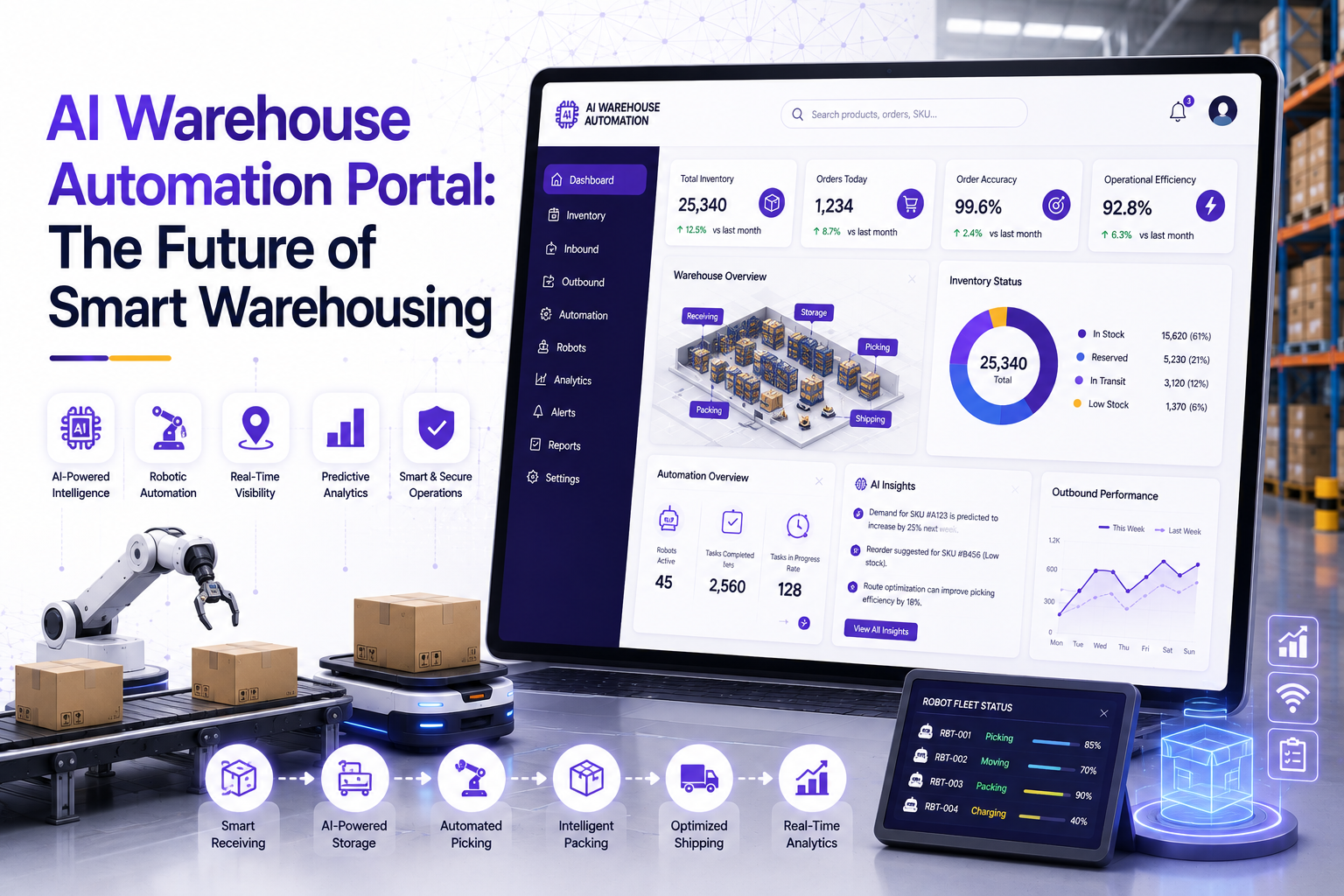

Walk into almost any modern distribution center today and you will notice something different from just a few years ago. The forklifts still move, the conveyor belts still hum, but there is a layer of intelligence running underneath it all that was not there before. That layer is AI warehouse automation, and it is quietly rewriting the rules of how goods get picked, packed, sorted, and shipped.
For CEOs and founders trying to keep up with rising labor costs, tighter delivery windows, and customers who expect same-day everything, this is not a trend you can afford to watch from the sidelines. Warehouses that have adopted intelligent systems are moving faster, making fewer errors, and running with far more visibility into what is actually happening on the floor at any given moment.
This guide breaks down what AI warehouse automation really means in practical terms, how the underlying software works, what benefits you can realistically expect, and how to evaluate a development partner if you are planning to build or upgrade your own system in 2026.
What Is AI Warehouse Automation, Really?
At its core, AI warehouse automation refers to the use of artificial intelligence, machine learning, computer vision, and robotics to handle warehouse operations that used to depend entirely on human decision making. That includes everything from predicting which products will sell out next week to guiding a robotic arm toward the exact spot where a box needs to be placed.
The important distinction here is between simple automation and intelligent automation. A conveyor belt that moves boxes from one end of a warehouse to another is automated, but it is not smart. It cannot decide which box should go first, reroute itself around a jam, or learn from mistakes. Add AI to that same system, and suddenly it can prioritize orders based on shipping deadlines, detect a bottleneck before it causes delays, and adjust its own workflow without a human stepping in.
This is why so many operations leaders describe 2026 as the year warehouse automation stopped being optional. The technology has matured, the hardware costs have dropped, and the software behind it has become genuinely reliable rather than experimental.
It also helps to separate the term from the marketing noise around it. Plenty of vendors slap the word AI onto features that are really just basic rule-based automation dressed up for a sales pitch. Genuine intelligence in this context means the system can handle situations it was not explicitly programmed for, learning from patterns in your data rather than following a fixed set of if-then instructions. That distinction matters a great deal when you are comparing vendors later on, because a system that only follows rigid rules will struggle the moment your business grows past the scenarios its rules were built for.
Why Warehouses Are Racing to Adopt AI This Year
A few forces are pushing this shift harder than ever. First, labor shortages in warehousing have not gone away. Finding and retaining reliable staff for repetitive, physically demanding roles remains difficult in most regions, and wages continue to climb. Second, e-commerce volumes keep growing, and customers now expect delivery windows that were unthinkable a decade ago.
Third, and this one gets overlooked often, the cost of getting things wrong has gone up. A single mis-picked order, a delayed shipment, or a stockout during a peak sales period can cost far more in lost customer trust than it used to. Businesses simply cannot afford the margin of error that manual processes allow.
On top of all that, the supply chain disruptions of the past several years taught operators a hard lesson: visibility matters. You cannot manage what you cannot see, and traditional warehouse management gave leaders a foggy, delayed picture of inventory and operations. AI changes that by turning raw warehouse data into real-time, actionable insight.
There is also a competitive angle that founders should not underestimate. Once a handful of players in any given industry adopt AI-driven fulfillment and start delivering faster with fewer errors, customer expectations shift for everyone in that space. Businesses that wait too long often find themselves competing on price alone because they can no longer match the speed and reliability that automated competitors offer as standard.
The Core Technologies Behind Modern Warehouse Systems
It helps to understand the individual pieces that come together to make an intelligent warehouse work, because these are the building blocks any development team will be working with.
- Machine learning and demand forecasting. Historical sales data, seasonal patterns, and even external factors like weather or local events feed into models that predict what inventory you will need and where it should be stored. This reduces overstock, prevents stockouts, and shortens the distance items need to travel during picking.
- Computer vision for quality control and tracking. Cameras paired with AI models can inspect packages for damage, verify that the right item was picked, and track inventory movement without a single barcode scan. This has become one of the fastest-growing applications inside modern facilities.
- Autonomous mobile robots and robotic arms. These handle physical tasks such as moving pallets, picking items from shelves, and sorting packages. Unlike older fixed automation, these robots use AI to navigate dynamically around obstacles and coworkers.
- Predictive maintenance. Sensors on equipment feed data into AI models that can flag a conveyor motor or robotic arm that is likely to fail soon, long before it actually breaks down and halts operations.
- Natural language interfaces. Increasingly, warehouse managers can simply ask a system questions in plain English, such as which SKUs are running low, and get an instant answer instead of digging through spreadsheets or dashboards.
Key Warehouse Processes That AI Is Transforming Right Now
It helps to walk through the actual operational flow of a warehouse and see where intelligent systems are making the biggest difference, because the impact is not spread evenly. Some steps benefit far more than others.
- Receiving and putaway. When a truck arrives, AI-powered systems can cross-check incoming shipments against purchase orders automatically using computer vision, flagging discrepancies before items even reach the shelf. From there, the software decides where each item should be stored, weighing factors like turnover rate, item size, and proximity to related products, instead of relying on a worker's memory or a static, rarely updated map.
- Picking and packing. This is usually where the biggest efficiency gains show up. AI-guided picking, whether through handheld devices, wearable scanners, or autonomous robots, routes workers along the shortest realistic path rather than a fixed sequence. Some facilities now use goods-to-person robotics, where shelving units are brought directly to a stationary worker instead of the worker walking the aisles, cutting travel time dramatically.
- Sorting and shipping. AI systems increasingly handle the decision of which carrier and shipping method offers the best balance of cost and delivery speed for each order, factoring in real-time carrier rates and delivery zone data rather than a single default rule applied to everything.
- Returns processing. Returns are notoriously expensive to manage manually. AI tools can now inspect returned items through computer vision to assess condition, automatically route items back to resellable inventory, recycling, or disposal, and update forecasting models so future demand predictions account for return patterns rather than ignoring them.
Seeing automation broken down this way makes it easier for decision-makers to prioritize. Most businesses do not need to automate everything at once. Identifying which process is currently the biggest bottleneck, whether that is slow picking or costly returns handling, gives you a clear starting point for where AI investment will pay off fastest.
Measuring ROI: The KPIs That Actually Matter
Founders evaluating this kind of investment are right to ask for numbers, not just promises. The good news is that warehouse automation lends itself well to measurement, since almost every action in the facility can be tracked and compared against a baseline.
Order cycle time is one of the clearest indicators. This measures how long it takes from the moment an order is placed to the moment it ships, and it typically drops noticeably once intelligent task assignment and optimized picking paths are in place. Pick accuracy is another metric worth tracking closely, since even a small reduction in mis-picks translates directly into fewer returns, fewer customer complaints, and lower shipping costs from correcting mistakes.
Labor cost per order is a metric that resonates strongly with CEOs because it ties automation directly to the bottom line. Rather than simply counting heads on the floor, this metric captures whether your existing team is producing more output per hour worked. Inventory turnover and carrying cost are equally important, particularly for businesses holding large amounts of capital in stock, since better forecasting typically frees up cash that was previously tied up in excess inventory sitting on shelves.
Finally, downtime avoided through predictive maintenance is worth tracking even though it is easy to overlook. A single unplanned equipment failure during a peak shipping period can cost far more than the maintenance system itself, so businesses that track near-miss failures caught early often find this metric alone justifies a significant portion of their investment.
Security, Compliance, and Data Ownership Questions to Ask
As warehouses become more data-driven, the questions decision-makers ask should extend beyond efficiency and into how that data is protected and who actually controls it. This matters even more for businesses handling regulated goods, such as pharmaceuticals or food products, where traceability requirements are strict.
Ask any potential technology partner where your operational data is stored, whether it is hosted on infrastructure you control or on the vendor's own servers, and what happens to that data if you ever switch providers. Businesses have been caught off guard before by discovering that years of valuable operational data were effectively locked inside a proprietary system with no clean way to export it.
It is also worth understanding how AI models are trained. Some vendors train shared models across multiple clients, which can improve performance over time but raises questions about whether your specific operational patterns are being used to benefit competitors using the same platform. Clarifying this upfront avoids uncomfortable surprises later.
Finally, for any warehouse handling regulated products, confirm that the system supports the audit trails and traceability records required by your industry. A forecasting tool that boosts efficiency but cannot produce a clean compliance report during an inspection creates a bigger problem than the one it solved.
What AI Warehouse Management Software Actually Does Day to Day
It is easy to talk about AI in the abstract, so let us get specific about what good AI warehouse management software looks like once it is actually running in a live facility.
- Tracks inventory in real time so businesses always know what is available in the warehouse.
- Predicts which products will be needed soon based on sales trends and past demand.
- Suggests the best storage location for every item to reduce unnecessary movement.
- Automatically creates picking routes so warehouse staff can collect items faster.
- Identifies low-stock products and alerts managers before they run out.
- Detects slow-moving inventory that is taking up valuable warehouse space.
- Prioritizes urgent customer orders to ensure they are packed and shipped first.
- Reduces picking and packing mistakes by verifying products before dispatch.
- Monitors incoming shipments and recommends where new stock should be stored.
- Assigns warehouse tasks to employees based on workload and priority.
- Helps optimize workforce schedules during busy and slow periods.
- Predicts equipment maintenance needs to reduce unexpected downtime.
- Monitors warehouse operations and flags unusual delays or bottlenecks.
- Estimates delivery timelines more accurately using live operational data.
- Generates real-time dashboards and reports without manual spreadsheet work.
- Learns from daily warehouse activities and continuously improves recommendations over time.
In simple terms: Instead of only storing inventory data, AI warehouse management software acts like an intelligent assistant that helps warehouses make faster decisions, reduce errors, improve productivity, and keep operations running smoothly every day.
The Real Benefits Businesses Are Seeing
- Faster order processing, allowing customers to receive their products sooner.
- Better inventory accuracy with fewer stock mismatches and manual errors.
- Lower operational costs by reducing wasted time and unnecessary labor.
- Improved warehouse productivity through smarter task allocation.
- Fewer picking and packing mistakes, leading to fewer returns and complaints.
- Better use of warehouse space by organizing inventory more efficiently.
- Reduced stockouts and overstock situations with accurate demand forecasting.
- Quicker decision-making through real-time data and AI-driven insights.
- Improved employee efficiency by automating repetitive warehouse tasks
- Better customer satisfaction with accurate orders and on-time deliveries.
- Easier handling of seasonal demand spikes without disrupting operations.
- Greater visibility across the entire warehouse, from receiving goods to shipping them
- Continuous process improvements as the AI learns from daily operations.
- Higher profitability by improving efficiency while reducing operational waste.
Common Challenges and How Smart Teams Handle Them
No transformation this significant comes without friction, and it is fair to walk through the honest challenges rather than pretend the path is smooth.
Integration with legacy systems is usually the first hurdle. Many warehouses still run on older inventory or ERP systems that were never designed to talk to AI-driven tools. The fix here is choosing a development partner who has actual experience building middleware and APIs that bridge old and new systems, rather than promising a rip-and-replace that rarely works cleanly in practice.
Change management is another real challenge. Staff who have done a job one way for years can be understandably wary of new technology, especially if they fear it threatens their role. The businesses that succeed tend to involve floor staff early, explain how the tools make their jobs easier rather than obsolete, and roll out changes in phases instead of all at once.
Data quality is a quieter but equally important issue. AI models are only as good as the data feeding them. Warehouses with messy, inconsistent historical records often need a cleanup phase before any forecasting model can perform reliably.
Finally, there is the question of scale. A pilot program in one facility can look fantastic, but scaling that same setup across five or ten locations introduces new complexity around networking, hardware logistics, and support. Planning for scale from day one avoids a lot of rework later.
How to Choose the Right AI Warehouse Automation Development Companies
- Choose a AI Warehouse Automation Development company with proven experience in warehouse management, logistics, and supply chain operations, not just general software development.
- Check whether the company has worked on real-world warehouse automation projects similar to your business.
- Ask for examples of how they integrate AI solutions with existing ERP, inventory management, WMS, and shipping systems.
- Look for a partner that can enhance your current software instead of recommending a complete system replacement.
- Evaluate how they approach your project during the initial discussions.
- A reliable vendor will first understand your warehouse processes, inventory, SKU catalog, and business challenges before suggesting a solution.
- Avoid companies that offer the same generic solution to every business without understanding your requirements.
- Make sure they provide post-launch support, including system monitoring, AI model updates, bug fixes, and feature enhancements.
- Confirm whether they offer ongoing maintenance and technical assistance as your warehouse operations grow.
- Understand their pricing model clearly, whether it is a fixed project cost, subscription, or usage-based pricing.
- Check how pricing will change as your order volume, users, or warehouse locations increase.
- Ask for client references or case studies from businesses that are similar to your industry and company size.
- Review their experience with AI technologies, automation tools, IoT devices, barcode scanners, RFID systems, and warehouse robotics, if these are part of your project.
- Evaluate their communication process, project management approach, and implementation timeline.
- Choose a development partner that can scale the solution as your business expands, ensuring long-term value from your investment.
What Does This Actually Cost in 2026?
Pricing varies enormously depending on scope, so treat any flat number with suspicion. A focused software project, such as an AI-driven inventory forecasting tool layered on top of an existing warehouse management system, can start in the range of $25,000 to $60,000. A fuller build that includes computer vision quality checks, task automation, and custom dashboards typically runs somewhere between $80,000 and $250,000, depending on complexity and the number of facilities involved.
Robotics integration adds a separate layer of cost entirely, since physical hardware, sensors, and safety systems are involved on top of the software. Businesses exploring robotics alongside their software rollout should budget for a phased approach rather than trying to automate everything in one go.
The honest advice here is to start with a pilot in one facility or one process area, measure the results, and expand from there. This keeps risk manageable and gives you real performance data to guide bigger investment decisions later.
The Future of Smart Warehousing: What to Watch For
Looking ahead through the rest of 2026 and into 2027, a few developments are worth keeping on your radar. Generative AI is starting to move beyond chat interfaces and into operational planning, with tools that can simulate different warehouse layouts or staffing scenarios before a single change is made on the floor.
Collaborative robots, the kind designed to work directly alongside human staff rather than in caged-off zones, are becoming more affordable and easier to deploy, which is opening up automation to mid-size warehouses that previously assumed robotics was out of reach.
Sustainability is also entering the conversation more seriously. AI-driven routing and slotting can reduce unnecessary movement inside a facility, which cuts energy use, and some forecasting tools now factor in carbon impact alongside cost when recommending shipping methods.
And perhaps most importantly, the barrier to entry keeps falling. What required a massive enterprise budget just a few years ago is now within reach of growing mid-market businesses, largely because cloud infrastructure and modular software have made custom builds far more affordable than they used to be.
Industry-Specific Considerations Worth Knowing
Not every warehouse looks the same, and the right approach to automation shifts depending on what you actually store and ship. A grocery or perishables operation, for instance, has to weight forecasting models toward shelf life and spoilage risk, not just sales velocity, since overstocking a fast-moving but perishable item can be just as costly as running out of it.
Apparel and fashion retailers face a different challenge entirely, with huge SKU counts driven by size and color variations, along with sharp seasonal spikes. Here, AI systems earn their keep mostly through smarter slotting and by predicting which specific variants will sell out first, rather than treating an entire product line as a single forecasting unit.
Industrial and B2B distributors, on the other hand, often deal with bulkier items, longer lead times, and fewer but larger orders. For this group, the biggest wins tend to come from predictive maintenance on heavy equipment and from optimizing how bulky inventory is stored to reduce wasted floor space, rather than from high-speed picking robotics designed for small parcel volume.
Whatever category your business falls into, a development partner worth hiring should be able to point to relevant experience in your specific niche, or at minimum ask detailed enough questions to understand where your operation differs from a generic e-commerce warehouse.
Final Thoughts
There is no single moment where a warehouse suddenly becomes smart. It happens gradually, through better forecasting, fewer picking errors, faster fulfillment, and a team that spends less time firefighting and more time planning ahead. AI warehouse automation is less about flashy robots and more about giving your operation the intelligence to make better decisions every single hour of the day, in 2026 and well beyond it.
If you are weighing this investment for your own business, the smartest first step is not choosing a robot or a software package. It is finding the right partner who understands both your industry and the technology well enough to build something that actually fits how you operate, not a generic template dressed up as innovation. Get that part right, and the rest of the transformation tends to follow naturally.