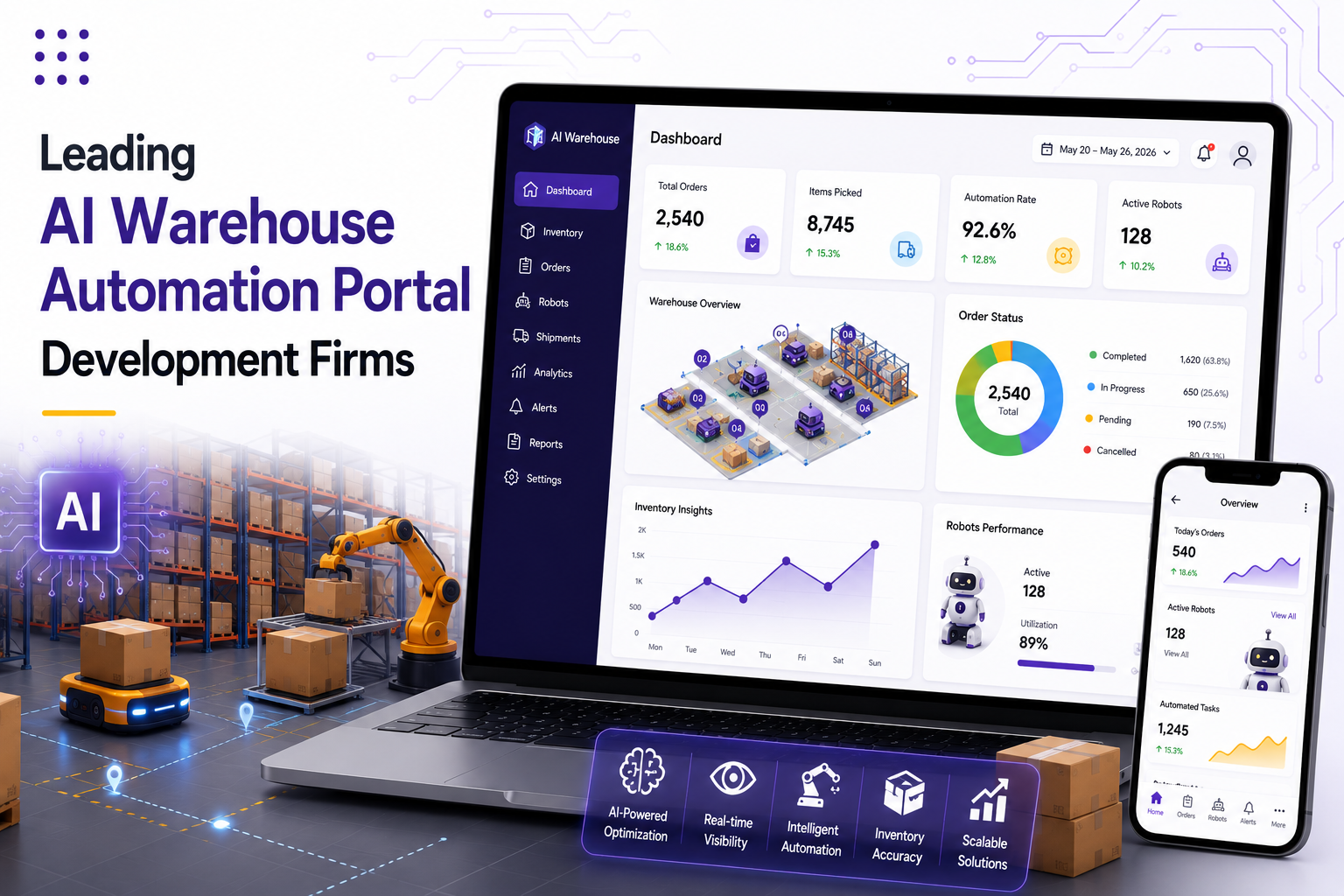

Warehouses are no longer just buildings full of shelves and forklifts. In 2026, the ones running efficiently are the ones running software that thinks ahead, routes pickers intelligently, predicts stockouts before they happen, and reroutes shipments the moment a delay shows up on the radar. That software is the AI Warehouse Automation Portal, and demand for one has moved from a nice to have request to a board level priority for logistics companies, third party fulfillment providers, manufacturers, and retailers running their own distribution.
The hard part for most founders is not deciding whether they need one. It is figuring out who can actually build it well. Warehouse automation software sits at an unusual intersection of robotics integration, real time inventory logic, sensor data, and AI decision making, and very few development teams are genuinely fluent in all four. Hire the wrong partner and you end up with a portal that looks polished in a demo but falls apart the moment order volume spikes or a robot fleet needs to talk to a decade old ERP.
Pricing also varies more than most buyers expect going in. A basic inventory and picker dashboard can start around $18,000 to $30,000, while a full AI Warehouse Automation Portal with robotics orchestration, predictive maintenance, and multi-site sync regularly runs past $150,000 once integrations and staff training are included. Knowing which tier a vendor actually specializes in, rather than what they claim to cover in a sales call, saves a lot of budget friction later.
This list breaks down 18 companies building AI Warehouse Automation Portal solutions in 2026, what each one is actually good at, and what a founder evaluating them should expect to pay, staff, and wait for before signing anything.
What an AI Warehouse Automation Portal Actually Needs to Do
Before comparing vendors, it helps to know what separates a genuinely useful automation portal from a rebranded inventory spreadsheet. The strongest platforms handle demand forecasting, automated slotting, robotic pick path optimization, real time stock visibility across multiple sites, and integration with existing WMS, ERP, and transport management systems without forcing a full replacement of what already works.
Just as important, the AI layer needs to explain its own decisions. A founder does not need a black box that quietly reroutes a shipment. They need a system that shows why, so operations teams can trust it during a peak season crunch instead of overriding it out of caution. Every company on this list is measured against that bar, not just uptime and hourly rates.
It also helps to think about how the portal will grow with the business. A single site operation today might be running three warehouses in two years, and a platform that only works well at one scale tends to become the reason a founder ends up rebuilding from scratch later. The company profiles below note where each vendor tends to fit best, whether that is a single facility just getting started or a multi site network already juggling complexity.
18 Companies Building AI Warehouse Automation Portals in 2026
1. Vantage Robotics Software
Vantage Robotics Software built its reputation writing the orchestration layer that lets autonomous mobile robots and human pickers share the same floor without collisions or dead zones. Their engineers came out of industrial robotics before moving into software, and it shows in how carefully their portals handle edge cases like a robot losing charge mid route or a picker manually overriding a suggested path. They also maintain a simulation environment so clients can test a new robot addition virtually before it ever touches the actual warehouse floor.
Vantage suits warehouses that already run robot fleets from established vendors and need a unifying AI layer on top, rather than companies automating a floor from scratch.
Engagements typically start with a two week floor audit before any code is written, since robot placement and travel patterns differ enough between facilities that a generic starting template rarely works well. Most projects run $60,000 to $120,000 for the orchestration layer alone, excluding hardware.
2. HireAIDevelopers
HireAIDevelopers focuses squarely on the AI layer rather than the full application stack, which makes them a strong fit for companies that already have a development team but lack in house machine learning talent. Their forecasting models are trained on client specific historical order data rather than generic retail datasets, which noticeably improves accuracy for niche product categories.
Best for founders who need deep AI expertise bolted onto an existing warehouse platform rather than a ground up rebuild.
They typically engage on a model retainer basis, billing for ongoing tuning and retraining rather than a single fixed project fee, since forecasting accuracy tends to drift as product mix and seasonality shift throughout the year and needs periodic recalibration.
3. Meridian WMS Solutions
Meridian has spent over a decade untangling legacy warehouse management systems for mid-sized UK retailers, and that background gives them an unusually practical view of what actually breaks during an AI upgrade. Rather than pitching a full rip and replace, they typically layer an AI decisioning module on top of the client's existing database, which shortens rollout time considerably compared to vendors that insist on rebuilding the entire stack from the ground up.
A sensible pick for founders who want AI capabilities without abandoning years of historical data trapped in an older system.
Projects usually run 4 to 7 months and include a data migration audit as a separate early phase, since Meridian has found that skipping this step is the single most common reason legacy WMS upgrades run over budget.
4. Fulcrum Automation Labs
Fulcrum's niche is connecting the physical side of a warehouse, conveyors, sorters, temperature sensors, to the AI portal so operators get early warnings before a mechanical failure halts a shift. Their platforms are built to flag a slipping conveyor belt or an overheating cold storage unit hours before it becomes a costly outage.
Best suited to founders running equipment heavy facilities, cold storage, or high throughput sortation centers where downtime is expensive.
Because their work depends on sensor hardware, Fulcrum usually asks for a facility walkthrough and equipment inventory before quoting, and pricing scales with the number of connected machines rather than a flat project rate.
5. Backend Development Company
Backend Development Company handles the unglamorous but essential part of an AI warehouse portal, the infrastructure that keeps thousands of inventory updates, sensor pings, and order events from colliding during peak hours. Their microservices approach means a single module, like the AI forecasting engine, can be upgraded without touching the rest of the platform.
Best for founders whose current bottleneck is technical debt or a system that cannot handle order volume spikes, rather than a lack of AI features.
They often start new clients with a load testing exercise on the existing system before writing any new code, which tends to surface exactly where a platform will buckle under a busy shopping season before that failure happens live.
6. NordWare Logistics Tech
NordWare builds automation portals with an unusual second objective alongside efficiency, reducing energy use and emissions across the warehouse floor. Their AI models factor in things like conveyor idle time and lighting zones when suggesting operational changes, which has made them popular with European clients facing tightening carbon reporting requirements.
A strong choice for founders operating in the EU who need automation software that also satisfies sustainability and compliance reporting obligations.
NordWare bills in euros by default and structures contracts around EU data residency requirements from the outset, which saves a renegotiation step that founders working with non EU vendors often run into partway through a build.
7. PixelDock Systems
Sitting near one of Europe's busiest ports, PixelDock built its portal around the specific chaos of cross docking, where goods move through a facility in hours rather than sitting in storage. Their scheduling AI predicts dock congestion and reassigns appointment windows before a bottleneck forms at the loading bay.
Best for founders running high velocity distribution operations where goods rarely sit still long enough for traditional inventory logic to apply.
Their pricing tends to reflect volume rather than headcount, since a single cross docking module can be built for a smaller facility for around $40,000 but scales up quickly once multiple freight forwarder integrations are added.
8. HireFullStackDeveloperIndia
HireFullStackDeveloperIndia takes on the entire build, frontend dashboards, backend logic, and the AI decisioning layer, which appeals to founders who want a single accountable team rather than coordinating multiple vendors. Their engagement model typically starts with a working prototype within a few weeks, then expands feature by feature based on operator feedback.
Best for founders starting from a blank slate who want one team responsible for the entire AI Warehouse Automation Portal rather than stitching pieces together.
Their offshore rate structure, generally $25 to $45 per hour depending on seniority, makes them a common choice for founders who want a full build without the overhead cost of hiring an in-house team from day one.
9. SwiftBin Technologies
SwiftBin's portals are designed to run on the handheld devices warehouse staff actually carry, with an emphasis on interfaces that work reliably even when a facility's wifi drops in a metal shelving corner. Their offline sync engine queues scans and updates locally, then reconciles automatically once connectivity returns.
A practical option for founders running facilities with patchy connectivity or a multilingual workforce that needs interfaces in more than one language.
SwiftBin usually ships a working mobile prototype within three to four weeks of kickoff, which appeals to founders who want to validate a scanner interface with floor staff early rather than waiting months to see the actual tool.
10. CargoLogic Software
CargoLogic focuses on the coordination problem that trips up growing operators, keeping inventory numbers accurate across several warehouses that are constantly transferring stock between each other. Their AI layer forecasts regional demand separately for each site rather than applying one national model, which tends to reduce both overstock and stockouts. The platform also automates transfer orders between warehouses when one site is running low and a neighboring one has surplus stock sitting idle.
Best suited to founders managing three or more warehouse locations who are currently reconciling stock counts manually between sites.
Pricing scales per connected warehouse site rather than as a single flat project fee, so founders planning to add locations later should ask for a per site rate upfront instead of renegotiating with each expansion.
11. DataEximIT
DataEximIT treats the AI Warehouse Automation Portal primarily as a data problem, building the pipelines that pull in sales history, supplier lead times, and seasonal trends before the forecasting model ever runs. Their dashboards are built for non technical operations managers, favoring plain visual summaries over raw data tables.
Best for founders who suspect their current forecasting is inaccurate because of messy or fragmented underlying data rather than a weak algorithm.
They typically begin with a data audit phase priced separately from the main build, usually $8,000 to $15,000, which often uncovers duplicate SKUs or mismatched location codes that would otherwise quietly undermine the AI model later.
12. StackFlow Robtics
StackFlow specializes in the software controlling automated storage and retrieval systems, the shuttle and rack machinery that brings inventory to a picker rather than the other way around. Their platforms are built to meet strict German and EU machinery safety standards, which matters for founders operating in regulated manufacturing adjacent facilities. Their engineering team includes staff with direct experience on the equipment manufacturing side, not just software, which shortens the back and forth typically needed to align a portal with existing hardware controllers.
Best for founders investing in or already running ASRS or goods to person hardware who need software that speaks directly to that machinery.
Because of the safety certification work involved, StackFlow's timelines run longer than most on this list, often 6 to 9 months, and they build in dedicated compliance testing phases that founders should budget extra time for.
13. Palletier Digital
Palletier is younger than most on this list but has carved out a specific niche in slotting, deciding which products sit where on the floor to minimize picker travel time. Their simulation tool lets operators test a proposed layout change virtually before physically moving a single pallet.
A good fit for founders whose main pain point is picker travel time and floor layout rather than forecasting or robotics.
Being a smaller team, Palletier keeps engagements tightly scoped, often delivering a slotting module as a standalone add-on for $15,000 to $25,000 rather than requiring a full platform rebuild to access the feature.
14. WebClues Infotech
WebClues Infotech runs a broad development practice that extends beyond warehousing, but their logistics vertical has grown steadily as more founders request combined web dashboards and mobile picker apps built on a shared backend. Their design team spends real time on interface usability, which shows in how quickly new warehouse staff tend to adopt their portals.
Best for founders who want a polished, easy to learn interface as much as they want strong backend automation logic.
WebClues typically runs a discovery workshop with actual warehouse staff before finalizing wireframes, which tends to catch usability issues that a design process built purely around management input would likely miss.
15. GridPick Systems
GridPick built its platform around the specific pressures of e-commerce fulfillment, where order volume can double overnight around a sale event and returns processing is nearly as demanding as outbound shipping. Their batching algorithms group orders intelligently so a single picker route can cover multiple shipments at once. The returns module also flags likely fraudulent claims automatically, which several clients have said quietly paid for the platform on its own within the first year.
Best for founders running direct to consumer fulfillment operations with high order volume and frequent returns.
GridPick prices around expected peak order volume rather than average daily volume, which founders should specifically flag during scoping since underestimating a Black Friday style spike is a common cause of mid contract renegotiations.
16. ScanCore Software
ScanCore built its portal around the specific paperwork and customs realities of Gulf region logistics, automating documentation steps that would otherwise require a dedicated compliance staffer. Their interfaces run fully bilingual out of the box, which has made them a common choice for operators serving both local and international clients from the same facility.
Best for founders operating in or shipping through the Middle East who need customs and compliance automation built in rather than bolted on.
Contracts are commonly structured in phases tied to specific ports or free zones, letting a founder launch automation at one facility before rolling the same portal out to additional Gulf locations without rebuilding the compliance logic each time.
17. FlowDock Technologies
FlowDock built its reputation solving problems that platforms designed for North American or European infrastructure often overlook, unreliable internet in outlying distribution centers and integration with regional carriers rather than global ones. Their portals are engineered to keep working smoothly on lower bandwidth connections without sacrificing the AI features running behind them. They also maintain direct relationships with several regional carriers, which cuts down on the custom integration work most outside vendors would otherwise need to quote separately.
Best for founders operating across Latin America who need software built for local infrastructure realities rather than adapted from a US first product.
Their quotes typically include local tax compliant invoicing as a standard feature rather than a paid add on, which saves a separate integration step that founders often discover is missing only after signing with a global vendor.
18. ZoneRunner Labs
ZoneRunner is a smaller, engineering heavy team focused on one problem, making split second decisions when something in the warehouse deviates from plan, a delayed truck, a mis picked item, a sudden demand spike. Their anomaly detection runs continuously in the background and surfaces exceptions to human operators before they cascade into bigger delays.
Best for founders who already have a functioning warehouse system but need a sharper real time decision layer bolted on top of it.
Given their narrow focus, ZoneRunner projects tend to be shorter than most on this list, often 8 to 12 weeks, and they typically require API access to an existing system rather than building a portal from the ground up.
Choosing the Right Partner for Your AI Warehouse Automation Portal
There is no single best company on this list, only the best fit for a specific warehouse, order volume, and existing tech stack. A founder running three regional distribution centers has a very different priority list than one launching a single automated fulfillment site from scratch, and the strongest AI Warehouse Automation Portal partner for one will not be the right choice for the other.
Before signing with any of the 18 firms above, ask to see a live demo running against data that resembles your own order patterns, not a polished sample dataset. Request references from clients running similar order volume, and clarify upfront how the vendor handles support once the portal is live rather than just during the build. The right partner should feel less like a vendor and more like an extension of the operations team making the warehouse run.
It is also worth asking each shortlisted vendor a direct question most sales calls skip over: what happens when the AI gets a prediction wrong. Every forecasting model misses occasionally, and the vendors worth working with will have a clear process for flagging those misses, retraining the model, and giving operations staff an easy way to override a bad suggestion without filing a support ticket. That answer tends to reveal more about a company's engineering maturity than any feature list on their website.