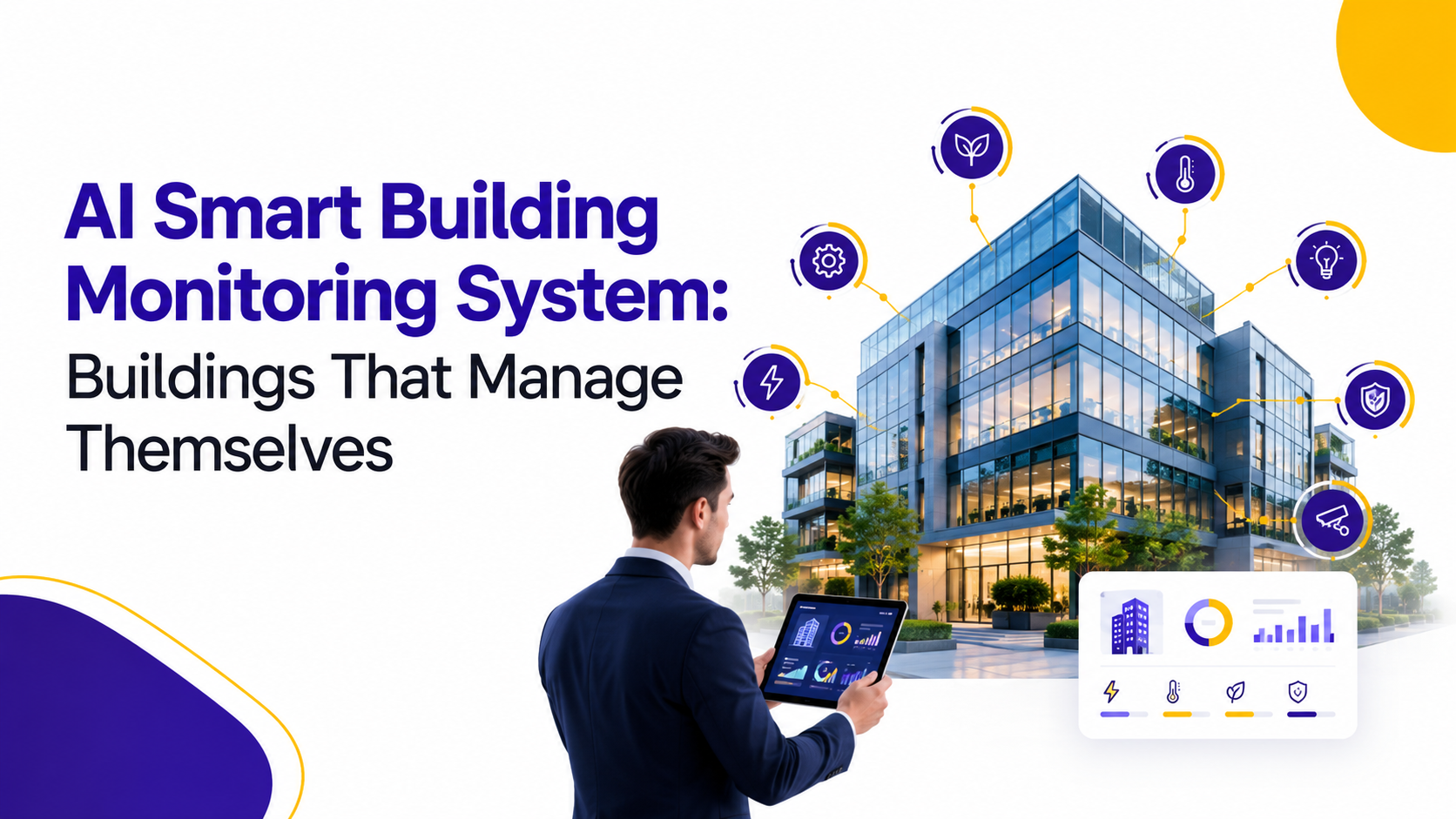

A building that notices a stuck vent before anyone complains. A parking garage that dims its lights when nobody is parked below. A chiller that schedules its own repair three weeks before it would have failed on a Friday afternoon. That is the practical promise behind AI smart building monitoring, and it has moved from pilot projects to standard practice faster than most facility teams expected.
The global smart building market grew from USD 141.8 billion in 2025 to a projected USD 164.7 billion in 2026, and is expected to climb toward USD 554.0 billion by 2033. Grand View Research points to AI-driven energy management and predictive maintenance as two of the biggest growth drivers behind that curve, and commercial real estate owners are watching those numbers closely because the operating cost savings are no longer theoretical.
For CEOs and facility decision-makers, the real question is not whether AI belongs in building operations anymore. It is how to choose the right AI building management software, avoid a messy rollout, and get measurable results within the first year. This guide breaks that down in plain language, section by section, with no jargon and no filler.
What Is an AI Smart Building Monitoring System?
At its core, an AI smart building monitoring system is a network of sensors, software, and machine learning models that watch a building's systems in real time and make decisions on their own, not just alert someone after something breaks.
Traditional building automation follows fixed rules. If temperature exceeds a set point, cooling turns on. AI monitoring goes further. It learns patterns, predicts problems, and adjusts continuously without waiting for a rule to be written for every scenario. That difference sounds small until you look at what it means in practice: a rule-based system reacts, while a learning-based system anticipates.
This shift matters because most commercial buildings run on infrastructure that was never designed to talk to each other. HVAC, lighting, security, and elevators typically sit on separate control systems, installed by different vendors, at different times. An AI monitoring layer sits on top of that patchwork and turns disconnected data into one coherent picture of how the building actually behaves day to day.
What It Actually Monitors
• HVAC performance and airflow across zones
• Lighting usage and occupancy patterns
• Energy consumption by floor, zone, or equipment type
• Water systems and early leak detection
• Fire, safety, and access control systems
• Equipment health for elevators, pumps, and chillers
• Indoor air quality, including carbon dioxide and humidity levels
• Structural sensors in larger facilities, tracking vibration and load stress over time
The Technology Stack Behind These Systems
It helps to know what is actually running under the hood before signing a contract, since vendors describe the same underlying pieces with very different marketing language.
• Predictive Analytics: Statistical and machine learning models trained on historical sensor data to forecast equipment failure and energy demand before either becomes a problem
• Computer Vision: Camera-based analysis used for occupancy counting, space utilization studies, and in some cases safety compliance monitoring without recording identifiable footage
• Digital Twins: A virtual, continuously updated model of the physical building, used to simulate changes like a new HVAC schedule before applying them in the real space
• Edge AI: Processing that happens on local hardware inside the building rather than in a distant data center, which keeps response times fast for time-sensitive actions
• Natural Language Reporting: Plain-language summaries generated automatically for facility managers, so nobody has to interpret raw dashboards to understand what changed and why
Not every building needs all five layers on day one. Most successful rollouts start with predictive analytics and edge processing, then add computer vision or digital twins once the core monitoring proves its value. Trying to deploy all five at once is one of the more common reasons early pilots run over budget and over schedule.
How AI Smart Building Monitoring Actually Works
The system runs through five stages, and skipping any one of them is usually why AI monitoring projects underperform.
1. Data Collection
Sensors placed across HVAC units, meters, doors, and equipment gather continuous data on temperature, energy draw, occupancy, and vibration. The quality of this stage determines everything downstream, since a model trained on noisy or incomplete sensor data will make unreliable predictions no matter how sophisticated the algorithm behind it is.
2. Edge Processing
Devices process raw data locally before sending it to the cloud, cutting latency and bandwidth costs. This step matters more than most vendors mention, since real-time decisions like adjusting airflow cannot wait for a round trip to a distant server. Our breakdown of edge computing in smart IoT and AI apps covers why this layer is non-negotiable for responsive systems, particularly in buildings with hundreds of connected sensors generating data every few seconds.
3. AI Analysis
Machine learning models compare current readings against historical patterns to spot anomalies, predict equipment failure, and forecast energy demand. Over time, the model also learns building-specific quirks, like how a particular chiller behaves differently in humid weather compared to a generic industry benchmark.
4. Automated Action
The system adjusts HVAC setpoints, dims lighting, reroutes power, or flags maintenance teams, often without waiting for human approval on routine actions. Higher-risk actions, such as shutting down equipment entirely, typically still route through a human approval step until the model has built up a longer track record.
5. Continuous Learning
Every adjustment feeds back into the model, so accuracy improves month over month instead of staying static like rule-based systems. This is also where most of the long-term value shows up, since a system that has run for two years usually outperforms one that just went live, even with identical hardware.
In short, data goes in, patterns get recognized, and the building adjusts itself, then gets smarter with every cycle.
Traditional BMS vs AI Smart Building Monitoring
Core Features to Look For in AI Building Management Software
Not every platform marketed as AI-powered actually uses machine learning. Some simply rebrand basic threshold alerts as intelligent monitoring. Here is what separates genuine AI building management software from a repackaged dashboard.
Real Benefits for Decision-Makers
The business case for AI smart building monitoring usually comes down to a handful of numbers finance teams actually care about.
• Lower energy bills: Often 10 to 25 percent lower depending on building type and current inefficiency, since the system continuously fine-tunes HVAC and lighting instead of running on a fixed schedule
• Fewer emergency repairs: Predictive alerts catch issues during scheduled maintenance windows instead of forcing an emergency callout during business hours
• Longer equipment lifespan: Reduced strain from constant manual overrides means chillers, pumps, and elevators run closer to their design specifications for longer
• Better tenant or employee satisfaction: Tied directly to consistent temperature and air quality, which shows up in retention numbers for commercial landlords
• Stronger ESG reporting: Automated logs replace manual energy audits, cutting the time facility teams spend compiling sustainability reports each quarter
According to the International Energy Agency, buildings account for close to 30 percent of global final energy consumption, and digitalization combined with smart demand-side management could cut that energy use by as much as 10 percent. For a large commercial portfolio, that percentage translates into real budget line items, not just sustainability talking points, and it is one reason procurement teams are moving faster on this than they were even two years ago.
Where AI Smart Building Monitoring Is Being Used
The use cases differ more than most guides admit. What works for a data center rarely maps directly onto a school campus, and vendors who claim a single configuration fits every building type are usually oversimplifying.
• Commercial Offices: Balancing occupancy-based HVAC with hybrid work schedules that change week to week, so the system has to adapt to attendance patterns rather than a fixed weekly calendar
• Healthcare Facilities: Monitoring air quality and equipment uptime where failures carry higher stakes, particularly around operating rooms and cold storage for medication
• Retail Spaces: Syncing lighting and climate control with foot traffic patterns to cut costs during slow hours without affecting the customer experience during peak times
• Data Centers: Preventing overheating through granular temperature monitoring across server racks, where even brief spikes can trigger costly downtime
• Manufacturing Plants: Tracking equipment vibration and temperature to predict mechanical failure before it halts a production line
• Educational Campuses: Managing energy use across dozens of buildings with different occupancy schedules, from lecture halls to dormitories that stay occupied overnight
• Hospitality Properties: Adjusting room climate control based on guest check-in and check-out patterns to avoid conditioning empty rooms
Choosing the Right AI Building Management Software
Before signing with any vendor, run through this checklist with your facility and IT teams together, not separately.
☐ Does the platform support your specific building types and existing hardware?
☐ Can it integrate with your current BACnet or Modbus systems without a full rip-and-replace?
☐ Does the vendor provide a clear data ownership and privacy policy?
☐ Is pricing based on square footage, number of sensors, or a flat subscription?
☐ Does it offer a pilot program before a building-wide rollout?
☐ What is the average time to see measurable energy savings?
☐ Can your internal team access raw data, or only the vendor's dashboard?
☐ What happens to historical data and model training if you switch vendors later?
Cloud infrastructure choice matters here too. Many facility teams underestimate the backend work involved in supporting real-time data across dozens of buildings. Working with experienced Google Cloud development teams early in the process avoids the scaling issues that show up months into a rollout, once data volume climbs past what a single server can comfortably handle.
It is also worth asking how the vendor handles model retraining. A system that never updates its predictions after the initial setup will drift out of accuracy as equipment ages and usage patterns shift, which defeats the purpose of choosing AI over a simpler rule-based tool in the first place.
Building In-House vs Partnering With a Development Team
One decision trips up more CEOs than any feature comparison: whether to build the AI layer in-house or bring in outside expertise. Both paths work, but they suit different situations.
• In-house build: Makes sense for large enterprises with an existing data science team and enough buildings to justify the ongoing engineering investment
• Vendor platform: Fits most mid-size portfolios, since off-the-shelf software gets a building monitored within weeks instead of the months a custom build requires
• Hybrid approach: Combines a vendor platform for standard monitoring with custom models built by a development partner for building-specific predictions the off-the-shelf tool cannot handle
Most facility teams underestimate how much ongoing tuning an AI model needs after the initial launch. A vendor with dedicated engineering support, or an outside partner from among established AI smart building monitoring development companies brought in specifically for model refinement, tends to keep prediction accuracy higher over the second and third year of operation than a system left to run unattended.
Common Challenges and How to Solve Them
Security and Compliance Considerations
Connecting building systems to the internet expands the attack surface, and that is a legitimate concern for any CEO signing off on this kind of investment, not something to wave away. A monitoring system that improves energy efficiency but introduces a new security gap is not a net win for the business.
• Confirm encryption both in transit and at rest for all sensor and occupancy data
• Ask whether the vendor segments building networks from corporate IT networks, since a breach in one should not expose the other
• Check for role-based access so facility staff, IT, and vendor support see only what their role requires
• Review data retention policies, particularly for occupancy and access data that could be considered personal information depending on your jurisdiction
• Verify the platform supports regular firmware updates for sensors, since outdated IoT devices are a common entry point for attackers
What This Costs, Roughly
Costs vary widely based on building size, existing infrastructure, and how many systems get connected. A single-building pilot covering HVAC and lighting typically starts in the five figure range, while a multi-building enterprise rollout with predictive maintenance across every system can reach well into six or seven figures.
Sensor hardware, installation labor, and software licensing each make up a meaningful share of that total, and the split shifts depending on whether a building already has partial automation in place or needs everything installed from scratch. Buildings retrofitting older infrastructure typically spend more upfront on hardware, while newer construction spends proportionally more on software and integration.
Working with experienced AI smart building monitoring development companies early helps avoid the two most expensive mistakes: over-sensoring a building before proving value, and choosing a platform that cannot scale past the pilot phase. Teams that need to hire AI developers for custom model training usually see a faster path to accurate predictions than those relying entirely on a vendor's generic, one-size-fits-all model.
Measuring ROI After Launch
A pilot that nobody measures properly is hard to defend when it comes time to ask for budget to expand it. Track these numbers from day one, not after someone in finance asks for them.
• Baseline energy usage: Capture at least 3 months of pre-installation data so the comparison after launch actually means something
• Maintenance ticket volume: Compare emergency versus scheduled repairs before and after, since the shift from reactive to predictive is one of the clearest early signals of success
• Prediction accuracy: Track how often the system's failure predictions turn out correct, and expect this number to climb steadily over the first year
• Occupant comfort complaints: A drop in temperature and air quality complaints logged with facility staff is an easy, low-cost metric that finance teams still find persuasive
Most facility teams see the clearest energy savings within the first two to three billing cycles, while predictive maintenance benefits take a bit longer to show up since the model needs a full seasonal cycle of data to catch patterns tied to weather changes.
What Is Changing in 2026
A few shifts are shaping how facility teams approach this over the next year.
• Predictive maintenance models are getting sharper, using years of accumulated sensor data rather than generic industry benchmarks
• More vendors are offering modular pricing, so buildings can start with one system instead of committing to a full platform
• Integration between AI building management software and existing security systems is becoming a baseline expectation, not a premium add-on
• Regulatory pressure around building emissions reporting is pushing adoption in regions that were previously slower to move
• Portfolio-wide dashboards are replacing building-by-building tools, giving multi-property owners one view across every location
Bringing It All Together
None of this requires ripping out existing infrastructure or waiting for a brand-new building. Most of what is described here layers onto systems that are already in place, sensor by sensor, zone by zone, over a matter of months rather than years.
The buildings that end up managing themselves well are not the ones with the most sensors. They are the ones where the right partner set things up correctly from the start, with clean data pipelines and models trained on real conditions rather than generic assumptions. Partnering with experienced AI smart building monitoring development companies to plan that rollout, rather than treating it as a one-time software purchase, tends to be what separates a building that actually runs smarter from one that just collects data nobody looks at.
If you are evaluating vendors this quarter, start small, measure the results honestly, and expand from there. That is a far better outcome than a building-wide rollout that stalls halfway through because nobody proved the value early enough to get buy-in for phase two.