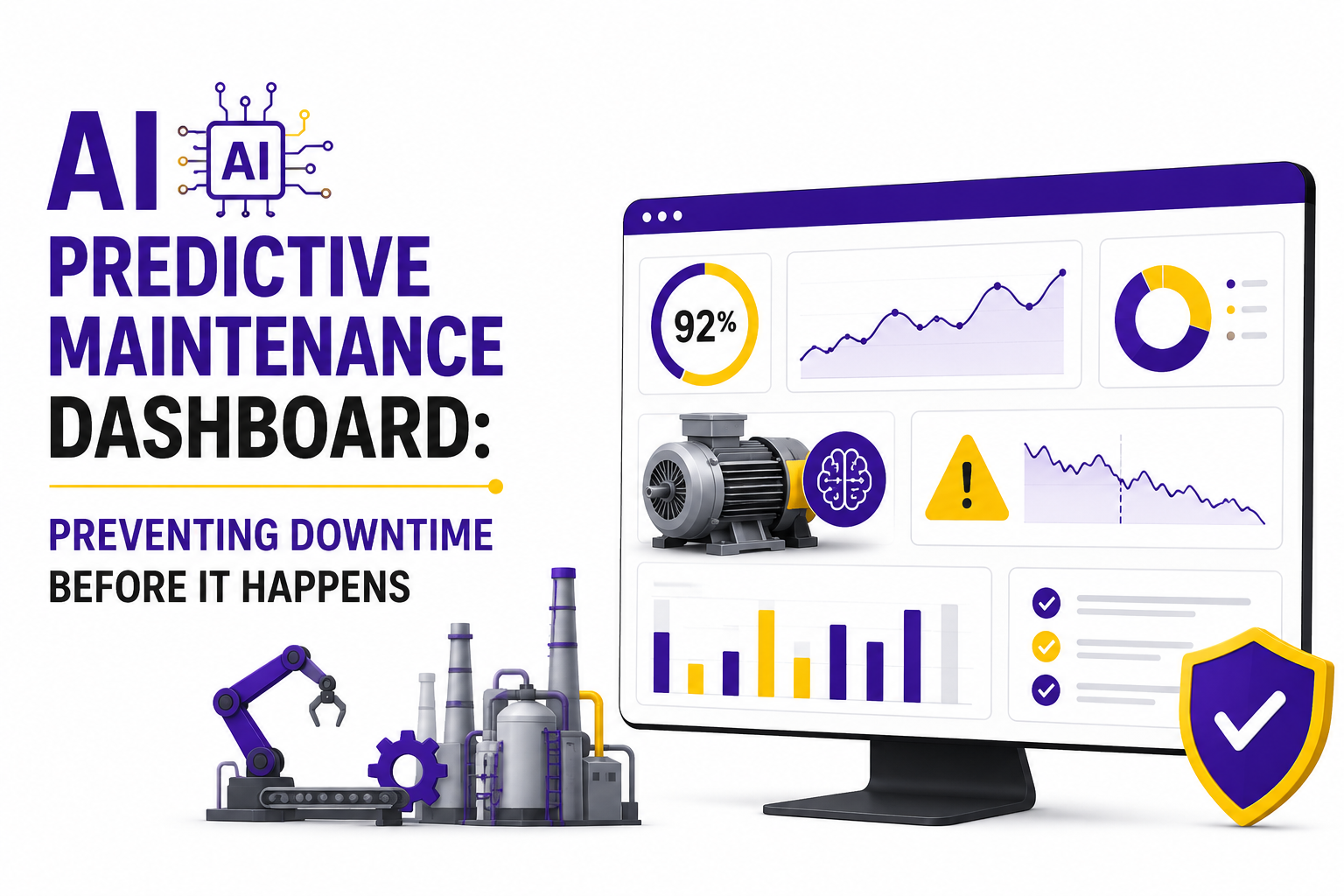

A machine rarely breaks down without warning. It usually tells you first, through a strange vibration, a temperature spike, a sound that is just slightly off from normal. The problem is that most maintenance teams are not listening for those signals until the machine has already stopped. That is the gap an AI predictive maintenance dashboard is built to close, and it is why so many operations leaders are rethinking how they plan repairs, staffing, and budgets heading into 2026.
If you run a facility, manage a fleet, or oversee any operation where equipment failure means lost revenue, you have probably already heard the term predictive maintenance thrown around in vendor pitches and industry panels. What gets lost in those conversations is the practical part: what does this actually look like on a screen, what does it take to build one that works for your specific equipment, and how do you pick a partner who can deliver it without turning into a two-year science project. That is what this guide is for.
This is not a technical manual written for engineers. It is written for the person who has to decide whether this investment is worth pursuing, sign off on a budget, and eventually sit across the table from a development team and ask the right questions. By the end, you should have a clear picture of what to expect, what it costs, and how to tell a capable partner apart from one that is simply good at demos.
What an AI Predictive Maintenance Dashboard Actually Does
Strip away the marketing language and a predictive maintenance dashboard is a single screen, or a small set of connected screens, that pulls live data from your machines and turns it into a clear answer to one question: is something about to go wrong, and if so, where. It replaces the old habit of fixing equipment on a fixed calendar, every 90 days whether it needs it or not, with a system that flags problems based on how the equipment is actually behaving right now.
Underneath that simple screen sits a fair amount of engineering. Sensors on the equipment stream readings such as vibration, temperature, pressure, and current draw. That data flows into a pipeline where machine learning models compare current patterns against historical failure signatures. When the model spots a pattern that has previously preceded a breakdown, it raises a flag on the dashboard, usually with a severity score and a suggested time window before failure becomes likely.
The result is that a maintenance manager stops reacting to alarms after the fact and starts working from a prioritized list of equipment that needs attention this week, this month, or this quarter. That shift alone is often what convinces a leadership team to fund the project in the first place.
It is worth being clear about what this is not. It is not a system that predicts failures with perfect precision, and it is not a replacement for skilled technicians. What it does is narrow the field, so the people doing the actual repair work spend their time where it matters most instead of walking the entire facility on a fixed schedule hoping to catch something before it fails.
Why Downtime Is a Bigger Problem in 2026 Than It Used to Be
Unplanned downtime has always been expensive, but the math has gotten worse in the last few years. Supply chains are tighter, so a delayed shipment because a conveyor line went down does not just cost you a day, it can cost you a customer who moves to a competitor with more reliable delivery. Labor is harder to find, which means the skilled technicians who used to catch problems by ear and by feel are retiring faster than they can be replaced. And equipment itself has gotten more complex, packed with electronics and software that fail in ways a purely mechanical inspection will never catch.
There is also a quieter cost that rarely makes it into the boardroom conversation: the wear on equipment that happens when a small issue is allowed to run for weeks before anyone notices. A bearing that is slightly misaligned does not just eventually fail, it also drags down everything connected to it, increasing energy use and accelerating wear on parts that were otherwise fine. An AI predictive maintenance system catches that kind of slow-burn problem long before it becomes a catastrophic one, which is a large part of why the return on investment tends to show up faster than people expect.
Put simply, the cost of doing nothing has grown, and the tools to do something about it have finally matured enough to be worth the investment for mid-sized operations, not just large industrial giants with unlimited budgets.
Insurance and compliance pressures have shifted too. Some industries now face stricter reporting requirements around equipment safety incidents, and a documented monitoring system can serve as evidence that a company took reasonable steps to prevent a failure. That is not the main reason most companies invest in this technology, but it has become a meaningful secondary benefit worth mentioning to a board or investor group during budget approval.
How AI Equipment Monitoring Software Works Behind the Screen
It helps to understand the moving parts, because that understanding is exactly what lets you ask the right questions when you are evaluating a development partner. Good AI equipment monitoring software is built in layers, and each layer solves a different problem.
The first layer is data collection. Sensors, whether newly installed IoT devices or existing PLC and SCADA systems, capture readings at regular intervals. The second layer is the ingestion pipeline, which cleans that raw data, handles missing readings, and standardizes formats coming from different equipment brands and generations. This layer sounds boring, but it is often where projects succeed or fail, because real factory data is messy in ways a demo environment never is.
The third layer is the model itself. Depending on the equipment and the failure modes involved, this might be a simpler statistical model looking for anomalies, or a more advanced deep learning model trained on years of historical failure data. The fourth layer is the dashboard interface, where all of that analysis gets translated into something a plant manager can actually use without a data science degree: color coded alerts, trend lines, and plain language recommendations.
When people say AI equipment monitoring software, they usually mean this entire stack working together, not just the visual dashboard on top. That distinction matters when you are budgeting a project, because a beautiful interface connected to a shallow model will give you false confidence, while a strong model with a confusing interface will sit unused by your team.
One detail that surprises a lot of first-time buyers is how much of the total project timeline goes into that second, unglamorous layer of data cleaning. Sensor readings drop out, clocks drift out of sync between devices, and different equipment vendors report the same measurement in different units. A development team that rushes past this step to get to the exciting model-building work is often the same team that delivers a dashboard with unreliable predictions six months later.
Core Features a Predictive Maintenance Dashboard Should Include
Not every dashboard needs every feature, but there is a set of capabilities that separates a genuinely useful tool from a glorified chart viewer. The table below covers what to expect from a well-built system.
A well-designed dashboard also needs to be honest about uncertainty. The best systems do not just say a machine will fail, they show a confidence level, because a maintenance team that gets burned by false alarms will stop trusting the system within a few months. That trust, once lost, is expensive to rebuild.
Industries Already Running on AI Predictive Maintenance
· Manufacturing – Monitors production equipment to predict failures and reduce unplanned downtime.
· Automotive – Tracks the health of assembly line machines and robotic systems to keep production running smoothly.
· Oil and Gas – Detects potential issues in drilling equipment, pipelines, and processing facilities before they become costly failures.
· Energy and Utilities – Predicts maintenance needs for power plants, transformers, wind turbines, and solar installations.
· Aviation – Monitors aircraft engines and critical components to improve safety and reduce maintenance delays.
· Railways – Uses AI to monitor trains, tracks, and signaling systems for early fault detection.
· Logistics and Warehousing – Keeps conveyors, forklifts, and automated warehouse equipment operating efficiently.
· Healthcare – Monitors MRI machines, CT scanners, ventilators, and other medical equipment to minimize downtime.
· Mining – Predicts failures in heavy machinery such as excavators, crushers, and haul trucks operating in harsh environments.
· Construction – Tracks the condition of cranes, excavators, and other heavy equipment to prevent unexpected breakdowns.
· Food and Beverage – Monitors processing and packaging equipment to avoid production interruptions and product waste.
· Chemical Industry – Detects equipment wear in reactors, pumps, compressors, and pipelines to improve operational safety.
· Marine and Shipping – Monitors ship engines and onboard machinery to reduce maintenance costs and avoid delays.
· Telecommunications – Predicts failures in network infrastructure, cooling systems, and data center equipment.
· Data Centers – Continuously monitors servers, cooling units, and power systems to ensure uninterrupted operations.
Signs Your Operation Is Ready for This Investment
Not every company needs to jump into predictive maintenance immediately, and a good development partner will tell you that honestly rather than pushing a sale. A few signs tend to indicate the timing is right. If unplanned downtime has happened more than a handful of times in the past year and each incident carried a real cost in lost production or missed deliveries that is a strong signal. If your maintenance team is still largely reactive, fixing things only after they break or on a rigid calendar regardless of actual condition, there is likely significant room for improvement.
Another sign is data availability. If your equipment already has some sensors in place, even basic ones, or if your team keeps reasonably organized maintenance logs, you have a head start that shortens the early data collection phase considerably. On the other hand, if your equipment is extremely varied and largely undocumented, it does not mean predictive maintenance is off the table, but it does mean the first phase of any project should focus on establishing that baseline data before expecting meaningful predictions.
Finally, consider your team's appetite for change. A predictive maintenance rollout works best when floor staff and management are both willing to trust a new process and adjust old habits. Without that buy-in, even a technically excellent system tends to get ignored in favor of the way things have always been done.
Build vs Buy: Off the Shelf Tools Versus Custom Development
What to Look for in AI Predictive Maintenance Development Companies
Choosing the right partner matters more than choosing the right algorithm, because even the best model is useless if it never makes it into a usable, reliable product. Here is what actually separates a solid partner from a risky one.
Look for teams with hands-on experience connecting to industrial hardware, not just experience with clean, pre-packaged datasets. A lot of firms can build an impressive demo using public sensor data. Far fewer have actually dealt with a decade-old PLC that outputs data in a format nobody documented properly. Ask for specific examples of the equipment types and protocols they have worked with, such as Modbus, OPC UA, or MQTT, and ask what happened when the data was messier than expected.
It is also worth asking how a firm handles model accuracy over time. Predictive models drift as equipment ages and operating conditions change, so a good AI predictive maintenance development company will have a plan for retraining and monitoring model performance after launch, not just at the initial handoff. If a vendor cannot describe how they will keep the model accurate a year from now, that is a real gap.
Finally, pay attention to how they talk about integration. The strongest AI predictive maintenance development companies treat the dashboard as one piece of a larger operational picture, and they ask early about your existing CMMS, ERP, and alerting tools rather than assuming everything will be built from scratch. A partner who is thinking about your entire maintenance workflow, not just the model, is usually the one who delivers something your team will actually keep using.
What Drives the Cost of an AI Predictive Maintenance Dashboard
Cost varies widely because the inputs vary widely, but a few factors consistently move the number. The type and age of your equipment matters, since older machinery without existing sensors requires hardware installation on top of the software build. The number of assets being monitored matters too, since scaling from ten machines to two hundred is not a linear cost increase, thanks to shared infrastructure, but it is not free either.
Data history also plays a role. If you already have years of maintenance logs and sensor readings, a development team can train more accurate models faster. If that history does not exist, part of the early budget goes toward simply collecting enough clean data before meaningful predictions are even possible. Integration complexity is another factor, particularly if your current systems are older or poorly documented.
As a rough range for 2026, a focused pilot covering one production line or a small equipment fleet typically falls between $25,000 and $60,000, while a full facility-wide rollout with deep ERP integration and custom model development can run from $80,000 well into six figures. These numbers shift based on region, team composition, and how much of the hardware layer needs to be built from scratch.
Common Mistakes Companies Make When Adopting This Technology
The most frequent mistake is trying to monitor everything at once. Teams get excited about the possibilities and want sensors on every piece of equipment in the building within the first quarter. This spreads the budget too thin and delays the point where anyone sees real results. A far better approach is starting with the equipment that causes the most pain when it fails, proving value there, and expanding from that success.
Another common issue is treating the dashboard as a set-and-forget purchase. Predictive models need attention. Equipment behavior changes as parts wear, processes shift, and new machinery gets added to a line. Without periodic retraining and review, prediction accuracy quietly declines, and technicians stop trusting alerts that used to be reliable.
A third mistake is skipping the change management side entirely. The best AI equipment monitoring software in the world will not help if the maintenance team was never trained on how to read it or does not trust the alerts enough to act on them. Successful rollouts always include time spent with the floor staff, not just the IT department, walking through what the alerts mean and how they should change day to day decisions.
A fourth mistake, less obvious but just as costly, is choosing a vendor based purely on the lowest quote. Predictive maintenance is not a one-time software purchase, it is an ongoing relationship that includes model retraining, hardware support, and system updates as your equipment changes. A cheaper initial build that skimps on any of those areas often ends up costing more over two or three years than a properly scoped project would have in the first place.
Measuring ROI: What Results to Realistically Expect
Leadership teams understandably want numbers before approving a budget, so it helps to know what a reasonable return looks like. Most companies that implement this technology well see a reduction in unplanned downtime somewhere between 25 and 45 percent within the first year, though the exact figure depends heavily on how reactive the maintenance process was beforehand. Companies starting from a purely reactive model tend to see the largest early gains simply because there was so much room for improvement.
Maintenance costs themselves also tend to shift rather than simply shrink. Emergency repair costs go down, but scheduled, planned maintenance costs may rise slightly at first as teams address issues the system catches that would previously have gone unnoticed until failure. Over time, as equipment runs more reliably and fewer parts fail catastrophically, total maintenance spend typically trends downward, often by 10 to 20 percent once the system has been in place for a full year or more.
Beyond the direct numbers, many operations report a less quantifiable but real benefit: better planning. Knowing roughly when a machine will need attention allows production schedules, staffing, and parts ordering to happen well in advance instead of in a scramble after something has already failed.
How to Choose the Right Development Partner for Your Project
Start by getting specific about your goals before you talk to any vendor. Do you want to reduce unplanned downtime by a certain percentage, extend the life of aging equipment, or cut the labor hours spent on routine inspections? A clear goal makes it much easier to evaluate whether a proposed solution actually fits your situation, rather than getting swept up in an impressive feature list.
Request a small proof of concept before committing to a full build. A short, scoped pilot on one or two critical machines will tell you far more about a vendor's real capabilities than any sales presentation. Pay attention to how they communicate during that pilot phase. Do they explain what the model is doing in plain language, or do they hide behind jargon when something does not work as expected?
It also helps to ask for references from companies in a similar industry, and to ask those references specifically about post-launch support, not just the initial build. Many AI predictive maintenance development companies are strong at delivery but weak at long-term maintenance of the system itself, and that gap only becomes obvious six months after launch when accuracy starts to slip and nobody is actively watching for it.
Where This Technology Is Headed Through 2026 and Beyond
A few shifts are already visible heading further into 2026. Edge computing is pushing more of the analysis directly onto equipment or nearby local servers, which cuts down on latency and reduces dependence on constant cloud connectivity, something that matters a great deal for remote sites like wind farms or offshore facilities. Generative AI is also starting to show up inside these dashboards, not to replace the prediction models, but to translate technical alerts into plain language explanations and suggested repair steps, which shortens the gap between an alert appearing and a technician knowing exactly what to do about it.
There is also a growing push toward standardization. Early predictive maintenance projects were often built as one off custom solutions with little reusability. Newer platforms are being built with more modular architecture, which makes it easier and cheaper to expand monitoring to new equipment types without starting from scratch each time. For companies planning a multi-year rollout, that shift matters, because it directly affects how much a second or third phase of the project will cost compared to the first.
None of this changes the core value proposition, though. The goal remains the same as it was when the first version of an AI predictive maintenance dashboard hit a factory floor: catch problems while they are still small and cheap to fix, instead of waiting for them to become expensive and disruptive.
Final Thoughts
Downtime has a way of feeling unavoidable right up until you have a system that proves otherwise. Once a maintenance team sees a failure flagged three weeks before it would have happened, the conversation in that building changes for good. Nobody wants to go back to guessing.
The technology behind an AI predictive maintenance dashboard is no longer experimental, and the companies capable of building one well are no longer rare or impossible to find. What matters now is being deliberate: pick the equipment that matters most, choose a partner who has actually dealt with machinery as messy as yours, and start small enough to prove the value before scaling it across the whole operation. Do that, and 2026 can be the year your team stops reacting to breakdowns and starts staying a step ahead of them.