
A pump that fails on a Tuesday afternoon does not send a warning email first. It just stops, and by the time a maintenance crew reaches it, the line behind it has already gone quiet. That single afternoon can cost a manufacturing plant more than a full year of software subscriptions, which is exactly why so many operations leaders spent 2025 asking the same question. Can we see a failure coming before it happens, instead of finding out after the machine is already down?
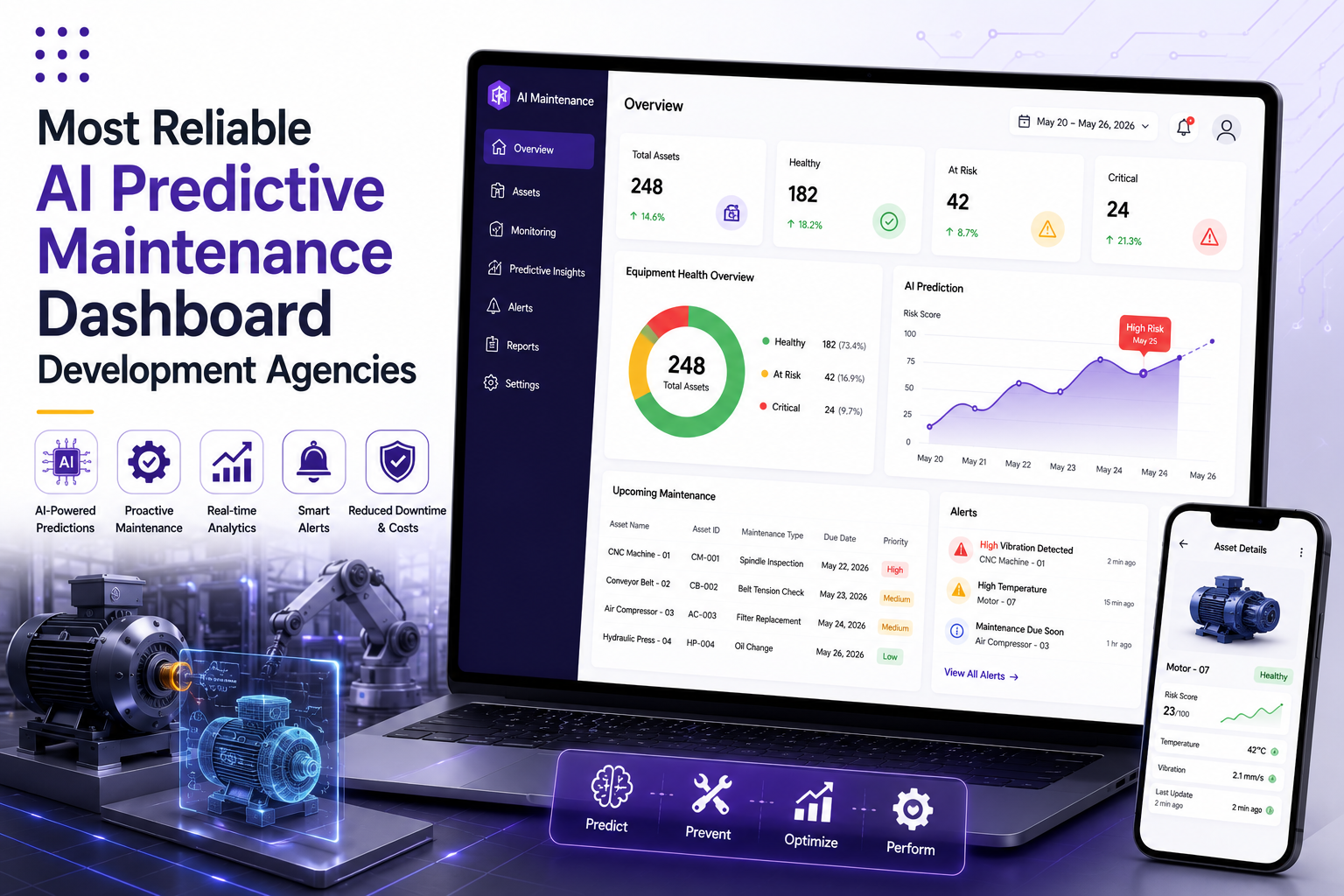
That question is what an AI Predictive Maintenance Dashboard is built to answer. It pulls readings from sensors, motors, and industrial equipment, runs that data through models trained to spot the early signs of wear, and puts the result in front of a plant manager in plain numbers and colors, not raw telemetry nobody has time to interpret. Done well, it turns maintenance from a reactive scramble into a scheduled task. Done poorly, it becomes another dashboard nobody opens after the first month.
That gap between a tool people actually use and one that gets ignored comes down almost entirely to who builds it. This guide walks through 18 AI Predictive Maintenance Dashboard development agencies that CEOs and founders are shortlisting in 2026 for exactly this kind of project, along with what each one is actually good at and where they tend to fall short.
Why the Right Development Partner Matters More Than the Tech Stack
Every agency on a shortlist will claim it can do machine learning, IoT integration, and real time dashboards. The part that separates a useful build from an expensive mistake is domain judgment, knowing which sensor readings actually predict failure for a specific type of equipment, how much historical data is needed before a model is trustworthy, and how to design an interface that a maintenance technician will glance at during a busy shift rather than dig through during a crisis.
Cost is the other variable founders underestimate. A basic AI Predictive Maintenance Dashboard proof of concept can run anywhere from $18,000 to $45,000, while a full production deployment across multiple facilities, with model retraining pipelines and integration into existing ERP or SCADA systems, regularly climbs past $150,000. The agencies below are grouped loosely by the kind of client they tend to serve best, from early stage startups validating an idea to enterprise manufacturers rolling out across dozens of plants.
Red Flags to Watch For Before You Sign
A few warning signs come up often enough in these projects that they are worth naming directly. If an agency quotes a fixed price without ever asking about the type of equipment involved, the number of sensors, or the failure history you already have, that quote is a guess, not an estimate. Predictive maintenance work depends entirely on data quality, and a serious partner will want to see a sample of your sensor readings before committing to a timeline or a price.
The second warning sign is vague language around accuracy. Nobody can promise a model will predict every failure, and any agency that claims otherwise either does not understand the limits of the technology or is telling you what you want to hear to close the deal. What a good partner will offer instead is a realistic accuracy range based on similar past projects, along with a plan for how that accuracy improves as the model sees more real world data over time.
Finally, ask directly what happens after launch. Some agencies treat delivery as the finish line and quietly step back, leaving the client to figure out model drift and retraining alone. The stronger partners on this list build a post launch support plan into the original scope, not as an upsell added later.
The 18 Agencies Worth Shortlisting in 2026
Each profile below covers the essentials founders typically want before a first call: how established the company is, where they operate from, roughly how large their teams are, and what they actually specialize in.
N-iX has built a reputation among mid-size and large manufacturers for handling the unglamorous part of predictive maintenance projects, the data pipeline that connects thousands of sensors to a model that actually works. Their engineering teams have hands-on experience with industrial protocols like OPC-UA and Modbus, which matters more than most founders realize until their agency cannot read the equipment's data in the first place.
Where N-iX stands out is in long-term partnerships rather than one-off builds. They tend to work best with companies that already have some sensor infrastructure in place and need a partner who can scale the analytics layer without starting from zero.
HireFullStackDeveloperIndia built its business around a simple pitch, giving founders direct access to dedicated developers instead of routing everything through account managers and change request forms. For teams building an AI Predictive Maintenance Dashboard on a defined budget, that model tends to keep costs predictable because you are paying for developer hours rather than a fixed scope that gets renegotiated halfway through.
Their full stack teams handle both the visualization layer and the backend services that feed it, which is useful when a startup needs one accountable partner rather than juggling a frontend shop and a data engineering firm separately. They are best suited to founders who know roughly what they want built and need fast, cost-effective execution.
ELEKS has been in the industrial software space long enough to have worked through the messy reality of legacy manufacturing systems that were never designed to talk to a modern analytics platform. That in-house experience with older SCADA and PLC systems is genuinely rare and often the difference between a project that ships and one that stalls in integration.
Their consulting-first approach means they typically spend real time understanding a client's equipment and failure history before writing a line of code, which extends timelines but tends to produce a model that reflects the client's actual operating conditions rather than a generic template.
Intellectsoft has shipped predictive maintenance products across manufacturing, energy, and logistics, and their portfolio includes several digital twin projects that pair naturally with dashboard work. A digital twin gives a model more context to reason from, which can meaningfully improve prediction accuracy for equipment with complex failure modes.
They lean toward mid-market and enterprise clients with existing engineering teams who need a specialized AI partner to complement in-house staff rather than replace them entirely.
The name is literal, this agency focuses almost entirely on the backend layer that any serious AI Predictive Maintenance Dashboard depends on. That includes the pipelines that ingest sensor data continuously, the databases that store years of equipment history, and the APIs that connect the model's output to whatever frontend a client chooses to use.
Founders who already have a frontend team or a specific dashboard design in mind often bring in Backend Development Company specifically to handle the data infrastructure, since that piece requires a different skill set than building the visual interface and is where many predictive maintenance projects actually run into trouble.
ScienceSoft's strength is on the statistical side of the work, building the anomaly detection and failure prediction models before handing that output to a dashboard layer. Their consultants tend to push back on unrealistic accuracy expectations early, which founders sometimes find frustrating but usually appreciate a year into the project.
They are a solid fit for companies that want a rigorous, data-first build and are willing to invest in a longer discovery phase to get the model right before visualization work even begins.
Belitsoft tends to appeal to founders who want a full custom build without the overhead of a large enterprise consultancy. Their project teams are smaller than some competitors on this list, which can mean faster decision making and more direct communication with the engineers actually writing the code.
They have delivered dashboard products across several industries beyond manufacturing, so their sensor integration experience is broad rather than narrowly specialized, which suits companies still defining exactly what their predictive maintenance product needs to cover.
HireAIDevelopers focuses specifically on the machine learning core of a predictive maintenance product, the piece that decides whether a dashboard is actually predicting failures or just displaying pretty charts of raw sensor readings. Their engineers work across common frameworks for time series forecasting and anomaly detection, which is the exact modeling problem most equipment failure prediction comes down to.
They are frequently brought in as a specialized AI layer on top of an existing product team, handling model development and retraining pipelines while another partner manages the frontend and infrastructure. That division of labor works well for founders who already have a technical co-founder or in-house developers.
Iflexion has quietly built a decent-sized manufacturing practice, and their case studies show a pattern of taking on clients with older, fragmented equipment fleets that need standardizing before any prediction model can be trained on top of them. That data cleanup phase is unglamorous but necessary, and Iflexion does not skip it.
They are a reasonable fit for mid-market manufacturers who need both the software build and a partner willing to help sort out messy, years-old equipment data first.
Innowise Group runs large enough teams to take on full-scope projects, from initial sensor network design through the finished dashboard, without needing to subcontract pieces of the work. That end-to-end capability appeals to founders who want a single point of accountability for the whole build.
Their pricing sits in the mid-range for this list, and their delivery timelines tend to be realistic rather than aggressively optimistic, which is worth more than it sounds during a project with this many moving parts.
DataEximIT positions itself around the full product build rather than a single layer of the stack, which means a founder can bring them a rough idea for an AI Predictive Maintenance Dashboard and leave with a working product rather than managing three separate vendors for design, data, and development.
Their team sizes are smaller than the large global consultancies on this list, which tends to mean more direct access to the actual engineers on the project and fewer layers of account management between a founder and the people doing the work.
Cleveroad's dashboard work leans heavily on strong UI and UX design, which matters more than it might seem for predictive maintenance products since the people using them are often maintenance technicians on the floor, not data analysts at a desk. A confusing interface gets ignored no matter how accurate the underlying model is.
They tend to work well with startups that need a polished, client-facing product quickly and are willing to bring in additional data science expertise separately if the modeling requirements get more advanced.
Appinventiv has a sizable AI practice and has published detailed case studies on predictive maintenance work, which gives prospective clients an unusually clear look at how they scope and price this kind of project before committing to a contract.
Their scale means they can staff larger teams quickly, which suits enterprise clients rolling out across multiple facilities on a compressed timeline, though smaller startups sometimes find their engagement minimums a bit high for an early stage build.
Konstant Infosolutions is a generalist development shop that has picked up predictive maintenance dashboard work as demand for it grew, rather than building the practice from the ground up around industrial AI specifically. That shows up as competitive pricing but a shorter track record in the more advanced modeling work than some specialists on this list.
They fit founders looking for a straightforward, budget-conscious build where the dashboard and data pipeline requirements are relatively standard rather than highly customized.
WebClues Infotech has built a broad portfolio of custom dashboard products, and their process tends to put design and usability testing earlier in the timeline than many technically focused competitors, which pays off once the dashboard actually reaches maintenance staff on a factory floor.
They are a reasonable middle-ground option for founders who want a full custom AI Predictive Maintenance Dashboard build without the price tag of the largest global consultancies on this list, while still getting dedicated design attention rather than a template interface.
Space-O Technologies built its reputation on custom app and dashboard work before expanding into AI-driven analytics, and that product background shows in how their dashboards are structured for actual day-to-day use rather than as a technical demo.
They tend to work well with startups that want both a web dashboard and a mobile companion app for maintenance staff who are rarely sitting at a desk.
Yellow positions itself as a product studio rather than a pure outsourcing shop, which shows up in how much time they spend on scoping and strategy before development starts. For a first-time predictive maintenance build, that upfront structure can save a founder from costly rework later.
They are best suited to early stage companies validating a predictive maintenance product concept before committing to the larger, multi-facility rollout that agencies further up this list are built to handle.
Softermii's IoT and analytics practice is newer than some of the specialists on this list, but their broader custom software background means they can typically handle the full scope of a dashboard build, including the less glamorous ongoing support work after launch that some agencies deprioritize.
They work well for founders who want a single long-term partner for both the initial build and continued iteration as the equipment fleet and data requirements grow.
What Actually Drives the Cost Up
Most quotes for an AI Predictive Maintenance Dashboard focus on the visible parts, the dashboard interface and the initial model. The costs that catch founders off guard tend to sit elsewhere. Retraining a model as equipment ages and failure patterns shift is an ongoing expense, not a one-time task, and agencies that quote a single flat fee without mentioning retraining are usually leaving that conversation for after the contract is signed.
Sensor hardware and connectivity are another hidden line item. A software agency can build a flawless dashboard, but if the underlying sensors are unreliable or the factory floor has poor connectivity, the whole system produces noisy, untrustworthy predictions. A handful of the agencies above, including N-iX and Iflexion, factor hardware and connectivity assessment into their process from day one rather than assuming a client's existing sensor network is ready to use as is.
Team composition matters just as much as the price on the proposal. A project quoted at a lower rate but staffed almost entirely by junior developers with one senior architect reviewing occasionally will often cost more in the long run through rework and missed edge cases. Before signing, ask which specific people will be on the project day to day, not just who appears on the sales call, and ask how much of that team has shipped a comparable industrial analytics product before.
Final Thoughts
There is no single best AI Predictive Maintenance Dashboard agency on this list, because the right one depends on what a founder already has in place. A startup validating an idea needs a partner willing to move fast on a smaller budget, while a manufacturer rolling out across a dozen plants needs an agency that has handled that scale before and will not quietly outsource the hard parts.
What matters most before signing anything is asking a prospective partner to walk through a past predictive maintenance project in specific detail, what sensors they worked with, how they validated the model against real failure data, and what happened after launch when the model needed retraining. The agencies that can answer clearly, without vague marketing language, are usually the ones that will still be picking up the phone a year into the contract.
It is also worth talking to more than one agency before deciding, even if the first conversation goes well. The way a company scopes a discovery call, the questions they ask about your equipment, and how honestly they talk about what could go wrong all say more about how the project will actually run than any portfolio page. An AI Predictive Maintenance Dashboard built by the right partner pays for itself the first time it catches a failure early. Built by the wrong one, it becomes a line item nobody wants to explain in next year's budget review.