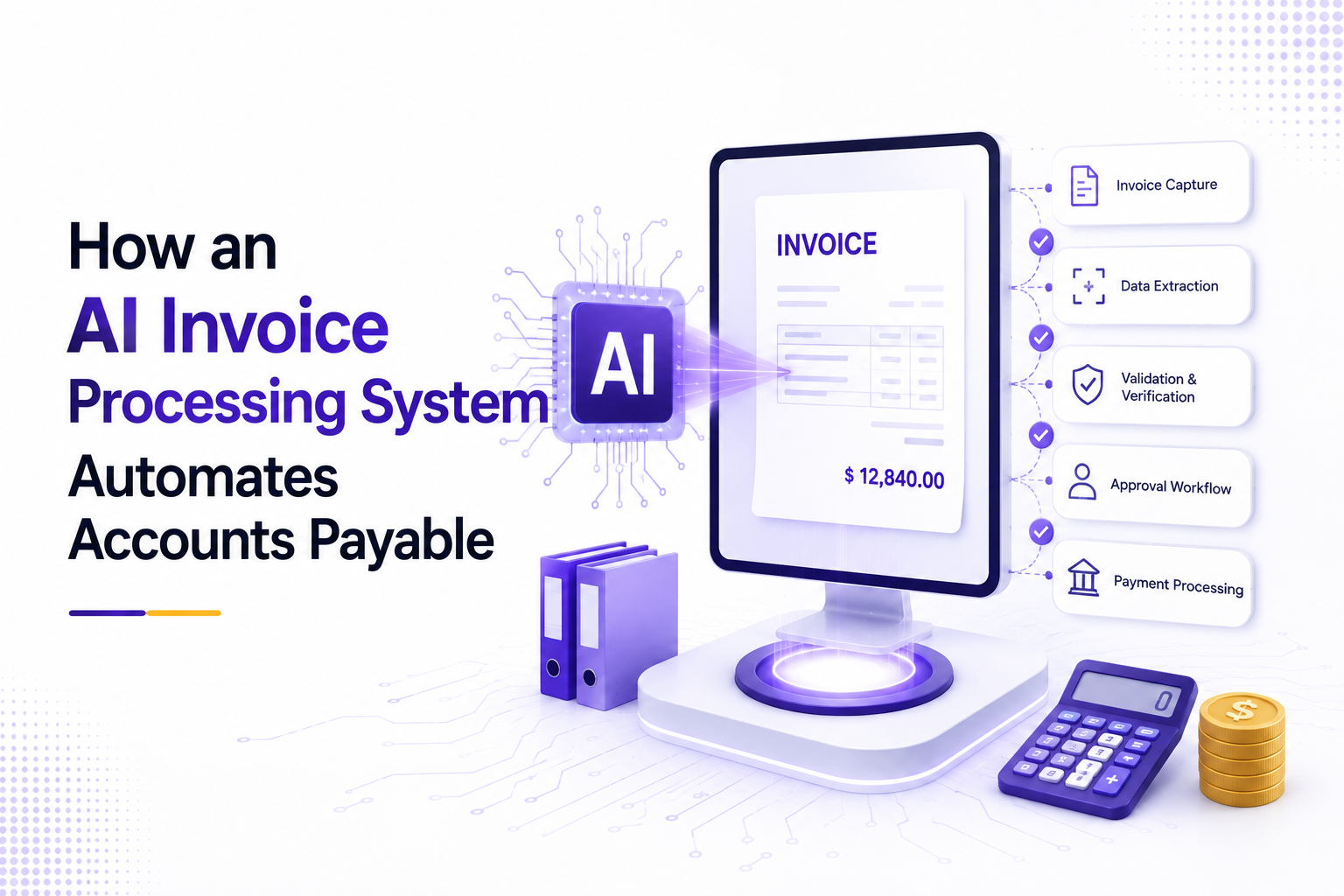

Every finance team has that one person who somehow knows exactly which vendor invoice is stuck in someone's inbox, which approval got skipped, and which payment is quietly running late for the third month in a row. That person is usually overworked, and honestly, no company should have to depend on one employee's memory to keep accounts payable functioning. This is precisely the gap that an AI invoice processing system is designed to close.
For years, accounts payable was treated as a back office chore, something to survive rather than improve. That thinking does not hold up anymore. Invoice volumes keep climbing, vendors expect faster payments, and finance leaders are under real pressure to close the books quicker while keeping headcount lean. In 2026, more CEOs and founders are looking seriously at AI invoice automation, not as a nice to have, but as a way to protect margins and free up their finance team for work that actually needs a human brain.
This guide walks through what an AI invoice processing system actually does, how the automation works behind the scenes, what kind of business impact you can realistically expect, and what to look for if you are evaluating AI invoice processing system development companies to build or customize one for your organization. No jargon, no fluff, just what a decision maker needs to know before committing budget to this.
One thing worth clarifying up front is that this is not really a technology decision. It behaves more like an operations decision that happens to run on software. The finance team still sets the rules, still owns the vendor relationships, and still makes the judgment calls on anything unusual. What changes is where their time and attention go, away from repetitive data entry and toward the parts of the job that actually require a person to think.
What Is an AI Invoice Processing System, Really?
At its core, an AI invoice processing system is software that reads incoming invoices the way a trained accounts payable clerk would, except it does it in seconds and never gets tired or distracted. It can pull invoices from email inboxes, shared drives, supplier portals, or scanned paper, and then extract the details that matter such as vendor name, invoice number, line items, tax amounts, and due dates.
This is different from the older optical character recognition tools many companies already tried and abandoned. Basic OCR just converts an image into text. It does not understand context, it cannot tell the difference between a subtotal and a shipping charge, and it breaks the moment a vendor changes their invoice template. A true AI invoice processing system uses machine learning models that keep learning from every document they process, so accuracy actually improves over time instead of staying static.
The system also does not stop at reading the invoice. It checks the extracted data against purchase orders and receiving records, flags anything unusual, routes the invoice to the right approver based on your company's rules, and prepares the payment once everything checks out. In other words, it manages the full life cycle of an invoice from arrival to payment, not just the data entry piece.
How AI Invoice Automation Actually Works, Step by Step
It helps to break down AI invoice automation into the stages it actually goes through, because most of the confusion around this technology comes from people picturing one giant black box rather than a series of logical steps.
The first stage is capture. The system pulls in invoices from every channel your vendors actually use, whether that is a PDF attached to an email, a paper invoice scanned at the mailroom, or a file dropped into a vendor portal. Good systems handle all of these without forcing your suppliers to change how they send you paperwork.
The second stage is extraction. This is where machine learning models identify and pull out the specific data fields, vendor details, invoice date, amounts, tax codes, and line item descriptions. Modern systems handle multiple languages and currencies here as well, which matters a great deal if you work with international suppliers.
The third stage is validation and matching. The system compares what it extracted against your purchase order and, where relevant, the goods receipt note. This is often called two-way or three-way matching, and it is where discrepancies get caught automatically instead of showing up as a surprise during month end close.
The fourth stage is exception handling. Not every invoice is straightforward. Some arrive without a matching purchase order, some have pricing that does not line up, and some come from a vendor the system has never seen before. Rather than blocking the whole process, a well built system flags only these specific cases for a human to review, while everything else keeps moving.
The fifth stage is approval routing. Based on rules you define, such as amount thresholds or department budgets, invoices get sent to the correct approver automatically, with reminders sent if someone is sitting on an approval too long.
The final stage is payment scheduling and reconciliation. Once approved, the invoice is queued for payment according to agreed terms, and the transaction is automatically reconciled against your accounting ledger, closing the loop without anyone needing to manually update a spreadsheet.
Why 2026 Is the Year More Companies Are Making the Switch
Accounts payable automation is not a new idea, but a few things have changed recently that are pushing more founders and finance leaders to act now rather than keep putting it off.
Finance teams have gotten leaner, not because companies want to cut corners, but because hiring has slowed and existing staff are already stretched across more responsibilities than a typical accounts payable clerk handled five years ago. Manual invoice processing simply does not scale well with a smaller team, and the cost of that gap shows up as late payment penalties, missed early payment discounts, and burned out employees.
At the same time, vendors have gotten less patient. Smaller suppliers in particular often depend on being paid on time to manage their own cash flow, and slow, manual accounts payable processes damage those relationships in ways that are hard to see until a key vendor starts deprioritizing your orders.
Fraud has also become a sharper concern. Invoice fraud, including fake vendor setups and altered bank details, has grown more sophisticated, and manual review alone is no longer a reliable defense. An AI invoice processing system can flag anomalies such as a sudden change in a vendor's bank account or duplicate invoice numbers far faster and more consistently than a person scanning invoices between other tasks.
None of this means manual accounts payable is impossible in 2026. It means the cost of staying manual, in time, in errors, and in risk, has quietly gotten a lot higher than most founders realize until they actually sit down and calculate it.
Core Capabilities Worth Looking For
Not every tool marketed as AI-powered actually delivers meaningful automation. When you are evaluating options, a few capabilities separate the systems that genuinely change how your accounts payable team works from the ones that just add a thin AI label to an old workflow tool.
Multi-format capture matters because your vendors will never all send invoices the same way, no matter how much you wish they would. The system needs to handle PDFs, images, structured e-invoices, and even paper scans without forcing manual reformatting.
Line item level extraction is important for any company dealing with detailed purchase orders, since matching at the summary level alone misses discrepancies buried in individual charges.
Duplicate and fraud detection should run automatically in the background, checking new invoices against historical data and flagging anything that looks off, such as a repeated invoice number or a payment routed to a newly changed bank account.
Multi-currency and multi-entity support is essential if you operate across borders or manage several subsidiaries, since manual currency conversion and entity-level reporting is one of the most error-prone parts of traditional accounts payable.
Integration with your existing accounting or ERP software is non-negotiable. A system that cannot connect cleanly with tools like QuickBooks, NetSuite, SAP, or Xero will create more manual work than it saves, because someone will end up rekeying data anyway.
Finally, look for a clear audit trail and analytics dashboard. Beyond compliance, this gives finance leaders visibility into cycle times, approval bottlenecks, and spend patterns that were previously buried in spreadsheets nobody had time to build.
The Real Business Impact: What Changes on the Ground
It is easy to talk about automation in abstract terms, so it helps to walk through what actually changes for a company after adopting AI invoice automation.
The most immediate shift is time. Staff who previously spent hours each week keying in invoice data and chasing approvals get that time back, and most companies redirect it toward vendor negotiations, cash flow forecasting, and spend analysis, work that genuinely benefits from human judgment.
Error rates drop noticeably, since manual data entry is one of the most common sources of accounts payable mistakes, from transposed numbers to duplicate payments. Fewer errors also means fewer awkward conversations with vendors about incorrect payments.
Days payable outstanding tends to shorten because invoices move through approval faster, which in turn opens the door to early payment discounts that many companies leave on the table simply because manual processing was too slow to capture them in time.
Month end close also gets faster, since reconciliation happens continuously rather than being crammed into the last few days of the month. This is one of the less obvious benefits, but finance leaders who have gone through it consistently mention it as one of the biggest quality of life improvements.
There is also a softer, harder to measure benefit around vendor relationships. Suppliers notice when they are paid consistently and on time, and that reliability often translates into better terms, priority during supply shortages, and simply smoother working relationships over the long term.
Visibility improves in a way that is easy to underestimate until you have it. Finance leaders using an AI invoice processing system can typically see, at any point during the month, exactly how much is outstanding, which invoices are pending approval, and which vendors are owed what, instead of waiting for a manual report to be pulled together right before a board meeting. That kind of real-time visibility changes how confidently a founder can answer cash flow questions on short notice.
There is also a compounding effect worth mentioning. The savings from reduced errors, faster processing, and captured early payment discounts tend to grow as invoice volume grows, since manual processes get proportionally more expensive and more error-prone as a company scales, while an automated system handles higher volume with very little added cost. This is part of why many finance leaders describe the return on this kind of investment as improving over time rather than staying flat.
Where AI Invoice Automation Still Has Limits
It would not be honest to present this as a technology without tradeoffs, and a good vendor or development partner should be upfront about the limitations too.
Data quality still matters enormously. If your purchase order data is messy or your vendor master list is outdated, an AI invoice processing system will surface those problems rather than magically fix them. In practice, this often means a cleanup effort is needed before rollout, which some companies underestimate when budgeting a project timeline.
Exception handling still needs a human in the loop. Highly unusual invoices, disputes, or one-off vendor arrangements will always require judgment calls that the system is not meant to make on its own, and that is by design rather than a flaw.
Integration with older, heavily customized ERP systems can take longer than expected, particularly for companies running legacy software that was never built with modern APIs in mind. This is one of the areas where the experience of your implementation partner makes a real difference.
Change management is often underestimated as well. Even the best system will face resistance if the accounts payable team was not involved early in the process, since they are the ones who know the day-to-day exceptions that a system needs to be configured around.
How to Choose the Right AI Invoice Processing System Development Companies
For founders who need a solution tailored to their existing workflows rather than a rigid off-the-shelf tool, working with one of the specialized AI invoice processing system development companies is usually the more practical route. A few criteria genuinely matter when comparing options.
Domain experience is the first thing to check. A development team that has already built finance or ERP adjacent products understands the nuances of accounting rules, tax handling, and audit requirements far better than a generalist software team learning on your project.
Security and compliance credentials deserve real scrutiny, not a quick glance. Since invoice data includes sensitive financial and banking information, ask directly about data encryption standards, access controls, and relevant certifications such as SOC 2 or ISO 27001, and get specific answers rather than marketing language.
Integration capability is another practical filter. Ask any AI invoice processing system development companies you shortlist for concrete examples of past integrations with the accounting or ERP platform you already use, since generic claims about API flexibility rarely hold up once real implementation begins.
Customization depth matters too. Every company has its own approval hierarchy, budget rules, and vendor relationships, so the development partner should be able to configure workflows around your business rather than asking you to change how you operate to fit their template.
Finally, look closely at the support model after launch. Accounts payable software is not something you set up once and forget. Vendor formats change, tax rules get updated, and new entities get added, so ongoing support and a clear pricing structure for future changes should be part of the conversation from day one, not an afterthought discovered later.
It is also worth asking how a prospective partner approaches the initial data cleanup phase, since this is frequently where projects slow down. A development team with real experience in this space will usually have a structured process for auditing your existing vendor and purchase order data before writing a single line of integration code, rather than discovering data quality issues midway through the build. Companies that skip this conversation with AI invoice processing system development companies during the evaluation stage often end up with a longer and more expensive rollout than originally quoted.
Pricing structure deserves the same scrutiny as the technical questions. Some development partners charge a flat project fee, others use a subscription model tied to invoice volume, and some blend the two with a smaller upfront build cost plus ongoing maintenance. None of these models is inherently better, but you should understand exactly what is included, what counts as a change request versus standard support, and how pricing scales as your invoice volume grows, before signing anything.
Signs Your Company Is Ready for This Now
Not every business needs to rush into automation immediately, but a few patterns tend to show up consistently in companies that end up regretting waiting too long.
If your accounts payable process depends heavily on one or two people who happen to remember which vendor invoices are pending, which purchase orders are still open, and which approvals are stuck, that is a fragility risk as much as an efficiency problem. The moment that person goes on leave or leaves the company, invoice processing tends to fall apart quietly, often for weeks before leadership even notices.
Growing invoice volume is another clear signal. Many founders first consider an AI invoice processing system after a period of rapid growth, when the number of vendors, purchase orders, and monthly invoices has doubled or tripled but the finance team has not grown at the same pace. Manual processes that worked fine at fifty invoices a month tend to break down completely at five hundred.
A rising number of late payment penalties or missed early payment discounts is also worth tracking closely, since these costs are easy to overlook individually but add up meaningfully over a full year. If your finance team cannot quickly tell you how much was lost to late fees last quarter, that is usually a sign the current process is not giving anyone real visibility.
Finally, if your company is preparing for an audit, a funding round, or an acquisition, having clean, automated, well documented accounts payable records tends to matter more than most founders expect. Investors and auditors notice when financial processes look organized, and AI invoice automation tends to produce exactly the kind of audit trail that makes due diligence smoother.
Common Mistakes Companies Make When Adopting This Technology
A number of accounts payable automation projects underdeliver, and it is rarely because the underlying technology failed. It is usually because of a handful of avoidable planning mistakes.
The first mistake is skipping data cleanup before rollout. Feeding an AI invoice processing system an outdated vendor master list or inconsistent purchase order records sets the project up for a rocky start, since the system ends up flagging far more exceptions than necessary simply because the underlying data was never in good shape to begin with.
The second is trying to automate everything at once instead of starting with a focused pilot. Companies that attempt a full switch across every vendor and department in one go tend to hit more friction, because there is no smaller batch of results to learn from before scaling up.
The third mistake is leaving the accounts payable team out of the planning process. The people who process invoices every day usually know exactly which exceptions come up most often, which vendors are difficult, and which internal approval steps genuinely add value versus which ones are just legacy habit. Involving them early leads to a much better configured system.
The fourth is underestimating the importance of the implementation partner's post launch support. A system that works well on day one but has no clear path for updates as vendor formats or tax rules change will slowly become less reliable over time, which defeats the purpose of automating in the first place.
Avoiding these four mistakes alone accounts for most of the difference between companies that see strong results from AI invoice automation within a few months and companies that end up disappointed with a project that technically works but never gets adopted properly.
A Realistic Implementation Roadmap for 2026
Founders often ask how long this actually takes, and the honest answer depends on complexity, but a typical rollout follows a recognizable pattern.
The first two to three weeks usually go toward discovery, mapping your current accounts payable workflow, identifying every vendor format you receive, and cleaning up purchase order and vendor master data that will feed the new system.
The next several weeks focus on integration and configuration, connecting the AI invoice processing system to your accounting software, setting up approval hierarchies, and training the extraction models on samples of your actual invoices rather than generic templates.
A pilot phase typically follows, running the system alongside your existing manual process for a set number of weeks so your team can compare results and build trust in the automation before fully switching over.
Once the pilot proves reliable, a full rollout follows, along with a short adjustment period where exception rules get refined based on real invoices that did not fit the original assumptions. Most companies find the system needs light tuning for the first month or two before it settles into a steady rhythm.
What Comes Next: AI Invoice Automation Beyond 2026
Looking slightly further ahead, the direction of this technology is moving from simple automation toward something closer to an active finance assistant. Early versions of agentic tools are already able to flag a pricing discrepancy and draft a query to the vendor automatically, rather than just routing it to a human for review.
Predictive cash flow forecasting is another area gaining traction, where the system does not just process invoices but also projects upcoming payment obligations against expected receivables, giving founders a clearer real-time picture of cash position rather than a static monthly snapshot.
Cross network fraud detection is also improving, where patterns flagged across one company's invoice data can help identify emerging fraud tactics before they show up elsewhere, similar to how fraud detection works in the payments industry more broadly.
None of this replaces the finance team. It simply keeps pushing more of the repetitive, error-prone work off their plate, which has been the entire point of AI invoice automation from the start.
Final Thoughts
There is a version of this article that ends by telling you automation is inevitable and you should adopt it immediately. That is not particularly useful advice on its own. What matters more is being honest about the tradeoff: an AI invoice processing system takes real setup effort, clean data, and a bit of patience during rollout, but the alternative is quietly accepting hours of manual work, avoidable errors, and missed early payment discounts as permanent costs of doing business.
If your accounts payable process still depends on one person's inbox and memory to run smoothly, that is usually the clearest signal that it is time to look into this seriously. Start by mapping your current invoice volume and pain points, then talk to a development partner who can show you, not just tell you, how the system would actually handle your specific vendor mix and approval structure. That conversation alone tends to make the decision a lot clearer than any comparison chart could.