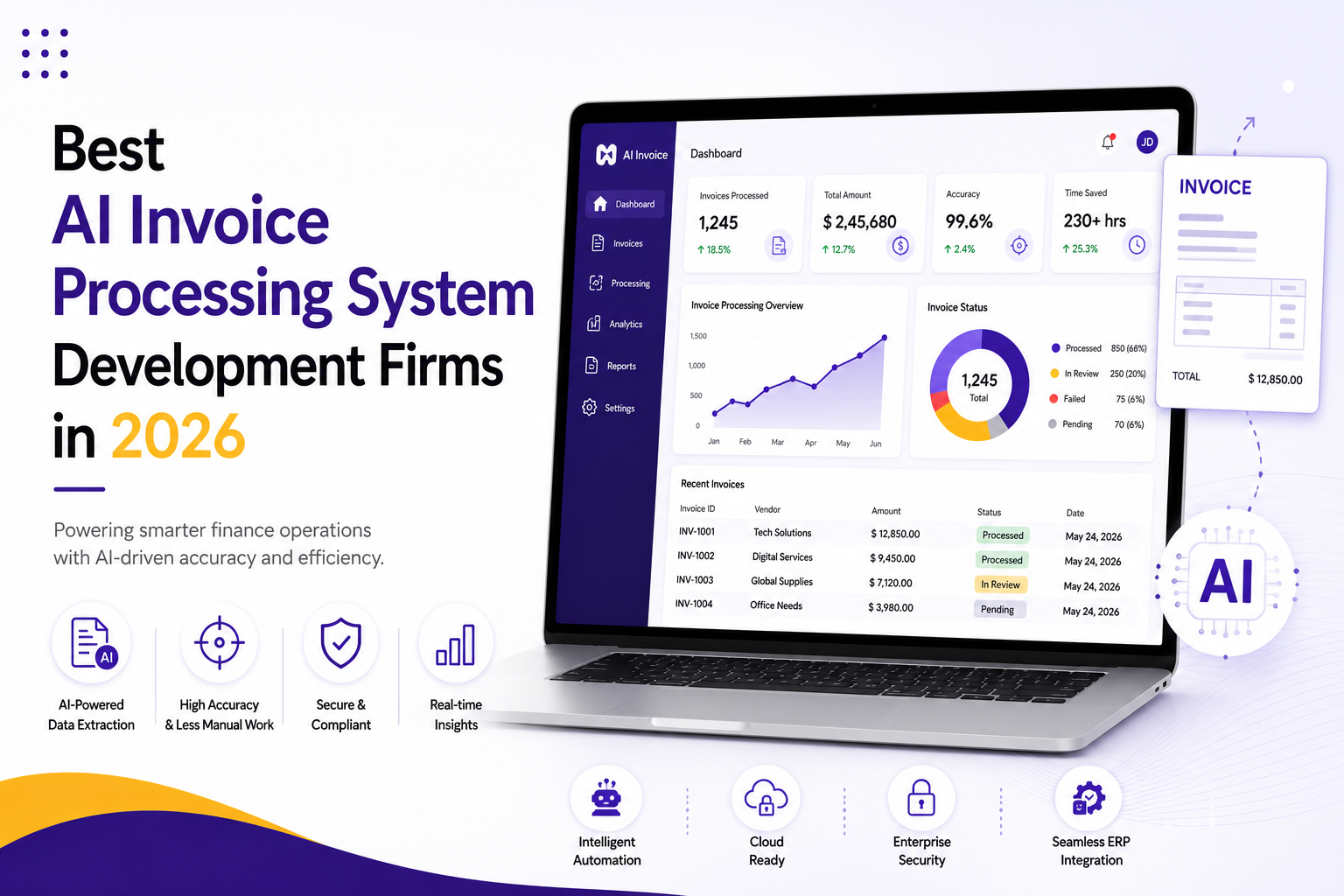

Accounts payable teams still lose entire days every month chasing PDFs sitting unread in a shared inbox, correcting mismatched purchase orders and typing line items into spreadsheets that someone will eventually have to double check. A 2025 Ardent Partners report puts a number on that pain. Manual invoice processing costs businesses close to $15.97 per invoice, while a properly automated setup brings that figure down to around $2.36. For a company handling 1,000 invoices a month, that gap alone is worth more than $163,000 a year. That is exactly why demand for a well built AI Invoice Processing System has grown so quickly through 2026.
Picking the right development partner for this kind of project is a different exercise than subscribing to off the shelf software. You are trusting a team to understand OCR accuracy, three way matching, ERP integrations and fraud checks, while still keeping the interface simple enough for your finance team to use every single day without a training manual. Choose the wrong partner and you end up with something that looks polished in a sales demo but breaks the moment a vendor sends an invoice in an unfamiliar layout or a new currency shows up mid batch.
This guide covers what has actually changed in invoice automation this year and then lists 25 development firms worth shortlisting, along with what each one does well and the type of business it tends to suit best. The goal is to save you the weeks that usually disappear into discovery calls, so you can start conversations with firms that already fit your situation.
What Changed in Invoice Automation This Year
Two years ago, most invoice tools were still built around rigid templates that broke the moment a vendor tweaked their layout or swapped a table format for a plain line item list. That rigidity has mostly disappeared. Modern platforms rely on large language models that read an invoice closer to how a person would, understanding context instead of matching fixed coordinates. A well designed AI invoice processing system now handles PDFs, scanned paper, forwarded emails and multi currency formats with far less manual correction, and vendors no longer need to follow a specific template for the system to read it correctly.
The other shift is depth. Businesses stopped being satisfied with a tool that only extracts data and drops it into a spreadsheet for someone else to review. Finance leaders now expect the system to code entries to the right general ledger account, match invoices against purchase orders and receipts automatically, flag duplicate or suspicious billing patterns, and route approvals based on rules that reflect how their organization actually works. Industry benchmarks from mid 2026 show that exception rates on fully automated setups have fallen to around 5.4%, down from over 22% on manual processes, and processing time has dropped from roughly 10 days to about 3 days per invoice. Firms that can build toward those numbers, rather than just promise OCR extraction, are the ones worth the shortlist below.
Compliance has also moved from an afterthought to a design requirement. With SOX guidance updates and PCAOB standards taking effect through late 2026, finance teams increasingly need a system that can explain why an invoice was approved or flagged, not just report that it was. That is pushing several vendors toward audit trails that log the exact rule or reasoning behind every decision, which matters far more during an external audit than a system that simply produces the right number without showing its work.
What to Check Before You Sign With Any Firm
Most sales calls in this space follow the same script. A vendor shows a clean demo invoice, the extraction works perfectly, and the conversation moves straight to pricing. The problem is that a clean demo invoice tells you almost nothing about how a firm will handle your actual invoice volume, which includes handwritten notes, scanned copies with a coffee ring in the corner and vendors who still send line items as a paragraph of text instead of a table. Before signing anything, ask to see the system work on a batch of your own recent invoices, not a curated sample the vendor has already tuned for.
It also helps to separate two very different kinds of firms early in the process. Some are software companies selling a subscription to a platform they built once and now maintain for thousands of customers. Others are development firms that will build or heavily customize a system specifically around your workflow. Neither approach is automatically better. A subscription platform is usually faster to deploy and cheaper at low volume, while a custom build takes longer but can match unusual approval structures or industry specific compliance rules that a general purpose platform was never designed to handle.
Every firm below is described with the information CEOs and finance leaders actually look for before a first call: what they specialize in, who they typically build for, how engagements are usually priced and where they are headquartered. Company order does not reflect ranking, and the list intentionally mixes dedicated development firms with established software platforms so you can compare both paths side by side.
The 25 Firms Worth Shortlisting
1. HireAIDevelopers
HireAIDevelopers builds custom AI Invoice Processing System pipelines around large language models rather than off the shelf OCR, which suits companies with unusual invoice formats or industry specific line item structures. Their teams typically work closely with in house finance staff during the training phase so the model actually reflects how the business codes expenses, and most engagements include a dedicated tuning period once the system is live in production.
2. Tipalti
Tipalti is built for companies paying suppliers across 196 countries in more than 120 currencies, with an intelligent purchase approval engine that matches invoices to purchase orders and supports parallel approvals. It suits adtech, e-commerce and financial services companies that need automated tax compliance built in rather than bolted on.
3. Backend Development Company
Backend Development Company focuses on the plumbing most vendors skip, building direct API connections between invoice capture and whatever ERP or accounting stack a business already runs. This makes them a strong fit for companies that already have finance tooling in place and simply need automation wired into it cleanly, without a lengthy platform migration in between.
4. Rillion
Rillion combines AI native invoice capture, claiming over 95% first pass accuracy, with three way PO matching and an in app assistant called Riley that answers questions about invoices and suppliers directly. It is best suited to mid market companies running 24,000 or more invoices annually across several entities or locations.
5. DataEximIT
DataEximIT works on larger, more structurally complex builds, often layering an AI Invoice Processing System into a broader accounts payable or ERP modernization project rather than delivering it as a standalone tool. Their strength is handling legacy system integration without forcing a business to rip out what already works, which matters for finance teams that have spent years customizing an existing ERP setup.
6. Stampli
Stampli centralizes invoice related conversations and approvals in a single interface, cutting down on scattered email threads during the review process. Its AI engine, known as Billy the Bot, reaches touchless processing rates of 70 to 80% after about 90 days of training on a company's own invoice history.
7. HireFullStackDeveloperIndia
HireFullStackDeveloperIndia builds the full stack around invoice automation, covering the extraction backend, approval workflows and the finance facing dashboard in a single engagement. This full ownership approach suits founders who want one team accountable for the entire project rather than coordinating multiple vendors.
8. Medius
Medius is built around a single metric, the touchless rate, and its dashboards make that number visible so finance teams can see exactly where manual work still creeps in. Its AI also analyzes every invoice for potential fraud, automatically flagging billing patterns that fall outside a supplier's normal history.
9. Rossum
Rossum pairs AI extraction with a review interface that only surfaces the fields the system is genuinely uncertain about, which keeps manual correction time low without removing human oversight entirely. It claims a 96% average accuracy rate without templates and works well for AP teams that want visible control over the learning process.
10. WebClues Infotech
WebClues Infotech tends to serve smaller finance teams that need a working AI invoice processing system in weeks rather than months, prioritizing a lean build over a long feature list. Their post launch support model is a common reason SMBs choose them over larger enterprise vendors, and pricing conversations tend to be more straightforward given the smaller scope of most engagements.
11. Nanonets
Nanonets appeals to technical buyers because of its API first approach to building bespoke extraction models rather than a fixed interface. Out of the box accuracy sits around 93 to 96%, improving to 98% or higher once the model is trained on a company's own invoice formats.
12. ABBYY
ABBYY has one of the longest track records in document intelligence and now documents field extraction accuracy of 99.5% on structured invoices and above 97% on semi structured formats. It suits enterprises that prioritize measurable extraction accuracy above almost everything else in a vendor evaluation.
13. HighRadius
HighRadius runs more than 24 AI agents across capture, coding, matching, approval and payment, and its touchless processing rate is among the highest documented in the enterprise segment. It integrates deeply with SAP and Oracle, though it is really built for companies well into nine figures of revenue.
14. Kognitos
Kognitos takes a neurosymbolic approach where processing logic is written and executed in plain English, and every decision is logged with the exact rule applied and the reasoning behind it. That audit trail maps to SOX and PCAOB requirements, making it a strong fit for enterprises facing heavy compliance scrutiny.
15. ChatFin
ChatFin treats invoice processing as one piece of a wider finance automation platform, connecting capture and coding to cash flow forecasting and reporting under a single data model. CFOs who want to eventually automate beyond accounts payable often prefer this over stitching together several point solutions.
16. Quadient
Quadient AP Automation sits in the gap between lightweight SMB tools and heavyweight enterprise platforms, offering three way PO matching and multi step approval routing without enterprise level pricing. It integrates with Sage, Acumatica and QuickBooks, which makes it a practical pick for growing mid market finance teams.
17. BILL
BILL runs its AI on more than 1.3 billion processed documents and over $1 trillion in transactions, which gives its extraction models an unusually large training base. Its published pricing and built in vendor network make it easier for growing companies to budget without a lengthy sales negotiation.
18. Docspire
Docspire cross checks every invoice against purchase order details, vendor master files and historical patterns rather than relying on extraction alone, which pushes straight through processing rates above 95%. It works well for organizations with more than 100 active suppliers where vendor level nuance matters.
19. Lido
Lido claims 99.9% extraction accuracy on scans without any templates or per vendor configuration, and setup usually takes minutes rather than weeks. It is built purely for capture and structured export, so teams that also need approval routing or payment execution typically pair it with a second tool.
20. Basware
Basware is built for organizations processing 50,000 or more invoices a year, with strong multi entity and multi currency support across the full procure to pay cycle. Implementation timelines are measured in months, so it fits enterprises with dedicated finance operations staff rather than lean teams.
21. Coupa
Coupa positions invoice automation as part of a broader spend management suite covering procurement, expenses and supplier risk in one place. Companies that want visibility across total spend, not just accounts payable, tend to choose Coupa over a standalone invoice tool.
22. AppZen
AppZen leans on historical invoice data from a company's specific vendors to improve line item accuracy through supervised learning loops over time. It is a common pairing for finance teams that already have an approval workflow tool and specifically need stronger extraction underneath it.
23. Automation Anywhere
Automation Anywhere extends existing robotic process automation bots with intelligent document parsing rather than replacing them, which suits organizations that already run RPA for other finance tasks. Touchless rates range from 60 to 75% depending on invoice complexity, performing best on high volume repetitive formats.
24. Order.co
Order.co connects purchasing and invoice approval into a single workflow, so a purchase order and its matching invoice never live in separate systems. Operations heavy businesses managing purchasing across several departments tend to get the most value from this combined approach.
25. Tailride
Tailride is built around the reality that most small business invoices arrive by email, so it captures data directly from the inbox rather than requiring uploads to a separate portal. It suits accounting firms and small businesses that want automation without adopting an entirely new workflow.
How to Actually Choose Between These Firms
Once you have a shortlist, the decision usually comes down to three practical questions rather than a feature checklist. First, does the firm have experience with your specific ERP or accounting stack, because a system that reads invoices perfectly but cannot post entries into NetSuite or SAP without manual work has only solved half the problem. Second, what does their exception handling actually look like, since industry data shows that the last 15 to 25% of invoices, the ones with unusual formats or missing fields, are where most of the real cost still sits. A vendor that only demos the easy cases has not solved invoice automation, they have solved the easy part of it.
Third, ask how the AI Invoice Processing System handles fraud and duplicate detection, and ask for a specific example rather than a marketing claim. Firms that can walk you through a real flagged invoice, what triggered the flag and how it was resolved, are usually the ones with a system that has actually been tested against messy, real world data rather than a clean demo dataset.
It is also worth asking directly about ownership of the data and the model. Some platforms use your invoice history to improve extraction across their entire customer base, which can be perfectly fine, but you should know whether that is happening and whether it affects data residency requirements if your business operates in a regulated industry. Development firms building a custom system usually give you full ownership of the trained model by default, while subscription platforms vary widely on this point and rarely mention it unless you ask directly during the sales process.
Finally, price the engagement over a full year rather than the first invoice or the first month. A tool with a low monthly fee but a per page overage charge can end up costing more than a flat enterprise contract once your volume grows past the plan you originally signed up for. Ask every firm on your shortlist for a projected annual cost at your expected volume twelve months from now, not just today's number, so you are comparing firms on the same basis rather than on introductory pricing.
Where This Leaves You
There is no single best firm on this list because the right choice depends entirely on your invoice volume, your existing tech stack and how much of the process you want to hand off versus keep visible in house. A company processing a few hundred invoices a month has very different needs from one running multiple entities across several currencies, and the firms above cover that entire range on purpose.
What matters most is starting the conversation with a firm whose specialization already matches your situation, instead of spending weeks explaining your requirements to a vendor that was never really built for them. Use the profiles above as a starting shortlist, ask each firm the questions covered in the previous section, and you will get a far clearer picture in two or three calls than most companies get after a month of scattered research.
The businesses that get the most out of this shift in 2026 are not necessarily the largest ones. They are the ones that treat vendor selection with the same discipline they would apply to hiring a senior finance hire, checking references, asking for a live test on real data and pricing the relationship honestly over a full year rather than a promotional first quarter. Do that, and an AI Invoice Processing System stops being a line item on a software budget and starts being the reason your finance team spends its time on decisions instead of data entry.