
Introduction
Running a business on spreadsheets, disconnected software, and manual month-end reports is expensive in ways most companies don't fully calculate until a bad quarter forces the question. An AI ERP system fixes that by putting one connected, intelligent engine behind every department instead of five teams working off five different versions of the truth.
The numbers back this up. The global ERP software market is projected to reach $106.22 billion in 2026 and climb to $281.58 billion by 2034, according to Fortune Business Insights, and a growing share of that spending is going toward AI-powered platforms rather than the legacy systems many businesses have leaned on for over a decade.
If you're a CEO or founder trying to work out whether an AI ERP system is worth the investment, or how to even start comparing vendors, this guide walks through what it actually does, what it costs, and how to choose the right team to build it, without the jargon.
This isn't a list of features copied from a vendor brochure. It's the questions a decision-maker actually needs answered before signing a contract: what changes on the ground, what it costs to get there, what typically goes wrong, and how to tell a serious development partner from one that will hand you a generic template with an AI logo stuck on top.
What Is an AI ERP System?
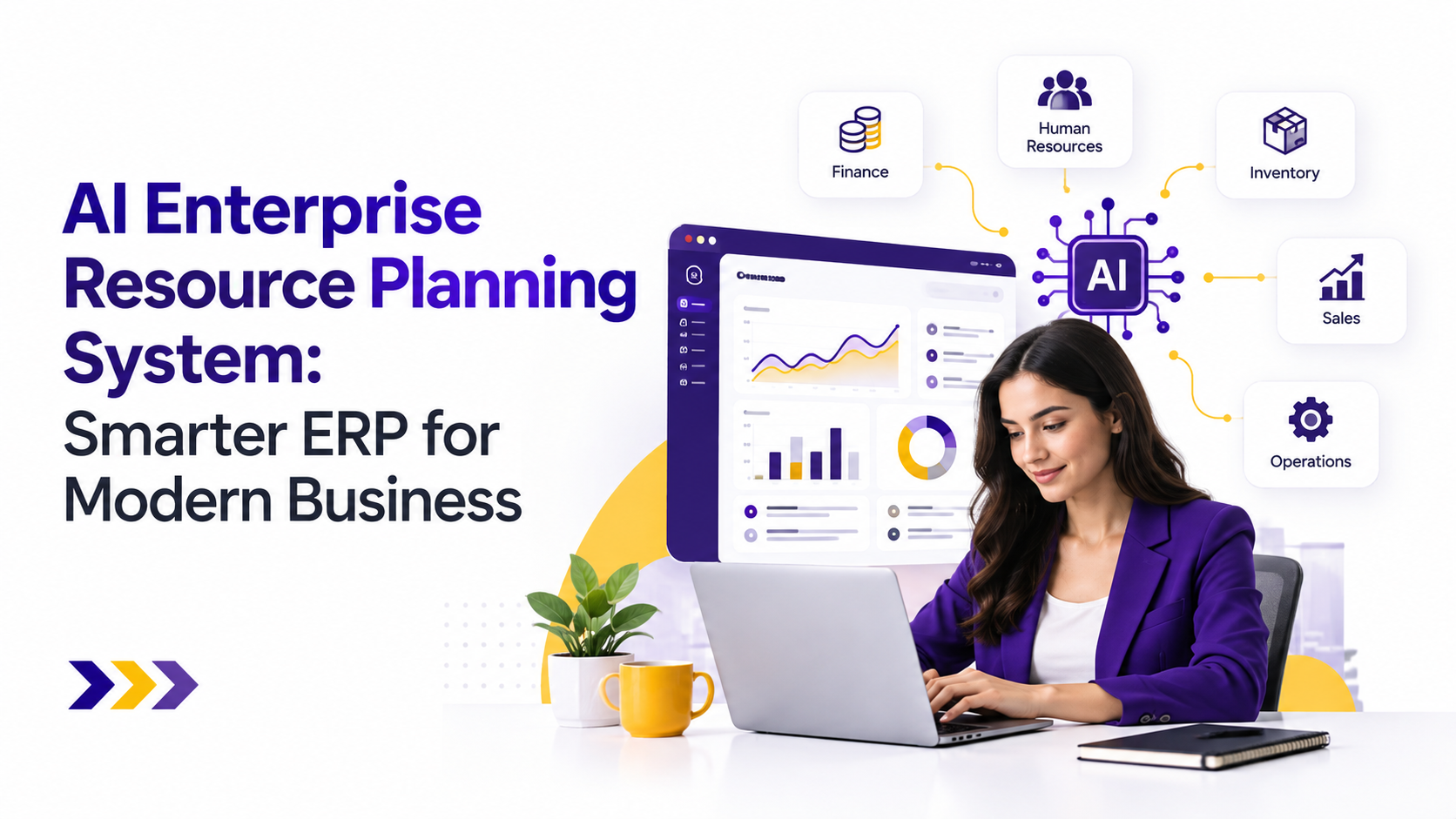
An ERP system, short for Enterprise Resource Planning, is the software that ties together finance, inventory, HR, sales, and supply chain into one shared database. Instead of five departments working off five different spreadsheets, everyone works off the same numbers.
An AI ERP system takes that same foundation and adds a layer of intelligence on top. Instead of just storing and displaying data, it studies patterns in that data, predicts what's likely to happen next, flags problems before they turn expensive, and automates the repetitive tasks that used to eat up hours of staff time every week.
Think of a traditional ERP as a filing cabinet with excellent organization. An AI enterprise resource planning software is that same filing cabinet, except it also reads every file, notices when something looks off, and tells you what to do about it before the problem reaches your customers or your balance sheet.
The distinction matters because a lot of software marketed as "AI ERP" is really just a traditional ERP with a chatbot bolted onto the login screen. A genuine AI ERP system has machine learning models woven into the core workflows themselves, not sitting off to the side as an add-on. It should be learning from every invoice processed, every order shipped, and every forecast that turned out right or wrong, and getting sharper as a result. That ongoing learning loop is really the entire point. A system that doesn't improve with use is just a database with a better search bar.
Why Businesses Are Moving to AI ERP in 2026
Adoption isn't slow or experimental anymore. The broader enterprise AI market is expected to grow from $23.9 billion in 2024 to roughly $42 billion in 2026, and Grand View Research projects it will reach $155.2 billion by 2030 as more companies fold artificial intelligence into their core business systems, ERP included.
Cloud-based ERP, which is the delivery model most modern AI ERP system builds run on, is expanding just as fast. Fortune Business Insights values the global cloud ERP market at $76.17 billion in 2026, on its way to $207.59 billion by 2034.
The wider AI market tells a similar story. It crossed $390.9 billion in 2025 and is on track to hit $539.5 billion in 2026, a sign of how much capital and engineering effort is going into making enterprise software genuinely intelligent instead of just digital.
What's driving this shift isn't hype. It's the fact that most mid-sized and large businesses are already generating far more operational data than any human team can realistically review by hand. Sales trends, supplier delays, cash flow patterns, and customer behavior all move fast enough that a monthly or quarterly report is often too late to act on. An AI layer doesn't just summarize that data faster, it watches it continuously and surfaces what actually matters, which is a very different job than traditional reporting was ever built to do.
There's also a labor angle that often gets left out of these conversations. Hiring and retaining skilled operations, finance, and supply chain staff has gotten harder and more expensive across most industries. An AI ERP system doesn't replace that expertise, but it does reduce how much of a skilled employee's time goes into repetitive lookups, manual reconciliations, and chasing down why two reports don't match. That time gets redirected toward the judgment calls only a person can make.
Traditional ERP vs AI ERP System: What Actually Changes
On paper, both systems manage the same departments. In practice, the day-to-day experience is very different.
None of this means a traditional ERP stops working the day you read this. Plenty of businesses run stable operations on systems that have nothing to do with AI. The difference shows up over time, in how quickly problems get caught, how much staff time goes into manual checks, and how confidently leadership can act on the numbers in front of them. Those gaps tend to widen as a company grows, which is why the switch usually becomes urgent right around the point a business scales past the size where a few spreadsheets and a shared drive stop being enough.
Key Features of an AI Enterprise Resource Planning Software
Not every platform marketed as "AI-powered" actually earns the label. Some vendors simply rebrand basic automation rules as "AI" without any real machine learning underneath them, which matters once you're relying on the system's predictions for actual budgeting and staffing decisions. Here's what a genuine AI enterprise resource planning software should include.
• Predictive Analytics: Forecasts demand, cash flow, and inventory needs weeks or months in advance instead of reacting after the fact.
• Intelligent Process Automation: Automates invoice processing, purchase order matching, and approval routing without manual intervention.
• Natural Language Interfaces: Lets staff ask questions in plain language, such as "what were our top-selling products last quarter," and get an instant answer.
• Anomaly and Fraud Detection: Flags unusual transactions, duplicate payments, or irregular spending patterns as they happen.
• Smart Inventory Management: Predicts stockouts and overstocking before they hurt cash flow or customer satisfaction.
• Automated Financial Reporting: Generates compliant reports continuously instead of during a stressful month-end close.
• AI-Assisted Workforce Planning: Helps HR forecast staffing needs and identify attrition risk earlier.
• Automated Vendor and Procurement Scoring: Ranks suppliers on delivery reliability, pricing trends, and quality history so purchasing decisions aren't based on gut feel.
• Multi-Currency and Multi-Location Intelligence: Adjusts forecasts and reporting automatically for businesses operating across regions, currencies, and tax jurisdictions.
A useful way to vet a vendor's claims is to ask them to walk through exactly which of these features live in a current customer's system today, versus which are on a roadmap. "Coming soon" AI features are common in this space, and there's nothing wrong with a phased rollout, but you want to know which one you're actually buying before you sign.
The Business Benefits of Switching to an AI ERP System
The features matter less than what they actually do for the business running them. Here's the practical payoff.
• Lower operational costs: Fewer manual tasks means fewer hours spent on data entry, reconciliation, and error correction.
• Faster decision-making: Leadership gets answers in real time instead of waiting for the next scheduled report.
• Fewer costly mistakes: AI catches data entry errors, duplicate orders, and pricing mismatches before they become customer-facing problems.
• Better customer experience: Accurate inventory and demand forecasting means fewer delays and stockouts.
• Easier scaling: Cloud-based AI ERP systems add users, locations, or modules without a full system overhaul.
• Stronger compliance: Continuous monitoring makes audits and regulatory reporting far less stressful.
Most of these benefits compound rather than stack. Faster decisions lead to better inventory calls, which lead to fewer emergency purchase orders, which lowers cost, which shows up again in the financial reporting the system is already generating in real time. That compounding effect is usually what makes the return on investment look modest in month one and substantial by month twelve.
Which Industries Get the Most Out of an AI ERP System
Every business handles data, but some industries feel the impact of an AI ERP system faster than others simply because their operations generate more moving variables to track.
• Manufacturing: Predictive maintenance and demand forecasting cut both downtime and excess inventory, two of the most expensive line items on a manufacturing balance sheet.
• Retail and e-commerce: Real-time demand signals help avoid both stockouts during peak season and overstock that ties up cash the rest of the year.
• Logistics and distribution: Route optimization and delay prediction reduce fuel costs and improve on-time delivery rates.
• Healthcare organizations: Supply forecasting and compliance reporting reduce the administrative load on staff who should be focused on patient care.
• Professional services: Resource and project forecasting help firms staff engagements accurately instead of over or under-hiring for a given quarter.
If your industry isn't on this list, that doesn't mean an AI ERP system won't help. It usually just means the return on investment takes a little longer to show up in hard numbers, and it is worth asking a potential development partner for examples from businesses closer to your own size and sector before assuming the payback timeline will match what worked for someone else.
The Technology Stack Behind a Modern AI ERP System
Most AI ERP systems built today lean on established cloud and AI platforms rather than reinventing infrastructure from scratch. Microsoft's ecosystem, in particular, has become a common backbone for enterprise-grade AI ERP system development companies because it combines cloud hosting, AI models, and business applications under one roof.
• Microsoft Azure: Provides the cloud infrastructure, storage, and scalability the ERP runs on.
• Microsoft Azure AI / Azure OpenAI Service: Powers the predictive and generative capabilities inside the system.
• Microsoft Dynamics 365: A common ERP and CRM framework that many custom AI ERP builds start from or integrate with.
• Microsoft Power Platform (Power BI, Power Automate, Power Apps): Handles dashboards, workflow automation, and low-code extensions.
• Microsoft Copilot: Adds the conversational, natural-language layer inside day-to-day business applications.
If your team already works inside the Microsoft ecosystem, building an AI ERP system on Microsoft's tools usually means a shorter implementation timeline and fewer integration headaches, since the pieces are already designed to work together.
That said, Microsoft isn't the only route. Some businesses build on Google Cloud or AWS instead, particularly if their existing engineering team already has deep experience there, or if they need a specific AI model that performs better for their industry. The right stack depends less on brand recognition and more on what your team already knows how to support, and what your development partner has actually shipped before. Ask any vendor to name the cloud and AI providers they default to, and why, before you commit to an architecture you'll be living with for years.
How to Implement an AI ERP System: Step by Step
1. Audit your current systems: List every tool, spreadsheet, and workaround currently in use so nothing gets missed during migration.
2. Define clear goals and KPIs: Decide what success looks like, whether that's faster reporting, lower error rates, or reduced headcount hours on manual work.
3. Choose a deployment model: Cloud, on-premise, or hybrid, based on your data sensitivity, budget, and existing infrastructure.
4. Select the right development partner: Compare experience, industry knowledge, and post-launch support, not just price.
5. Clean and migrate your data: Poor data quality is the single biggest cause of AI ERP rollouts underperforming.
6. Run a pilot: Test with one department or location before a company-wide rollout.
7. Train your team: AI ERP systems only pay off when staff actually trust and use the recommendations they generate.
8. Monitor and optimize continuously: The AI models improve as they see more of your real business data, so treat the first few months as tuning, not just launch.
Most businesses underestimate step five, data migration, and overestimate how ready their existing records actually are. Duplicate customer entries, outdated product codes, and inconsistent naming conventions are normal in systems that have grown organically over several years. Budgeting real time for cleanup before migration, rather than during it, is one of the more reliable ways to keep a project on schedule.
What to Look for in AI ERP System Development Companies
Picking the right partner determines whether your AI ERP system becomes a genuine growth driver or an expensive shelf project. Here's what separates strong AI ERP system development companies from the rest.
☐ Proven experience with your specific industry, not just ERP in general
☐ Transparent development timelines and milestone-based delivery
☐ In-house AI and machine learning expertise, not only ERP configuration skills
☐ Post-launch support and staff training included in the scope
☐ Clear data security and compliance practices, documented up front
☐ Verifiable case studies or references you can actually check
☐ A modular, flexible architecture that scales as your business grows
The best AI ERP system development companies treat implementation as a partnership rather than a one-time project. They stay involved after go-live to fine-tune the AI models as your business data grows and changes.
It's also worth asking how a prospective partner handles disagreements about scope. Every implementation runs into moments where the original plan doesn't quite fit what the business actually needs, whether that's a module that turns out to be unnecessary or an integration that's more complex than anyone anticipated. A development team that has a clear, documented change-management process will save you weeks of back-and-forth compared to one that handles every adjustment as an informal, undocumented favor.
What Determines the Cost of an AI ERP System
Cost varies widely because so much of it depends on scope. These are the main factors that move the number up or down.
As a rough guide, small businesses adopting a modular, pre-built AI ERP platform can expect setup costs in the low tens of thousands of dollars, with monthly subscription pricing from there. Mid-sized and enterprise deployments involving custom AI model training, deep legacy integrations, and multi-location rollouts run considerably higher, often into six or seven figures depending on scope. Any vendor unwilling to give you a detailed, itemized estimate before the project starts is a red flag worth taking seriously.
Common Challenges and How to Manage Them
It's worth saying plainly that no AI ERP system runs itself perfectly from day one. Expect a settling-in period where the AI's predictions need correction and staff need reminders to actually check the dashboard instead of falling back on old habits. Businesses that treat the first quarter after launch as a tuning phase, rather than expecting instant perfection, tend to get to a stable, trustworthy system faster than those who panic at the first inaccurate forecast.
Where AI ERP Is Headed Next
The technology is still moving quickly, and what counts as a premium feature today is likely to be standard within a couple of years. A few directions worth watching if you're planning a purchase meant to last:
• Agentic AI that can handle multi-step workflows on its own, not just flag issues for a human to resolve
• Deeper generative AI integration for drafting reports, summaries, and forecasts in plain language
• Industry-specific AI ERP modules built for manufacturing, healthcare, or retail rather than one generic template
• Voice and conversational interfaces becoming a standard way to query business data
• Greater emphasis on explainable AI, so leadership can see why the system made a recommendation, which matters for audits and compliance
None of these trends mean you should wait for the "perfect" version before adopting an AI ERP system. Every platform on the market today will look different in three years. Choosing a vendor with a modular architecture and a clear upgrade path matters more than trying to predict exactly which feature will matter most down the line.
Final Thoughts
An AI ERP system isn't about replacing the people running your business, it's about giving them fewer manual tasks and more usable information. The market data makes it clear that adoption is accelerating, and the businesses moving first are already ahead on cost, speed, and decision quality.
If you're evaluating an AI enterprise resource planning software for 2026, treat this as a decision about the next five years of how your business runs, not just a software purchase. Take time to compare vendors, ask direct questions about data security and post-launch support, and choose a partner who understands your industry rather than a one-size-fits-all package.
There is no perfect moment to make this switch, and waiting for one usually just means staying with a slower system for longer than necessary. The businesses that come out ahead over the next few years won't necessarily be the ones with the biggest budgets, they'll be the ones that made a clear-eyed, well-planned decision now instead of putting it off for another budget cycle.