
Ask any operations head what actually slows a company down and very few will say lack of ambition. Most will point to the same quiet culprit, data that lives in five different systems and never quite agrees with itself. Finance closes the books on numbers that procurement has not seen. Warehouse counts do not match what the sales team is promising customers. None of this happens because people are careless. It happens because the software running the business was never built to think, only to store. The result is a business that spends more energy reconciling its own records than actually growing.
That gap is exactly why so many CEOs and founders are now looking to build a proper AI Enterprise Resource Planning System instead of patching together another round of spreadsheets and disconnected tools. The right development partner does not just digitize your operations, it gives them a layer of intelligence that catches problems before they become expensive ones. The challenge is that dozens of firms claim to build this kind of software, and only a handful actually have the engineering depth to pull it off well. This list breaks down 12 firms worth shortlisting in 2026, what each one is genuinely good at, and how to think about picking the right one for your business.
Before jumping into the list, it helps to get clear on what this category of software actually does and why 2026 has become such a pivotal year for adopting it. AI adoption inside ERP platforms has moved past the experimental stage that defined the last few years, and the firms building these systems today are working with far more mature tooling than they had even twelve months ago. That maturity is part of why comparing vendors carefully now, rather than rushing into the first pitch deck that sounds impressive, makes such a meaningful difference to the outcome.
What Is an AI Enterprise Resource Planning System?
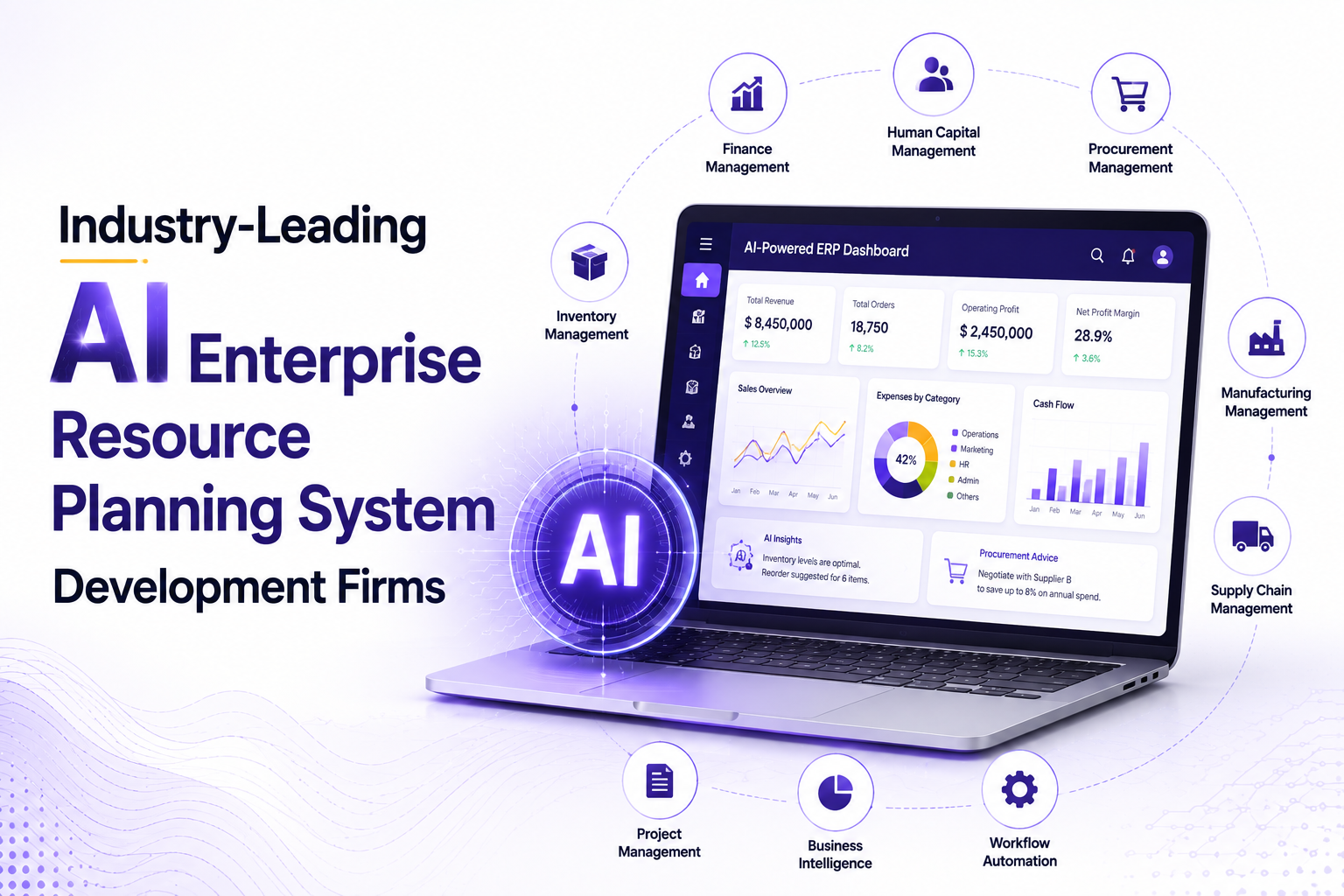
An AI Enterprise Resource Planning System is business software that brings core operations such as finance, inventory, HR, sales, and supply chain into one connected platform. What sets it apart from a traditional ERP is the intelligence layer sitting on top of it. Instead of simply storing and organizing data, it studies patterns in that data, predicts what is likely to happen next, and automates decisions that used to require someone manually working through spreadsheets. Think of it as the difference between a filing cabinet and an assistant who has actually read every file, remembers what happened last quarter, and tells you what to expect next quarter before you even ask.
The technology behind this shift is not new in isolation. Machine learning, predictive analytics, and natural language processing have existed for years. What changed is how affordable and reliable it has become to embed these tools directly into everyday business software, rather than treating them as a separate research project that only large enterprises could justify funding.
What Is It Used For?
- Tracking inventory levels and predicting when stock will run low
- Automating invoicing, payroll, and financial reporting
- Forecasting demand so businesses avoid overstocking or understocking
- Managing HR tasks like onboarding, attendance, and performance reviews
- Spotting unusual patterns in transactions that could signal fraud or errors
- Connecting sales, procurement, and production so every department works from the
same real time data
How Will It Benefit a Business?
In simple terms, it saves time, cuts costs, and removes much of the guesswork that comes with running a company. Manual data entry and repetitive admin work get automated, which means fewer errors and fewer people stuck doing tasks a machine can handle faster. Over time, this frees up staff to focus on judgment calls and relationship building instead of data cleanup.
- Faster decision making, since reports and forecasts update automatically instead of waiting on someone to compile the
- Lower operational costs, because the system catches inefficiencies humans often miss
- Better accuracy in financial and inventory data, which means fewer costly mistakes
- Improved customer experience, since AI can predict demand and keep products or services available when needed
- Scalability, so the system grows with the business instead of needing a complete overhaul every few years
Who Benefits From It?
- Founders and CEOs get a clearer, real time view of the entire business without chasing updates from every department
- Finance teams save hours on manual reconciliation and reporting
- Operations and supply chain managers get accurate forecasts instead of relying on guesswork
- HR departments can automate repetitive admin work and focus more on people, not paperwork
- Growing companies benefit the most, since the system scales with them instead of forcing a switch to new software every time the business expands
Common AI Features Worth Looking For
Not every firm builds the same depth of intelligence into their platform, so it helps to know what to ask for before you start comparing proposals. These are the features that separate a genuinely smart AI Enterprise Resource Planning System from one that simply has AI in its marketing copy, and asking about each one directly during a vendor call tends to reveal a lot about how deep their actual experience runs.
- Demand forecasting that adjusts automatically as seasonal patterns and market conditions shift
- Anomaly detection that flags unusual transactions before they turn into bigger financial problems
- Natural language search so non technical staff can query reports without learning a query language
- Automated document processing for invoices, purchase orders, and shipping paperwork
- Predictive maintenance alerts for businesses running physical equipment or vehicle fleets
12 Industry Leading AI Enterprise Resource Planning System Development Firms
1. Hourly Developers
Hourly Developers built its reputation on a simple idea, clients should only pay for the development hours they actually need, without the overhead that usually comes bundled with agency contracts. That model has made the firm a common starting point for companies exploring a AI Enterprise Resource Planning System for the first time, since it keeps early stage costs predictable while still giving access to senior engineers.
The team works across finance modules, inventory automation, and AI powered forecasting, and typically assigns a dedicated pod rather than rotating developers in and out of a project. Best for founders who want flexible engagement terms and a partner willing to scale the team up or down as the ERP build evolves.
Because they sit near the top of most client shortlists for this category, Hourly Developers also tends to have the most readily available case studies covering different industries, from retail inventory systems to manufacturing production tracking. That range makes it easier for a prospective client to find a comparable past project before committing to a scope of work.
2. ScienceSoft
Few firms on this list have been in business as long as ScienceSoft, and that history shows up in how carefully they approach enterprise builds. Rather than treating AI as a separate add on, the company folds machine learning and predictive analytics directly into the ERP architecture from the earliest planning stages, which reduces the rework that often happens when AI gets bolted on later.
ScienceSoft holds ISO certifications covering data security and quality management, which matters for industries like manufacturing and healthcare that cannot compromise on compliance. Best for established companies replacing an aging legacy ERP system that has grown too rigid to keep up with the business.
They also publish detailed technical breakdowns of their ERP methodology, which gives prospective clients an unusually clear view of how a project will actually be scoped and staffed before any contract is signed. That transparency tends to shorten the vendor evaluation process considerably.
3. Backend Development Company
As the name suggests, this firm lives and breathes backend engineering, which happens to be the part of any AI Enterprise Resource Planning System that determines whether the platform actually holds up under real business load. Their engineers focus heavily on database architecture and the API layers that connect finance, inventory, and HR modules without creating bottlenecks.
Clients often bring them in specifically to harden the backend of an ERP build that a front end focused agency has already started. Best for companies that already have a design partner and need serious backend and data engineering firepower to match.
Their engineers are also comfortable working with existing legacy databases, which means a client does not always need to rebuild historical records from scratch. That skill alone has saved several clients months of otherwise painful data migration work.
4. DataArt
DataArt built its name working with finance, healthcare, and retail clients who cannot afford sloppy data handling, and that discipline carries directly into their ERP work. Their strength is less about flashy AI features and more about getting the underlying data architecture right, which is ultimately what separates a reliable ERP system from one that quietly generates bad numbers.
With thousands of engineers across global delivery centers, DataArt can staff large, multi year ERP programs without the ramp up delays smaller shops face. Best for enterprises in regulated sectors where data governance and audit trails matter as much as the AI capabilities themselves.
They also maintain long standing partnerships with major cloud providers, which gives clients more flexibility when deciding whether an ERP system should run on a single cloud or across a hybrid environment for redundancy.
5. HireFullStackDeveloperIndia
This firm positions itself as a one stop option for companies that want a single team handling both the frontend dashboards and the backend logic of their ERP system. That full stack approach tends to shorten development timelines since there is less back and forth between separate frontend and backend vendors.
Their developers have shipped ERP dashboards with embedded forecasting widgets and automated alert systems, which is often exactly what founders picture when they first imagine an AI powered platform. Best for startups and mid sized businesses that want one accountable team from wireframe to launch.
Pricing tends to sit on the more accessible end for this category, which makes them a common choice for companies testing whether a custom ERP build is worth the investment before scaling into a larger enterprise contract.
6. Simform
Simform's engineering culture leans heavily on cloud infrastructure, which shows in how they approach ERP builds. Instead of designing a system that runs on a single server and hoping it scales later, they architect for cloud elasticity from day one, so the platform can handle a sudden spike in transactions without falling over.
That cloud first mindset also makes their AI integrations easier to update, since models can be swapped or retrained without rebuilding the whole system. Best for companies planning aggressive growth who need an ERP system that will not need a rebuild in two years.
Simform's client list spans healthcare, logistics, and fintech, which means their team has already dealt with the specific compliance headaches those industries bring to an ERP rollout, rather than encountering them for the first time on a client's project.
7. HireAIDevelopers
While many firms on this list treat AI as one feature among many, HireAIDevelopers built its entire practice around it. Their engineers specialize in the machine learning models that actually power forecasting, anomaly detection, and natural language queries inside an ERP system, rather than general purpose software development.
Companies often bring them in specifically to build or improve the AI layer of an ERP platform that another team has already developed. Best for businesses that already have core ERP infrastructure and want to add genuinely useful predictive intelligence on top.
Their team also spends time explaining how each model reaches its predictions, which matters for finance and operations leaders who need to justify automated decisions to auditors or board members rather than simply trusting a black box output.
8. BairesDev
BairesDev operates on a nearshore staffing model, pulling bilingual engineering talent from across the Americas to work in close time zone alignment with US based clients. For an ERP build, that overlap matters more than people expect, since daily standups and quick decisions move faster when teams are not working eight time zones apart.
Their scale also means they can quickly assemble a large team for companies needing to launch an ERP system on a tight deadline. Best for US businesses that want the responsiveness of an in house team without the cost of hiring one directly.
BairesDev has worked with large global brands, which means their processes are built to handle strict security review and procurement requirements that smaller vendors sometimes struggle to satisfy during enterprise sales cycles.
9. Toptal
Toptal works differently from the other firms on this list. Rather than assigning a pre built agency team, it connects businesses with individual freelance engineers who have passed a rigorous screening process, reportedly accepting a small fraction of applicants. For an ERP project, this means hand picking specialists rather than working with whoever happens to be available at an agency.
This model suits companies that already have a clear technical roadmap and internal project management, since Toptal engineers plug into an existing process rather than owning the entire delivery. Best for businesses with strong in house leadership that just need senior individual talent to execute a specific piece of the build.
Rates run higher per hour than a typical outsourced agency, but clients often find that a single senior engineer moves faster than a larger junior heavy team, which can even out the total project cost over time.
10. WebClues Infotech
WebClues Infotech has grown from a general software agency into a firm that regularly handles enterprise grade ERP projects alongside its mobile and web development work. That breadth means they are comfortable connecting an ERP system to customer facing apps, which some more narrowly focused firms struggle with.
Their AI practice covers predictive analytics and automation workflows that plug directly into ERP modules for finance and operations. Best for companies that want their ERP system tightly connected to customer facing products from the same vendor.
WebClues also offers ongoing maintenance packages after launch, which appeals to smaller businesses that do not have an internal IT team ready to take over support once the initial build is complete.
11. Apptunix
Apptunix positions its ERP work around the idea that these platforms should function as centralized business intelligence hubs rather than basic record keeping tools. Their approach leans on automation and cloud technologies to help clients streamline workflows across finance, HR, and supply chain from a single interface.
The firm has built a track record working with both startups and larger enterprises, which gives them range in project size and complexity. Best for businesses that want an ERP partner who treats AI as central to the platform rather than an afterthought.
They also handle the mobile side of enterprise software well, so companies wanting field teams or remote staff to access ERP data through a dedicated app rather than a desktop browser tend to find that capability useful.
12. Techcronus Business Solutions
Techcronus has built its practice specifically around Microsoft Dynamics ERP and CRM systems, which makes them a strong pick for companies that want to build on top of an established enterprise framework rather than starting from scratch. Their team customizes Dynamics 365 environments with AI driven automation and reporting tailored to the client's industry.
They have delivered projects for manufacturing, healthcare, and retail clients, and hold NASSCOM and Microsoft Partner credentials that signal a stable, audited business. Best for companies already using or planning to use Microsoft's ecosystem who want deep Dynamics specific expertise.
Because their specialty is narrower than a general purpose development shop, onboarding tends to move faster since the team is not learning Dynamics architecture on the client's dime.
How to Choose the Right Development Partner
With 12 strong options on the table, the decision usually comes down to three questions. First, does the firm have real experience building the specific modules your business needs, whether that is inventory forecasting, financial automation, or HR workflows. Second, can they show you how their AI actually improves on a standard ERP system rather than just adding a chatbot on top. Third, does their team size and delivery model match your timeline, since a firm built for quick freelance engagements works differently than one built for large, multi year enterprise rollouts. It is also worth asking how each firm handles data ownership and portability, since some vendors make it easier than others to migrate away later if the partnership does not work out.
It also helps to ask every shortlisted firm for a past ERP project you can actually look at, not just a case study summary. A working demo or a reference client conversation will tell you more in twenty minutes than a sales deck will in an hour.
Budget conversations are worth having early too, since the cost of an ERP build swings widely depending on how many modules you need and how much custom AI functionality gets built rather than adapted from an existing framework. Firms that ask detailed questions about your current workflows before quoting a number are usually the ones who end up delivering something that actually fits, while firms that quote instantly off a short call are more likely to underestimate the real scope of the work.
Final Thoughts
There is no single best firm on this list, only the one that fits how your business actually operates. A fast growing startup needs a different kind of partner than a manufacturer replacing a twenty year old legacy system, and being honest about which category you fall into will save months of back and forth during vendor selection.
What matters most is picking a team that treats your operational data as seriously as you do, because an AI Enterprise Resource Planning System is only as good as the judgment built into it. Take the time to talk to two or three firms from this list before committing, compare how they think through your specific problems, and choose the one that asks better questions than the others.
The businesses that get the most value out of this investment tend to treat the launch as a starting point rather than a finish line. Models improve with more data, workflows get refined once real employees start using the system daily, and the firms on this list who stay involved after launch tend to be the ones whose clients see returns compound over the following years rather than plateau after the initial rollout.