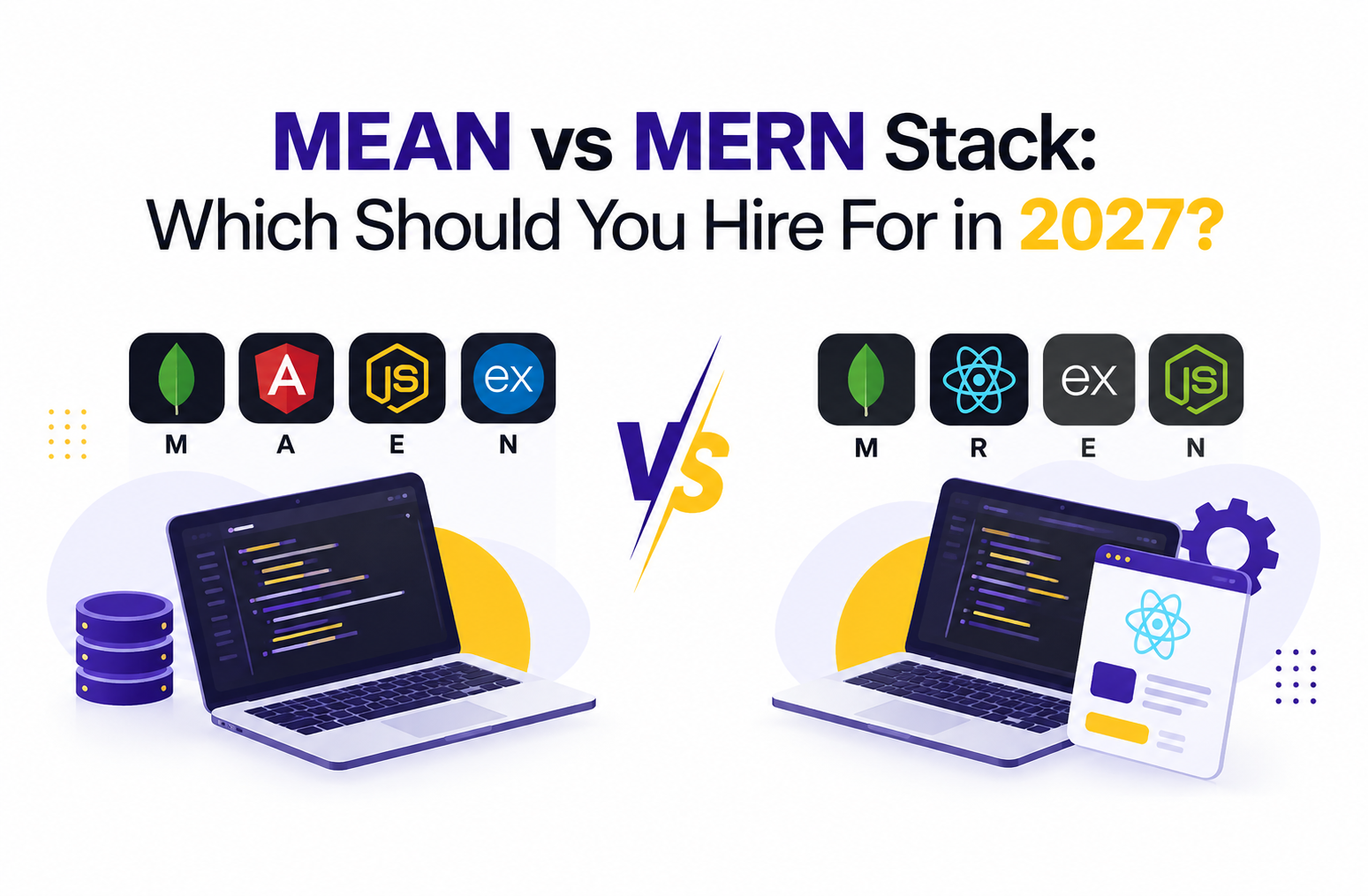

If you are staffing a full stack JavaScript team this year, you have almost certainly run into these two names again and again: MEAN and MERN. Both stacks run on MongoDB, Express, and Node on the backend, and both let your whole team write JavaScript from the browser down to the database. The one piece that changes is the frontend framework, Angular for MEAN and React for MERN, and that single swap ends up changing how you hire, how fast your team ships features, and what a developer costs you per hour.
This guide walks through the MEAN Stack vs alternatives question in plain terms, no theory you cannot use on a Monday morning. You will get a side by side comparison table, numbers on developer availability and pay, a breakdown of where each stack actually fits, and a section on the other JavaScript stacks worth knowing before you lock in a hiring decision. By the end, you should be able to tell a recruiter or a technical lead exactly which stack to search for and why, instead of repeating a buzzword you read somewhere.
What Is the MEAN Stack, in Plain Words
MEAN stands for MongoDB, Express, Angular, and Node. Four tools, one language running through nearly all of them (Angular actually leans on TypeScript, a superset of JavaScript, but the two are close cousins).
• MongoDB stores data as flexible JSON like documents instead of rigid rows and columns, so a product record with ten fields today can grow to fifteen fields next year without a painful migration.
• Express sits on top of Node and handles the plumbing of a web server: routes, requests, responses, and middleware, without forcing much structure of its own.
• Angular is Google's frontend framework. It ships as a complete toolkit, including routing, form handling, dependency injection, and a command line tool that scaffolds new projects for you.
• Node runs JavaScript outside the browser, which is what lets your backend and frontend share one language and, often, one set of developers.
Put these four together and MEAN gives you a single language family across the entire application. A developer who understands the pattern can move between the API layer and the UI layer without switching mental models every hour of the day. That consistency is exactly why MEAN shows up so often at banks, insurers, logistics companies, and government contractors, places where an application gets maintained for five or ten years by rotating teams who did not write the original code.
What Is the MERN Stack, in Plain Words
MERN keeps the same backend as MEAN and swaps Angular for React. The M, the E, and the N stay exactly the same: MongoDB, Express, and Node.
• React is a library, not a full framework, built by Meta for constructing user interfaces out of small, reusable components.
• Because React is a library rather than a complete framework, teams choose their own tools for routing, state management, and forms. That gives more freedom, but it also means more decisions early in a project, and more ways two React codebases can end up looking nothing alike.
• React uses a virtual DOM to figure out the smallest possible change needed on screen before touching the real page, which is part of why React heavy interfaces tend to feel snappy even on modest hardware.
• MERN is the stack most coding bootcamps teach first, which is one reason the hiring pool for MERN developers is noticeably larger than for MEAN developers in almost every country.
MERN tends to show up at startups, marketplaces, SaaS products, and anywhere a small team needs to ship something working fast and adjust based on real user feedback rather than a two year roadmap.
MEAN vs MERN Stack Comparison 2027: The Side by Side Table
Numbers and rates shift year to year, so treat the figures below as directional ranges pulled together from current hiring platforms, job boards, and developer surveys rather than fixed prices. Use them to sense the gap between the two stacks, then get a live quote for your specific project.
Performance: Does the Frontend Choice Actually Matter
Both stacks run on the same Node engine underneath, so raw server side performance is close enough that it rarely decides the outcome. The difference shows up on the frontend, in how each framework updates what the user sees.
React's virtual DOM compares the new UI to the old one and applies only the small patches needed, which keeps interfaces fast even when data changes often, think live dashboards, chat apps, or trading screens. Angular uses a real DOM with an optimized change detection system, and modern Angular versions have closed a lot of the performance gap that used to separate the two. For a typical business application, a user will not feel the difference. For a highly interactive product with hundreds of moving pieces on one screen, React still tends to hold a small, measurable edge in most benchmark comparisons.
Initial load time is a separate story. Angular applications ship a larger JavaScript bundle by default because the framework brings more built in features. React applications, especially ones built with care around code splitting, often load a first screen faster. Neither gap is large enough to build a hiring decision on by itself, but it is worth knowing before someone tells you one stack is simply faster than the other.
Learning Curve and Developer Experience
Angular asks more of a developer on day one. TypeScript, decorators, modules, dependency injection, and RxJS observables all show up early, even in a small project. The payoff is that once a developer knows the pattern, most Angular codebases look similar to each other, which makes it easier to hand a project to a new team later.
React asks less on day one. A developer can build a working component within an hour of installing it. The tradeoff arrives later: because React does not force a structure, two teams solving the same problem can end up with two very different codebases, and a project that grows without discipline can turn into something only its original authors fully understand.
• New hire, junior team, tight timeline: MERN is usually the faster path to a working product.
• Long term product, rotating team, strict code standards required: MEAN's structure pays off over years, not weeks.
• Mixed team with some senior developers who can set conventions: either stack works, the senior team members become the structure Angular would have given you for free.
Hiring in 2027: Talent Pool, Availability, and What Developers Actually Cost
According to the 2025 Stack Overflow Developer Survey, React is used by roughly 44.7 percent of professional developers, compared to about 18.2 percent for Angular. That gap has held steady, and in most years Angular's share has grown only a point or two even as React's has climbed. The practical effect is simple: post a MERN developer role and you will likely see two to three times as many applicants as you would for a MEAN role of similar seniority, in roughly the same number of days.
That does not make MEAN developers hard to find, especially in India, Eastern Europe, and the Philippines, where large development agencies maintain dedicated Angular teams for enterprise clients. It does mean you should budget slightly more time for sourcing if the role specifically requires Angular experience at a senior level.
Where Each Stack Actually Fits: Real Use Cases
Rather than picking a stack because it sounds modern, match it to what you are actually building.
Choose MEAN when you are building
• An internal enterprise tool that finance, HR, or operations teams will use daily for years
• A banking, insurance, or healthcare portal that needs to pass strict compliance reviews
• A large application that multiple teams will touch over a long lifespan, where consistent structure matters more than speed on day one
• A real time application such as a live chat system or collaborative dashboard, where Angular's built in tooling for forms and state handles complexity well
Choose MERN when you are building
• A minimum viable product you need to demo to investors or early customers within weeks
• A consumer facing marketplace, social app, or content platform where the UI changes often based on user feedback
• A product that will eventually need a mobile app, since React Native shares patterns and sometimes code with a React web app
• A small team of one to four developers who need to move fast without waiting on a large framework's conventions
Scalability: Which Stack Handles Growth Better
Both stacks scale well on the backend because MongoDB, Express, and Node are identical in either case, and both work comfortably with the same hosting, containers, and cloud infrastructure. The scaling question that actually matters is frontend maintainability as your team grows.
Angular enforces a module system that keeps large applications organized almost by default, which is why you will find it running core systems inside large banks and insurance companies that need dozens of developers working on the same codebase without stepping on each other. React needs deliberate architecture decisions, folder conventions, and often a state management library such as Redux or Zustand, to reach the same level of order at scale. Teams that skip that step early often pay for it later with a codebase that is difficult to onboard new hires into.
Neither stack has a hard ceiling. Facebook runs React at a scale of billions of users, and Google's own products lean on Angular internally. The real limiting factor is almost always the engineering discipline your team brings, not the framework itself.
Security Considerations for Both Stacks
Security in a MongoDB, Express, and Node backend depends far more on how your team writes code than on which frontend sits in front of it. That said, a few points are worth knowing before you hire.
• Angular includes built in protection against cross site scripting by automatically sanitizing values bound to the template, which removes a common source of bugs for less experienced developers.
• React does not sanitize by default, and a developer using dangerouslySetInnerHTML carelessly can open the same kind of vulnerability Angular blocks automatically. This is a training issue more than a framework flaw.
• MongoDB deployments need careful attention to authentication and network access rules. A surprising number of public data leaks over the years have traced back to a MongoDB instance left open without a password, not a flaw in the database itself.
• Express, being minimal, leaves security middleware up to the developer. Most experienced teams add packages such as Helmet and rate limiting from day one rather than after an incident.
When you interview a candidate for either stack, ask how they handle input validation, authentication token storage, and dependency updates. The answers tell you more about your future security posture than which framework they list on a resume.
MEAN Stack vs Alternatives: MERN, MEVN, and the Rest of the JavaScript Family
MEAN and MERN get most of the attention, but they are not the only JavaScript stacks worth knowing about in 2027. If you are asking which is better, MEAN Stack or its alternatives, for full stack JavaScript work, the honest answer is that it depends on which alternative you are weighing it against.
MEVN (MongoDB, Express, Vue, Node)
MEVN swaps in Vue for the frontend layer. Vue sits between Angular and React in philosophy: more structured than React out of the box, lighter and easier to learn than Angular. Teams pick MEVN when they want a gentle learning curve without giving up all structure. The tradeoff is a smaller hiring pool than either MEAN or MERN, so sourcing takes longer.
PERN (PostgreSQL, Express, React, Node)
PERN keeps the same E, R, and N as MERN but replaces MongoDB with PostgreSQL, a relational database. Teams choose PERN over MERN when their data has clear relationships, think orders tied to customers tied to payments, that a relational database enforces more naturally than a document database.
Next.js on a Node and MongoDB or PostgreSQL backend
A growing number of teams in 2027 are not choosing plain React at all, but Next.js, a framework built on top of React that adds routing, server rendering, and image handling out of the box. It solves several of the decisions a plain MERN team has to make manually, at the cost of adopting another layer of conventions. If your team is comparing MEAN Stack vs alternatives specifically for search engine visibility, a Next.js based stack usually renders pages faster for search crawlers than a plain React single page app.
The backend across almost every one of these stacks stays Node and Express, or a close variant. That matters for hiring, because a developer comfortable with Node can usually adapt to a different frontend framework faster than a developer trying to learn Node from scratch. If you are building a hiring pipeline for the next few years, prioritizing strong Node and JavaScript fundamentals over framework specific experience will widen your candidate pool without much added risk.
Common Hiring Mistakes to Avoid
A lot of hiring decisions between these two stacks go wrong for reasons that have nothing to do with the technology itself. Here are the mistakes that show up most often when companies staff a MEAN or MERN team.
• Hiring based on resume keywords alone. A candidate who lists Angular five times and React zero times might still be weaker on Angular fundamentals than someone with two years of hands on project work. Ask candidates to walk through a real project, not recite a framework's feature list.
• Assuming a MERN developer can jump onto a MEAN project on day one. The backend transfers cleanly. The frontend does not. Budget two to four weeks of ramp up time for a developer switching frameworks, even a strong one.
• Choosing the stack before scoping the project. Teams sometimes lock in MERN because it is trendy, then discover six months later that the application needed Angular's structure all along. A short technical discovery phase before you post a single job listing saves this headache.
• Ignoring the maintenance phase. The stack that is fastest to build with is not always the cheapest to maintain. A fast MVP built in MERN with no code standards can cost more to fix later than it saved during the initial sprint.
• Underpaying for senior talent in a smaller pool. Since fewer developers know Angular deeply compared to React, trying to hire a senior MEAN developer at a junior React rate usually leads to a long, frustrating search.
A Quick Scenario Walkthrough
Sometimes it helps to see the decision applied to a real situation rather than as an abstract rule. Here are three short scenarios based on the kind of briefs that come up most often.
Scenario 1: A three person startup building a booking app
The founders have six months of runway and need a working product to show investors. Speed matters more than long term structure right now, and the team is small enough that Angular's enforced conventions add overhead without much payoff. MERN is the clear choice here, paired with a simple state management setup and a plan to revisit architecture once the product finds traction.
Scenario 2: A regional bank replacing a legacy loan processing system
The application will be maintained for a decade, touched by dozens of developers over that time, and must pass a compliance audit every year. Angular's built in structure, dependency injection, and TypeScript by default reduce the risk of a new developer introducing a bug that a less structured framework might not catch as early. MEAN fits this brief far better than MERN would, even though it will take longer to staff the initial team.
Scenario 3: A mid size agency building client websites with frequent design changes
The agency needs developers who can move between three or four client projects a month, each with a different visual design and content structure. A large hiring pool, a shorter ramp up time per project, and a component based approach that adapts quickly to new layouts all point toward MERN, often paired with Next.js for the SEO heavy client sites.
Market Trends Heading Into 2027
• React's usage lead over Angular has continued to widen rather than close, according to multiple developer surveys tracked over the last three years, which keeps pushing more new projects and more bootcamp graduates toward MERN.
• Angular has not lost ground in the enterprise. Large financial institutions and government contractors continue renewing Angular based systems rather than rewriting them, which keeps demand for experienced Angular developers steady even as its overall market share stays smaller than React's.
• TypeScript adoption keeps rising across both stacks. Angular has required it from the start, and a growing share of new MERN projects now default to TypeScript as well, narrowing one of the gaps that used to separate the two stacks.
• AI assisted coding tools have made the learning curve gap between MEAN and MERN a little less painful, since a developer picking up Angular for the first time can lean on code generation for the boilerplate that used to take the longest to learn.
• Server side rendering and frameworks like Next.js are pulling some MERN hiring away from plain React roles and toward Next.js specific roles, particularly for content heavy and SEO driven products.
So, Which Should You Hire For in 2027
There is no universal winner here, and anyone who tells you otherwise is probably trying to sell you a specific team. The right call depends on three questions.
• How long will this application live? A tool you expect to run for one to two years and then replace favors MERN's speed. A system you expect to maintain for five years or more favors MEAN's built in structure.
• How big will the team get? A team that will stay under five developers rarely needs Angular's enforced organization. A team that will grow past fifteen developers across multiple squads benefits from it.
• How fast do you need to hire? If you need to fill three developer seats in the next month, MERN's larger talent pool makes that timeline realistic. MEAN searches typically take longer, especially for senior roles.
A useful shortcut: startups building a first product, agencies handling many small client projects, and teams that expect frequent design changes tend to do well with MERN. Enterprises building internal systems, regulated industries, and teams planning for a long maintenance window tend to do well with MEAN. If your project sits somewhere in the middle, the deciding factor usually comes down to which framework your current team already knows well, since retraining a team costs more in the first six months than any theoretical performance gap between the two stacks.
Key Takeaways
• MEAN and MERN share the same backend (MongoDB, Express, Node). The real choice is Angular versus React on the frontend.
• MERN has the larger talent pool and, in most markets, slightly lower hourly rates, which usually means faster hiring.
• MEAN's built in structure pays off on long lived, large team enterprise projects more than on fast moving MVPs.
• Performance differences between the two are small for most business applications and only become noticeable in highly interactive, data heavy interfaces.
• Alternatives like MEVN, PERN, and Next.js based stacks are worth a look if your data model, SEO needs, or team background do not fit MEAN or MERN cleanly.
Final Thoughts
The MEAN versus MERN debate gets treated like a rivalry online, but in practice it is closer to choosing between two well built cars that both get you where you need to go. One has more standard features built in. The other lets you pick your own upgrades and usually costs a little less to fill up. Base your 2027 hiring decision on your project's timeline, your team's current skills, and how big the codebase will realistically get, not on which stack has more posts written about it this month. Either one, built by developers who know it well, will serve your business better than the trendier stack built by developers still learning it on the job.