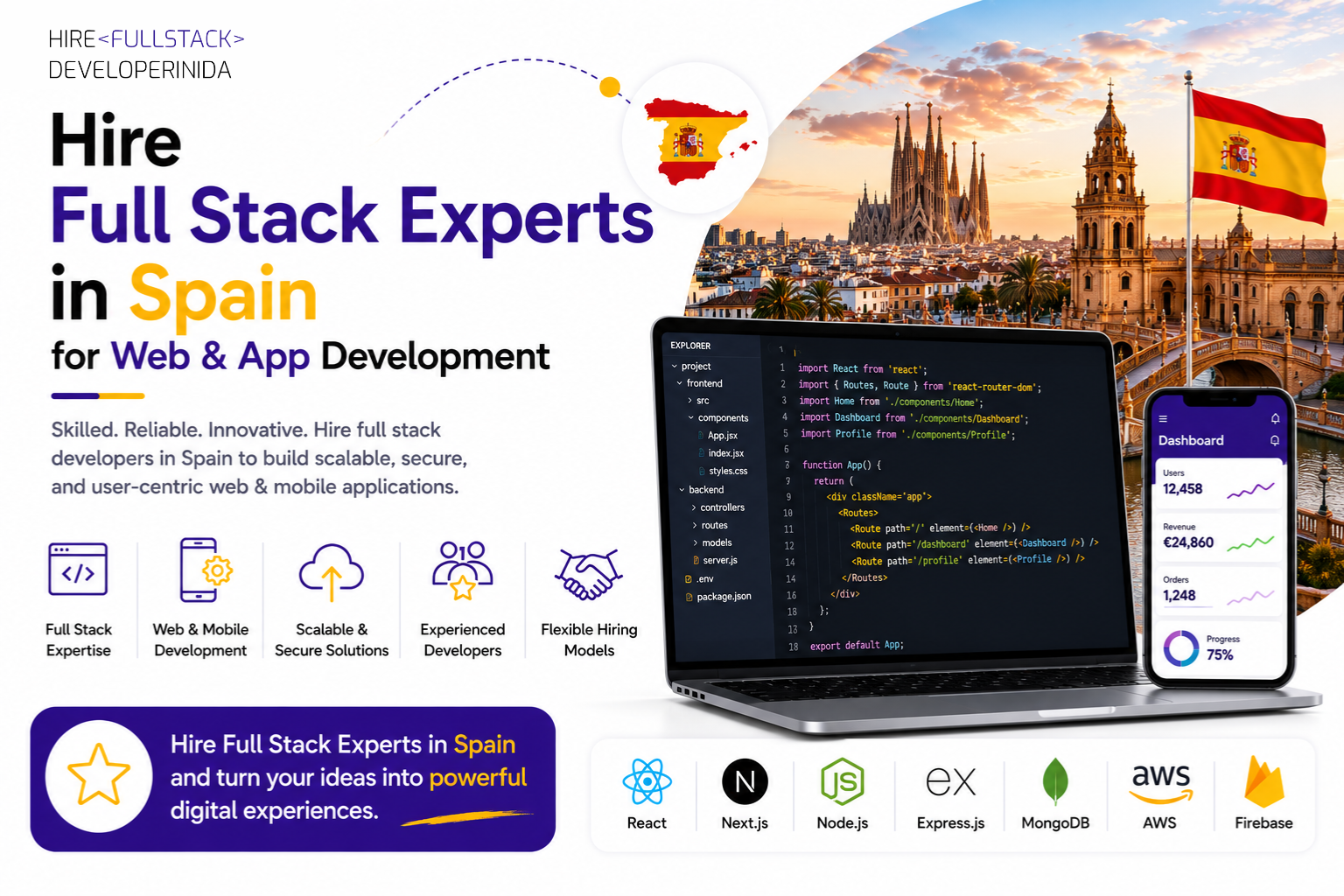

Let us start with the part that rarely makes it into these articles: most founders who hire full stack developers without a clear framework end up rebuilding their product within 18 months. Not because the developers were bad. Not because the idea was wrong. But because the partnership was not built on the right foundations from day one.
Spain has quietly become one of the most interesting destinations for full stack development talent in Europe. Cities like Barcelona, Madrid, Valencia, and Seville are producing engineering teams that combine strong technical education with bilingual communication skills and a work culture that actually values timely delivery. But none of that matters if you do not know what to look for, how to structure the engagement, and which hidden variables will determine whether your project succeeds or stalls.
This blog is written specifically for CEOs, Founders, and decision-makers who are already comparing their options and need clarity, not a pitch. So let us get into the things that actually matter.
Why Spain? The Real Story Behind the Tech Talent Surge
You have probably seen Spain mentioned in listicles about European tech hubs. But the reasons it keeps appearing go deeper than lifestyle and weather. Spain has been systematically investing in its digital infrastructure since 2020, and by 2026, that investment is paying off in ways that directly benefit companies hiring development talent.
Spanish universities have dramatically expanded their computer science and software engineering programs. Institutions like the Polytechnic University of Madrid and the Polytechnic University of Catalonia are consistently producing graduates who are fluent in modern JavaScript frameworks, backend languages like Python and Node.js, cloud architecture, and mobile development using Flutter and React Native.
Beyond education, Spain has seen an influx of senior engineers returning from Silicon Valley, Berlin, and London. These are developers who built products at scale abroad and have come back bringing methodologies, tooling preferences, and standards that align with what global companies expect. When you work with a Full Stack Development Company Spain, there is a good chance that leadership within that team has direct international product experience, not just local market exposure.
There is also the time zone factor, which is underrated. Spain operates on Central European Time, meaning it shares working hours with most of the UK, Germany, France, and Western Europe. For US-based companies, Spain offers a workable overlap window that avoids the extreme lag issues that come with hiring in Southeast Asia. Evening standups are possible without anyone staying at the office until midnight.
What Full Stack Actually Means in 2026 (and Why It Matters for Your Hire)
The phrase full stack has been diluted over the years. In conversations with clients, we often find that two companies using the same term mean very different things. Before you start shortlisting candidates or agencies, you need a working definition that matches your product needs.
In 2026, a genuinely capable full stack developer or team should be able to handle:
- Frontend development using React, Next.js, or Vue.js with a strong eye for performance and user experience
- Backend development using Node.js, Django, Laravel, or similar, with secure API design and database architecture
- Cloud deployment and infrastructure on AWS, Google Cloud, or Azure, including CI/CD pipeline setup
- Mobile development for iOS and Android, ideally using cross-platform frameworks like Flutter or React Native
- AI feature integration, since most commercial products in 2026 include at least one intelligent layer, whether it is a recommendation system, chatbot, or content automation tool
The reason this definition matters is that a gap in any of these areas creates downstream problems. A team that is strong on frontend but weak on cloud architecture will build a product that looks polished but does not scale under real-world traffic. A team that handles backend brilliantly but treats mobile as an afterthought will ship an app that users abandon within a week.
When evaluating any Full Stack Development Company Spain, ask them to walk you through a recent project that required all of these capabilities. Not a portfolio slide. A real walkthrough where you understand the challenges they navigated and the decisions they made under pressure.
The Cost Conversation: What the Numbers Actually Mean
Most blogs drop a rate range and move on. That is genuinely unhelpful. Here is a more useful way to think about cost when hiring full stack talent in Spain.
The Three Cost Layers You Need to Account For
Layer 1: The Visible Rate
Spanish full stack developers working in-house at a company or on a freelance basis typically charge between 45 to 90 euros per hour depending on specialization and seniority. A dedicated full stack team from a mid-tier agency in Spain will generally price engagements between 60,000 and 180,000 euros annually depending on team size and project complexity. These are the numbers most buyers focus on.
Layer 2: The Management Overhead
This is where many founders get surprised. A cheaper development team that requires constant direction, produces code that needs extensive review, or communicates poorly ends up costing more in management time than a more expensive team that operates independently. Before signing a contract, assess how much of your own time or your CTO's time will need to be invested in day-to-day oversight. Factor that into the total cost.
Layer 3: The Risk-Adjusted Cost
This is the cost most people ignore until it is too late. A development partner that takes shortcuts on architecture, skips proper testing, or builds a product that cannot be easily handed off to an internal team later will cost you far more in rework, technical debt, and delayed revenue than you saved on the initial contract. When you see a quote that is significantly below market, the question to ask is not why so cheap but rather what are they leaving out.
Spain, compared to the UK, Germany, or the Netherlands, offers a genuine cost advantage at comparable quality levels. You are typically looking at 25 to 40 percent lower rates for similar output. That gap is real and meaningful. But it only stays meaningful if you choose the right partner.
Freelancer vs Agency vs Dedicated Team: The Decision Framework
This is one of the most common questions founders face, and the answer is genuinely dependent on where you are in your product lifecycle.
Freelance
Hiring a freelancer from Spain makes the most sense when you have a very defined scope, the work is additive rather than foundational, and you have the internal capacity to manage and review what is being delivered. A senior freelance developer in Spain brings focus and flexibility, but they are not a substitute for a team with product management, QA, and design capabilities built in.
Agency
Partnering with a Full Stack Development Company Spain makes more sense when you are building something from scratch, need end-to-end accountability, or are scaling a product that already has traction and requires coordinated input across design, development, and infrastructure. An agency brings a process, not just code.
Dedicated Team
A dedicated team model, where a group of developers work exclusively on your product but are employed through a partner company, sits between these two options. It gives you the consistency of an in-house team with the flexibility of not carrying full-time employment overhead. This model has grown considerably in Spain over the past three years, particularly for Series A and Series B startups that need to move fast but are not yet ready to build a full internal engineering function.
The Hidden Factors Most Buyers Never Evaluate
Portfolio reviews and technical tests are standard. What gets skipped far too often are the factors that actually determine day-to-day working quality.
Documentation Culture
Ask any development partner you are evaluating to show you their documentation for a past project. Not a polished case study. The actual technical documentation they maintain internally. A team with a strong documentation culture builds products that are easier to maintain, easier to hand off, and less vulnerable to the single developer problem, where one person's departure brings development to a halt.
How They Handle Disagreement
A development team that agrees with everything you say is a liability. You want technical partners who will push back when a feature request creates architectural risk, flag when a deadline is unrealistic, and recommend alternatives when the initial brief has a fundamental flaw. During your evaluation process, deliberately propose something technically questionable and see how the team responds. Silence or immediate agreement should concern you.
Post-Launch Support Standards
Launch day is when the real work begins, not when it ends. Ask specifically about how the company handles bug reports after go-live, what their average response time is for critical issues, and whether they offer ongoing maintenance retainers. In Spain, the best development companies offer structured post-launch support packages that are priced transparently. Be wary of partners who are vague about what happens after the handoff.
The Ownership Question
This is not just a legal formality. It is a value indicator. A development partner that hands over clean code, complete repositories, all credentials, and no lock-in dependencies from day one is telling you something important about how they operate. Those that try to retain leverage through proprietary tools, unpublished code, or delayed access to infrastructure are worth avoiding regardless of how impressive their portfolio looks.
What the Best Spain-Based Teams Are Building in 2026
The range of work coming out of Spanish development teams in 2026 is significantly more sophisticated than it was even three years ago. These are not teams doing simple brochure websites and basic e-commerce builds. The leading full stack teams in Spain are working on:
SaaS platforms with AI automation layers, where workflow tools that used to require significant manual input are now being rebuilt with large language model integrations that handle classification, summarization, and decision support.
Fintech and insurtech applications where regulatory compliance is baked into the architecture from day one, not retrofitted later. Spain's proximity to EU regulations makes Spanish developers particularly well-prepared for GDPR compliance and the AI Act implications that are now directly relevant to any product with AI-driven decision-making.
Healthcare and medtech products where both reliability and data sensitivity are non-negotiable. Several Barcelona-based teams have built a strong reputation in this vertical specifically because their engineering culture prioritizes auditability and test coverage.
Marketplace and platform products that connect multiple user types, require sophisticated matching logic, and need to handle payments, notifications, and real-time interactions at scale.
The Shortlisting Process: A Practical Framework
If you are actively comparing development partners right now, here is a structured approach that will save you time and give you more useful signal than a standard RFP process.
Step 1: Define your evaluation criteria before you start talking to anyone. List the technical requirements, the communication expectations, the timeline constraints, and the commercial boundaries. Having this documented prevents you from making emotionally driven decisions based on a compelling pitch.
Step 2: Ask each candidate to respond to the same brief with a technical approach document. Not a quote. A document that explains how they would tackle the core architectural challenge in your project. This reveals technical thinking, communication style, and how seriously they took the brief.
Step 3: Speak to references, and not the ones the company provides. Find independent reviews on platforms like Clutch and look for patterns, both positive and negative, across multiple client experiences.
Step 4: Pilot before you commit to a long contract. A two to four week paid discovery sprint where the team diagnoses your existing architecture or builds a proof of concept gives you real working evidence of their capability and communication quality.
Step 5: Negotiate structure, not just price. Milestone-based payment schedules, clear definitions of done, agreed escalation paths for scope changes, and exit terms that protect your code access are all more valuable than squeezing an extra five percent off the monthly rate.
Contract and Legal Considerations for Hiring in Spain
If you are working with a Spain-based development company or freelancer from outside the EU, there are a few practical legal considerations worth knowing.
Spain operates under EU intellectual property law, which means that by default, if a developer creates something as part of their employment, the employer owns it. But if you are engaging a freelancer or an agency under a service contract, you need to explicitly state IP transfer in the agreement. Do not assume it is included. Ensure your contract specifically assigns all rights to the work product to your company upon payment.
GDPR compliance is not optional if your product will serve EU users. The good news is that a Spain-based development partner will already be operating within the GDPR framework and should understand data handling requirements natively. Confirm this during your evaluation rather than assuming.
For US-based companies, consider how payments will be structured to minimize currency risk. Contracting in euros provides cost predictability for the Spanish partner, and many international payment platforms now make euro transactions straightforward from a USD account.
Green Flags and Red Flags When Evaluating a Full Stack Development Company Spain
Since you are going to have a lot of sales conversations during this process, knowing what to look for beyond the portfolio will save you from expensive mistakes.
Green flags that indicate a trustworthy development partner:
- They ask detailed questions about your business goals before talking about technology choices
- They proactively raise potential technical risks in your brief rather than just confirming everything is doable
- They show you real client testimonials, not just logos, and have verifiable case studies
- They have clearly defined onboarding and project management processes they can walk you through
- They are transparent about team composition, including who will actually work on your project versus who presented in the pitch
Red flags that suggest you should keep looking:
- They promise fixed timelines before fully understanding the scope
- Their pricing is dramatically below market without a clear structural reason
- They cannot show you code from past projects or explain architectural decisions in plain language
- They use excessive technical jargon in client communications, which suggests they may not be comfortable with transparency
- They resist milestone-based payment structures and push for large upfront deposits
Building a Long-Term Partnership vs a One-Off Engagement
One of the most valuable things you can do when hiring full stack development talent in Spain is to think about the engagement as a partnership rather than a transaction. This is not idealism. It is pragmatism.
Development teams that know your product well are dramatically more effective than new teams who need three months to understand your codebase before they can contribute meaningfully. Every time you switch development partners, you pay a re-onboarding cost in time, money, and momentum. The companies that build the best digital products are usually the ones that invest in continuity.
That said, continuity is only valuable if the relationship is working well. Build natural review points into the engagement, typically at 90-day intervals, where you formally assess whether the partnership is delivering the expected outcomes. This gives both sides the chance to course correct before small problems become structural ones.
The Decision Sitting Ahead of You
Here is the honest reality of where you are right now. You are likely comparing four or five options, and several of them look credible on the surface. Pricing differences seem meaningful but confusing. Everyone claims to deliver on time and with great communication.
The frameworks in this blog exist because the standard decision criteria, price, portfolio, and a couple of reference calls, do not capture the variables that actually predict success. The teams that deliver exceptional products are not necessarily the ones with the longest client lists. They are the ones with the strongest process discipline, the most honest communication, and the clearest understanding of what you are trying to build and why.
Spain's full stack development ecosystem in 2026 offers genuine quality at a real cost advantage compared to Western European alternatives. But advantage only materializes when you do your evaluation thoroughly. Use the frameworks and questions in this article as your filter, and you will significantly raise your odds of making a hiring decision you are still happy with a year from now.
The best development partnerships do not feel like outsourcing. They feel like an extension of your own team. That kind of partnership is available in Spain. Go find it with your eyes open.