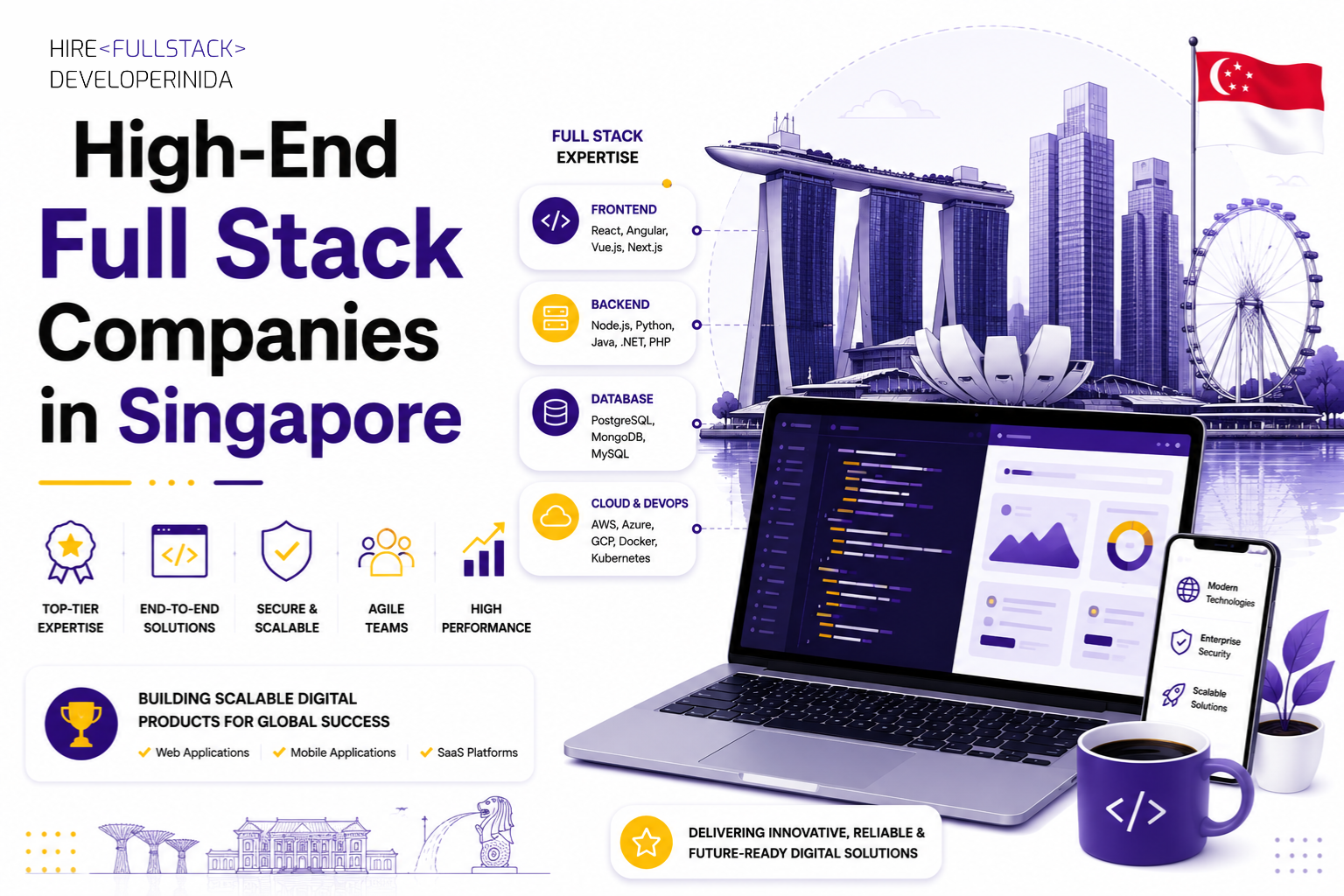

Let's skip the part where most blogs tell you Singapore is a 'thriving tech hub' and that digital transformation is 'accelerating.' You already know that. What you actually want to know is: which full stack development company in Singapore is worth trusting with your product, your budget, and frankly, your reputation?
That's a harder question than it sounds. Singapore's tech ecosystem in 2026 is more crowded than ever, and the difference between a company that looks great on paper and one that actually delivers is not always obvious from a website or a sales call. There are studios that charge premium rates but operate like glorified freelancer collectives. There are offshore-heavy shops that put a Singaporean face on work being done three time zones away. And then there are genuinely capable teams that can take a product from concept to production with real accountability.
This guide is written specifically for CEOs, founders, and decision-makers who are in shortlisting mode. Not just browsing. You need enough detail to make a confident call, and you want to avoid the usual traps. So we've put together a list of 15 companies, an honest look at costs, and the questions most people forget to ask until it's too late
Why Singapore, and Why Does the Company You Pick Actually Matter?
Singapore sits at an unusual intersection in the global tech landscape. It has the regulatory clarity of a Western market, the geographic advantage of being the commercial gateway to Southeast Asia, and a talent ecosystem shaped by strong engineering universities and years of government-backed investment in tech infrastructure.
But here is the thing most blogs miss: hiring a full stack development company in Singapore is not just about access to local talent. It is about accountability in a jurisdiction where contracts are enforceable, data protection laws are serious, and companies have real reputations to protect. That changes the dynamic entirely compared to hiring offshore in markets where follow-through is less certain.
The stakes are higher, yes. But so is the reliability. In 2026, as AI-assisted development becomes standard and product cycles compress, having a partner who can actually keep up matters more than it did two or three years ago.
The Hidden Cost Conversation Nobody Has Upfront
Cost is the thing every founder thinks about first and talks about last. Let's reverse that.
A high-end full stack firm in Singapore typically operates in a range of SGD 150 to SGD 350 per hour, depending on seniority, specialization, and engagement model. Project-based engagements for a mid-complexity web or mobile product (say, a customer-facing platform with backend logic, integrations, and a custom dashboard) often land between SGD 80,000 and SGD 300,000. That is a wide range, and the reason it is wide is that nobody talks clearly about what moves the number.
Here is what actually drives cost beyond the obvious hourly rate:
- Scope clarity at the time of proposal. Vague briefs lead to change orders. Change orders are where budgets bleed.
- Tech stack decisions. Some firms will steer you toward what they know, not what is best for your product. A poorly chosen stack creates long-term maintenance costs that dwarf the initial build.
- Post-launch support terms. Many firms quote attractively for build but charge separately for every bug fix, security update, or performance issue after handover.
- Team continuity. If the senior developer who understood your product leaves mid-project, who covers the ramp-up cost?
The firms that are genuinely worth their rates are the ones who talk about all of this upfront. If a company is avoiding these conversations during the proposal stage, that tells you something.
15 High-End Full Stack Development Companies in Singapore Worth Knowing
These companies have been selected based on capability depth, client feedback patterns, technical credibility, and their ability to handle complex, production-grade work. They are not all Singapore-headquartered, but all operate meaningfully in the Singapore market with delivery capabilities that hold up under scrutiny.
1. Thoughtworks
Thoughtworks is one of the few firms globally that consistently delivers at the intersection of software engineering and organizational transformation. Their Singapore office works with enterprises across financial services, healthcare, and logistics. They are known for bringing genuine engineering discipline, not just output. If your product has complex architecture requirements or needs to scale aggressively, they are worth the conversation.
Services: Full stack engineering, cloud architecture, AI integration, digital product strategy. Best For: Enterprises and scale-ups. Notable: Strong in agile transformation alongside delivery.
2. Backend Development Company
Backend Development Company brings a sharp focus on server-side architecture, API ecosystems, and database engineering, making them an excellent choice when your product's core complexity lives beneath the surface. While many firms try to be generalists, this team's depth on the backend layer means your integrations, data flows, and performance bottlenecks get handled by people who have seen those problems before. They serve clients in fintech, SaaS, and enterprise software who need reliability over flash.
Services: Backend architecture, API development, database optimization, cloud infrastructure. Best For: Products where performance and scalability are non-negotiable. Notable: Specialists in complex API ecosystems and high-load systems.
3. Futureworkz
Futureworkz has been operating in Singapore for over a decade and has a reputation for honest delivery. They work primarily with startups and growth-stage businesses and are known for strong communication throughout the project lifecycle. Their team handles everything from web apps to mobile, and they have invested heavily in React and Node.js expertise. What sets them apart is their willingness to push back on scope when something does not serve the client's actual goal.
Services: Web and mobile app development, React, Node.js, startup MVPs. Best For: Founders who want a team that challenges assumptions. Notable: One of Singapore's more established boutique dev shops.
4. HireFullStackDeveloperIndia
Despite the name, HireFullStackDeveloperIndia has built a reputation as a cost-efficient but technically serious option for companies in Singapore looking for flexible engagement models. They offer staff augmentation and dedicated team arrangements that work well for founders who have internal product ownership but need execution muscle. Their developers are experienced across MEAN, MERN, and PHP-based stacks, and their project managers are trained to work across time zones without the usual communication friction.
Services: Full stack development, staff augmentation, dedicated development teams. Best For: Founders with strong internal product direction who need reliable execution. Notable: Competitive rates with strong English communication and project management.
5. Palo IT
Palo IT operates as a technology consultancy with strong delivery arms, which means they bring strategic input alongside code. They have a significant Singapore presence and work across sustainability, fintech, and public sector projects. Their teams are cross-functional by design, meaning product designers, engineers, and business analysts work together from day one rather than in handoff sequences.
Services: Full stack development, agile consulting, UX design, cloud migration. Best For: Companies that want strategy and delivery from the same partner. Notable: Known for sustainability-focused tech projects.
6. HireAIDevelopers
HireAIDevelopers has carved out a distinct position in 2026's market by focusing on AI-integrated full stack development. If your product requires machine learning pipelines, LLM-powered features, or intelligent automation layered into a web or mobile application, this team brings genuine depth. They are not a generic dev shop that added 'AI' to a services page after the buzz started. Their engineers hold real credentials in AI and data engineering, and their client roster includes companies building in healthcare diagnostics, financial analytics, and e-commerce personalization.
Services: AI-integrated development, LLM applications, ML pipeline engineering, full stack delivery. Best For: Product companies building AI-native or AI-enhanced platforms. Notable: One of the few shops that truly blends AI engineering with product-grade full stack delivery.
7. Appnox Technologies
Appnox has built a strong track record with mobile-first product builds, but their full stack capabilities have grown considerably. They work across iOS, Android, and web platforms with integrated backend development, and they are particularly strong with cross-platform frameworks like Flutter and React Native. For founders building consumer apps that need to launch on multiple platforms simultaneously without maintaining separate codebases, Appnox is worth a closer look.
Services: Mobile app development, cross-platform builds, full stack web development. Best For: Consumer-facing product companies launching across iOS and Android. Notable: Strong in Flutter and React Native ecosystems.
8. DataEximIT
DataEximIT occupies an interesting space in the market: they combine data engineering capability with full stack development in a way that is genuinely integrated rather than bolted together. This matters a great deal for companies building analytics platforms, data-heavy SaaS products, or applications where the data layer is as important as the user interface. Their team includes developers with backgrounds in ETL pipelines, data warehousing, and BI tools, which means they can build the product and the underlying data infrastructure together without the usual handoff gaps.
Services: Full stack development, data engineering, BI integration, SaaS product development. Best For: Companies building data-intensive products. Notable: Rare combination of full stack delivery and genuine data engineering depth.
9. Monk's Hill Ventures Portfolio Companies (Incubated Boutiques)
A slightly different entry on this list, but worth knowing about. Several boutique development studios in Singapore have emerged from the Monk's Hill Ventures ecosystem, and they bring startup-grade product thinking alongside engineering execution. These teams are smaller and more selective about clients, but if you can get a meeting, you often get access to engineers who have built at scale and understand what it takes to get from MVP to Series A product quality.
Services: MVP builds, product strategy, full stack development. Best For: Early-stage founders who want startup DNA in their dev partner. Notable: Smaller teams, higher selectivity, product-first mindset.
10. WebClues Infotech
WebClues Infotech has been delivering across web, mobile, and enterprise software for over a decade, building a client portfolio that spans the US, Europe, and Asia Pacific including Singapore. What makes them particularly relevant for founders doing regional expansion is their experience building multilingual, multi-currency, and compliance-aware applications. Their full stack teams are fluent in both modern JavaScript frameworks and enterprise-grade backend technologies, and they offer flexible engagement models ranging from fixed-price project delivery to long-term development partnerships.
Services: Web app development, mobile apps, enterprise software, ecommerce platforms. Best For: Businesses building regionally scalable products. Notable: Strong portfolio in multi-market applications and long-term client relationships.
11. Zag Studios
Zag Studios is a Singapore-based product and engineering studio that takes a relatively unconventional approach: they are selective about the clients they take on, and they operate at the premium end of the market. They work best with companies that already have a clear product vision and need a team that can translate it into technically excellent execution without a lot of hand-holding. Their strength is in rapid, high-quality builds that do not accumulate technical debt.
Services: Product design and engineering, full stack development, SaaS builds. Best For: Founders with strong product clarity who want premium execution. Notable: Selective intake, strong design-engineering integration.
12. Infocomm Media Development Authority (IMDA) Accredited Vendors
If you are a Singapore-registered company, working with an IMDA-accredited vendor opens access to government co-funding schemes that can meaningfully reduce your development costs. In 2026, several grants including the SMEs Go Digital programme still support digital solution adoption for qualifying businesses. The IMDA-accredited vendor list includes full stack development companies that have passed capability assessments. This is a cost consideration most founders either do not know about or do not pursue early enough.
Services: Varies by vendor but includes web, mobile, and enterprise development. Best For: Singapore-registered SMEs eligible for co-funding. Notable: Access to government grant frameworks can offset 30-70% of development costs.
13. Accenture Song Singapore
For enterprises with significant budgets and complex transformation requirements, Accenture Song Singapore brings unmatched scale and cross-functional capability. They can field teams that span engineering, data, design, and change management simultaneously. The caveat, of course, is that this level of resource comes with a price point that makes sense for large enterprises but is generally out of range for startups or early-growth companies. That said, for the right engagement, the depth they bring is unmatched.
Services: Digital transformation, full stack engineering, AI implementation, cloud services. Best For: Large enterprises with complex multi-workstream requirements. Notable: Unmatched scale, best suited for organizations with $500K+ development budgets.
14. Synerzip
Synerzip serves clients in Singapore and the broader Asia Pacific region with a focus on product engineering and dedicated development teams. They are structured for long-term engagements where you essentially extend your internal team with their engineers who operate on your tools, in your workflows, and with your codebase context. They work well for companies that are post-MVP and building toward scale, where continuity and domain familiarity matter more than raw speed.
Services: Product engineering, dedicated development teams, DevOps, QA. Best For: Post-MVP companies scaling their product. Notable: Strong in long-term team extension models.
15. Tech Mahindra Singapore
Tech Mahindra's Singapore operations sit at the enterprise end of the spectrum, with strong presence in telecommunications, banking, and manufacturing sectors. Their full stack capabilities are backed by global delivery infrastructure, and they have made visible investments in AI and digital engineering capabilities in recent years. For established companies in regulated industries who need a development partner that can navigate compliance requirements without slowing down delivery, Tech Mahindra is a credible option.
Services: Digital transformation, full stack engineering, enterprise application development, AI integration. Best For: Enterprises in regulated industries. Notable: Strong in telco, BFSI, and manufacturing sector technology.
The Questions That Separate Good Vendors from Great Partners
Most shortlisting conversations focus on portfolio, rates, and timelines. Those matter, but they are table stakes. Here is what to dig into instead:
- Who specifically will be working on your project? Not the credentials of the company in general, but the actual team members. Ask to meet them before signing.
- What happens when someone leaves mid-project? This is not a hypothetical. It happens. How a company answers this tells you a great deal about their process maturity.
- Can you talk to a previous client who had a project go sideways? A company that only connects you with happy reference clients is curating your due diligence.
- How do they handle technical disagreements with clients? Do they defer, or do they have a principled process for raising concerns?
- What does code ownership look like post-delivery? Make sure IP assignment, repository access, and documentation standards are explicit in the contract.
These are the conversations that reveal whether you are dealing with a transactional vendor or a genuine development partner.
What to Expect from Top Full Stack Firms in 2026
The development landscape has shifted meaningfully in the past eighteen months. Here are the real changes affecting how good firms in Singapore are operating right now:
- AI-assisted development is standard, not experimental. Senior engineers at credible firms use AI coding tools daily, which compresses certain build phases. But this also means lower-quality shops are using the same tools to mask shallow expertise. Speed is no longer a reliable proxy for quality.
- Security-first development is non-negotiable. With Singapore's PDPA enforcement maturing and growing cross-border data flows across ASEAN, good firms in 2026 are building security into architecture decisions, not patching it on at the end.
- Composable architectures are replacing monoliths. Firms that are still pitching custom-built monolithic systems for new products are behind the curve. Microservices, API-first design, and modular frontends are what modern full stack delivery looks like.
- Green tech considerations are entering procurement criteria. Several larger clients in Singapore now have sustainability KPIs attached to their vendor relationships. This includes asking about cloud infrastructure efficiency and carbon footprint of development operations.
The best full stack development company Singapore has available to you in 2026 is not necessarily the biggest or the most-featured on Google. It is the one whose engineering philosophy, communication style, and engagement model align with where your product actually needs to go.
Engagement Models and What They Actually Mean for Your Budget
The three most common engagement structures you will encounter:
- Fixed Price Projects work best when the scope is genuinely well-defined and unlikely to change. Be honest with yourself about whether that describes your situation. Fixed price sounds budget-safe but can create adversarial dynamics when scope creeps (and it usually does).
- Time and Materials gives you flexibility but requires internal bandwidth to manage properly. You need someone on your side actively tracking progress, asking the right questions, and making timely decisions. If you do not have that capacity, T and M engagements can run long
- Dedicated Teams are the most underused model for companies with ongoing product development needs. You essentially retain a team at a monthly rate, typically 20 to 40 percent cheaper than project-by-project engagement with the same firm, and you get continuity, institutional knowledge, and predictability.
One final cost note: the cheapest proposal is rarely the cheapest project. When a company comes in significantly below market rate, build in a mental buffer for what the overruns, communication breakdowns, or quality rework will add to the final number.
Making the Call with Confidence
Here is the honest truth about choosing a full stack development company Singapore: no list, no review platform, and no amount of due diligence will completely eliminate uncertainty. What good research does is shift the odds meaningfully in your favor.
The companies on this list represent different points on the spectrum of size, specialization, pricing, and style. Some will be right for your product. Some will not. The ones you should shortlist seriously are the ones where the first conversation already felt like they understood what you are trying to build rather than trying to fit you into a service they already sell.
Singapore's tech ecosystem in 2026 rewards founders who do their homework and go into partner conversations with specific, informed questions. The companies that deserve your business will appreciate that. The ones that do not are telling you something important.
Your product deserves a partner who thinks about it the way you do: seriously, specifically, and with a genuine interest in seeing it succeed. That firm exists. This guide should help you find them faster.