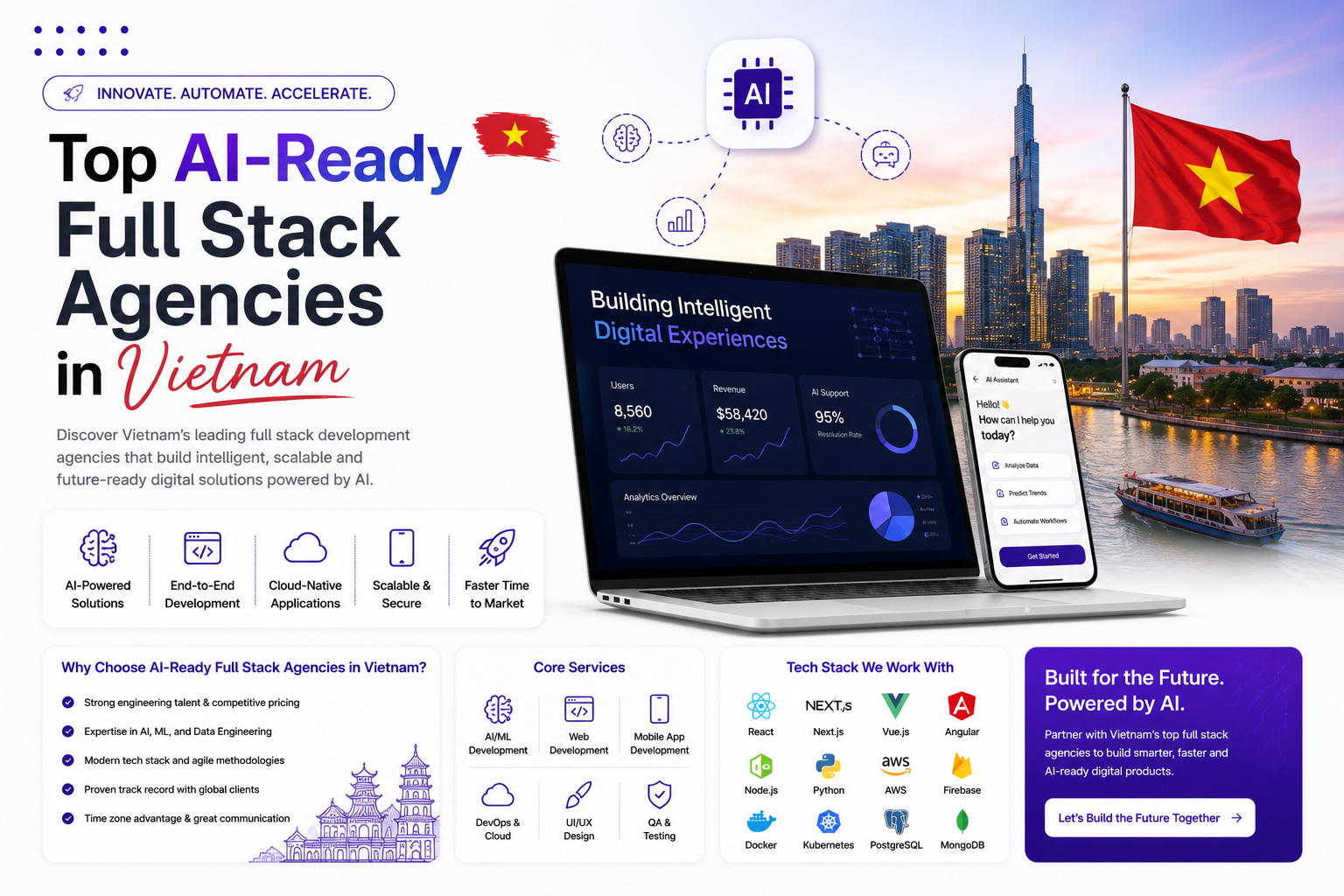

A few months ago, a founder I was talking to said something that stuck with me. He said he had twenty two tabs open, each one a different agency website, and every single one claimed to be the top rated AI development partner in Vietnam. By the third hour, every logo, every testimonial, and every case study had started to blur into one giant wall of sameness. If that sounds familiar, you are not alone, and honestly, the problem is not that good agencies do not exist. The problem is that almost every blog covering this topic reads like it was written by the same template, with the same five generic lines about Vietnam being a rising tech hub with affordable rates.
This guide takes a different approach. Instead of just listing names and hourly rates, we are going to look at what each agency is actually good at, where they tend to fit best, and what 2026 specific shifts, like the rise of AI agents, retrieval based features, and AI ops, mean for how you should be evaluating a partner right now. If you are a founder, CEO, or decision maker trying to shortlist a full stack development company in Vietnam that can also handle AI features properly, this should save you a few of those twenty two tabs.
Why Vietnam's Full Stack Scene Looks Different in 2026
For years, the pitch for hiring developers in Vietnam was simple: good engineering talent at a fraction of Western costs. That part is still true, but it is no longer the main story. What has changed in the last year or so is that a large number of Vietnamese agencies have quietly built internal AI practices, often starting as small experimental teams that worked on side projects, and have now turned those experiments into actual service lines. This matters because hiring a generalist full stack development company Vietnam today often means you also get access to people who have spent the last year working specifically on things like AI agents, automated workflows, and large language model integrations, without paying a premium for a separate specialist AI vendor.
There is also a quieter shift happening around cost. Most blogs treat cost as a simple hourly rate comparison, but the more useful question in 2026 is how an agency structures AI related costs versus traditional development costs. Some agencies bundle AI feature development into their regular rate, while others quote it separately because the underlying AI infrastructure, things like vector databases or model hosting, carries its own ongoing cost that has nothing to do with developer hours. Understanding this distinction early can prevent a budget surprise three months into a project, which is honestly more useful than knowing whether an agency charges twenty eight or thirty two dollars an hour.
What to Actually Look For Before You Reach Out
- Ask whether AI feature work is billed at the same rate as regular development, or as a separate specialist rate.
- Check if the team has handled post launch AI maintenance, not just initial integration, since models and prompts need updating over time.
- Look for agencies that can show you a working internal AI tool they built for themselves, not just client work, as a sign of genuine in house capability.
- Confirm whether the quoted team size includes dedicated AI engineers or if those would be brought in as outside contractors.
Why AI Readiness Matters More Than Full-Stack Capability in 2026
A few years ago, most founders looking for a Full Stack Development Company Vietnam focused primarily on technical expertise. The conversation usually revolved around frameworks, programming languages, development speed, and hourly rates. While those factors remain important, the evaluation criteria have shifted significantly in 2026.
Today, many software products are expected to include some level of AI functionality, whether it is intelligent search, recommendation systems, customer support automation, workflow automation, predictive analytics, or AI-powered assistants. As a result, choosing an agency based solely on traditional full-stack development experience can be a costly mistake.
The more relevant question is whether the agency can successfully combine software engineering with AI implementation.
When evaluating potential partners, founders should look for evidence of:
- Real-world AI project experience rather than experimental prototypes.
- Experience with retrieval-based systems and AI agents.
- Understanding of AI infrastructure costs.
- Knowledge of model monitoring and maintenance.
- Ability to optimize AI usage costs after launch.
Traditional Development vs AI-Ready Development
The distinction is becoming increasingly important because AI-related expenses often continue long after development is complete. Agencies that understand both development and AI operations can help founders avoid unnecessary infrastructure spending and improve long-term product sustainability.
In many cases, a technically strong AI-ready team can create greater business value than a larger development team that lacks practical AI deployment experience.
The List: 15 Full Stack Agencies in Vietnam Worth Shortlisting in 2026
Each profile below covers location, team size, typical hourly rate range, and what they specialize in, followed by a short note on where they actually shine. None of these are ranked in strict order, since the right fit depends entirely on what stage your product is at and what kind of AI feature you are building.
1. HireFullStackDeveloperIndia
Despite the name pointing toward India, this agency runs a sizable Vietnam based delivery pod that many founders use specifically because it blends India pricing with Vietnam engineering speed. They are heavily focused on a staff augmentation model, meaning you get named developers added to your existing team rather than a black box agency relationship. For startups that already have a CTO but need extra hands on AI chatbot or automation features, this flexible setup tends to work better than a fixed scope contract.
2. Backend Development Company
As the name suggests, this team built its reputation on backend engineering, but over the last two years they have expanded into full stack delivery without losing that backend first mindset. For founders building AI heavy products, this matters because most AI features live or die on how well the backend handles data pipelines, queues, and model serving. Backend Development Company brings senior architects into early calls rather than account managers, which a lot of founders find refreshing when they are trying to validate technical feasibility before signing anything.
3. Saigon Technology
Saigon Technology has been around long enough to have worked with several waves of foreign founders, and in 2026 their generative AI practice is one of the fastest growing units in the company. They are particularly active in fintech and healthtech builds, sectors where AI features need to be wrapped in proper compliance and audit trails rather than bolted on as a gimmick. Their project managers tend to be fluent in both technical and business language, which helps when you are explaining your roadmap to investors and need your dev partner to back you up.
4. NashTech
NashTech is one of the oldest Full Stack Development Company Vietnam in the country, and in 2026 it has quietly become the go to partner for companies that need both software development and AI consulting under one roof. What stands out is their dedicated AI labs team that sits alongside the regular delivery squads, so when a client asks for an AI feature midway through a project, they are not starting from zero. Their client list leans toward UK and Australian mid sized enterprises, and they are known for very structured project governance, which founders coming from corporate backgrounds tend to appreciate.
5. KMS Technology
KMS Technology is one of the largest tech employers in Vietnam, and that scale shows up in how they handle AI projects. They run their own innovation studio that experiments with new AI tooling before it gets offered to clients, so by the time you ask for something like a recommendation engine or an AI search feature, they have usually already built a prototype internally. The tradeoff is that smaller startups sometimes feel like a small fish here, so this option suits founders who already have a sizable budget and want a partner that can scale with them for years.
6. HireAIDevelopers
This is one of the few agencies in Vietnam that was essentially built around the AI wave rather than adding AI as a side service. Their developers spend a large chunk of their time specifically on large language model integration, retrieval systems, and AI agents that plug into existing full stack apps. If your core product idea is the AI feature itself, rather than AI being an add on, HireAIDevelopers tend to ask sharper technical questions in the first call than most generalist agencies, which can save you weeks of back and forth later.
7. TPS Software
TPS Software has long been a favorite for eCommerce and marketplace builds, and their 2026 offering now bundles in AI powered analytics as a standard add on rather than a separate quote. This is useful for founders running online stores who want to add things like demand forecasting or personalized product recommendations without hiring a separate data science vendor. Their delivery teams are split into vertical pods by industry, so you are likely to get developers who have already shipped something similar to your idea before.
8. DataEximIT
DataEximIT is a Full Stack Development Company Vietnam and has built a strong niche around helping early stage founders move from idea to MVP quickly, and their AI automation arm has grown fast because so many startups now want at least one AI feature in their first release. What founders tend to like is their willingness to give a fixed price quote for an MVP scope, which is rare among agencies their size. They also maintain a small US based business development team, so timezone overlap for calls is less painful than with some Vietnam-only shops.
9. Axon Active Vietnam
Axon Active operates on a dedicated development center model, which basically means they set up what feels like their own offshore office inside their company. This works particularly well for founders who plan to scale a tech team gradually over several years rather than just shipping one project. Their AI ops tooling team has been getting more attention lately because they help clients monitor and retrain AI models after launch, something a lot of agencies forget to plan for until it becomes a problem.
10. WebClues Infotech
WebClues Infotech has expanded its Vietnam wing specifically to handle overflow work for clients who want the cost advantages of Vietnamese engineering talent without switching agencies. Their on demand platform experience, things like delivery apps and booking systems, means they already have reusable AI modules for things like route optimization and demand prediction. Founders building marketplace style apps often find that WebClues can shortcut a few weeks of development by reusing these existing modules instead of building from scratch.
11. Rikkeisoft
Rikkeisoft has strong roots in mobile and embedded development, which gives them an edge for AI products that involve hardware or computer vision, like smart retail or logistics tracking apps. Their full stack teams are used to working alongside Japanese clients, which means documentation and process discipline tend to be very thorough, sometimes more than founders from other regions expect. If your product involves cameras, sensors, or any physical device talking to a cloud backend, this is one of the few agencies on this list that has done it repeatedly.
12. CMC Global
CMC Global is part of one of Vietnam's largest technology corporations, and that backing shows up in the size of AI projects they are willing to take on. They have recently set up a generative AI center of excellence that works across industries like banking, telecom, and retail. This is generally not the first stop for a bootstrapped startup, but for founders who have raised a meaningful round and need a partner that can also help with things like data governance and security certifications, CMC Global is worth a serious look.
13. Savvycom
Savvycom has carved out a strong reputation in healthtech, and their AI work in 2026 is heavily focused on things like symptom checkers, appointment automation, and clinical data summarization. They are used to working with regulated industries, so their developers ask about data privacy and compliance earlier than most, which can feel slow at first but tends to save founders from costly rework later. Their full stack teams are comfortable with both Flutter and native mobile stacks, useful if your AI feature needs to run smoothly on lower end devices too.
14. Tinh Van Group
Tinh Van Group has a long history working on large government and enterprise software contracts, and their document processing AI tools, built originally for handling huge volumes of paperwork, have now become a product offering for private sector clients too. If your startup deals with heavy document workflows, contracts, invoices, forms, their AI document extraction modules can often be adapted faster than building something from scratch. Their pricing reflects their enterprise background, so smaller startups may find their minimum engagement sizes a bit higher than boutique shops.
15. HireAIDevelopers
Rounding out the list is a smaller, boutique style studio that has built a niche serving solo founders and very early stage teams who need an AI MVP without enterprise level overhead. They tend to work in small pods of three to five people, which means faster decisions and fewer layers of approval. The tradeoff is obviously scale, this is not the team for a product that needs to support hundreds of thousands of users on day one, but for proving out an idea quickly and cheaply, their lean setup works in a founder's favor.
So Which One Should You Actually Pick
If you have made it this far, you probably already noticed that the right answer depends less on which agency has the flashiest website and more on where your product actually is right now. A founder validating a rough idea with a small AI feature is going to have a very different experience with a three thousand person enterprise team than with a sixty person boutique studio, and neither is wrong, they are just built for different jobs. The honest advice is to take your shortlist down to three names, get on a call with each, and pay attention not to what they promise but to what questions they ask you back. The agencies that ask sharp, sometimes uncomfortable questions about your AI feature's actual usage and cost are usually the ones who have shipped enough AI projects to know where the bodies are buried
And if there is one thing this whole search process tends to teach founders, it is that a full stack development company Vietnam is rarely just a vendor anymore. The good ones, the ones on this list included, increasingly act more like a technical co founder you are renting by the hour, and that shift is probably the most 2026 thing about this entire industry.
Hidden Cost Factors Founders Often Discover Too Late
One reason founders struggle to compare agencies is that development quotes rarely tell the entire story. Two companies may provide similar estimates, yet the actual cost of ownership over the first year can differ substantially.
While most discussions focus on hourly rates, experienced founders pay close attention to post-launch expenses that can influence the total project budget.
Some commonly overlooked cost drivers include:
AI Infrastructure Costs
- Large language model usage fees
- Vector database hosting
- AI monitoring tools
- Prompt optimization and testing
Cloud and Scalability Costs
- Database growth
- File storage
- Traffic spikes
- Backup systems
Product Maintenance Costs
- Security updates
- Framework upgrades
- Bug fixes
- Performance optimization
Third-Party Service Costs
- Email services
- SMS providers
- Analytics platforms
- Payment gateways
- Customer support software
Approximate Annual Cost Allocation
For founders planning long-term products, understanding these costs is often more valuable than comparing hourly development rates. The most successful software projects are usually not the cheapest to build; they are the ones designed with sustainable operational costs from the beginning.
This is particularly true when working with a Full Stack Development Company Vietnam that offers AI capabilities. A lower development quote may appear attractive initially, but agencies that proactively discuss infrastructure, maintenance, and AI usage costs often provide more accurate budgeting and fewer surprises after launch.