
Here is something most vendor research guides miss entirely: choosing the wrong development partner does not usually become obvious on day one. It becomes obvious three months in, when the codebase is a mess of shortcuts, the timeline has slipped twice, and every change request triggers a renegotiation of the budget. The cost of that mistake is rarely just the money. It is the time, the missed window, and the toll on the team trying to salvage it.
That is the context in which this guide is written. Not as a directory that simply lists companies for the sake of volume, but as a practical shortlisting resource for founders, CEOs, and product decision-makers who are actively comparing vendors and need enough substance to make a call with confidence.
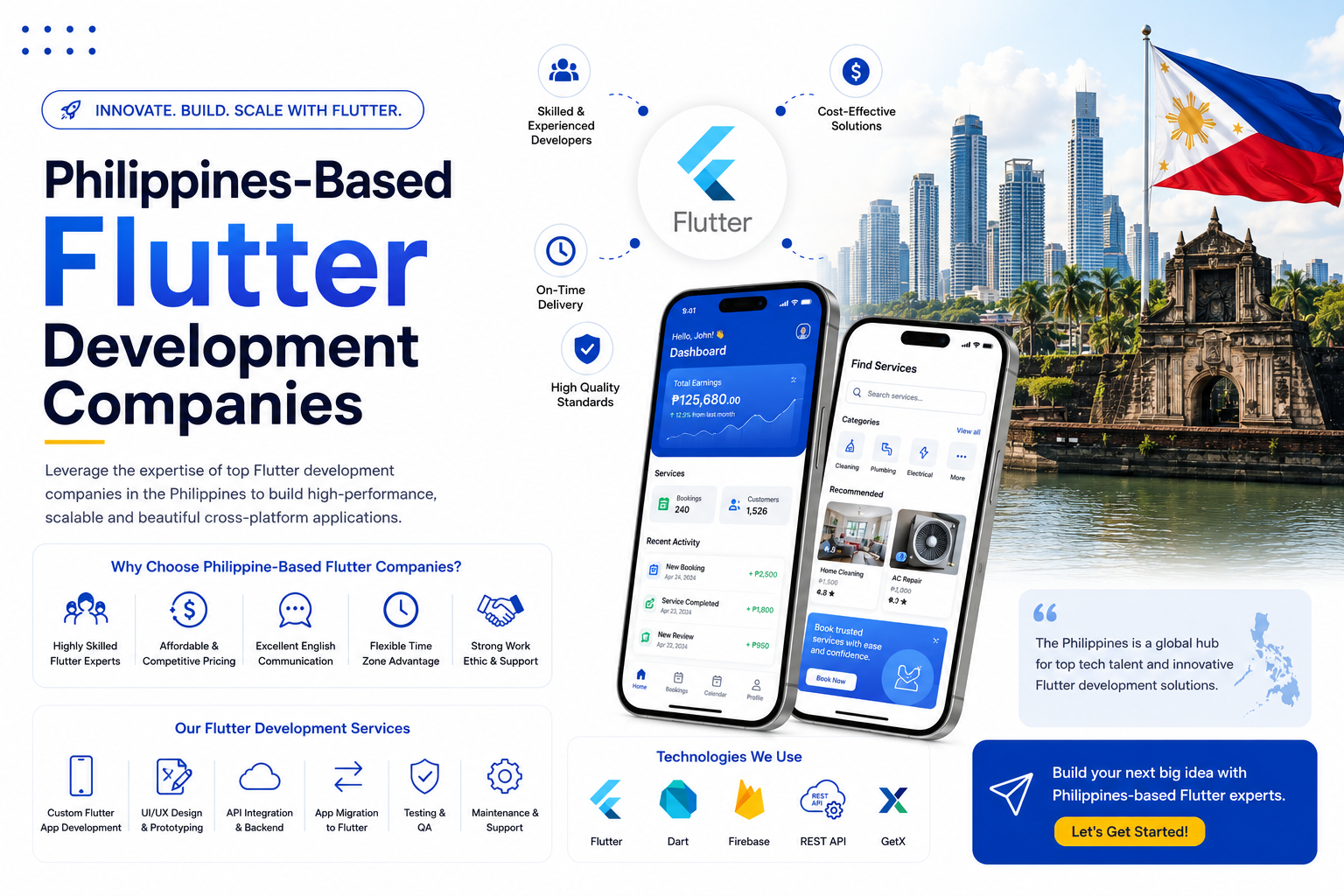
The Philippines has grown into one of the most credible Flutter development hubs in Asia. When most people think of outsourcing to the Philippines, they picture customer support or back-office work. The reality in 2026 is considerably different. Filipino Flutter development teams are shipping production-grade cross-platform apps for healthcare platforms in Australia, logistics companies in the US, and fintech products across Southeast Asia. The talent pool is deep, the cost advantage over Western markets remains real, and the timezone overlap with major client geographies has proven workable for thousands of distributed teams.
The keyword bringing many readers to this page is Flutter Development Company Philippines, and this guide addresses exactly that search intent: not with superficial listings, but with company profiles built around the details that actually inform a hiring decision.
Why the Philippines Has Become a Flutter Development Hub Worth Paying Attention To
There is a reason companies from the US, UK, Australia, and Singapore keep returning to the Philippines for mobile development work. It is not just about cost savings, though those are real. It is about a combination of factors that took years to converge.
Filipino developers have a strong command of English, which is not a small thing. Miscommunication in software projects does not just create awkward meetings; it creates defects, scope gaps, and delays. Teams that can discuss product requirements, challenge assumptions, and flag concerns in the same language as the client tend to ship more accurate software. The Philippines benefits from a decades-long relationship with English as a professional language, and that shows in how Flutter teams engage with clients.
Beyond communication, the educational pipeline into software development has matured significantly. Universities in Metro Manila, Cebu, and Davao now produce graduates with exposure to modern frameworks including Flutter and Dart, and a generation of developers who started their careers on React Native have moved into Flutter as the framework's maturity became undeniable.
The time zone factor is also worth naming plainly. Philippine Standard Time sits in a position that gives meaningful working overlap with both Australian eastern time zones and late-afternoon US Pacific time. For teams running daily standups or weekly sprint reviews, that overlap is genuinely functional rather than theoretical.
And then there is the rate structure. Experienced Flutter developers in the Philippines typically cost between 30 and 60 percent less than equivalent talent in Western markets, without the same quality gap that existed in the early years of offshore development. That range varies depending on the company's positioning, team seniority, and engagement model, but the arbitrage is real and meaningful for companies managing product development budgets carefully.
25 Flutter Development Companies in the Philippines Worth Evaluating
Each profile below covers the information that actually shapes a vendor decision: location, team size, area of expertise, client context, and the specific characteristic that makes that company worth considering.
1. Exist Software Labs
2. Stratpoint Technologies
3. Backend Development Company
4. MicroSourcing
5. Azeus Systems
6. HireFullStackDeveloperIndia
7. Lenddo (now VerifyMe Philippines)
8. QBO Innovation Hub (QBO Tech)
9. HireAIDevelopers
10. Pointwest Technologies
11. Sourcefit Philippines
12. DataEximIT
13. Accenture Philippines (Mobile Practice)
14. SION IT Services
15. WebClues Infotech
16. Coredev Technologies
17. Yondu Inc.
18. Mobius Technology Solutions
19. Sprout Solutions
20. IdeaSpace Foundation (Tech Builders)
21. Nexus Studios PH
22. IPC (iPeople Corporation Philippines)
23. Accenture Flex PH (Consulting Mobile Unit)
24. KMC Solutions (Tech Staffing Division)
25. Penbrothers Tech Division
How to Evaluate a Flutter Development Company Philippines Vendor Without Getting Burned
Having a list of 25 companies is useful. Knowing how to interrogate that list is what actually protects you. Here are the evaluation dimensions that matter most, and that most decision-makers overlook.
- Ask Specifically About Dart Version History and State Management Approach
Flutter development quality varies enormously depending on how a team manages state, handles navigation, and structures its Dart code. Generic answers like "we use best practices" are red flags. Ask them to walk you through a recent project's architecture. Ask which state management library they favor and why. The answer tells you whether you are dealing with practitioners or generalists. - Request a Sample of Real App Performance Metrics
Flutter has a reputation for smooth 60 or 120 frames per second rendering, but only when implemented well. Ask vendors for Lighthouse or Flutter DevTools screenshots from a live app they built. If they cannot produce real performance data, that is informative. - Understand the Ownership Structure of Your Code
Some Philippine vendors use proprietary internal frameworks or component libraries that technically sit between you and your own codebase. When you leave, those proprietary layers stay with them. Make sure your contract specifies full source code ownership and that no third-party proprietary frameworks are embedded in the deliverable without full licensing clarity. - Test Communication Before You Sign Anything
Run a short discovery or scoping exercise with your shortlisted vendors before committing. Notice how they document requirements, how they respond to ambiguity, and how quickly they identify gaps in the brief. That behavior during the sales process is a reasonable predictor of how they will operate during delivery. - Understand Rate Structures Beyond the Headline Number
Philippine Flutter vendors typically quote either a monthly retainer for a dedicated team, a fixed project fee, or a time-and-materials rate. Each model creates different incentive structures. Fixed-price contracts protect budget but often trade flexibility for scope rigidity. Time-and-materials models give flexibility but require stronger project management oversight on your side. Understand which model you are entering and what the overrun clauses look like.
What Flutter Development Actually Costs When You Source From the Philippines
Cost transparency is rare in vendor guides. Most blogs wave at ranges without giving you the context to know whether a quote is reasonable. Here is a clearer picture for 2026.
Junior Flutter developers in Philippines (one to three years of experience) typically cost between USD 800 and USD 1,500 per month on a dedicated engagement. Mid-level developers with strong production app experience range from USD 1,500 to USD 2,800. Senior Flutter engineers with architecture experience, strong Dart proficiency, and cross-platform release management skills command USD 2,800 to USD 4,500 per month, which still represents a substantial discount to comparable talent in the US or UK where the same profile costs USD 8,000 to USD 14,000 monthly.
Project-based pricing adds a different layer. A clean, well-scoped Flutter app with standard features (authentication, two or three primary screens, API integration, push notifications) typically costs between USD 15,000 and USD 40,000 from a mid-market Philippine vendor. Complex apps with real-time data syncing, offline capabilities, custom animations, and multi-platform release management fall in the USD 40,000 to USD 100,000 range. Enterprise-grade apps with compliance requirements, heavy third-party integrations, and extensive testing cycles can exceed USD 150,000.
These ranges also shift depending on whether the vendor is a large company with management overhead or a lean, specialized shop. A 500-person firm carries more infrastructure cost that eventually appears in your rate. A focused 60-person Flutter-first studio may deliver comparable quality at a lower blended rate because their cost base is leaner.
Hidden costs worth budgeting for include project management time (expect to spend 10 to 15 percent of the project timeline on your own oversight even with a strong vendor), App Store and Google Play submission cycles (each rejection adds days), and post-launch support which many vendors price separately from the build contract.
Conclusion
Shortlisting a Flutter Development Company Philippines vendor is not really a research problem. The information is available. It is a judgment problem: deciding which signals matter, which ones are noise, and which companies have the specific combination of capability, communication, and cultural fit that your product and team actually need.
The 25 companies in this guide represent a genuinely broad cross-section of what the Philippine Flutter development market looks like in 2026. Some are large enough to absorb enterprise-scale complexity. Some are lean enough to move fast on startup timelines. Some bring niche strengths in AI integration, IoT, data pipelines, or compliance-heavy sectors that make them the right choice for very specific products.
No list makes the decision for you. But a well-built list narrows the field to where the decision becomes manageable. That is what this guide is designed to do.
Take your top three to five candidates through a structured discovery conversation. Examine
their code if they will show it. Talk to one or two of their previous clients if you can. And pay
close attention to how clearly and directly they answer questions about past failures or project challenges. The vendors who can discuss what went wrong on a past project and what they did about it are almost always more trustworthy than the ones whose portfolio is nothing but success stories.
The right Flutter partner is out there. This guide is a starting point for finding them.