
So you have a project in mind. Maybe a web app, an AI tool, a data pipeline, or an automation system. You know Python is the way to go. And now comes the big question that everyone eventually asks: what is this actually going to cost me?
The answer is not as simple as a flat number. The cost to hire a Python developer depends heavily on where that developer is based. A senior Python engineer in San Francisco is going to charge a very different rate than an equally skilled developer sitting in Bangalore or Warsaw. And before you assume cheaper always means better value, or that expensive always means higher quality, let us actually walk through everything you need to know.
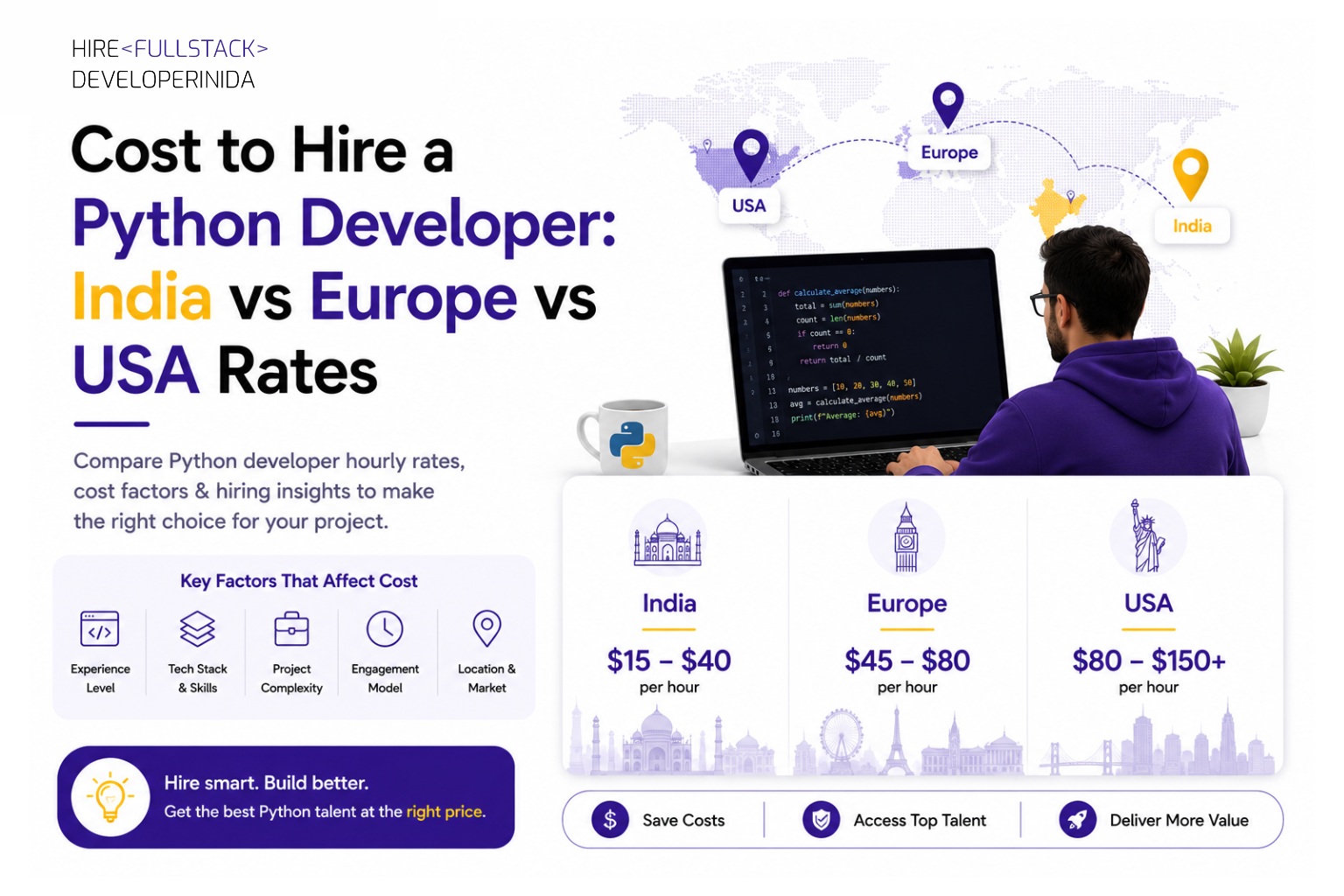
In this blog, we break down the Python developer hourly rate comparison across India, Europe, and the USA. We also cover hidden costs, engagement models, skill levels, and what you should actually be paying for in 2026.
Why Python? A Quick Reality Check
Before we get into the numbers, here is a short reminder of why you are probably here in the first place. Python has become one of the most in-demand programming languages in the world and in 2026, that demand is only growing stronger.
From machine learning and AI development to backend APIs, data analytics, automation scripts, and fintech platforms, Python is everywhere. It is beginner friendly but also powerful enough for enterprise-grade systems. That versatility means Python developers are needed across every industry and that keeps their rates competitive globally.
Now let us talk money.
What Factors Actually Affect the Cost to Hire a Python Developer?
Before jumping into the regional comparison, it helps to understand what drives the numbers. Here are the main factors that influence how much you will pay:
Experience and Skill Level
A junior developer who just finished their bootcamp charges less than a mid-level developer with three years of experience on real projects. And a senior or lead developer with deep expertise in Django, Flask, FastAPI, or ML frameworks like TensorFlow and PyTorch will cost significantly more. Always factor in experience when you compare rates.
Location
This is the biggest variable. Developer salaries and freelance rates are deeply tied to the local cost of living, the local tech market, and regional demand. A developer in rural India earns very differently from one in Mumbai, and a developer in Eastern Europe charges differently from one in London.
Engagement Model
Are you hiring full-time? Part-time? Project-based freelance? Or going through an agency or outsourcing firm? Each model has a different cost structure and a different level of commitment on both ends.
Tech Stack Specialization
A Python developer who also knows AWS, Docker, Kubernetes, or has deep NLP and generative AI experience is going to cost more than someone doing basic scripting. Specialization commands a premium.
Type of Project
Short-term projects or simple scripts are priced differently from ongoing product development or complex enterprise systems. Always be upfront about project scope when discussing rates.
Python Developer Rates in the USA
Let us start with the most expensive market and the one that often sets the global benchmark.
In 2026, the United States remains the highest-paying market for Python developers. Whether you are hiring through a staffing agency, a freelancing platform like Toptal or Upwork, or directly as a full-time employee, expect to pay premium rates.
These numbers include cities like San Francisco, New York, Seattle, and Austin, where the tech market is extremely competitive. If you are in a smaller city or hiring remotely within the US, rates can dip slightly but rarely go below $60 per hour for a competent Python developer.
One thing to note is that US-based developers usually come with a fully professional setup, timezone alignment if you are US-based, strong communication, and legal simplicity. But those benefits come at a real cost.
If you are building a startup with limited runway, hiring a full team of US-based Python developers can drain your budget fast. This is why many founders and product leaders look at other markets.
Python Developer Rates in Europe
Europe is a mixed bag in the best possible way. The continent has a huge variation in developer rates depending on whether you are looking at Western Europe like Germany, UK, Netherlands, or France versus Central and Eastern Europe like Poland, Ukraine, Romania, and Bulgaria.
Western Europe
Western European developers are close in rate to the US in many cases. They often work in strong time zones for US companies and have excellent education systems producing top-tier engineers.
Central and Eastern Europe (CEE)
This is where Europe gets really interesting for businesses looking to balance quality and cost. Countries like Poland, Romania, Czech Republic, and Ukraine have produced a strong tech workforce over the past decade.
The CEE region is extremely popular for nearshoring. European time zones make communication easy, the cultural fit with Western businesses is solid, and developer quality is consistently high. In 2026, this region continues to attract massive investment from tech companies looking for scalable teams without the US price tag.
Python Developer Rates in India
India is the world's largest tech outsourcing hub and for good reason. With over five million software developers and a growing number of Python specialists, India offers some of the most competitive rates in the global market.
In 2026, Indian Python developers remain highly sought after for outsourcing, product development, and remote team building. Here is a realistic breakdown of what you can expect:
India has several major tech hubs including Bangalore, Hyderabad, Pune, Chennai, and Delhi NCR where a large concentration of talented developers work. Many of them have worked with global clients, hold certifications in cloud platforms and AI, and are fully comfortable working in English.
One thing that has changed in 2026 is the rise of quality-first Indian developers. The days of bulk outsourcing with mixed results are giving way to specialized dev shops and boutique agencies that focus on specific domains like fintech, health tech, and AI. These teams charge more but deliver consistently.
Python Developer Hourly Rate Comparison: Side by Side
Here is a clean Python developer hourly rate comparison across all three regions so you can see the full picture at once:
As you can see, the spread is significant. A senior Python developer in the US can cost three to four times more per hour than an equally experienced developer in India. Eastern Europe sits in a sweet spot between cost and proximity for European businesses.
The Hidden Costs You Often Forget to Budget For
Rates are just the starting point. When you hire Python developer talent, there are additional costs that people often overlook, especially when hiring internationally.
Recruitment and Vetting Costs
Whether you use a recruiter, a platform, or do it yourself, finding good Python talent takes time and money. Technical screening, portfolio reviews, test projects, and interviews all add up. Some platforms charge 10 to 20 percent of the first-year salary as a placement fee.
Onboarding and Ramp-Up Time
No developer, no matter how good, hits the ground running on day one. You are paying for their time while they learn your codebase, your tools, and your team processes. For complex projects, this can take two to six weeks.
Project Management Overhead
When working across time zones, you need clear project management. This means tools like Jira, Slack, Notion, and dedicated time for standups and reviews. The cost of a project manager or even just your own time managing developers is real.
Infrastructure and Tools
Your developer needs access to your development environment, version control, cloud infrastructure, and testing tools. This is often forgotten in budget planning.
Quality Assurance
Good code needs testing. Whether you have a dedicated QA team or your developers are expected to test their own work, this effort has a cost. Skipping QA is how expensive bugs end up in production.
Communication and Time Zone Gaps
Hiring the cheapest developer on the planet means nothing if it takes 24 hours to get a response to a critical question. Time zone misalignment adds invisible overhead that compounds over a long project. Factor this in seriously.
Which Engagement Model Makes the Most Sense for You?
When you decide to hire Python developer talent, you have a few different ways to structure that engagement. Here is a quick breakdown:
Freelancers
Great for short-term tasks, bug fixes, or specific features. Platforms like Upwork, Toptal, and Freelancer.com connect you with thousands of Python developers globally. Rates vary wildly, so always check reviews, portfolios, and do a small test project first. Freelancers give you flexibility but not always reliability.
Dedicated Remote Developers
Many companies now hire dedicated remote developers directly or through a staffing agency. This model works well for long-term product development. The developer works exclusively or primarily for you, they join your standup meetings, use your tools, and become part of your virtual team. India and Eastern Europe are the go-to regions for this model in 2026.
Outsourcing to an Agency or Dev Shop
If you want a team to take on a project end to end, outsourcing to a development agency can make sense. You get a project manager, developers, designers, and QA under one roof. The cost is higher than hiring individual developers but the accountability and structure are better. Indian agencies and Eastern European firms are particularly strong in this model.
Full-Time In-House Hiring
If your product is core to your business and requires continuous development, hiring full-time in-house makes long-term sense. Yes, the cost is higher especially in the US and Western Europe but you get cultural alignment, faster communication, and deeper investment in your product.
Quality vs Cost: The Honest Truth
People often ask: is it worth saving money by hiring in India or Eastern Europe, or do you get what you pay for?
The honest answer is that quality is not tied to geography. It is tied to the individual developer, their experience, their communication skills, and their work ethic. There are brilliant developers in India who outperform average developers in the US. And there are mediocre developers everywhere.
What geography does affect is the average rate and the typical supply. India has a larger pool of mid-level and junior developers at lower rates, which makes it great for scaling teams. Eastern Europe tends to have a stronger culture of engineering excellence and closer timezone alignment for European businesses. The US offers the highest density of specialized talent in cutting-edge fields like AI and ML.
The key is to vet carefully no matter where you are hiring from. Use structured interviews, code challenges, portfolio reviews, and reference checks. Do not let the hourly rate be your only filter.
What Has Changed in 2026 and What You Should Know
The developer market in 2026 looks a bit different from even two years ago. Here are some trends worth knowing before you start hiring:
- AI-assisted development is now standard. Python developers who know how to use tools like GitHub Copilot, Claude, and other AI coding assistants are more productive. Look for developers who have adapted to this workflow.
- Generative AI and LLM expertise commands a serious premium. If you need a Python developer who can work with large language models, RAG pipelines, or agent-based systems, expect to pay 20 to 40 percent more than standard rates.
- Remote work is fully normalized. This means more Indian and Eastern European developers are now working directly for US and European companies rather than through agencies. This opens up great direct hiring opportunities.
- The Indian rupee and Eastern European currencies have not kept pace with inflation in the same way as the US dollar or Euro, which means the cost advantage of these regions has actually grown slightly in 2026.
- Companies are now more selective about outsourcing partners. The race to the bottom on pricing has largely ended. Businesses want quality, communication, and reliability over rock-bottom rates.
How to Hire Python Developer Talent Without Making Costly Mistakes
Here are some practical tips before you make your first hire:
Define Your Requirements Clearly
Before you post a job or approach a developer, know exactly what you need. What frameworks will they work in? What is the expected output? What are your timelines? Vague requirements lead to vague candidates.
Use a Technical Assessment
Always include a short technical test. It does not need to be a full project but a practical coding task that reflects real work. This filters out developers who look great on paper but struggle with actual execution.
Prioritize Communication Skills
Especially for remote hires, communication is half the job. A developer who writes clear messages, asks good questions, and gives proactive updates is worth more than a genius who goes silent for days.
Start with a Small Paid Trial
Before committing to a long engagement, run a short paid trial project. This lets you see how they work in practice before you are fully invested.
Check Their Portfolio for Relevant Experience
Python is used for so many different things. Make sure their portfolio shows experience relevant to your needs. A developer who has built machine learning pipelines may not be the best fit for building REST APIs, and vice versa.
So What Should You Actually Budget?
Here is a practical guideline to help you plan:
- If you are a US-based startup with a modest budget, a strong Eastern European or Indian senior developer or small team is your best value. Budget $40 to $75 per hour for solid talent.
- If you need cutting-edge AI or ML work, expect to pay a premium regardless of location. Senior AI-focused Python developers start at $70 per hour even in India and can go to $200 per hour in the US.
- If you are building a long-term product and need a dedicated team, a 3 to 5 person team in India or Eastern Europe can deliver strong results at $15,000 to $40,000 per month total, depending on seniority.
- If you are a European business, Eastern European developers offer the best balance of cost, quality, and timezone alignment. Budget $45 to $85 per hour for mid to senior talent.
The key takeaway is that there is no one-size-fits-all answer. The right hire is the one that matches your project needs, your budget, your timeline, and your communication style. Use this blog as a starting point for your planning and always do your own due diligence.