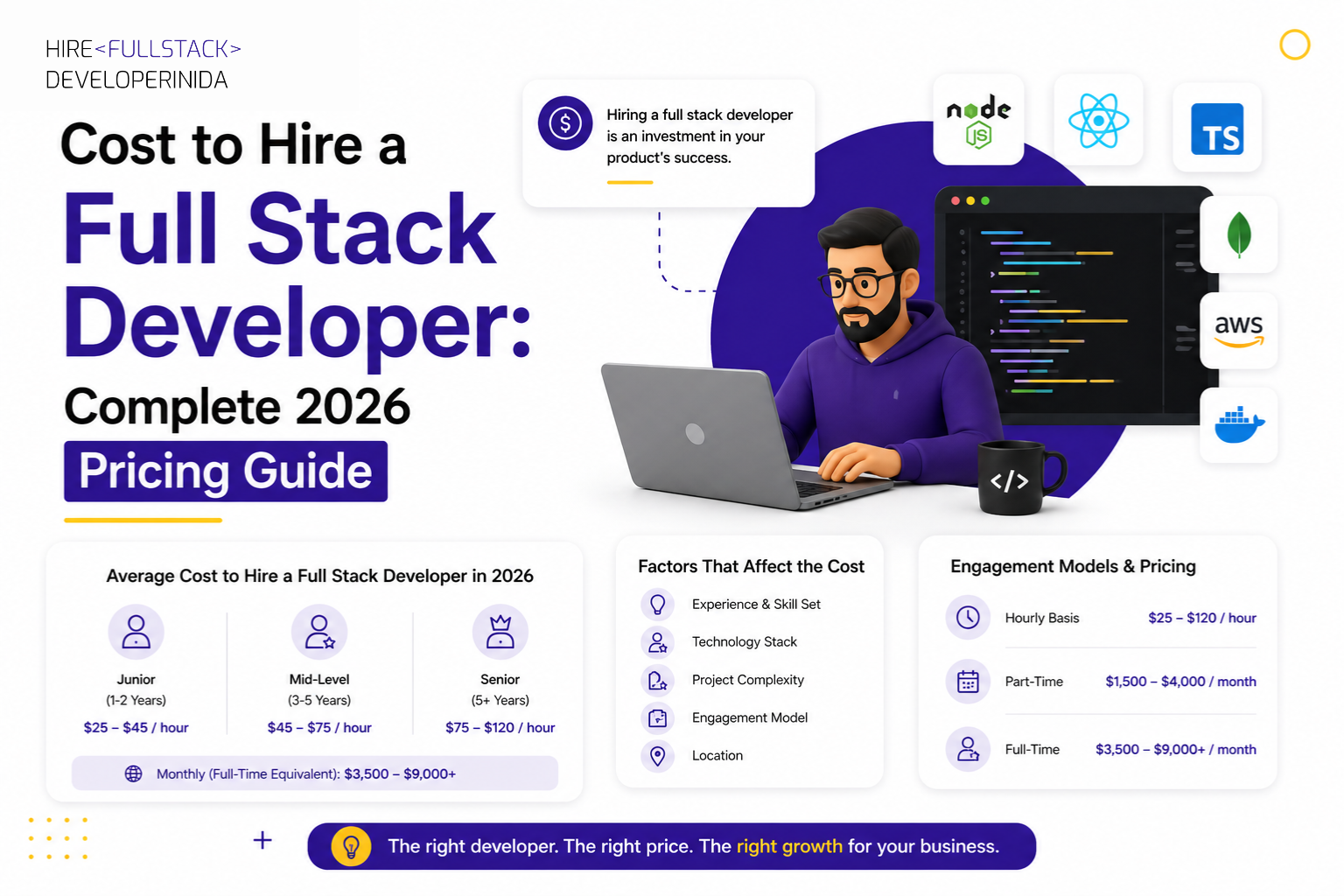

You googled it. You found a dozen articles with perfect-looking salary charts. And now you are more confused than before.
That is the problem with most content on full stack developer cost 2026. It gives you numbers without context. It shows you averages without telling you WHY those averages are misleading for your specific situation.
So let us do this differently. This guide is going to walk you through the real cost of hiring a full stack developer in 2026, including the parts that most blogs skip entirely. We are talking about the hidden costs, the pricing traps, the geography tricks, and the honest truth about what cheap actually costs you in the long run.
Whether you are a startup founder trying to ship your first product, a business owner modernizing your tech stack, or a project manager trying to build a budget, this is the guide you actually needed.
First Things First: What Exactly Are You Paying For?
Here is something nobody tells you upfront. When you hire a full stack developer, you are not just paying for code. You are paying for:
- Frontend skills (React, Vue, Angular, the stuff users see and touch)
- Backend skills (Node.js, Python, databases, APIs, the logic behind the scenes)
- DevOps basics (deployment, cloud hosting, CI/CD pipelines)
- Problem solving under pressure
- Communication and ability to translate business needs into technical decisions
A developer who can genuinely do all of this well is rare. And rare things cost money. Keep that in mind as we go through the numbers.
The Big Picture: Full Stack Developer Cost 2026 by Hiring Model
There are basically four ways you can bring a full stack developer onto your project. Each comes with a completely different price tag and a completely different set of tradeoffs.
Option 1: Hire In House (Full Time Employee)
This is the most expensive option on paper, but often the most cost effective over the long term for ongoing projects.
But wait. These are just base salaries. Here is the part most budget conversations skip entirely.
So a developer with a $130,000 salary in the US can realistically cost you $165,000 to $185,000 per year when you add everything up. That is the real full stack developer cost 2026 that nobody puts in the headline.
Option 2: Hire a Freelancer
Freelancers are fantastic for project based work. You pay for what you need, and nothing more.
The catch with freelancers? You often get exactly what you pay for. A $20 per hour developer might cost you double in the long run if you spend weeks fixing bugs or redoing work. More on that later.
Option 3: Work With a Dev Agency or Outsourcing Company
Agencies come in all shapes and sizes. Some are premium boutique studios. Others are offshore teams with a polished sales website.
Agencies are ideal when you need a full team quickly and do not want to manage individual hires. The extra cost usually covers project management, quality assurance, and accountability.
Option 4: Staff Augmentation
This is the model that blew up in 2024 and 2025 and is now completely mainstream in 2026. You bring in a developer through a staffing partner, and they work as part of your team but are technically employed elsewhere.
- Cost is typically 20 to 40% lower than a direct hire with full benefits
- You get dedicated developers without the long term commitment
- The vendor handles HR, taxes, equipment, and compliance
- You lose some control compared to a direct employee
Staff augmentation monthly rates in 2026 typically range from $5,000 to $18,000 per developer depending on seniority and location.
Experience Level Matters More Than You Think
Across every hiring model, the single biggest cost driver is experience level. And in 2026, the gap between junior and senior developers has actually widened compared to previous years because AI tools have made junior work easier to automate, pushing more value toward truly experienced engineers.
The honest advice here: Resist the urge to hire junior developers to save money on anything that is customer facing or business critical. A senior developer can often do in two weeks what takes a junior three months, with fewer bugs and better architecture decisions.
The Geography Game: Where Your Developer Lives Shapes Everything
In 2026, geography is no longer just about salary. It is about timezone overlap, communication fluency, cultural work norms, legal compliance, and quality consistency.
The True Cost of Going Cheap Offshore
Here is a scenario that plays out constantly. A startup hires a developer from a low cost market at $18 per hour. The code looks fine at first. Then:
- Bugs start showing up in production that were not caught
- Communication takes hours per day because of timezone and language gaps
- The developer disappears for two weeks during a critical phase
- The startup hires a senior developer to review the codebase and finds it needs a partial rewrite
That $18 per hour developer ended up costing more than a $70 per hour Eastern European developer would have. This is not a knock on any region. There are world class developers everywhere. The point is that the hourly rate tells you almost nothing on its own.
The Sweet Spot Regions in 2026
Based on quality, communication, timezone flexibility, and cost, these regions are consistently delivering strong value in 2026.
- Eastern Europe (Poland, Romania, Ukraine, Czech Republic): Strong technical education, European timezone, English proficiency, rates of $35 to $80 per hour
- Latin America (Colombia, Argentina, Brazil, Mexico): US timezone or close to it, fast growing talent pool, rates of $30 to $75 per hour
- India (Tier 1 cities: Bangalore, Hyderabad, Pune): Massive talent base, strong English, improving communication norms, rates of $20 to $60 per hour
- Southeast Asia (Philippines, Vietnam): Growing technical quality, often underrated, rates of $20 to $55 per hour
Project Type Changes Everything: What Does Your Build Actually Need?
The full stack developer cost 2026 also depends heavily on what you are building. Not every project needs the same level of complexity or seniority.
These are full project cost estimates, not monthly rates. Most projects of any real complexity take three to twelve months to build properly, and then require ongoing maintenance.
The Hidden Costs Nobody Puts in the Budget
This is the section most pricing guides completely ignore. Let us fix that.
- Maintenance and Updates
Once your product is live, it needs constant care. Servers need updating. Dependencies become outdated. Security patches need applying. Features need tweaking based on user feedback. Budget at least 15 to 25% of your initial development cost every year for maintenance. A $60,000 app realistically needs $9,000 to $15,000 per year just to stay healthy. - Tech Debt Is a Real Bill
Shortcuts taken during development create tech debt. And tech debt accumulates interest. That feature that would have taken two days to build properly but was rushed in four hours? It might cost you a week of developer time to untangle six months later. This is an invisible cost that sneaks up on growing companies. - The Integration Tax
Modern apps talk to other services. Payment gateways, CRMs, analytics tools, communication APIs, authentication providers. Each integration takes extra development time. Each one needs monitoring. Budget an extra $500 to $3,000 per major third party integration, both upfront and for ongoing maintenance. - Scaling Costs
A developer who built your MVP beautifully might not have the skills to architect a system that handles 100,000 users. Scaling often means bringing in a more senior developer or architect for a short engagement to redesign parts of the system. This is normal and expected, but it costs money. Plan for it. - Turnover Is Expensive
If you hire full time and your developer leaves, you are looking at three to six months of recruitment time, plus training a replacement, plus the productivity dip. Industry studies consistently put the cost of replacing a software developer at 50 to 200% of their annual salary when you factor in lost productivity and rehiring costs.
What Changed in 2026: New Factors Affecting Developer Pricing
The hiring landscape in 2026 is genuinely different from even two years ago. Here is what is reshaping the market right now.
AI Tools Changed the Productivity Equation
Developers using GitHub Copilot, Claude, Cursor, and similar tools are significantly more productive than developers who are not. A skilled developer with good AI tool fluency can realistically do 30 to 50% more in the same time. Some companies are using this as an argument to pay less. Smarter companies are using it as a reason to hire fewer but more skilled developers who can leverage these tools effectively.
Remote Work Is Fully Normalized
The premium that US based developers once commanded for being local has compressed significantly. Companies are now comfortable hiring from anywhere as long as there is timezone overlap and strong communication skills. This has created more competition and, ironically, has stabilized salaries at the senior level while putting downward pressure on junior and mid level rates.
Specialization Commands Premium Pricing
In 2026, the most expensive full stack developers are not the ones who know the most frameworks. They are the ones who combine technical skills with domain expertise. A full stack developer who deeply understands fintech compliance or healthcare data regulations or e-commerce conversion optimization can command 30 to 60% more than a generalist with equivalent coding ability.
Contract to Hire Is Now the Standard
Fewer companies are making straight permanent hires without a trial period. The contract to hire model (where you bring someone on as a contractor for three to six months before offering a full time role) is now the dominant approach for many organizations. This protects both sides and has changed how developers structure their availability.
How to Actually Budget for Hiring a Full Stack Developer
Here is a simple framework that works for most situations.
A project you think will cost $40,000 should realistically be budgeted at $55,000 to $65,000 if you want it to actually get done without cutting corners.
Quick Sanity Check: Red Flags When Hiring
Before you sign any contract or transfer any deposit, watch out for these warning signs:
- Rates that seem impossibly low for what they claim to deliver
- No portfolio or only mockups with no live links
- Vague answers when you ask about their specific experience with your tech stack
- Reluctance to do a small paid test project before committing
- No clear process for communication, updates, or milestone delivery
- Requests for a very large upfront payment before any work is shown
- No contract or a contract full of vague language about deliverables
The Bottom Line
There is no single right answer to how much a full stack developer costs in 2026. The honest answer is that it depends entirely on what you need, where they are, how long you need them, and how critical the work is to your business.
What we hope this guide made clear is that the number on the rate card is almost never the actual number. Full stack developer cost 2026 is about the total cost of the outcome, not just the hourly rate or the salary. When you hire well, you invest in speed, quality, and fewer problems down the road. When you hire cheap, you often pay more in the end.
Take your time, define your needs clearly, budget realistically, and treat your developer well. The best ones have options, and they choose clients who respect their work.