
Think about the last time you had a genuinely smooth restaurant experience. Orders came out right. The table was ready when promised. The loyalty points actually showed up. The app worked without crashing. That experience did not happen by accident. Behind it was a stack of coordinated software doing a lot of heavy lifting.
The restaurant industry runs on tight margins, high staff turnover, and customer expectations that shift constantly. A POS terminal and a basic ordering page were enough five years ago. In 2026, they are the bare minimum. Restaurants that compete seriously across dine-in, takeaway, delivery, reservations, and loyalty programs are operating full-blown digital ecosystems, not just apps.
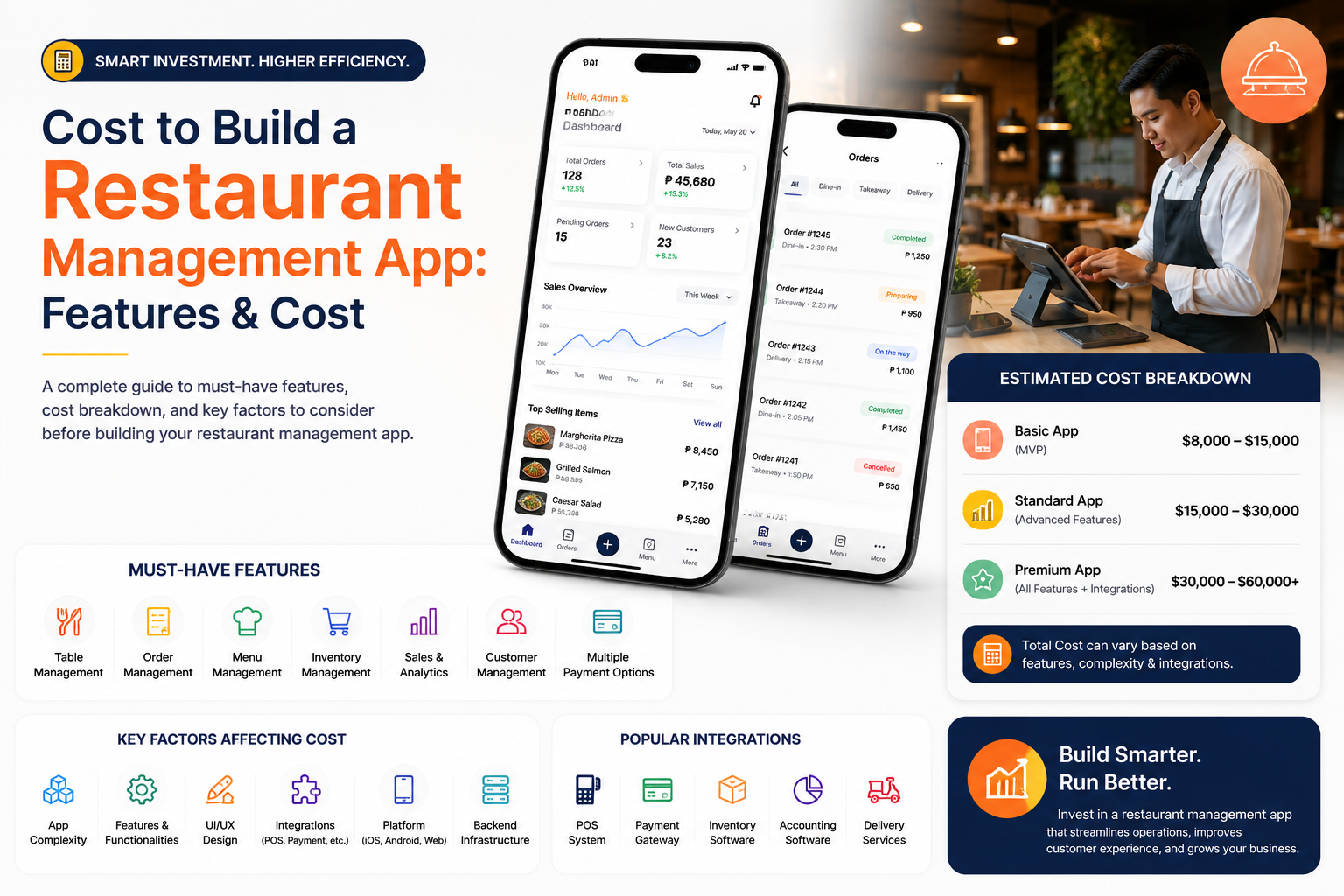
If you are planning to build a restaurant management platform, whether for your own brand, a restaurant chain, or as a SaaS product for the hospitality sector, the cost to build a restaurant management app is one of the first questions you will ask. This guide is not going to give you a vague range and call it a day. We are going to break down costs by panel, by feature set, by AI capability, and by development stage, so you can make a decision based on actual numbers.
What Is a Restaurant Management App?
A restaurant management app is not just the customer-facing screen where someone picks a burger and pays. It is a connected system of multiple panels and modules that coordinate every operational layer of a restaurant business.
Here is how it differs from basic POS software:
The shift from POS to a full management ecosystem is not optional for growing restaurant brands. It is the infrastructure that enables loyalty programs, ghost kitchen coordination, real-time inventory control, and the kind of customer experience data that actually informs business decisions.
Complete Restaurant Management App Architecture
A production-ready restaurant management platform involves multiple interconnected panels. Each one serves a specific audience with specific workflows. Here is a breakdown of every component you need to plan for.
1. Restaurant Admin Panel
The admin panel is where restaurant owners and managers run the business. It is the operational nerve center.
• Dashboard: Real-time overview of orders, revenue, table occupancy, and kitchen status. Gives managers an at-a-glance pulse of daily operations.
• Menu management: Add, edit, and schedule menu items with pricing, photos, dietary tags, and availability windows. Critical for seasonal menus and multi-location consistency.
• Inventory management: Track ingredient stock levels, set low-stock alerts, and connect depletion to orders placed. Reduces waste and prevents mid-service shortages.
• Order management: Monitor all incoming orders across channels in one view. Flag delays, resolve issues, and push orders manually when needed.
• Table management: Visual floor plan with real-time occupancy status. Helps staff seat guests efficiently and reduces idle table time.
• Reservation management: Accept, modify, and cancel reservations. Send automated reminders and manage waitlists during peak hours.
• Staff management: Assign roles, track shift schedules, monitor attendance, and manage access permissions across the platform.
• Kitchen monitoring: Live connection to the Kitchen Display System (KDS) to track preparation status and flag bottlenecks before they cascade.
• Analytics: Revenue trends, popular items, peak hour data, customer retention metrics, and staff performance reports.
• Customer database: Centralized profiles with order history, preferences, dietary notes, and loyalty points.
• Loyalty management: Set up and manage reward programs, send targeted offers, and track redemption rates.
• Multi-location management: For chains, manage menus, pricing, and staff across all branches from one interface.
2. Customer Mobile App
This is the front door of your digital experience. A poorly designed customer app drives users to competitors. A well-built one increases repeat orders and loyalty.
• Registration and social login: Frictionless onboarding through email, phone, or social accounts. Every extra step in sign-up loses users.
• Menu browsing: Visually rich menus with filters for dietary preferences, allergens, and cuisine type. Speed of loading matters here.
• Table reservations: Real-time availability, party size selection, and special requests. Confirmation and reminder flow included.
• Online ordering: Supports dine-in pre-ordering, takeaway, and delivery from a single interface. Modifiers, add-ons, and special instructions supported.
• Delivery tracking: Live GPS tracking for delivery orders with estimated arrival updates. Reduces customer service calls significantly.
• Digital payments: Multiple payment methods including cards, wallets, UPI, and buy-now-pay-later options. PCI compliance is non-negotiable.
• Reviews and ratings: In-app feedback tied to specific orders, not just the restaurant overall. Gives owners item-level insight.
• Loyalty points: Automatic earning and redemption with clear balance visibility. Gamification drives repeat visits.
• Reorder functionality: One-tap reordering of previous meals. Surprisingly high conversion feature for regular customers.
3. Waiter and Staff App
The staff app brings tableside efficiency. It eliminates paper pads, reduces order entry errors, and speeds up kitchen communication.
• Table assignment: Staff can see which tables they own and track occupancy status in real time.
• Order taking: Digital order entry with modifiers and special instructions sent directly to the kitchen. No verbal relay errors.
• Kitchen communication: Push updates from the floor to the kitchen and receive prep status back. Reduces the back-and-forth between front and back of house.
• Billing and payments: Generate bills, apply discounts, split checks, and process payments tableside.
• Shift tracking: Clock in and out, view assigned tables, and access shift notes from management.
4. Kitchen Display System (KDS)
The KDS is one of the most underrated components in restaurant tech. It replaces printed tickets and verbal call-outs with a live digital screen that kitchen staff can see and interact with.
• Live order queue: All incoming orders displayed in real time, colour-coded by channel (dine-in, takeaway, delivery).
• Preparation status: Kitchen staff mark items as in-progress and completed. Admin and waiter panels update automatically.
• Priority management: Urgent orders, late orders, or high-value table orders flagged for faster handling.
• Order completion tracking: Completed orders are archived with timestamps. Useful for measuring kitchen speed and identifying bottleneck dishes.
Restaurants that move from verbal coordination to a KDS typically see order accuracy improve significantly and average preparation time drop by 15 to 25 percent.
5. Delivery Partner App
If you operate your own delivery fleet rather than relying entirely on third-party platforms, a delivery partner app is essential.
• Order assignment: Automatic or manual assignment based on proximity and availability.
• Route navigation: Integrated maps with optimized routing, especially useful for multi-stop delivery batches.
• Status updates: Partners update pickup, in-transit, and delivered statuses. Customer and admin panels sync in real time.
• Earnings dashboard: Partners see completed deliveries, earnings, and payment summaries.
6. Host and Reception Panel
For full-service restaurants with significant foot traffic, the host panel manages the experience before a guest even sits down.
• Reservation management: Check upcoming bookings, confirm arrivals, and modify reservations in real time.
• Waitlist management: Add walk-in guests to a digital waitlist with estimated wait time communication via SMS.
• Table allocation: Assign available tables based on party size and seating preferences.
• Customer arrival tracking: Mark guests as arrived, seated, or departed. Feeds into table availability for reservations.
7. Super Admin Panel (For Restaurant Chains)
If you are building a platform for a restaurant chain or a white-label SaaS product, the super admin panel is where everything is controlled at scale.
• Franchise management: Onboard new locations, assign territories, and manage franchise-specific configurations.
• Multi-branch control: Push menu updates, pricing changes, and policy changes across all branches simultaneously.
• Centralized reporting: Consolidated revenue, order volume, and customer data across all locations. Essential for strategic decision-making.
• Role management: Define and assign access levels for corporate staff, branch managers, and franchisees.
• Configuration management: Control which features are enabled per location, per tier, or per subscription plan.
Development Cost Breakdown by Panel
Cost estimates below reflect a South Asia or Eastern Europe based development team. North America and Western Europe rates will typically be 60 to 100 percent higher for the same scope.
Total project cost by scope:
Hidden Costs Most Blogs Ignore
The development invoice is only part of what you will actually spend. Here is what gets left out of most cost guides and why it matters.
- Payment Gateway Integration
Setting up Stripe, Razorpay, PayTabs, or similar gateways involves development time for each integration, testing across edge cases, and ongoing PCI compliance requirements. Expect $2,000 to $5,000 in initial integration cost and compliance costs that vary by region.
POS Hardware and Software Integration
If your client already uses a POS system like Square, Toast, or Lightspeed, integrating it with a new management platform adds significant complexity. Budget $3,000 to $8,000 depending on how well-documented the POS API is.
- Third-Party Delivery Platform Integrations
Connecting to Uber Eats, Deliveroo, Zomato, or Talabat APIs is not free work. Each integration takes time to build and maintain as those platforms update their APIs regularly. Factor in $1,500 to $3,000 per integration, plus ongoing maintenance.
- SMS and Push Notification Costs
Transactional SMS for order confirmations, reservation reminders, and OTP verification adds up quickly at scale. Twilio and similar services charge per message. A restaurant sending 10,000 SMS per month could spend $150 to $500 monthly depending on region and provider.
- Cloud Hosting and Infrastructure
A properly architected restaurant platform on AWS or Google Cloud, with separate environments for staging and production, load balancing, and database redundancy, will cost $300 to $1,500 per month depending on traffic volume and data storage needs.
- Database Scaling Costs
As order volumes grow and customer profiles accumulate, database performance requires active management. Query optimization, indexing, and periodic scaling add both engineering time and infrastructure cost that is rarely budgeted upfront.
- Security and Compliance
If your platform stores payment data or personal customer information, you need regular security audits, penetration testing, and GDPR or regional compliance reviews. Annual security costs range from $2,000 to $10,000 depending on scope and geography.
- App Store Fees and Review Processes
Apple charges a $99 per year developer fee and takes 30 percent of in-app purchases. Google Play charges a $25 one-time registration fee. Both platforms require review before launch, and rejections can delay go-live by days or weeks.
- Post-Launch Maintenance
Operating system updates, bug fixes, performance improvements, and minor feature additions typically cost 15 to 20 percent of the original development cost annually. This is not optional. Unmaintained apps degrade in performance and security quickly.
- Analytics and Monitoring Tools
Mixpanel, Amplitude, or Segment for behavioral analytics, plus Sentry or Datadog for error monitoring, add $200 to $800 per month depending on the tools selected and usage volume.
AI Features Transforming Restaurant Management Apps in 2026
AI is no longer a nice-to-have feature in restaurant technology. It is an operational advantage. The restaurants that are winning on margins and retention are using AI to do things their competitors still do manually.
Customer-Facing AI Features
- AI Menu Recommendations
The system analyzes a customer's order history, time of day, weather, and even trending items to suggest what they might want before they search for it. Business benefit: increases average order value by 10 to 18 percent. Technical complexity: moderate to high. Requires a recommendation engine and historical data volume to be meaningful. Additional cost: $8,000 to $15,000.
- AI Upselling
Rather than showing static 'you may also like' suggestions, AI upselling adapts in real time based on cart contents, past behavior, and margin data from the admin side. Business benefit: measurable lift in revenue per order without any staff involvement. Technical complexity: moderate. Additional cost: $5,000 to $10,000.
- Personalized Offers
AI identifies customer segments (lapsed visitors, high-frequency regulars, new users) and triggers tailored promotions automatically. Business benefit: higher redemption rates compared to blanket discounts. Technical complexity: moderate. Additional cost: $6,000 to $12,000.
- Smart Search
Natural language search that understands 'something spicy without onions' instead of requiring exact menu item names. Business benefit: reduces order abandonment from search friction. Technical complexity: moderate. Additional cost: $4,000 to $8,000.
- Voice Ordering
Customers speak their order, the AI interprets it, confirms item selection, and adds to cart. Gaining traction in drive-through and kiosk environments in 2026. Technical complexity: high. Additional cost: $15,000 to $30,000.
Restaurant Operations AI Features
- Demand Forecasting
Uses historical order data, seasonal patterns, local events, and weather forecasts to predict how many covers and which dishes to expect on any given day. Business benefit: reduces over-preparation and understaffing. Technical complexity: high. Additional cost: $12,000 to $20,000.
- Inventory Prediction
Connects demand forecasting directly to inventory management. The system recommends purchase quantities before stock runs out rather than reacting after. Business benefit: reduces emergency sourcing costs and food waste. Technical complexity: high. Additional cost: $10,000 to $18,000.
- Food Waste Reduction
AI tracks preparation waste, customer plate returns, and expiry patterns to flag which items are over-produced and which menu combinations reduce waste most. Business benefit: direct cost savings. Technical complexity: moderate to high. Additional cost: $8,000 to $14,000.
- Staff Scheduling Optimization
Analyzes historical traffic patterns to suggest optimal staffing levels by hour and role, reducing both overstaffing costs and understaffing problems during peak periods. Technical complexity: moderate. Additional cost: $6,000 to $10,000.
- Dynamic Pricing
Adjusts menu item prices in real time based on demand, time of day, and capacity availability. Common in delivery-first restaurants and cloud kitchens. Technical complexity: high. Additional cost: $10,000 to $20,000.
AI-Powered Customer Support
• Chatbots: Handle FAQs, order status queries, and complaint routing without human intervention. Cost: $4,000 to $8,000.
• Reservation assistants: AI-driven conversational booking via WhatsApp, website chat, or the app itself. Cost: $5,000 to $12,000.
• Automated order support: Proactively notify customers of delays, offer compensation, and escalate edge cases. Cost: $4,000 to $9,000.
AI Feature Cost Summary
Cost Comparison: Traditional vs AI-Powered Restaurant Management Platform
A key nuance here: AI features only deliver measurable ROI once there is enough transaction data to train on. For a new restaurant or MVP, AI adds cost without immediate benefit. For a restaurant doing 200 or more orders per day, AI features typically pay for themselves within 6 to 12 months.
Restaurant Management App Development Timeline
Factors That Influence Development Cost
Two restaurant management apps with similar feature lists can differ by $50,000 or more in development cost. Here is what drives that gap.
- Number of panels: Each additional panel adds a development stream. A platform with all seven panels costs 3 to 4 times more than a simple two-panel MVP.
- AI functionality: Every AI feature requires additional backend infrastructure, model selection, data pipeline work, and testing. Adding a full AI layer to a mid-level product typically adds 40 to 60 percent to the total cost.
- Multi-location support: Managing menus, pricing, and staff across 10 locations is architecturally different from a single-location app. Multi-branch logic adds 20 to 35 percent to backend complexity.
- Third-party integrations: Each external integration (POS, delivery platform, loyalty tool, accounting software) adds development time and ongoing maintenance overhead.
- Technology stack: React Native for cross-platform apps costs less than separate native iOS and Android builds. A microservices backend costs more to build but scales better than a monolith.
- Team location: An equivalent team in India or Eastern Europe typically costs 50 to 70 percent less per hour than one in the United States or Western Europe. Quality varies and requires careful vetting.
- Scalability requirements: Building for 50 daily orders is different from building for 50,000. Performance requirements, load balancing, and database design all scale in cost.
Future Trends in Restaurant Technology for 2026 and Beyond
These are not speculative concepts. Each of the following is either in production at scale or in active pilot across restaurant groups right now.
- Voice-Based Ordering at Scale
Voice AI in drive-throughs processed millions of orders across North American fast-food chains in 2024 and 2025. In 2026, the technology is moving into quick-service restaurant kiosks and table ordering systems. The accuracy rates are now high enough for commercial deployment, and the labor cost savings are making the ROI calculation compelling.
- AI Restaurant Operations Managers
Not a human replacement, but a decision-support layer that monitors all operational metrics simultaneously, flags anomalies, suggests corrective actions, and learns from manager responses over time. Think of it as a business intelligence layer that acts rather than just reports.
- Predictive Inventory with Supplier Integration
The next evolution of inventory management connects demand forecasting directly to supplier ordering systems. When the platform predicts a busy Saturday, it can initiate a supplier order automatically within predefined parameters. Reduces manual procurement work and emergency sourcing costs.
- Computer Vision in Kitchen Operations
Cameras with AI vision are being tested for plating consistency checks, portion control monitoring, and hygiene compliance verification. Not mainstream yet but moving toward it as hardware costs drop and regulatory pressure around food safety increases.
- Autonomous Customer Ordering Experiences
Full-cycle digital ordering, from item selection through customization, payment, loyalty redemption, and kitchen submission, with zero staff involvement for standard orders. Table QR codes with AI assistance are the entry point. The end state is a completely self-served ordering experience for customers who prefer it.
Conclusion
Most restaurant management app guides will tell you the cost depends on your features. That is not wrong, but it is not particularly useful either. Here is a more direct framework.
If you are a single-location restaurant owner testing digital ordering, an MVP with a customer app, basic admin panel, and KDS will get you operational for $35,000 to $55,000. Do not overbuild at this stage. Validate the demand first.
If you are a growing brand with multiple revenue channels, takeaway, delivery, dine-in, and reservations, and you want to own the customer relationship rather than renting it from third-party platforms, a mid-level platform at $75,000 to $110,000 gives you everything you need without the AI overhead until you have enough transaction volume to justify it.
If you are building a restaurant chain management system or a SaaS product for the hospitality sector, the enterprise build is the only option that holds up at scale. Budget $130,000 to $200,000 for development and plan for 15 to 20 percent annually in maintenance and iteration.
The restaurants that will win on margin and customer retention in the next three years are the ones building infrastructure now, not reacting to it later. The cost to build a restaurant management app is significant. The cost of building the wrong thing, or building nothing and losing ground to competitors who did, is higher.