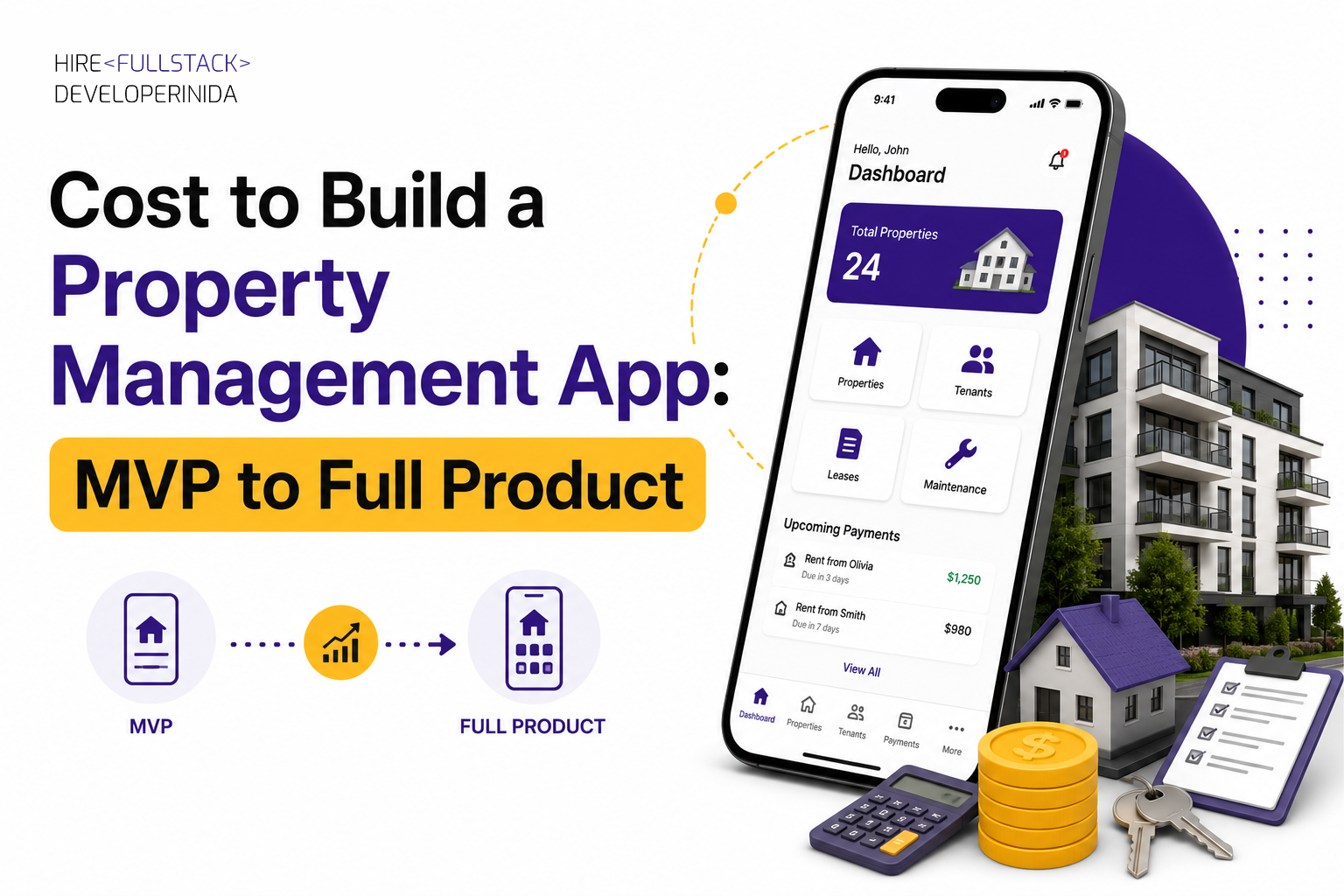

Here is something most people do not say out loud: building a property management app is one of the most deceptively complex projects a founder can take on. Not because the idea is complicated. The idea is clear. You want to digitize rent collection, maintenance requests, lease management, and tenant communication. Simple enough on paper. But the moment you sit across from a development team and start talking specifics, the scope quietly doubles, the timeline stretches, and the original budget you had in mind starts looking like a very optimistic rough draft.
This blog is written for founders, CEOs, and decision makers who are already past the idea stage. You are not here to read about what a property management app is. You are here because you need to understand the real cost to build a property management app in 2026, what drives those costs up or down, where most products get stuck between MVP and full launch, and how to make a smart investment decision rather than an expensive learning curve.
So let us get into it, without the fluff.
Why Property Management Apps Cost More Than Most SaaS Products
Before we get to numbers, it helps to understand what makes this category expensive to build correctly. Property management software sits at the intersection of finance, legal compliance, real estate operations, and multi user role management. You are not building a simple CRUD app. You are building a system that handles money movement, legal documents, audit trails, and real time communication between landlords, property managers, tenants, and sometimes maintenance vendors.
That means your app needs to handle different permission levels for each user type, integrate with payment gateways for rent collection, generate legally compliant lease documents, track maintenance workflows, send automated reminders, and maintain a history log that could be referenced in a dispute. Every one of these is a module on its own. And each module has edge cases that only surface after real users start using the product.
This is why the cost to build a property management app tends to surprise founders who have previously built simpler digital products. The complexity is not always visible upfront, but it compounds fast.
What Does an MVP Actually Include in 2026?
The word MVP gets used loosely. In the context of property management, a genuine MVP is not a mockup or a prototype. It is a working product that can onboard a property manager, add properties, invite tenants, collect rent, and handle basic maintenance requests. That is the minimum bar for something a real user could pay for
A proper MVP for a property management app in 2026 typically includes the following:
- Property and unit listing with basic details
- Tenant onboarding and lease storage
- Online rent collection with payment gateway integration
- Maintenance request submission and tracking
- Basic dashboard for landlords and property managers
- Email and push notification system
- Role based access control for landlord, manager, and tenant
Building this correctly, not quickly, takes roughly 4 to 6 months with a competent team. A rushed MVP creates technical debt that becomes a budget problem in Phase 2.
The Real Cost to Build a Property Management App: Breaking It Down
Let us move past vague ranges. The cost to build a property management app depends on three primary variables: the scope of features, the geography and seniority of your development team, and whether you are building native mobile apps or going web first.
Here is a realistic breakdown based on 2026 market rates:
These figures are based on a mid tier development agency or a team with a mix of senior and mid level engineers. If you are working with a top tier US or UK agency, add 40 to 60 percent to these numbers. If you are hiring an offshore team from South Asia or Eastern Europe, you might come in 20 to 30 percent lower on the low end, but quality variance is a real risk that needs to be managed.
The Hidden Costs Nobody Puts in Their Quote
This is where most founders get caught off guard. The quoted development cost is only part of what you will actually spend. Here are the cost layers that rarely appear in initial estimates but show up in your invoices:
- Payment Gateway and Compliance Costs
Integrating Stripe, Plaid, or a similar payment processor for rent collection is not plug and play. Setting up ACH transfers, handling failed payments, managing refunds, and staying compliant with financial regulations in your target geography adds both development time and ongoing transaction fees. Stripe, for example, charges around 0.8 percent per ACH transaction. On a portfolio processing $500,000 in monthly rent, that becomes real money very quickly.
- Cloud Infrastructure Setup and Ongoing Hosting
A property management app stores sensitive financial and personal data. That means you need a properly architected cloud setup on AWS, Google Cloud, or Azure, with backups, staging environments, security configurations, and monitoring. Budget $1,500 to $3,000 per month for a properly set up infrastructure once you are past MVP. Many teams under budget this because they price for the first month, not for the second year.
- Legal and Compliance Work
If your app generates lease agreements, handles security deposits, or processes rent, you are operating in a legally sensitive space. Depending on the states or countries you serve, you may need a legal review of your document templates, terms of service, privacy policy, and data handling practices. This is not optional, and it is not cheap. Budget at least $5,000 to $15,000 for proper legal groundwork before launch.
- QA, Security Testing, and Bug Fixes Post Launch
A standard development quote covers building the feature. It does not always cover the full quality assurance cycle. Expect to spend 15 to 20 percent of your development budget on dedicated QA, penetration testing, and addressing the inevitable list of post launch fixes that come once real users start testing your assumptions.
MVP to Full Product: What Changes and Why It Costs More
Most teams build an MVP, get their first users, then realize the gap between a working product and a product that scales is larger than expected. Here is what the upgrade path typically looks like:
- Multi Property and Portfolio Management
Your MVP might handle 10 properties cleanly. But property management companies often manage hundreds or thousands of units across different locations. Scaling the data architecture and UI to handle that without degrading performance is a significant engineering effort. This alone can add $25,000 to $40,000 to your full product build.
- Advanced Reporting and Financial Reconciliation
Property managers need detailed income reports, owner statements, expense tracking, and sometimes integration with accounting tools like QuickBooks or Xero. Basic reporting in an MVP is fine. Full financial reporting that a property management company would actually use to run their business is a separate module with serious complexity.
- AI Powered Features That Are Becoming Standard in 2026
This is one of the biggest shifts in 2026 compared to two years ago. Property management apps that want to compete at the enterprise or mid market level are now expected to have AI powered features baked in. These include predictive maintenance alerts based on historical data, automated tenant screening with AI scoring, smart lease renewal recommendations, and natural language search across property records. Adding a well integrated AI layer adds $30,000 to $60,000 to your product roadmap, but it is increasingly what separates a competitive product from one that feels dated.
- Mobile App Expansion
Many MVPs launch the web first. But tenants expect a mobile experience. Adding a dedicated iOS and Android app using React Native or Flutter, properly tested across devices and operating system versions, adds $40,000 to $70,000 depending on how feature rich the mobile experience needs to be.
Build vs. Buy vs. White Label: The Decision Most Founders Rush
Before committing to building from scratch, founders should spend at least a few hours seriously evaluating three options.
Building from scratch gives you full control, full ownership, and the ability to differentiate. It is the right choice if your product has a genuinely unique angle, a specific niche, or a feature set that existing tools simply do not offer. It is an expensive choice, and it requires patience.
White labeling an existing property management platform gives you speed to market and a lower upfront investment. The tradeoff is that you are dependent on someone else's roadmap, limited in what you can customize, and often paying per seat in a way that gets expensive as you grow.
Hybrid building, where you build your core differentiating features on top of open source frameworks or low code tools, is gaining traction in 2026. It reduces your initial build cost but requires a strong technical lead who can make good decisions about what to build versus what to buy.
The cost to build a property management app from scratch ranges from $57,000 for a lean MVP to over $190,000 for a full featured product. But if you go white label, you might be looking at $10,000 to $30,000 in setup and branding costs plus ongoing licensing. Run the numbers over a 3 year horizon before making the call.
How to Choose the Right Development Partner in 2026
The company you hire is as important as the budget you set. Here is what separates good development partners from expensive ones:
- They have built fintech or property tech products before, not just generic SaaS apps. The nuances of payment compliance and multi role systems need domain familiarity.
- They ask hard questions before writing code. A good partner pushes back on scope, flags edge cases early, and helps you prioritize features by user value rather than just building what you describe.
- They have a QA process built into their workflow, not added at the end. Quality assurance as an afterthought is one of the most common reasons property management apps fail at launch.
- They give you a realistic timeline with buffers. Any team that promises a full featured property management app in 8 weeks is either lying or cutting corners you will pay for later.
- They have references you can actually call. Not just case studies on their website, but real clients who went through a full product build with them.
2026 Trends That Are Reshaping Property Management App Development
The market in 2026 is different from even two years ago. A few shifts are directly affecting how property management apps get built and what they need to include:
- Embedded Finance Features
Property management platforms are increasingly expected to offer more than just rent collection. Rent to own tracking, security deposit management, owner disbursements, and even in app financing for maintenance work are features that more enterprise clients now expect. This embedded finance layer adds 20 to 30 percent to your backend complexity.
- IoT Integration for Smart Buildings
Commercial and premium residential property managers are starting to expect IoT integration. Smart lock access, energy monitoring, and automated maintenance triggers based on sensor data are entering the mainstream. Building an architecture that can accommodate IoT data streams does not necessarily cost a fortune now, but not designing for it means expensive rewrites later.
- Regulatory Technology for Rent Control Compliance
Rent control regulations are tightening in many US cities and across Europe. Property management apps that want to serve these markets need to build compliance modules that track allowable rent increase percentages, flag non compliant lease terms, and generate documentation for regulatory submissions. This is a niche feature but a highly valuable one for the right customer segment.
How to Think About ROI, Not Just Budget
Property management software is a subscription based business. Whether you are building for internal use or as a SaaS product, the investment calculation should be based on value created over time, not just upfront cost.
For a SaaS model, a property management platform charging $150 per month per property manager, with a portfolio of 200 clients, generates $30,000 per month in revenue. At that rate, a $150,000 full product investment pays back in roughly 5 months, assuming you hit that user base. The question is not just what does this cost. The question is what is the fastest path to a product your target customers will pay for.
For internal tools built by a real estate company to replace manual processes, the ROI is measured differently. If your property management team is spending 40 hours per week on tasks that an app could automate, the annual salary savings alone often justifies a six figure development investment within the first year.
The Bottom Line for Founders Ready to Build
Building a property management app in 2026 is not a small project, and anyone who tells you otherwise is selling you something. The cost to build a property management app is real, it is significant, and it is worth every dollar when you do it right.
The founders who succeed in this space are not the ones with the biggest budgets. They are the ones who spend time on the right things before writing a single line of code. They validate their niche clearly. They choose a development partner based on domain experience rather than the lowest quote. They build an MVP that real users will pay for, then use that feedback to build the next version smarter.
The market is growing, the demand is there, and the technology in 2026 makes it easier than ever to build something genuinely useful. The only thing between you and a product that works is making the right calls before you start. Use this blog as a reference point, not a final answer, and get specific with the right partner before you commit.