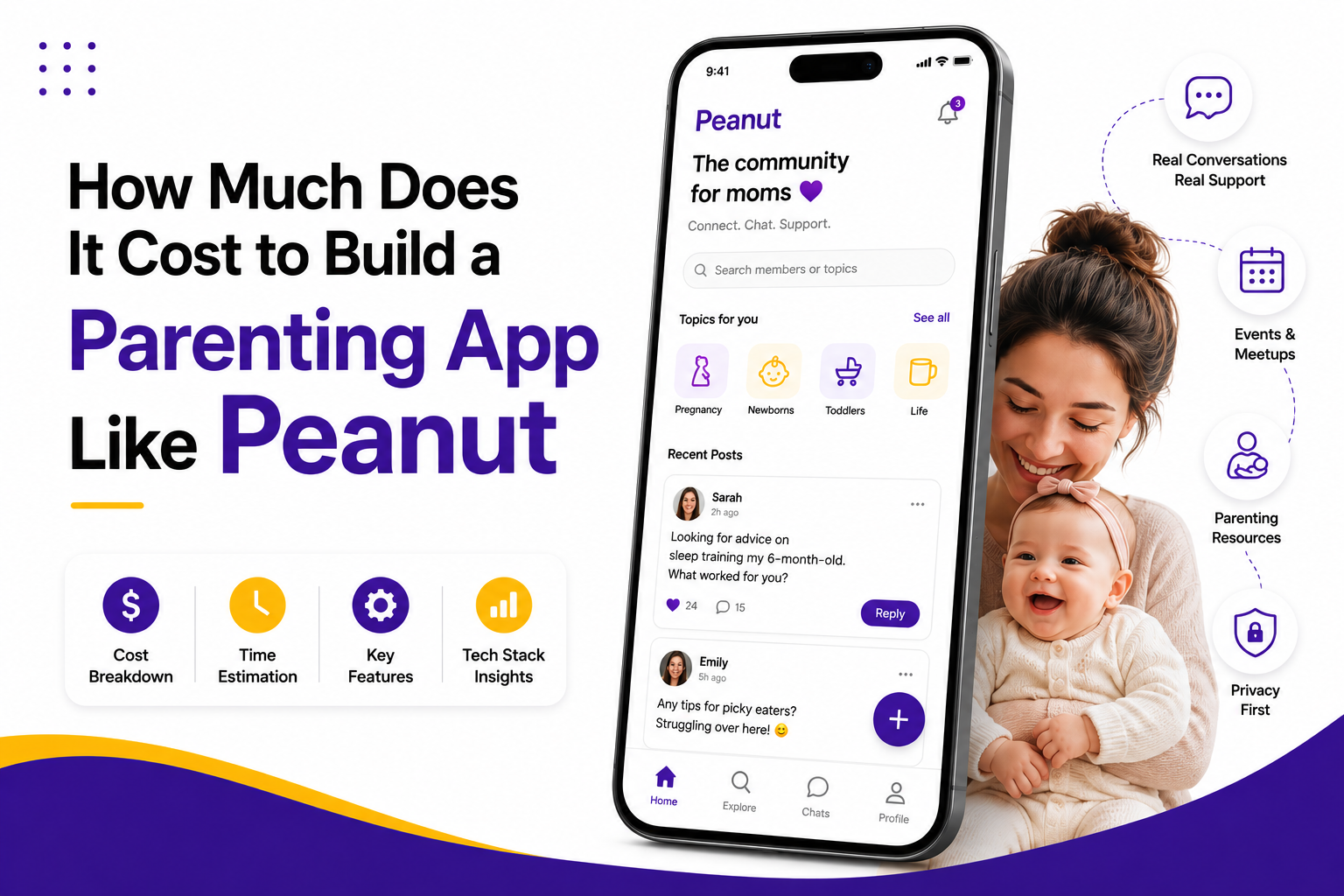

If you have spent any time scrolling through parenting forums or talking to new mothers about how isolating early parenthood can feel, you already understand why Peanut became such a runaway success. It gave parents a place to find each other based on real life stages rather than just location. That single idea turned into a business worth building a company around, and now founders everywhere are asking the same question. What would it actually take, in terms of money and time, to build something similar?
This guide answers that question directly. We will walk through the real parenting app development cost in 2026, break down every stage of development, and show you exactly where your budget goes when you plan a Peanut app clone development project. Whether you are a solo founder testing an idea or a company scaling a new product line, you will leave this article with a clear, honest picture of the numbers involved.
So let us get into it. How much does it cost to build an app like Peanut? The short answer is that it depends heavily on scope, but the long answer, the one that actually helps you plan a budget, is what the rest of this guide is for.
What Is Peanut and Why Does It Matter in 2026
Peanut is a social networking app built specifically for women navigating pregnancy, motherhood, and the various stages that follow. It works a bit like a dating app in terms of its swipe based matching, but instead of romance, it connects women who share similar circumstances such as due dates, children's ages, or parenting philosophies. Users build profiles, join community groups, message each other, and access curated content on topics ranging from fertility to postpartum recovery.
The reason this model keeps attracting founders and investors in 2026 is simple. Parenting has become more isolating in an era of remote work, smaller nuclear families, and reduced access to extended family support. Communities that used to form naturally around neighborhoods or extended relatives now need to be built digitally. Add to that the fact that parents, especially first time parents, are highly motivated to spend money on tools that reduce stress and uncertainty, and you get a market that is both emotionally sticky and commercially viable.
Peanut itself has expanded well beyond its original pregnancy and newborn focus. The platform now serves women through fertility, trying to conceive, postpartum, and even menopause life stages, which shows how much room there is for a well built parenting app to grow into adjacent audiences over time.
From a business standpoint, this is exactly why parenting apps hold real appeal for founders in 2026. The global market keeps expanding as smartphone use rises and as more parents actively search for digital communities rather than relying only on family advice passed down informally. Unlike many social apps that struggle to justify paid subscriptions, parenting apps sit inside a category where users are already comfortable paying for expert guidance, premium groups, and curated content, because the stakes tied to a child's wellbeing feel personal and immediate.
There is also a retention advantage worth noting. A user's parenting stage changes constantly, moving from pregnancy to newborn to toddler to school age, so a well designed app can keep offering relevant value for years rather than months. That naturally extending lifecycle is part of why investors view this category as durable, and it is a major reason founders keep asking about parenting app development cost before they commit to a full roadmap.
Core Features You Need Before You Estimate Cost
Before anyone can give you a realistic number for parenting app development cost, you need a clear feature list. The scope of features is the single biggest factor that decides your final budget, so it is worth spending real time here rather than rushing straight to the pricing tables further down this guide.
- Profile creation and onboarding. Users build a profile with their parenting stage, interests, location radius, and preferences. Onboarding usually includes a short questionnaire that improves matching quality later.
- Swipe based matching. A card style interface lets users browse and connect with other parents nearby, similar in mechanics to dating apps but tuned for friendship and support rather than romance.
- Group communities. Topic based or location based groups where members post questions, share experiences, and build smaller circles within the larger app.
- Direct and group messaging. Real time chat, often with support for photos, voice notes, and read receipts, forms the backbone of daily engagement.
- Content and expert resources. Articles, expert Q&A sessions, and curated advice keep users returning even on days they are not actively chatting.
- Events and meetups. Local event listings, whether virtual or in person, help transition online friendships into real world connections.
- Safety and moderation tools. Verification, reporting, blocking, and content moderation are non negotiable for any app built around vulnerable life stages like pregnancy and new parenthood.
- Push notifications and reminders. Timely nudges around messages, group activity, and milestones keep retention healthy without feeling intrusive when frequency is tuned carefully.
- Search and location filters. Letting users narrow down by neighborhood, due date range, or specific interest keeps the community feeling relevant rather than overwhelming as it grows.
- Multi language and localization support. If you plan to expand beyond one country, building localization into the architecture early avoids a costly rebuild when you eventually enter new markets.
None of these features are optional if your goal is a genuine Peanut app clone development project. Cutting corners on safety or moderation in particular tends to cost far more later, both in reputation and in engineering hours spent retrofitting protections that should have existed from day one. It is worth treating this feature list as the foundation for every conversation you have with a potential development partner, since a vague brief almost always leads to a vague, and often unreliable, quote.
How Much Does It Cost to Build an App Like Peanut: The Real Numbers
Here is the number most founders actually want. A functional, well built parenting app like Peanut typically costs between $40,000 and $180,000 to build, depending on platform choice, feature depth, and design complexity. That is a wide range, and for good reason. A basic MVP with core matching and messaging sits at the lower end, while a fully featured app with AI powered recommendations, video content, and advanced moderation systems sits closer to the top.
It helps to think about this range the same way you would think about building a house. A basic structure with the essentials costs one amount, while custom finishes, extra rooms, and premium materials push the number up considerably, even though both projects technically produce a house. Parenting apps work the same way, and the earlier you decide which tier you are actually building, the more accurate every quote you receive will be.
To answer the cost to build a parenting app like Peanut question properly, you need to look at three separate tiers rather than a single flat number. Most agencies and in house teams price projects this way because it reflects how real budgets get allocated once a product roadmap is set.
Cost by Project Complexity
Cost Breakdown by Development Phase
Every parenting app project moves through the same broad phases, and each one carries its own share of the total budget. If you want a realistic cost to build a parenting app like Peanut, understanding this phase by phase breakdown helps you spot where an agency's quote might be inflated or, just as often, dangerously underpriced.
Cost by Development Phase
Notice that backend and frontend development together consume more than half of the entire budget. This is because matching algorithms, real time chat infrastructure, and moderation systems require substantial engineering work that is invisible to end users but essential to the product actually functioning at scale. If a quote you receive allocates most of the budget to design and very little to backend engineering, that is often a warning sign that the underlying technical complexity has been underestimated.
What Actually Drives Parenting App Development Cost Up or Down
Two apps with an identical feature list on paper can end up with wildly different price tags. That gap almost always comes down to a handful of decisions made early in planning.
- Platform choice. Building for iOS and Android separately using native code costs more than a cross platform approach using a single codebase, though native apps often perform better and feel smoother to users. Many founders choose cross platform for the initial launch and move to native later once the product has proven demand.
- Design complexity. A highly custom, animated, brand distinct interface takes considerably longer to design and build than a template driven layout, but it also tends to create stronger emotional trust with users navigating a sensitive life stage.
- Matching algorithm sophistication. Simple filter based matching is inexpensive to build. Machine learning powered matching that improves over time with user behavior adds real engineering cost, though it often pays for itself through stronger retention once the user base is large enough to train on.
- Real time chat infrastructure. Scalable messaging that supports thousands of concurrent users, media sharing, and delivery guarantees is more expensive than basic chat functionality, particularly once you factor in the servers needed to keep messages fast during peak hours.
- Content moderation systems. Automated moderation combined with human review workflows adds both development cost and ongoing operational cost, but it is one of the areas where under investing creates the most risk for a community built around new and expecting parents.
- Third party integrations. Payment gateways, identity verification services, push notification providers, and analytics platforms each bring licensing fees and integration hours, and the total can add up quickly if not scoped carefully at the start.
- Scalability requirements. Architecture built to handle rapid user growth from day one costs more upfront but avoids expensive rebuilds later, which matters a great deal if you expect a viral launch or press coverage soon after release.
- Team location. Where your development team is based changes hourly rates dramatically, which we will cover in detail in the geography section below, and it is often the single biggest lever founders have over their final number.
Development Cost by Geography
Where you hire your team is often the single biggest lever you can pull on total project cost. The same feature set can cost two or three times more depending on which region builds it, which is why so many founders spend real time researching this decision before signing any contract.
Hourly Rates and Estimated Project Cost by Region
None of these numbers make one region objectively better than another. Many founders choose a hybrid model, keeping product management and design closer to home while working with an offshore or nearshore parenting app development company for the bulk of engineering, which balances cost against communication ease. Time zone overlap, English proficiency, and a proven portfolio in social or community apps matter just as much as the hourly rate itself, so treat the cheapest option with the same scrutiny you would give the most expensive one.
A Realistic Timeline: What to Expect Month by Month
Cost and timeline are tied together closely enough that it helps to walk through them side by side. Here is roughly what a mid range build, the tier most founders end up choosing, looks like on a calendar.
- Month 1. Discovery, competitor research, and a finalized feature list, along with early wireframes for the core screens.
- Months 2 and 3. Full UI and UX design completed, backend architecture planned, and development begins on the profile, matching, and messaging systems.
- Months 4 and 5. Core features move toward completion, group communities and content sections are built, and the first internal test builds start circulating.
- Month 6. Quality assurance across devices, security testing, and fixes based on internal feedback rounds.
- Month 7. App store submission, final polish, and a soft launch to a small user group before the wider public release.
Delays almost always come from one of two places, scope creep during development or slow decision making on design approvals, so keeping both tight is the most reliable way to protect your original timeline and budget together.
Team Composition and What Each Role Costs
A parenting app is not built by one or two people, even at the MVP stage, since matching, real time chat, and community moderation each require dedicated expertise. Here is the typical team structure and the role each person plays across a standard project.
Team Roles and Monthly Cost Range
Some agencies bundle several of these roles into a single retainer, which can simplify pricing but makes it harder to see exactly where your money goes. When evaluating a parenting app development company, ask for a role by role breakdown rather than a single lump sum, since it makes future scope changes much easier to price fairly.
Hidden Costs Founders Often Miss
Budgets tend to go wrong not because of the obvious line items but because of the ones nobody mentions until the invoice arrives. Here are the ones worth planning for from the start.
- App store fees. Apple charges an annual developer fee, and Google has a one time registration fee, both small but easy to forget when budgeting, along with any in app purchase revenue share once you introduce paid features.
- Third party API costs. Push notifications, SMS verification, and mapping services often charge based on usage, which scales with your user base, so a service that felt nearly free during testing can turn into a meaningful monthly line item after a successful launch.
- Cloud hosting. Server and storage costs grow as your user base grows, and a successful launch can bring an unexpectedly large hosting bill in the first few months, particularly if the app includes photo or video sharing inside groups and chats.
- Content moderation staffing. Automated tools catch most issues, but a human review team is usually needed for edge cases, especially in a community built around a sensitive topic like parenting where a missed report can cause real harm.
- Post launch iteration. Real users behave differently than test users, and the first three months after launch typically require a round of fixes and small feature adjustments that were not part of the original scope, no matter how thorough your testing phase was.
- Legal and compliance review. Data privacy laws around health related information, especially anything touching pregnancy or child related data, often require a legal review that founders forget to budget for, and this becomes more complex the moment you plan to operate across multiple countries.
- Customer support tooling. As your community grows, you will likely need a help desk platform and dedicated support staff to handle account issues, safety reports, and billing questions, none of which typically appear in an initial development quote.
How to Reduce Cost Without Cutting Corners
There is a real difference between spending less money and building something cheap, and the founders who succeed understand that distinction well.
- Start with a true MVP. Launch with core matching, messaging, and community features first, then add advanced features once you have real user feedback guiding priorities instead of guessing what users will want.
- Use cross platform frameworks. Building once for both iOS and Android using a shared codebase can meaningfully lower development hours compared to fully native builds, while still delivering a smooth experience for most parenting app use cases.
- Choose proven third party tools. Use established providers for chat infrastructure, push notifications, and analytics rather than building these systems from scratch, since reinventing infrastructure that already exists rarely produces a better outcome than buying it.
- Work with a nearshore or offshore team. Hiring a skilled team in a lower cost region, as covered earlier, is often the single biggest lever for reducing total spend without lowering quality, provided you invest time upfront in clear communication and documentation.
- Plan your roadmap before writing a single line of code. Scope changes mid development are consistently the most expensive mistake founders make, since reworking existing code costs far more than planning it correctly the first time, and this holds true regardless of which team or region builds your app.
- Negotiate a phased payment structure. Paying by milestone rather than a large upfront sum keeps your development partner accountable to delivery dates and gives you room to adjust scope between phases without renegotiating an entire contract.
Monetization Strategies Worth Planning For Early
Most founders treat monetization as a later stage conversation, but the choices you make here actually affect your architecture and your budget from the very beginning, which is why it deserves a place in any serious cost discussion rather than an afterthought at launch
- Freemium subscriptions. Core matching and messaging stay free, while premium tiers unlock features such as advanced filters, unlimited groups, or an ad free experience.
- Expert consultations. Paid one on one or group sessions with lactation consultants, therapists, or pediatric specialists create a high value revenue stream that also strengthens trust in the platform.
- Sponsored content and partnerships. Brands in the baby product and parenting space often pay for sponsored posts or featured placement, though this requires careful moderation so it does not undermine user trust.
- In app events and workshops. Ticketed virtual or in person events, from prenatal classes to toddler meetups, give the app an additional revenue channel beyond subscriptions.
- Affiliate and marketplace commissions. Curated product recommendations, from strollers to feeding supplies, can generate commission revenue when integrated thoughtfully rather than aggressively.
Whichever combination you choose, plan for it during the architecture phase rather than bolting it on later. Payment processing, subscription management, and expert booking systems all need to be considered when your development partner scopes the original project, since retrofitting them after launch is one of the more expensive mistakes founders make.
Choosing the Right Parenting App Development Company
Cost matters, but it should never be the only factor in your decision. A parenting app development company that understands the emotional weight of parenting related products, and the safety and privacy obligations that come with it, will save you money in the long run even if their initial quote looks slightly higher.
Ask potential partners for examples of similar community or social matching apps they have built, not just generic mobile projects. Ask how they approach content moderation and user safety, since this is where inexperienced teams tend to underestimate both effort and risk. And ask for a transparent, phase by phase quote rather than a single number, since that transparency tells you a great deal about how the rest of the relationship will go once real work begins.
It also helps to ask how a prospective partner handles communication across time zones, especially if you choose an offshore or nearshore parenting app development company to manage cost. A team with an established process for daily updates, shared project boards, and regular demos will save you far more time than a slightly cheaper team that leaves you guessing about progress between milestones.
If you are specifically looking at Peanut app clone development, be direct about that with any agency you talk to. A team that has genuinely studied what makes Peanut work, rather than treating it as a generic dating app template, will ask you sharper questions about your target community and will usually give you a more realistic budget from the very first conversation. Pay attention as well to how a company talks about post launch support, since a partner who treats launch as the finish line rather than the starting point is rarely the right long term fit for a product built around an ongoing community.
Conclusion
Building a parenting app is not just a technical project, it is an attempt to solve a genuinely difficult human problem, which is why the apps that succeed tend to be the ones built with real care rather than the ones built purely to hit a feature checklist. The numbers in this guide give you a realistic starting point, somewhere between $40,000 for a lean MVP and $180,000 or more for a fully featured product, but the exact figure for your project will come down to the choices you make around platform, design, team location, and feature depth.
It is worth remembering that every successful parenting app started as an unproven idea with a budget attached to it, and the founders who moved forward anyway are the ones who eventually built something parents genuinely relied on. The market is not shrinking, and the appetite for thoughtful, safety conscious community products is if anything growing stronger as parents look for alternatives to noisy, ad heavy social platforms.
The best next step is not to chase the lowest quote you can find. It is to sit down with a development partner, walk through your feature list line by line, and build a budget you actually understand rather than one you simply trust. That is how founders end up with a product that feels as considered and as trustworthy as the parents it is meant to serve.