
Let's start with something most blogs assume you already know — and skip entirely.
What is Fleet Management?
Fleet management is the process of overseeing and coordinating a company's vehicles to make sure they are being used efficiently, safely, and cost-effectively. That sounds straightforward on paper. In practice, it covers everything from knowing where your vehicles are at any given moment, to making sure drivers are following safe routes, to tracking whether a truck needs a service before it breaks down on a highway at 2 AM.
For a business running even 10 to 15 vehicles, doing this manually is genuinely chaotic. Spreadsheets for maintenance logs, phone calls to track driver locations, paper forms for fuel fill-ups, and guesswork on route planning. It works until it does not, and when it stops working, it usually costs money.
Fleet management as a discipline applies across industries more than most people realize. Logistics and delivery companies are the obvious ones. But construction firms managing heavy equipment, healthcare providers running patient transport, municipalities overseeing public utility vehicles, retailers with last-mile delivery networks, and field service companies with technician fleets all fall under the same umbrella. Anywhere a business operates vehicles as part of its core operations, fleet management is happening — either well or poorly.
So where does a fleet management app come in?
A fleet management app is the software layer that replaces the spreadsheets, the phone calls, and the guesswork. It brings vehicle location, driver activity, fuel consumption, maintenance schedules, route planning, and compliance records into a single system that updates in real time.
The word "app" here is slightly misleading in terms of scope. A proper fleet management solution is not just a mobile app your drivers use. It is typically a combination of three things working together: a mobile app for drivers, a web-based dashboard for fleet managers and dispatchers, and a backend system that processes and stores data from vehicles, devices, and users simultaneously.
What makes it genuinely complex to build — and relevant to this entire cost conversation — is that it is not a passive tool. It deals with live data from moving vehicles, real-time location pings, sensor inputs from hardware installed in those vehicles, and decisions that need to be made fast. A route change, a driver alert, a geofence breach. These are not things that can wait for a page refresh.
In 2026, the expectations around fleet management software have shifted considerably. Two years ago, real-time GPS tracking and basic reporting were considered the core. Today, fleet operators expect predictive maintenance alerts before breakdowns happen, AI-based route optimization that factors in live traffic and driver hours simultaneously, driver behavior scoring tied to insurance premiums, and EV-specific modules for companies transitioning away from combustion vehicles.
That shift in expectations is precisely why the cost to build a fleet management app varies as dramatically as it does. You are not just building a map with dots on it. You are building a system that processes high-frequency data, makes intelligent decisions, integrates with hardware installed in physical vehicles, and scales reliably as the number of vehicles and users grows.
Understanding that scope is the right starting point before any number in this blog makes sense.
Real Truth: You have probably already Googled the cost to build a fleet management app and found answers ranging from $20,000 to $500,000 with very little explanation for why the gap is so enormous. That range is not wrong. It is just incomplete.
The truth is that most cost guides are written for search engines, not for someone actually trying to make a business decision. They list features, throw out a number, and call it a day. What they skip is the part that actually matters to you: why costs shift so dramatically, what choices drive those shifts, and where companies quietly bleed budget without realizing it until the project is halfway done.
This blog is written differently. Whether you are building an internal operations tool to manage 50 vehicles or a SaaS platform that logistics companies will subscribe to, the cost to build a fleet management app depends on a specific set of decisions you will need to make early. This guide breaks down every one of them with real numbers, realistic timelines, and the kind of context that helps you walk into a vendor conversation with confidence.
Types of Fleet Management Apps and Their Development Costs
What Exactly Are You Building? Defining the Scope First
Before any number makes sense, you need clarity on what kind of fleet management app you are actually building. There are three fundamentally different product types, and each has a different cost profile.
These ranges assume you are building a custom product from scratch. If you are using white-label platforms or extending an existing fleet tool, the cost structure changes entirely. Most of this guide focuses on custom development, which is where the real decision-making happens.
Core Features and What Each One Actually Costs
The most common mistake founders make is treating features like a checkbox list. In reality, each feature has a cost that depends on how complex the logic is, how much real-time processing it requires, and how well it needs to integrate with other systems.
Here is a realistic breakdown of what core fleet management features cost to build in 2026, assuming a mid-tier development team based in South Asia or Eastern Europe.
The driver behavior scoring feature is increasingly common in 2026 because fleet operators are using it to lower insurance premiums and reduce accident liability. The AI component is what pushes the cost up significantly compared to simpler rule-based alert systems.
The Tech Stack Decision and Its Impact on Your Budget
Your technology choices are one of the biggest cost levers in this entire project. Two teams can build the same feature set and end up with a 40 percent cost difference based on stack decisions alone.
Mobile App: Native vs. Cross-Platform
Building separate native apps for iOS and Android increases development time by roughly 60 to 80 percent compared to a well-executed Flutter or React Native app. For most fleet management use cases in 2026, cross-platform development is the smarter financial call, especially since driver-facing apps do not typically require heavy device-specific functionality.
Backend Architecture
The backend is where fleet management apps either scale gracefully or become expensive technical debt. Real-time tracking, concurrent users, and high-frequency data writes demand a backend that is built for it from day one.
• Monolithic architecture: Lower upfront cost ($15,000 to $25,000 for backend) but scaling becomes expensive beyond a certain point.
• Microservices architecture: Higher upfront investment ($30,000 to $55,000) but scales far more efficiently and makes future feature additions cheaper.
• Serverless with managed services: Good middle ground for early-stage products. AWS Lambda, Google Cloud Run, or Azure Functions can keep infrastructure costs low in the early months.
Maps and Location APIs
This is one of the most overlooked cost lines in fleet app development. Most developers default to Google Maps, which is fine technically but can become surprisingly expensive at scale.
For a fleet running 200 vehicles with location pings every 30 seconds, you are looking at roughly 1.4 million API calls per day. At Google Maps pricing, that adds up to $4,000 to $10,000 per month in API costs alone. Mapbox or HERE often make more financial sense at that volume.
Team Structure and Hiring Model: The Decision That Moves the Budget Most
Nothing impacts the cost to build a fleet management app more than who you hire and how you hire them. Here is what the same product would cost across different hiring models in 2026.
A pattern worth noting: companies that hire the cheapest option without proper project management often end up spending 30 to 50 percent more in rework, bug fixes, and feature rebuilds. The quoted cost and the final cost diverge most when due diligence on the vendor is skipped.
Recommended Team Composition for a Mid-Complexity Build
- 1 Project Manager / Scrum Master: Oversees timeline, communication, sprint planning
- 1 to 2 Backend Developers: API development, database architecture, real-time data handling
- 1 to 2 Mobile Developers: Driver app for iOS and Android
- 1 Frontend Developer: Admin dashboard and fleet operator web interface
- 1 DevOps Engineer (part-time): Cloud setup, CI/CD pipeline, server scaling
- 1 QA Engineer: Testing, regression, device compatibility
- 1 UI/UX Designer: User flows, prototyping, interface design
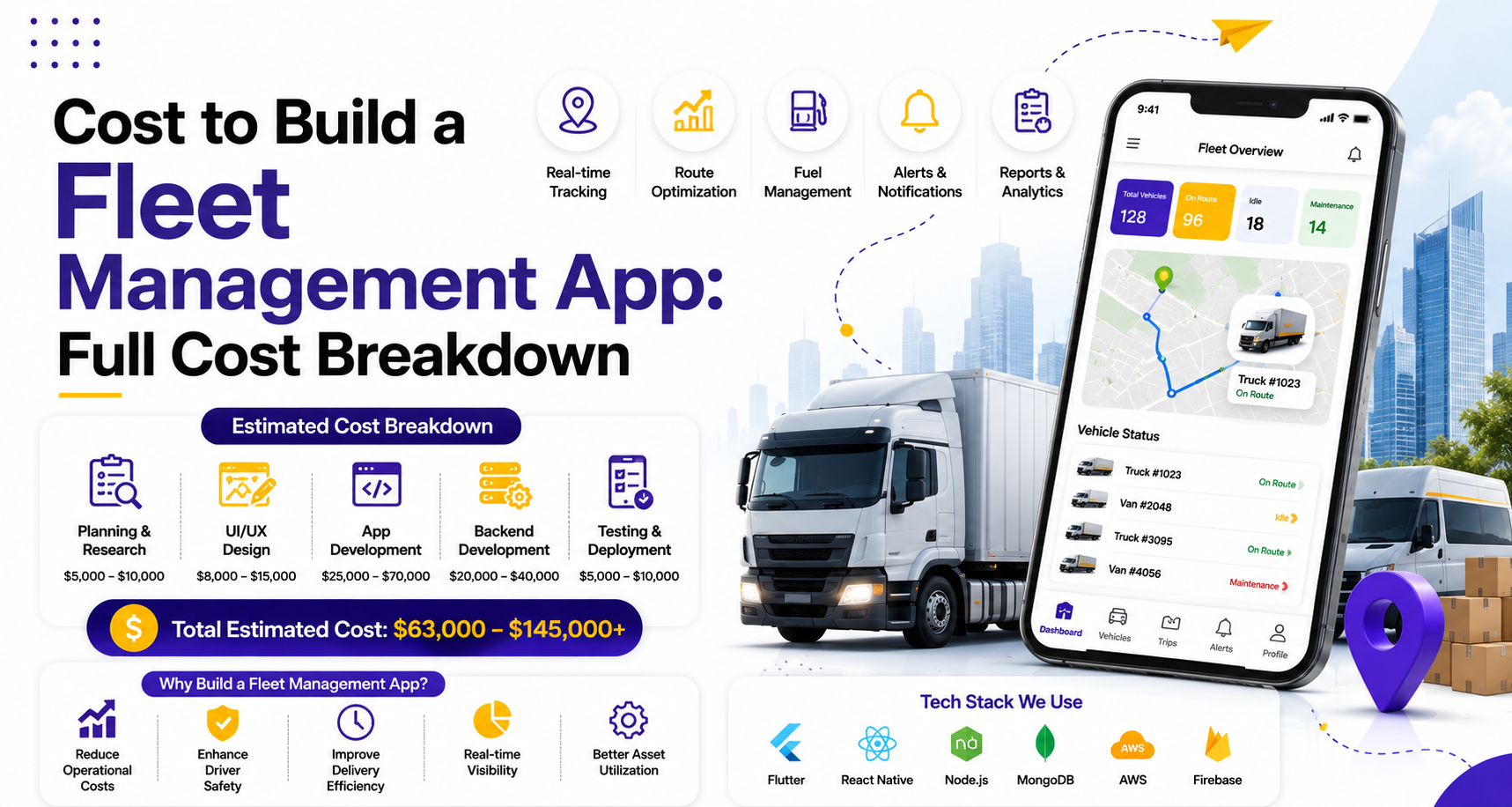
This team running for 5 to 7 months at a South Asian agency rate would cost between $65,000 and $120,000 depending on feature scope. At an Eastern European rate, the same team would run $130,000 to $200,000.
Hidden Costs Most Budgets Forget
This is the section most cost guides skip entirely. These are the expenses that do not show up in the initial quote but will absolutely show up in your bank account.
IoT Hardware and Vehicle Integration
Many fleet apps rely on OBD (On-Board Diagnostics) devices or proprietary GPS hardware installed in vehicles. These are not app development costs but they are project costs, and they affect your architecture decisions.
- OBD-II GPS trackers: $30 to $120 per vehicle (one-time hardware cost)
- 4G cellular data per device: $3 to $10 per vehicle per month
- Hardware-software integration: Add $8,000 to $25,000 to your development budget for custom protocol handling
Compliance and Data Privacy
Depending on your market, fleet apps touch sensitive data including driver locations, behavior records, and vehicle diagnostics. In 2026, this means dealing with GDPR if you operate in Europe, CCPA in California, and sector-specific rules in logistics, healthcare, and government contracting.
Legal review and compliance audit: $3,000 to $15,000
GDPR/CCPA technical implementation: $5,000 to $18,000 additional development cost
Penetration testing and security audit: $4,000 to $12,000
Third-Party Integrations
Fleet management apps rarely live in isolation. They typically need to connect with ERP systems, accounting software, HR tools, or fuel card providers. Each integration adds cost.
Post-Launch Maintenance
This is the cost that surprises founders most. After launch, you are looking at ongoing expenses that typically run 15 to 20 percent of your initial development cost annually.
• Bug fixes and OS compatibility updates: Ongoing, roughly $1,000 to $3,000 per month
• Cloud infrastructure: $500 to $8,000 per month depending on fleet size and data volume
• Third-party API fees: Maps, SMS, push notifications, data providers
• Feature enhancements: User feedback drives new requirements; budget $2,000 to $6,000 per sprint cycle
AI and Advanced Features Reshaping Fleet App Development in 2026
The fleet management space has changed considerably in the last two years. What used to be a nice-to-have is now becoming a competitive baseline, especially for companies trying to sell to larger enterprise clients.
- Predictive Maintenance
AI models trained on vehicle sensor data can now predict component failures with 85 to 92 percent accuracy before they cause breakdowns. Building this from scratch requires significant ML expertise and historical data pipelines. Expect an additional $25,000 to $60,000 to build a proprietary predictive model, or $8,000 to $18,000 to integrate a pre-trained model from a provider like AWS SageMaker or Azure ML. - AI-Powered Route Optimization
Static route planning tools are becoming obsolete. Modern optimization engines factor in live traffic, weather, driver hours of service, vehicle load constraints, and customer time windows simultaneously. Building this capability from scratch is expensive and time-consuming. Most teams in 2026 use a hybrid approach: a routing API like Google Routes Preferred or Here Routing v8 as the base engine, with a custom optimization layer on top. Budget $18,000 to $40,000 for this component. - Computer Vision for Driver Safety
Dash cameras integrated with computer vision to detect distracted driving, fatigue, and unsafe lane changes are becoming standard in enterprise fleet apps. Integrating a computer vision SDK from providers like Mobileye or Nauto adds $12,000 to $30,000 to your development scope, plus per-vehicle licensing fees. - EV Fleet Management
Electric vehicles introduce new data streams that traditional fleet software was not designed for: battery state of charge, charging station availability, range anxiety algorithms, and regenerative braking logs. If your fleet includes EVs or you are building for clients who are transitioning, you need dedicated EV modules. This adds $15,000 to $35,000 to your development budget.
Development Timeline: What to Realistically Expect
Total timeline for a mid-complexity fleet app: approximately 6 to 10 months with a well-coordinated team. Many projects run longer not because of technical complexity but because of delayed feedback cycles, shifting requirements, and unclear decision-making on the client side.
Total Cost Summary by Build Tier
Here is how everything adds up across three common build scenarios.
These numbers assume a development team in South Asia or Eastern Europe. Building the same product with a US-based team multiplies these estimates by 1.8x to 3x.
Final Thoughts: The Budget You Plan for and the Budget You Need
Here is something most vendors will not tell you directly: the cost to build a fleet management app is not just a development expense. It is a strategic commitment.
Companies that treat it purely as a cost to minimize often end up rebuilding their apps within two years because the first version cannot handle the scale they eventually reach. The ones that do it right invest slightly more upfront in architecture, security, and data design, and they almost never need a full rebuild.
The other thing worth saying out loud: the biggest variable in your budget is not the hourly rate of your developers. It is the clarity of your requirements before development starts. Scope changes mid-project are the single most expensive thing that can happen to a fleet app build. Every week of delay, every feature added after the architecture is set, and every pivot in user experience adds cost at a rate that compounds quickly.
If you are at the stage of evaluating vendors or shortlisting development partners, the right question to ask them is not just how much will this cost. Ask them what decisions will have the biggest impact on that cost. A team that can answer that question intelligently is a team that understands what they are building.