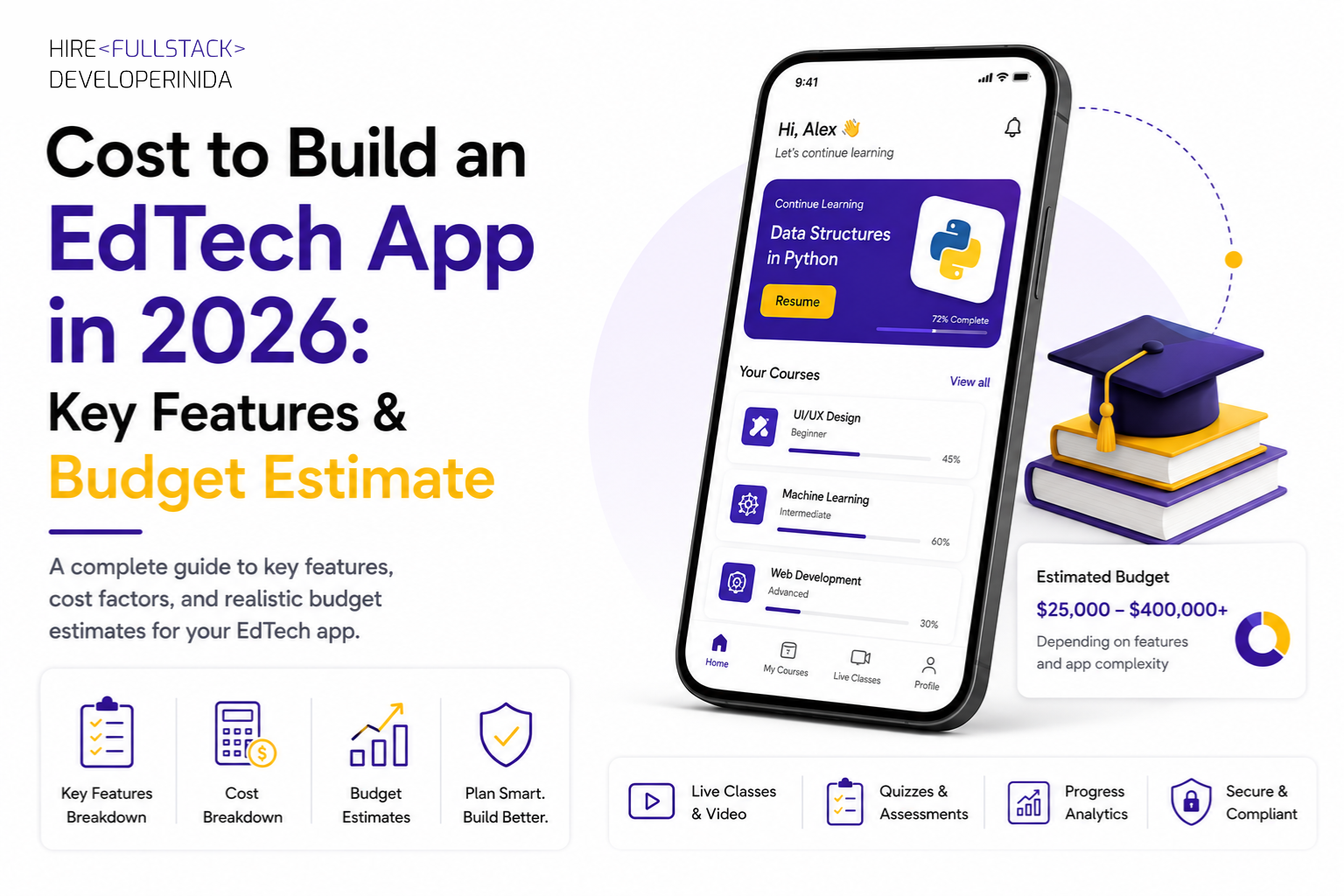

Cost to Build an EdTech App in 2026: Key Features & Budget Estimate

Cost to Build an EdTech App in 2026: Key Features & Budget Estimate

The EdTech industry did not slow down after the post-pandemic correction. It recalibrated. In 2026, the growth is coming from a different direction: AI-native learning tools, corporate upskilling platforms, and government-funded school digitization programs across Asia, the Middle East, and Latin America. The money is real. The opportunity is real.

And yet, the number one reason EdTech products fail to launch is not the idea. It is not the team. It is the budget. Specifically, a budget built on incomplete information.

Most EdTech app development cost estimates you will find online were written two or three years ago. They do not account for the AI infrastructure costs that are now baked into nearly every feature, the new compliance requirements that came into force in major markets in 2025 and 2026, or the real-world infrastructure costs that only appear once you have actual users streaming video and taking live classes at scale.

This guide is built for 2026. It covers the actual cost layers that determine what you will spend, the market dynamics that are pushing prices in specific directions, the team model choices that create 40 to 60 percent cost variance on identical scopes, and the hidden line items that appear in nearly every EdTech project but almost never in a proposal.

Whether you are evaluating vendors, preparing a funding ask, or building an internal business case for a board or leadership team, this is the breakdown that will hold up under scrutiny. 

The Real Question Is Not How Much. It Is What Are You Actually Paying For.

Here is something most cost breakdowns never say: two apps with identical feature lists can have wildly different development costs depending on how the team builds them, where they are based, what infrastructure decisions they make, and what "done" means to them.

Before any number makes sense to you, you need to understand the four layers of EdTech app cost.

Layer 1: Feature Development Cost

This is what everyone talks about. Building a video player, adding quizzes, setting up user profiles. This is usually 40 to 50 percent of your total spend.

Layer 2: Infrastructure and Hosting Cost

Nobody mentions this upfront. Your app needs servers, CDNs, databases, and video streaming services. For an EdTech app serving 10,000 learners with video content, monthly infrastructure can run anywhere from $800 to $8,000 depending on your architecture choices. This cost grows with your users.

Layer 3: Compliance and Security Cost

In 2026, this is non-negotiable. COPPA for apps serving under-13 users in the US, FERPA for student data, GDPR for European learners, and the newer AI Transparency requirements that several countries are rolling out. Getting compliant is not free. Expect to spend 8 to 15 percent of your development budget just on this.

Layer 4: Post-Launch Maintenance Cost

Most proposals quote you a build cost. Nobody tells you that maintaining an app costs roughly 15 to 20 percent of the original build cost every year. A $150,000 app will cost you $22,000 to $30,000 every year just to keep running, updated, and bug-free.

Industry insight: 68 percent of EdTech founders say they underestimated post-launch costs by more than 40 percent. The build is just the beginning.

EdTech App Development Cost in 2026: The Real Ranges

Now let us talk about actual numbers. But we are going to structure this differently. Instead of complexity tiers, we are going to talk about what you are actually building and who you are building it for.

App Type

Build Cost (USD)

Monthly Infra

Annual Maintenance

Simple Course Player (video + quizzes)

$25,000 to $55,000

$200 to $600

$4,000 to $9,000

LMS with Instructor Portal

$70,000 to $140,000

$800 to $2,500

$12,000 to $22,000

AI-Powered Adaptive Learning App

$120,000 to $280,000

$2,000 to $8,000

$20,000 to $45,000

Live Tutoring Marketplace (like Chegg or Vedantu)

$180,000 to $400,000

$5,000 to $15,000

$35,000 to $70,000

Corporate L&D Platform with Analytics

$100,000 to $220,000

$1,500 to $5,000

$18,000 to $38,000

K-12 School Platform with Parent Dashboard

$90,000 to $180,000

$1,000 to $4,000

$15,000 to $30,000

 Notice the infrastructure column. That is the number that creeps up silently and surprises founders in month three.

The 2026 Factor: AI Is Not Optional Anymore. And It Has a Price Tag.

In 2025, adding AI features to your EdTech app was a differentiator. In 2026, learners expect it. An app without personalized recommendations, smart progress tracking, or automated doubt resolution is going to feel dated before it even launches.

So what does building AI into your EdTech app actually cost?

  • AI Features and Their Real Cost Breakdown
  • Adaptive learning engine that adjusts content difficulty: $18,000 to $45,000 to build, plus $400 to $1,200 per month for inference API costs
  • AI-powered doubt solving chatbot (using LLMs): $12,000 to $35,000 to build, plus $200 to $800 per month depending on usage volume
  • Automated quiz and content generation from uploaded material: $15,000 to $40,000 to build
  • Voice-based learning assistant: $20,000 to $60,000, heavily dependent on language support
  • Proctoring and cheat detection for online assessments: $25,000 to $70,000, often outsourced to specialized vendors

Here is what nobody tells you: AI features have a dual cost structure. You pay to build them, and then you pay every single month based on how much your users use them. A chatbot that handles 50,000 queries a month is going to cost more in API fees than one handling 5,000.

Before you greenlight AI features, ask your team to model what the per-user AI cost looks like at 1,000 users, at 10,000 users, and at 100,000 users. The math should not surprise you at scale.

Reality check: One well-known EdTech startup in 2025 built an AI tutor that worked beautifully at beta. At 80,000 active users, their monthly LLM API bill hit $40,000. They had not planned for it.

 Where Your Money Actually Goes: The Honest Team Breakdown

A $150,000 EdTech app budget does not go to one person. Here is how it actually splits across a typical team and what each role actually contributes to your cost.

Role

What They Actually Do

Hourly Rate (US Agency)

Hourly Rate (Offshore)

Project Manager

Keeps scope in check, runs sprints, your main contact

$80 to $120

$20 to $40

UX Designer

Builds learning flows, accessibility, user journeys

$90 to $140

$25 to $50

Frontend Developer

Everything the learner sees and interacts with

$100 to $150

$30 to $60

Backend Developer

Data, APIs, user management, content delivery

$110 to $160

$35 to $65

Mobile Developer

iOS and Android native or cross-platform builds

$100 to $155

$30 to $60

AI/ML Engineer

Builds and integrates intelligent features

$140 to $220

$45 to $90

QA Engineer

Testing across devices, edge cases, load testing

$70 to $110

$20 to $40

DevOps Engineer

Infrastructure, deployment, scaling, monitoring

$110 to $160

$35 to $65

Most EdTech apps need 6 to 10 people working simultaneously for 4 to 9 months. That is why the numbers add up fast.

The Team Model Decision That Changes Everything

Nobody talks about this enough, but how you structure your development team changes your total cost by 40 to 60 percent. Here are your actual options in 2026.

Option 1: US or UK Based Agency

Average cost: $140,000 to $400,000 for a mid-complexity app. You get strong project management, legal accountability, and time-zone alignment. Communication is easy. But you pay a significant premium.

Option 2: Offshore Agency (India, Eastern Europe, Southeast Asia)

Average cost: $40,000 to $140,000 for the same scope. The savings are real, but so are the risks if you do not vet the team properly. Ask for EdTech-specific portfolio items. A team that built retail apps is not automatically qualified to build adaptive learning systems.

Option 3: Hybrid Model (Product Manager in-house, Dev Team Offshore)

Average cost: $60,000 to $180,000. This is increasingly the preferred model in 2026 for bootstrapped EdTech founders. You keep strategic control in-house while leveraging cost-efficient development talent offshore. The key is finding a strong product manager who can bridge the gap.

Option 4: No-Code or Low-Code Platforms

Platforms like Bubble, Thinkific, or Teachable are not real custom app development, but they serve a purpose. If your MVP does not need advanced AI, custom learner journeys, or proprietary infrastructure, a no-code platform can get you to market for $5,000 to $25,000. The ceiling hits fast though. Once you need custom logic, integrations, or scale beyond what the platform allows, you are looking at a full rebuild.

The Hidden Costs No Proposal Mentions (But You Will Pay Anyway)

This is the section that most people reading about EdTech app development cost in 2026 actually need. Here are the costs that quietly destroy budgets.

  • Content Production
    Your app is a shell without content. Video production for a single high-quality learning module can cost $3,000 to $15,000 depending on production quality. An app with 20 courses needs a content budget that often exceeds the development budget. This is almost never mentioned in cost breakdowns.
  • Third Party Integrations
    Payment gateways, video conferencing (Zoom, Daily.co), email marketing tools, analytics platforms, SSO providers, LTI compliance for school integrations. Each integration takes developer hours. Budget $2,000 to $8,000 per integration for setup, testing, and documentation.
  • App Store Fees and Reviews
    Apple charges $99 per year for a developer account. Google charges $25 once. But the hidden cost is the review process. Apple regularly rejects EdTech apps for policy reasons, especially those involving minors or payments. Each rejection cycle costs 1 to 3 weeks of developer time to fix and resubmit.
  • Accessibility Compliance
    WCAG 2.2 compliance for users with disabilities is legally required in many markets and is increasingly becoming a baseline expectation in EdTech. Retrofitting accessibility after launch costs 3 to 5x more than building it in from the start. Budget for it upfront.
  • Localization
    If you are building for markets like India, the Middle East, or Latin America, you will need multiple language versions. Localization is not just translation. It involves UI redesign for RTL languages, currency and date formatting, region-specific content, and sometimes entirely different compliance frameworks.
  • Security Audits
    A professional penetration test for an EdTech app runs $8,000 to $25,000. If your app handles student data or payments, skipping this is not an option. Do it before launch, not after a breach.

One budget reality that rarely gets discussed: the average EdTech app launch involves 11 line items that were never in the original proposal. Founders who know this in advance plan for it. Those who don't run out of runway.

 What Drives Cost Up. And What Keeps It Down.

Here is a practical framework for understanding what levers you control in your EdTech app development cost in 2026.

These drive cost up significantly

  • Custom video player with offline download, speed controls, and chapter markers
  • Real-time features like live classes, collaborative whiteboards, or multiplayer exercises
  • AI features that require custom model training rather than API integrations
  • Multi-tenant architecture for B2B (one app serving multiple school districts or companies with separate branding)
  • Gamification systems with leaderboards, badges, streaks, and social features
  • SCORM and xAPI compliance for enterprise LMS integrations

These keep cost down without hurting quality

  • Starting with one platform (web or mobile) and expanding later based on real user data
  • Using proven EdTech-specific third-party tools rather than building everything from scratch
  • Phased feature delivery: launch with core features, add AI and advanced features in version 2
  • Using open-source LMS frameworks as a foundation and customizing rather than building from zero
  • Avoiding over-engineering the backend before you have real load to plan for

How to Read a Development Quote (So You Stop Getting Surprised)

Most founders accept development proposals without knowing what to look for. Here is what a trustworthy EdTech app development quote should include in 2026.

  • A clear scope document that lists every feature with a description, not just a name
  • Separate line items for design, frontend, backend, mobile, QA, and project management
  • Third-party integration costs called out separately
  • Hosting and infrastructure estimates, not just for launch but for 6 and 12 months post-launch
  • A maintenance and support plan with monthly cost
  • Change order policy: what happens when scope changes mid-project
  • Deliverables at each milestone so you can validate before paying

If a quote does not have these elements, you are not comparing apples to apples when you evaluate multiple vendors. A $60,000 quote and a $90,000 quote for the same project may differ entirely on what is and is not included.

Realistic Timeline vs Budget Trade-offs in 2026

Another dimension nobody maps out: the relationship between your timeline and your cost. Speed is expensive in software development.

Timeline

Approach

Cost Impact

Risk Level

3 to 4 months

Aggressive, MVP only, small feature set

Lowest build cost

High: corners get cut

5 to 7 months

Standard delivery, most features in v1

Market rate

Medium: manageable

8 to 12 months

Thorough build with phased releases

15 to 25% higher total

Low: well-tested

12 months+

Enterprise-grade with full compliance

Highest total investment

Very low if managed well

The decision about timeline is really a decision about risk. Moving faster means less time for testing, less time to catch architecture problems early, and more chance that you will pay to redo work later. Moving slower means you stay out of the market longer and burn more runway on development.

The sweet spot for most EdTech startups in 2026 is a 5 to 7 month build with a hard MVP scope, followed by a quarterly feature release cycle based on what actual users ask for.

The Questions to Ask Before You Sign Anything

If you are about to hire a team or agency for your EdTech app, here are the questions that will tell you whether they actually understand what they are building.

  • How have you handled video content delivery at scale? What CDN do you use and why?
  • How do you approach COPPA or FERPA compliance in your architecture?
  • What does your QA process look like across different devices and screen sizes?
  • Can you show me an EdTech app you built that is live and serving real users?
  • How do you handle scope changes mid-project and what does that cost?
  • What happens after launch? What does month 3 look like in terms of your support?
  • How do you estimate AI feature costs, especially the ongoing inference costs?

A team that cannot answer these clearly either has not built EdTech apps before or is telling you what you want to hear. Both are red flags.

Conclusion: Build It Like You Know Where the Money Goes

In 2026, EdTech app development cost is not determined by complexity alone. It is determined by decisions: the team model you choose, the AI features you commit to before understanding their usage-based cost structure, the compliance requirements you address upfront versus retrofit later, and the infrastructure architecture you commit to in month one that you will be living with in month eighteen.

The EdTech products that are scaling right now share one characteristic that has nothing to do with technology. Their founders and product leaders treated the budget as a strategic document, not a line item approval. Every cost decision mapped back to a user outcome and a business metric.

That means being honest about what version one actually needs to validate. It means understanding what your infrastructure costs look like at 10x current scale before you build for it. It means asking your development team the questions in this guide before you sign a proposal rather than after you have burned half the budget on the wrong architecture.

Nidhi Jain

Nidhi Jain

Nidhi is an exceptionally talented and creative content writer, bringing life to ideas through her words. With marketing knowledge and a deep understanding of various industries, she crafts captivating content that resonates with our audience. Her in-depth knowledge of trending tech and consumer affairs adds a unique perspective to her work, making it engaging and impactful.

Build Your Agile Team

We provide you with a top-performing extended team for all your development needs in any technology.

Hourly
$20
It Includes
Duration
Hourly Basis
Communication
Phone, Skype, Slack, Chat, Email
Hiring Period
25 Hours (MIN)
Project Trackers
Daily Reports, Basecamp, Jira, Redmime, etc
Methodology
Agile
Monthly
$2600
It Includes
Duration
160 Hours
Communication
Phone, Skype, Slack, Chat, Email
Hiring Period
1 Month
Project Trackers
Daily Reports, Basecamp, Jira, Redmime, etc
Methodology
Agile
Team
$13200
It Includes
Team Members
1 (PM), 1 (QA), 4 (Developers)
Communication
Phone, Skype, Slack, Chat, Email
Hiring Period
1 Month
Project Trackers
Daily Reports, Basecamp, Jira, Redmime, etc
Methodology
Agile

Frequently Asked Questions

Can I get investor funding to cover EdTech app development costs instead of bootstrapping?
Yes, and many EdTech startups do. But investors in 2026 expect to see evidence of demand before writing a check. Most successful rounds are raised after an MVP or waitlist proves interest. Building a no-code prototype or a Figma-based demo is often enough to start those conversations without spending six figures upfront.
What happens to my app cost if I want to add support for vernacular or regional languages in India or other multilingual markets?
Localization for a regional language adds roughly $8,000 to $20,000 per language for UI adaptation, content translation, TTS integration, and testing. RTL language support like Arabic or Urdu requires a deeper UI redesign. Budget early and do not treat this as an afterthought.
Is it cheaper to build once and deploy on web, iOS, and Android, or should I build them separately?
Cross-platform frameworks like Flutter or React Native reduce multi-platform development cost by 30 to 40 percent compared to building three separate native apps. However, features like offline downloads, advanced video handling, and deep device integrations still require platform-specific work that narrows that cost gap.
How do EdTech apps typically monetize, and does the monetization model affect development cost?
Subscription billing, pay-per-course, freemium with premium unlocks, and B2B licensing are the main models. Each requires different backend logic. Subscription billing with trial periods, promo codes, and family plans is more complex to build than one-time purchases. Expect $10,000 to $30,000 extra for a robust billing system.
What is the cost impact of building for schools and districts specifically, compared to direct-to-consumer EdTech?
B2B EdTech for schools requires district-level admin portals, roster syncing with tools like Clever or ClassLink, FERPA compliance, and often LTI integration with existing school LMS platforms like Canvas or Schoology. These requirements add $30,000 to $80,000 compared to a standard consumer app of the same size.