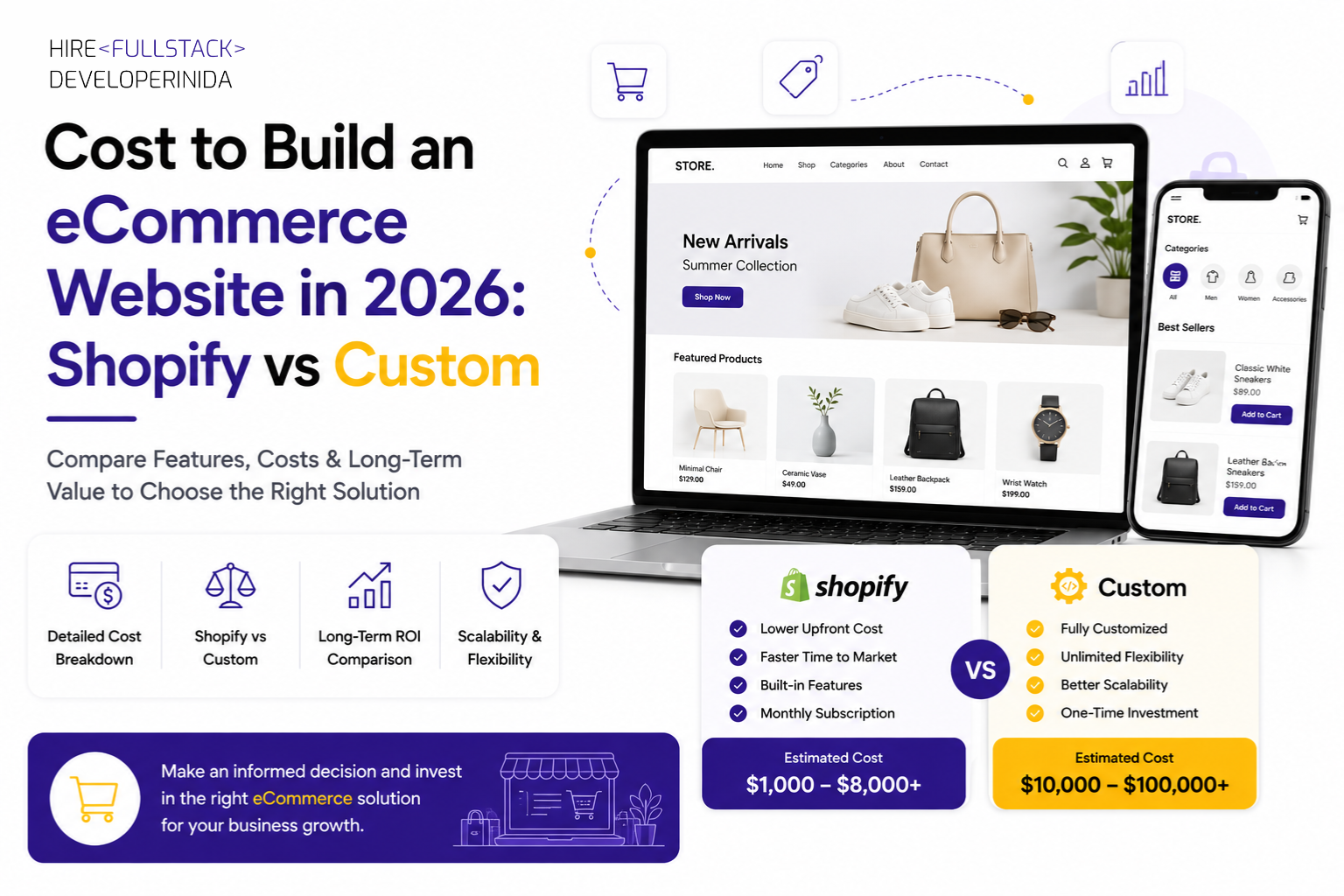

What if the question is not "how much does it cost to build an eCommerce website" but "how much am I willing to spend before I figure out whether this business works"?
That is a different question. And it leads to very different decisions.
Most people searching for eCommerce website development cost are trying to figure out a number they can put in a spreadsheet or pitch to someone who controls the budget. That is completely fair. But the stores that end up overspending are usually the ones that went looking for a number without first getting clear on what they were actually buying, what stage their business was at, and what they genuinely needed on day one versus six months in.
This guide gives you the numbers. But it also gives you the thinking behind them, because a number without context is just a number.
Shopify vs Custom — The Real Numbers Nobody Tells You
Let me be upfront with you. Most blogs that cover eCommerce website development cost give you the same tired information. They list a few price ranges, compare Shopify plans, throw in a chart, and call it a day. You probably already know that drill.
This one is different.
We are going to talk about the costs that sneak up on you six months after your store goes live. And why businesses can choose the exact same Shopify plan and end up spending wildly different amounts. We are going to get into the parts of eCommerce costs that developers talk about among themselves but rarely mention in public guides.
Whether you are a first time store owner trying to figure out your budget, or someone who has been running an online store for years and is thinking about switching platforms, this guide covers what you actually need to know.
The Honest Starting Point: What Are You Really Paying For?
When people ask about eCommerce website development cost, they usually think in terms of the platform fee and maybe a developer's hourly rate. That is only the visible part of the iceberg.
Here is the fuller picture of what an eCommerce website actually costs to exist and run:
- Platform or hosting (the thing you pay monthly or annually)
- Design and development (one time or ongoing)
- Domain name and SSL certificate
- Apps, plugins, and integrations
- Payment gateway fees (this one quietly eats your revenue every single day)
- Content creation — product photos, copy, videos
- Marketing tools — email software, SEO tools, ad tracking
- Maintenance and updates
- Customer support tools
Most cost comparison blogs lump these into vague categories. We are going to break each one down for both Shopify and custom builds so you know exactly what you are signing up for.
Shopify Costs in 2026: Beyond the Pricing Page
Shopify is still one of the most popular eCommerce platforms in the world, and the 2026 version has added AI assisted product descriptions, better analytics, and improved checkout customisation. But the pricing has also crept up.
The Official Plans
These numbers look clear on the surface. But here is the part the pricing page does not highlight.
The Transaction Fee Trap
If you are using any payment gateway other than Shopify Payments, you pay an extra fee on top of the gateway's own fee. On the Basic plan, that is 2% per transaction. If your store does $30,000 a month in revenue, you are silently handing over $600 every single month just in platform transaction fees. That is $7,200 per year on top of your plan cost.
This is one of the biggest silent costs in eCommerce website development cost calculations that business owners realise too late. The moment you switch to a local or region specific payment provider because Shopify Payments is not available in your country or does not support your currency well, that transaction fee starts adding up fast.
The App Store Dependency
Shopify's base functionality is intentionally lean. The platform is designed so you buy the features you need through its App Store. In 2026, the average Shopify store runs somewhere between 6 and 14 apps. Here is a realistic app cost breakdown for a growing store:
If you are running a mid size store with a basic stack of apps, you are likely spending $200 to $600 per month on apps alone. That is before design, development, or marketing.
Theme Costs
Free Shopify themes exist and are genuinely decent in 2026. But premium themes range from $180 to $400 as a one time cost. More importantly, if you want a heavily customised design or unique checkout experience, you are going into custom Liquid template development, which means hiring a Shopify developer at $50 to $150 per hour depending on their location and experience.
A professional Shopify store setup with custom design work in 2026 typically lands between $3,000 and $15,000 for development alone.
Custom eCommerce Website Costs in 2026: The Full Breakdown
Custom built stores are usually developed on platforms like WooCommerce (WordPress), Magento, or fully bespoke builds using frameworks like Next.js or Laravel with headless commerce setups. The eCommerce website development cost for a custom build is more complex, but it buys you something Shopify cannot easily give you: complete control.
Development Costs by Build Type
Hosting for Custom Builds
Unlike Shopify where hosting is included in your plan, custom builds need their own hosting. This is where many business owners underestimate costs.
- Shared hosting: $5 to $30 per month (fine for very small stores, not recommended for anything serious)
- VPS hosting: $40 to $200 per month
- Dedicated server or managed cloud (AWS, Google Cloud, Linode): $100 to $1,000 per month depending on traffic
- Managed WordPress hosting with WooCommerce optimisation (Kinsta, WP Engine): $50 to $500 per month
A growing custom eCommerce store with decent traffic and performance standards should budget $100 to $300 per month for hosting in 2026.
The Maintenance Cost Nobody Budgets For
This is something most eCommerce cost guides skip entirely, and it is one of the most important things you need to know.
Custom built stores require ongoing maintenance. That means:
- Plugin and theme updates (some updates break things, requiring developer fixes)
- Security patches and vulnerability monitoring
- Database optimisation as your product catalog and order history grows
- Server performance tuning as traffic increases
- Integration maintenance when third party APIs update their endpoints
A realistic custom eCommerce maintenance budget is $200 to $800 per month if you are keeping a developer on retainer, or $1,500 to $5,000 per year if you handle issues as they arise. Skipping this budget is how stores end up with outdated plugins, security vulnerabilities, and slow load speeds.
The Hidden Costs Both Platforms Share
Here is the section that separates a real budget from an optimistic one. These costs apply whether you go Shopify or custom, and they are consistently underestimated.
- Payment Processing Fees
Every transaction on your store costs you money regardless of platform. Stripe charges 2.9% plus $0.30 per transaction in most markets. PayPal's rates are similar. On a $50 order, you lose roughly $1.75 to the payment processor before platform fees. Over thousands of orders, this is a significant line in your P&L.
For businesses processing $100,000 per month, payment processing alone can cost $2,900 or more every month. This is often left out of eCommerce website development cost discussions because it is operational rather than a build cost, but it absolutely needs to be in your planning. - Product Photography and Content
A store is only as good as its product images. Professional product photography ranges from $25 to $150 per product depending on complexity, number of shots, and whether you need lifestyle images. For a store launching with 100 SKUs, that is potentially $2,500 to $15,000 just for images. This almost never appears in a developer's quote. - SEO and Performance Work
Both Shopify and custom stores need ongoing SEO investment. Technical SEO audits run $500 to $3,000. Monthly SEO retainers for eCommerce range from $800 to $5,000. Page speed optimisation is often needed after launch because developers prioritise functionality over performance during the build. Core Web Vitals issues are particularly common on stores with large image galleries. - Returns and Refund System Setup
In 2026, returns management has become a significant part of eCommerce operations. Setting up proper returns portals, automated refund flows, and carrier integrations adds $300 to $2,000 to a project depending on complexity. Many businesses discover this gap after launch when they are handling returns manually.
Shopify vs Custom: The Real World Comparison
Let us put real numbers to two real world scenarios so you can see how the eCommerce website development cost plays out over three years.
Scenario A: Fashion Brand, 500 Products, Mid Size
In this scenario, Shopify is actually slightly cheaper over three years. But the custom build gives you more design flexibility and zero platform transaction fees, which becomes more valuable as revenue grows.
Scenario B: Electronics Store, 5,000 Products, High Traffic
At higher volumes, the custom platform still carries a higher upfront and maintenance cost. But once revenue crosses a certain threshold, the elimination of transaction fees and the ability to build custom checkout flows and pricing logic makes custom development increasingly attractive.
The New Costs in 2026: AI Tools, Headless Commerce, and What They Add
This is where 2026 is genuinely different from previous years.
- AI Powered Features
Both Shopify and custom platforms now offer AI integrated features like personalised product recommendations, dynamic pricing, automated descriptions, and AI chat support. These come with their own costs:
- Shopify Magic (built in AI tools) is included in plans but advanced features sit behind Plus
- Third party AI personalisation engines like Nosto or LimeSpot range from $99 to $999 per month
- Custom AI integrations for product discovery on bespoke builds can add $5,000 to $30,000 to a development project - Headless Commerce
Headless eCommerce, where the front end is built separately from the back end commerce logic, has gone from an enterprise trend to a realistic option for mid market businesses in 2026. The appeal is performance and design flexibility. The reality is cost.
A headless Shopify setup using Hydrogen (Shopify's framework) or a Next.js front end connecting to Shopify's Storefront API typically costs $15,000 to $50,000 to build and requires developers with specific skills. Maintenance is also higher because you are managing a front end codebase separately.
It is worth it for businesses where site performance and unique UX are central to the brand. It is overkill for a store doing under $1 million per year.
What Stage Are You At? Matching Budget to Reality
One of the most useful things you can do when thinking about eCommerce website development cost is to match your platform choice to your current stage rather than your future ambitions.
- Just Starting Out (Under $10K Budget)
Shopify Basic or WooCommerce on shared or budget managed hosting is the right call. Do not over engineer your first store. Focus your budget on product photography, a clean theme, and a basic email marketing setup. Keep development to the essentials.
Realistic all in first year budget: $3,000 to $8,000. - Established Business, Ready to Grow ($10K to $50K Budget)
This is where the Shopify vs custom question gets interesting. If your revenue is under $500,000 per year and your requirements are fairly standard, Shopify Advanced or a well built WooCommerce store serves you well. If you have complex requirements like multi currency pricing, custom bundles, or B2B wholesale pricing, a custom build starts making more sense here.
Realistic budget: $15,000 to $40,000 including development, apps, and first year operations. - Scaling Business ($50K Plus Budget)
At this stage, the transaction fees on standard Shopify plans become a real cost driver. Custom platforms or Shopify Plus with negotiated rates start to make financial sense. Headless commerce is worth evaluating. Dedicated development resources, either in house or a retained agency, become part of the operational model.
The Questions You Should Ask Before Spending Anything
Before you get a single developer quote or sign up for any platform, get clear on these:
- How many products are you launching with, and how many will you have in two years?
- Do you need multi currency or multi language support? This adds significant complexity.
- What payment gateways do you need? Some are Shopify Payments incompatible.
- Will you sell B2B and B2C from the same store? This changes the platform decision significantly.
- Do you have an existing tech stack (ERP, CRM, inventory system) that needs to integrate?
- What are your performance requirements? A media heavy fashion store and a text heavy software store have very different needs.
Developer quotes without answers to these questions are guesses. Any agency or freelancer who gives you a solid quote without asking these questions first is also guessing.
Final Thought: The Cost Is Never Just the Build
Here is the question worth sitting with after reading all of this. Not "which platform is cheaper" but "which platform am I still happy with when my store is twice the size it is today?"
Shopify and custom builds are both genuinely good choices in 2026. The businesses that regret their decision are almost never the ones that picked the wrong platform. They are the ones that picked the right platform for the wrong stage of their business, and then outgrew it faster than their budget could handle a migration.
Know your stage. Know your next two years. Then pick. That order matters more than any pricing comparison ever will.