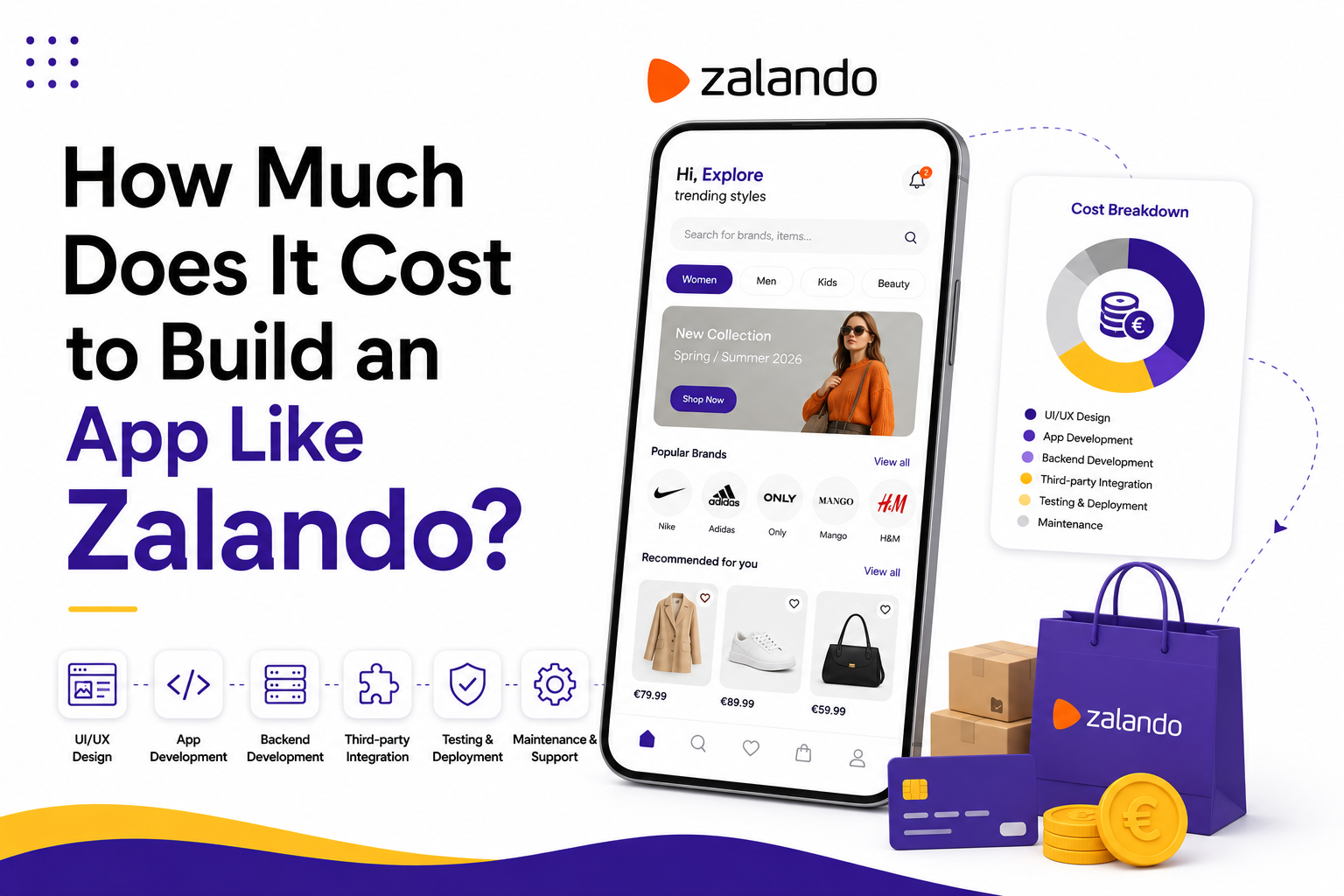

Zalando isn't just a shopping app anymore. It's a logistics network, a recommendation engine, a multi-brand marketplace, and a returns machine, all stitched together behind a clean product feed. Founded in Berlin in 2008 as a shoe retailer, it now serves customers across more than two dozen European markets and pulls in tens of millions of monthly visitors. So when someone starts researching the cost to build an app like Zalando, the honest answer is: it depends entirely on which version of Zalando you're actually trying to build.
This guide breaks down the real cost drivers behind the cost to build an app like Zalando, the feature-by-feature pricing, the technology decisions, the team structures, and the hidden expenses that most quick estimates leave out. If you're about to have a conversation with a development agency, read this first — it'll change the questions you ask.
Why the Cost to Build an App Like Zalando Varies So Much
Before pricing anything out, it helps to understand what you're pricing. Zalando runs a live product catalogue spanning millions of SKUs, real-time inventory sync across thousands of brand partners, a personalization engine trained on billions of interactions, a reverse-logistics operation built specifically around fashion returns, and a second-hand resale arm (Zircle) layered on top of the core retail experience. None of that happened in a single release cycle, and none of it is required for a first version of your product.
This is exactly why every "cost to build an app like Zalando" estimate you'll find online spans such a wide range — anywhere from $30,000 to $500,000, depending on the source. Both numbers can be technically correct, because they're describing completely different projects. A bare-bones fashion storefront and a full multi-vendor marketplace with AI personalization share almost nothing in common except the word "app."
The useful framing isn't "how do we clone Zalando." It's "which of these systems actually move the needle for our users on day one, and which can wait." That single question is what actually controls your budget more than any technology choice you'll make.
What Makes Zalando the Benchmark for Fashion eCommerce
Zalando has become the reference point for fashion eCommerce for a reason. It handles millions of concurrent users without buckling, processes real-time stock changes across thousands of independent brand partners, and runs a recommendation system that adapts to every scroll, click, and abandoned cart. Its mobile experience is polished enough to win industry design awards, and its return policy — free, easy, no-questions-asked — has become a category expectation rather than a differentiator.
Understanding this matters because it reframes the question founders usually ask. It's not "what does Zalando cost." It's "what does the specific subset of Zalando's capabilities that my customers actually need cost." Those are very different numbers, and conflating them is the single biggest reason first-time app founders get sticker shock three months into a build.
Core Features That Drive the Cost to Build an App Like Zalando
Every serious estimate for the cost to build an app like Zalando comes down to feature scope. Here's what each major module actually involves from a development standpoint, and what it typically costs to build in 2026.
User Registration and Profile Management
This looks simple and rarely is. You need social login options, guest checkout, saved addresses, order history, size and style preferences, and wishlist functionality that syncs across devices. In 2026, users also expect personalization to begin the moment they create a profile, which means your registration flow needs to feed directly into your recommendation engine from day one, not as an afterthought bolted on later.
Estimated cost: $6,000–$15,000
Product Catalogue and Search
Zalando lists millions of products across categories, sizes, colors, and brands. Even at a fraction of that scale, building a catalogue architecture that handles multiple categories, filter combinations, size variants, and brand-level metadata requires serious backend planning. The search functionality alone — autocomplete, typo tolerance, synonym handling (so "sneakers" also surfaces "trainers"), and relevance ranking — is a meaningful engineering investment on its own.
Estimated cost: $15,000–$36,000
Personalization and Recommendation Engine
This is the feature that separates a good fashion app from a genuinely great one. AI-driven recommendations based on browsing history, purchase patterns, and style preferences are now a baseline expectation for serious fashion platforms, not a premium add-on. Building this well requires both software engineering and applied machine learning expertise, and it's one of the few features where cutting corners shows up immediately in user experience.
Estimated cost (in-house build): $12,500–$32,000 Estimated cost (third-party API, e.g., Algolia, Nosto, Dynamic Yield): $500–$5,000/month subscription
Shopping Cart and Checkout
The checkout experience is where you either convert a user or lose them permanently. Multiple payment options — cards, digital wallets, buy-now-pay-later, and local payment methods for each market you serve — all need support, and every additional payment method is effectively its own integration project.
Estimated cost (checkout flow): $10,000–$24,000 Estimated cost (per payment gateway): $5,000–$14,400
Order Management and Tracking
Users want to know exactly where their order is at every moment. Real-time tracking, push notifications for status updates, estimated delivery windows, and easy cancellation all need to be built and tightly integrated with your logistics partners' systems.
Estimated cost: $7,500–$20,000
Returns and Refunds
Zalando built much of its reputation on making returns painless. That ease requires a dedicated returns portal, automated refund processing, and tight integration with fulfillment partners. For a fashion app where sizing is inherently uncertain, this isn't an optional feature — it's a core part of the trust relationship with your customers, and skimping here shows up directly in churn.
Estimated cost: $6,000–$16,000
Seller or Brand Partner Portal
If you're building a marketplace model rather than a single-retailer storefront, brands need a separate portal to manage their catalogues, inventory, pricing, and performance analytics. This is essentially a second application running alongside your consumer-facing app, and it adds significant development effort accordingly.
Estimated cost: $17,500–$40,000
Admin Dashboard and Analytics
Your internal operations team needs tools too. Order management, user management, product approval workflows, discount configuration, and performance analytics all need a well-designed internal dashboard. This part of the build is easy to underestimate during planning and incredibly important for actually running the business day to day.
Estimated cost: $10,000–$24,000
Wishlist, AR Try-On, and Social Features
Wishlist syncing across devices is relatively inexpensive to add on top of existing account infrastructure. AR/VR try-on experiences and second-hand marketplace functionality (the Zircle model) are the features that push a project from "solid fashion app" into "platform," and they add meaningfully to both cost and timeline.
Estimated cost (combined): $20,000–$50,000, depending on how far you take AR/VR specifically
Push Notifications, Design, QA, and DevOps
Push notification infrastructure runs $4,000–$9,600. UI/UX design — genuinely important in a category this visually competitive — typically costs $15,000–$40,000. QA and testing run $10,000–$28,000, and DevOps/deployment setup adds another $7,500–$20,000.
Total Cost to Build an App Like Zalando: The Full Picture
Pulling every module together, here's the honest range for the cost to build an app like Zalando at different levels of ambition:
| Feature / Module | Estimated Hours | Estimated Cost (USD) |
|---|---|---|
| User Auth and Profiles | 120–180 hrs | $6,000–$14,000 |
| Product Catalogue and Search | 300–450 hrs | $15,000–$36,000 |
| Recommendation Engine (AI) | 250–400 hrs | $12,500–$32,000 |
| Shopping Cart and Checkout | 200–300 hrs | $10,000–$24,000 |
| Payment Gateway Integration | 100–180 hrs | $5,000–$14,400 |
| Order Tracking and Logistics | 150–250 hrs | $7,500–$20,000 |
| Returns and Refund System | 120–200 hrs | $6,000–$16,000 |
| Seller or Brand Portal | 350–500 hrs | $17,500–$40,000 |
| Admin Dashboard | 200–300 hrs | $10,000–$24,000 |
| Push Notifications | 80–120 hrs | $4,000–$9,600 |
| UI and UX Design | 300–500 hrs | $15,000–$40,000 |
| QA and Testing | 200–350 hrs | $10,000–$28,000 |
| DevOps and Deployment | 150–250 hrs | $7,500–$20,000 |
Full-featured platform: $130,000–$320,000 Lean build without marketplace/AR layer: $60,000–$120,000
This range is wide on purpose. Team location, feature scope, design ambition, and market reach all pull the final number in different directions, and any agency quoting you a single fixed figure without asking about your feature list first hasn't actually scoped your project.
How Team Location Changes the Cost to Build an App Like Zalando
Where your developers sit affects your budget more than almost any other single decision you'll make.
- North America / Western Europe: $100–$200/hour
- Central & Eastern Europe (Poland, Romania, Ukraine): $40–$80/hour
- South & Southeast Asia (India, Vietnam, Philippines): $20–$45/hour
On a project this size, the gap between a US-based team and an outsourced team in India or Eastern Europe can easily run $150,000–$200,000 on identical feature scope. That's precisely why so many funded fashion-tech founders source engineering talent from these regions for large builds — not purely because it's cheap, but because the rate arbitrage is large enough to fund an entire second feature set with the savings.
The caveat that matters: location doesn't guarantee quality either way. Vet for proven eCommerce experience specifically, strong English-language project communication, and a development process that matches how your team actually works — not just the lowest hourly rate on the page.
The Technology Stack Behind the Cost to Build an App Like Zalando
Frontend/Mobile: React Native remains the default choice for cross-platform mobile development in 2026 — one codebase serving both iOS and Android with near-native performance. Flutter is a solid alternative for teams that prefer it. For the web storefront, Next.js is the standard choice because server-side rendering matters enormously for SEO on a catalogue with this many individual product pages.
Backend: Node.js and Python dominate here, with Python specifically favored for its machine learning ecosystem powering the recommendation layer. Microservices architecture is close to mandatory at this scale — search, payments, and notifications need to scale and deploy independently of one another as traffic grows unevenly across features.
Data layer: PostgreSQL handles structured data like orders and user profiles. Elasticsearch is the standard for product search because of its speed and flexibility with complex filter queries. Redis handles caching and session management to keep response times fast even under heavy load, like a Black Friday traffic spike.
Cloud and infrastructure: AWS, Google Cloud, and Azure are all viable in 2026. Most fashion platforms at this scale combine managed Kubernetes for container orchestration, a CDN for fast global image delivery, and S3-compatible storage for product photography. Expect $3,000–$8,000/month in infrastructure costs once you're live, scaling upward with traffic.
MVP First, Platform Second: Managing the Cost to Build an App Like Zalando
The single most useful piece of advice in this entire guide: don't try to build the full platform on day one. Zalando didn't build Zalando on day one either.
A sensible MVP includes account creation, a browsable catalogue with basic filtering, checkout with two or three payment methods, order tracking, and a simple admin panel. That scope typically costs $60,000–$120,000 and takes four to six months with a team of four to six developers. It's enough to get real users interacting with your product and generating the data you need to decide intelligently what to build next.
From there, the path usually looks like this:
- Months 1–6: Launch MVP, validate core product-market fit, gather real usage data
- Months 6–12: Add recommendation engine, seller/brand portal, and deeper analytics — full-featured v1
- Months 12–24: Scale to multi-market support, marketplace expansion, and AI personalization throughout — genuine platform territory
The founders who get this right ship the MVP, watch what users actually do with it, and only then invest in the expensive features. The ones who get it wrong try to build the recommendation engine, the seller portal, and the AR try-on feature all before they've validated that anyone wants the core product in the first place — and that's the single most common way an app development budget spirals past its original estimate.
Hidden Costs That Catch Founders Off Guard
The development quote you receive is not your total cost. This is one of the most common surprises for first-time app builders, and it's worth being completely direct about what else you'll spend money on.
Third-party integrations. Payment processors charge per transaction. Shipping APIs carry monthly fees. Email service providers, SMS gateways, analytics platforms, customer support tools, and fraud detection services all cost money every single month. Budget at least $2,000–$5,000/month in SaaS tooling once you're operating at any reasonable scale.
Content and product photography. A fashion app lives and dies on visual quality. If you're running a marketplace with brand partners, they typically supply their own imagery. If you're selling your own products, professional fashion photography is a real budget line that can easily run $10,000–$50,000 for a decent catalogue.
Legal and compliance. eCommerce apps need to comply with regulations like GDPR for user data protection, and in the EU specifically, accessibility standards and Digital Markets Act obligations add further legal and technical overhead. Consulting a legal expert to ensure compliance typically costs $5,000–$15,000.
App store fees. Apple takes 15–30% of in-app purchases, Google similarly. Both platforms require annual developer account fees on top of that.
Ongoing maintenance. Apps don't maintain themselves. Budget 15–20% of your initial development cost annually for security updates, OS compatibility patches, bug fixes, and incremental feature development. For a platform that cost $150,000 to build, that's $22,500–$30,000 per year in ongoing engineering spend, indefinitely.
How Zalando Actually Makes Money (and Why It Should Shape Your Feature List)
Worth understanding before finalizing your own feature roadmap: Zalando's revenue isn't purely transactional. Alongside standard retail margins, it runs a subscription tier (Zalando Plus) offering exclusive member benefits, earns advertising revenue from displaying targeted brand placements within the app itself, and generates additional income from curated style-box subscriptions containing pre-selected fashion items.
If you're building a genuine platform rather than a straightforward single-brand retailer, deciding early which of these revenue streams you actually want baked into your product changes your feature priorities substantially. A subscription tier and an ad-serving system for brand partners are both real engineering line items with their own cost — not just business-model decisions made in a slide deck after the app ships.
Realistic Timelines for Building an App Like Zalando
Budget and timeline are two sides of the same conversation, and founders consistently underestimate the second one.
A well-scoped MVP with a focused feature set and a competent team of four to six developers typically takes four to six months from kickoff to launch. Adding the seller portal, recommendation engine, and advanced analytics stretches that to nine to twelve months for a genuinely full-featured v1. A true Zalando-scale platform — multi-market support, marketplace functionality, AI-driven personalization throughout — is realistically an eighteen to twenty-four month undertaking.
These timelines assume a well-organized project with clear requirements, regular reviews, and a decision-maker who responds quickly to approvals. Unclear requirements and slow sign-offs are, without question, the two biggest timeline killers on any project of this size — far more disruptive than any single technical decision.
Choosing a Development Partner Without Overpaying
A few things matter more than hourly rate when picking who actually builds this for you:
- Proven eCommerce experience — not just "we've built apps before," but specifically catalogue-heavy, high-transaction-volume retail platforms with real production traffic behind them
- Communication process — daily reports, shared project trackers (Jira, Basecamp, Redmine), and a clear escalation path matter enormously once a project spans multiple months and time zones
- Post-launch support model — ask what maintenance actually looks like before you sign, not after launch when you have no leverage left.
- Technology fit — a team already fluent in React Native, Next.js, Node.js or Python, and comfortable working in a microservices architecture will move measurably faster than a generalist shop learning your stack on your budget.
- Transparent estimation — a partner who breaks down cost by feature module, the way this guide does, is giving you something you can actually negotiate and scope against. A single flat number is not an estimate; it's a guess with a decimal point.
The Bottom Line on the Cost to Build an App Like Zalando
Building a fashion eCommerce app at real scale costs somewhere between $130,000 and $320,000 in 2026, with a lean, focused MVP achievable for $60,000–$120,000. That range is wide because the variables — team location, feature scope, design ambition, and market reach — are genuinely different for every founder reading this guide.
What doesn't change, regardless of budget: every feature costs more than the first estimate suggests, every timeline runs longer than the initial plan, and the products that actually succeed in this space are the ones that shipped something real, watched actual users interact with it, and built the expensive features only after proving those features would matter.
Start with what you can afford to build well. Scale with what you learn along the way. That's not a compromise on ambition — it's literally how Zalando got to where it is today.