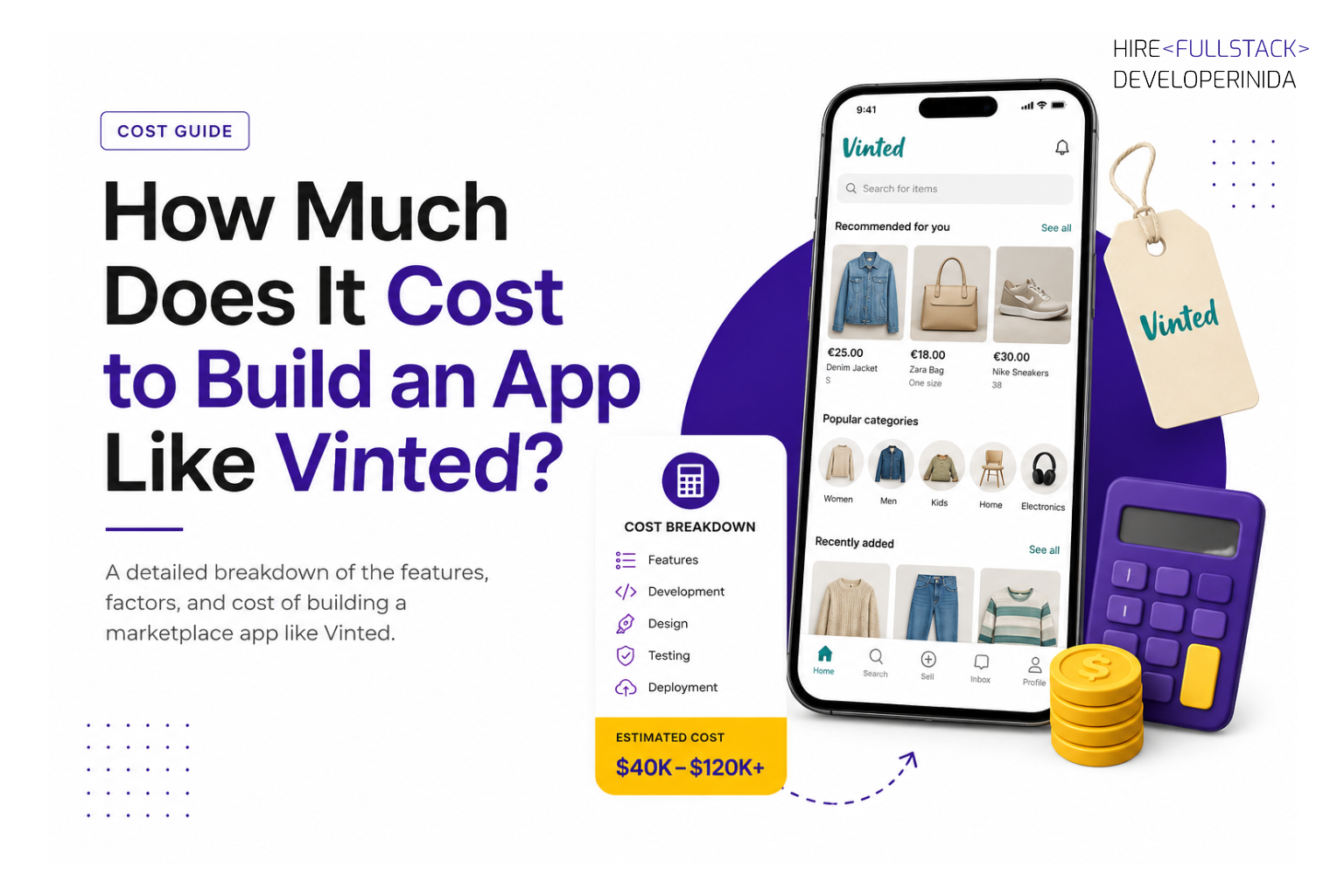

You typed "how much does it cost to build an app like Vinted" and got approximately 47 tabs open right now, didn't you?
And every single one of them said something like "it depends on the complexity" and then listed user registration and a search bar as features. Super helpful. Thanks, internet.
Here is the truth nobody says out loud: most of those blogs were written to rank on Google, not to actually help you make a decision. They are vague on purpose because the agency writing them wants you to fill out a contact form at the bottom.
This one is different. Not because we are special, but because we are going to treat you like someone who has already done the basic research and now wants the real picture. The budget traps. The things that cost nothing to plan for but a fortune to fix later. The decisions that look small but quietly determine whether your total spend is $60,000 or $200,000.
If you are thinking about building a resale marketplace app in 2026, you are actually entering a space that is growing faster than most people realize. The global secondhand fashion market is on track to cross $350 billion by 2028. Vinted alone crossed 65 million users. The opportunity is genuinely there.
But so is a very long list of ways to burn your budget before you ever launch.
So let's get into it properly.
First, Understand What Kind of App Vinted Actually Is
Most people think Vinted is just a selling app. It is not. Vinted is a peer to peer secondhand fashion marketplace. That means it is a two-sided platform where buyers and sellers both have completely different journeys inside the same app.
This distinction matters because building a two-sided marketplace is genuinely more complex than building a regular ecommerce app. You are not just building one product. You are building two user experiences that have to talk to each other in real time, handle trust between strangers, manage payments securely, and somehow make both sides feel like the app was made just for them.
Here is what makes Vinted specifically interesting from a technical standpoint:
- It uses computer vision to auto-suggest categories and pricing when you upload a photo
- It has a built-in shipping integration with multiple carriers across different countries
- It runs a buyer protection system that holds payments in escrow until the buyer confirms receipt
- It supports in-app messaging between buyers and sellers
- It has a wardrobe system where sellers can organize and display their listings
- It uses AI to show personalized feeds based on style preferences and browsing behavior
Each of these things has a cost. And most blogs do not break them down individually.
The Cost Framework Nobody Uses But Should
Here is a better way to think about the cost to build resale marketplace app. Instead of thinking about it as one big number, think about it in three distinct budget zones.
Zone 1: The Foundation (What You Cannot Skip)
This is the layer that makes the app work at all. No shortcuts here. It includes your backend infrastructure, your database design, your authentication system, your core buying and selling flow, and your payment integration.
In 2026, building this foundation for a marketplace app with basic features typically runs between $25,000 and $60,000. That range depends heavily on where your development team is located, which we will cover shortly.
Zone 2: The Trust Layer (What Makes Users Stay)
This is the part most blogs treat as a feature list but it is actually a separate strategic layer. For a secondhand marketplace like Vinted, trust is the product. If users do not trust the platform, they leave. Period.
- The trust layer includes things like:
- Escrow payment handling so buyers feel safe
- Seller verification and ratings systems
- Dispute resolution workflows
- Anti-fraud detection using behavioral signals
- Real-time chat with message history
Building a solid trust layer typically adds $20,000 to $45,000 to your total project cost. And here is the important part: cutting corners here will cost you more in the long run through chargebacks, fraud, and user churn.
Zone 3: The Growth Layer (What Makes the Business Scale)
This is where things like AI recommendations, push notification systems, analytics dashboards, seller tools, promotional features, and marketplace boosting options live. You do not need all of these on day one. But you need a technical architecture that can support them later without requiring a full rebuild.
Depending on how many growth features you include at launch, this adds anywhere from $15,000 to $80,000 to your budget.
Real Cost Breakdown: Feature by Feature
Here is a breakdown of the major components and what they realistically cost in 2026. These figures assume a mid-tier development team, and we will talk about regional variations right after this.
The Geography Factor: Where Your Team Is Located Changes Everything
This is one of the biggest hidden variables in any app development cost discussion. The exact same app can cost wildly different amounts depending on where you hire.
So if your app requires 2,000 hours of development work, that is $40,000 with an Indian team or $300,000 with a US-based agency. Same app. Same features. Very different invoice.
The smart approach many founders use in 2026 is a hybrid model: a product manager and a tech lead in their home country for communication and strategy, with execution happening in Eastern Europe or India. This can cut costs by 40 to 60 percent while keeping quality high.
The Costs That Will Surprise You After Launch
This is the section that could save you from a very unpleasant surprise six months into your launch. Most cost-related blogs focus entirely on the build. But for a marketplace app, the ongoing costs are significant and often underestimated.
- Cloud Infrastructure and Hosting
A marketplace app is not a brochure website. It handles real-time data, images, transactions, and user sessions simultaneously. In the early stage with light traffic, your monthly infrastructure bill on AWS or Google Cloud might be $300 to $800. But as you grow, this scales fast. At 50,000 active monthly users, expect to spend $3,000 to $8,000 per month on infrastructure alone. - Payment Processing Fees
This one genuinely surprises people. Stripe, the most common payment processor for marketplaces, charges around 1.5 to 2.9 percent plus a fixed fee per transaction. On a platform where people are selling $15 dresses and $40 jackets, this adds up quickly. On $500,000 in gross merchandise value, you are paying $7,500 to $14,500 just in payment fees. This is not avoidable but it should be in your financial model from day one. - Content Moderation
Vinted has a huge team dedicated to keeping the platform safe and listings accurate. When you are starting, you can rely on automated tools and user reporting. But as you scale, you will need human moderators. Budget for this from the beginning, either as a line item for a moderation team or for a third-party trust and safety service. - App Store Fees
Apple takes 15 to 30 percent of any in-app purchases or subscriptions. If you plan to monetize through a seller subscription model or boost features (like Vinted does), this is a real cost. Many marketplace founders are caught off guard by this when they launch their premium features. - Bug Fixes and Maintenance
Budget at least 15 to 20 percent of your original development cost annually for maintenance, bug fixes, OS updates, and security patches. On a $100,000 build, that is $15,000 to $20,000 per year just to keep things running smoothly.
The AI Features That Are Now Table Stakes in 2026
When Vinted launched, AI-powered features were a competitive advantage. In 2026, they are quickly becoming baseline expectations for any serious marketplace app. Here is what users now expect and what it costs to build:
- Smart Photo-Based Listing
When a seller uploads a photo of a jacket, the app should automatically suggest the category, detect the brand if visible, and estimate a fair price range based on similar sold items. This feature alone can increase listing completion rates by over 30 percent. Building it requires integration with a computer vision API like Google Vision or a custom-trained model. Cost: $8,000 to $20,000 depending on accuracy requirements. - Personalized Discovery Feed
The reason people open Vinted every day is because the feed shows them things they actually want. This is not magic. It is a recommendation engine trained on their browsing history, saved items, purchases, and style signals. Building a basic version using collaborative filtering costs $10,000 to $15,000. A more sophisticated system with real-time personalization can run $25,000 or more. - AI Pricing Suggestions
Helping sellers price their items correctly is a massive retention tool. Sellers who price well sell faster and stay on the platform longer. This feature pulls data from historical sales of similar items and suggests a competitive price range. Cost to build: $6,000 to $14,000.
Build vs Buy vs White Label: The Decision That Changes Your Budget More Than Anything
Here is something almost no blog covers properly. You do not necessarily have to build everything from scratch.
- Build From Scratch
Full custom development. Maximum flexibility. Highest cost and longest timeline. Best for founders with a clear, differentiated vision and access to significant funding. Timeline: 9 to 18 months. Cost: $75,000 to $250,000+. - White Label Marketplace Platform
Companies like Sharetribe, CS-Cart, and Marketplacer offer pre-built marketplace frameworks that you can customize. You can launch a functioning resale marketplace in 8 to 16 weeks for $15,000 to $40,000. The tradeoff is limited flexibility and recurring platform fees of $500 to $2,500 per month. - Hybrid Approach
Start with a white label platform to validate your concept and reach, then migrate to a custom build once you have revenue and user data to justify it. This is genuinely the smartest path for most founders in 2026. You spend $20,000 to $40,000 to launch, learn what your users actually want, and then invest $100,000+ in building exactly that.
The Hidden Cost of Compliance and Legal
Nobody talks about this in app development blogs. But for a resale marketplace that handles payments, user data, and cross-border transactions, compliance is a real expense.
- GDPR compliance if you have European users: $5,000 to $15,000 in legal and technical setup
- PCI DSS compliance for payment handling: this is often handled via Stripe or similar but there are audit requirements
- Terms of service and privacy policy drafting: $2,000 to $5,000 with a tech-focused lawyer
- VAT/tax handling for marketplace transactions varies by country and can require significant backend work
These are not optional if you want to operate legally and protect yourself. Plan for $10,000 to $25,000 in legal and compliance costs, especially if you plan to launch in multiple countries.
How Long Does It Actually Take?
Cost and time are directly connected. The faster you want to move, the more developers you need, which means higher cost. Here is a realistic timeline breakdown:
A white label solution compresses this to 8 to 16 weeks. A hybrid approach typically takes 4 to 6 months for the initial launch.
What Is Your Monetization Strategy and Why It Changes Your Build Cost
This is another thing most blogs do not connect to the cost conversation. But your monetization model directly determines which features you need to build, and therefore how much you spend.
- Commission-Based (Like Vinted)
You take a percentage of each sale. This requires a robust payment and escrow system from day one. High upfront build cost but sustainable long term. Adds $15,000 to $30,000 to the core build. - Seller Subscription Model
Sellers pay a monthly fee for access or premium features. Requires subscription management, billing cycles, and tiered access control. Adds $8,000 to $15,000 to the build. - Listing Boost and Promoted Placements
Sellers pay to feature their items higher in search results. Requires an ad system, bidding logic, and priority queue in your search algorithm. Adds $10,000 to $20,000.
Many successful marketplaces combine all three. If that is your plan, build the architecture to support all of them even if you only launch with one.
So What Is the Final Number?
Here is an honest summary based on everything above:
And remember: the build cost is just the beginning. Your first year of operation will add infrastructure, payment fees, marketing, customer support, and legal costs on top of that.
Final Thoughts: The Question is Not Just What It Costs
Here is the thing about building a marketplace app that nobody puts in the summary section.
The founders who succeed are not the ones with the biggest budgets. They are the ones who spent their first $30,000 learning what their users actually wanted, then spent the next $100,000 building exactly that. The ones who failed usually did the opposite. They spent everything upfront building the full vision, launched to silence, and ran out of runway before they could fix it.
Vinted did not become Vinted overnight. They launched in Lithuania in 2008, spent years figuring out what made sellers stay and buyers come back, and slowly expanded based on what the data told them.
You do not need to out-feature Vinted. You need to out-focus them in one specific market or one specific niche. That is actually very doable.
So if you take one thing from this blog, let it be this: your first version should answer one question. "Will real people use this?" Everything else, the AI recommendations, the boost features, the multi-country shipping, can come after you have answered that question with actual users and not just assumptions.
Now go build something real.