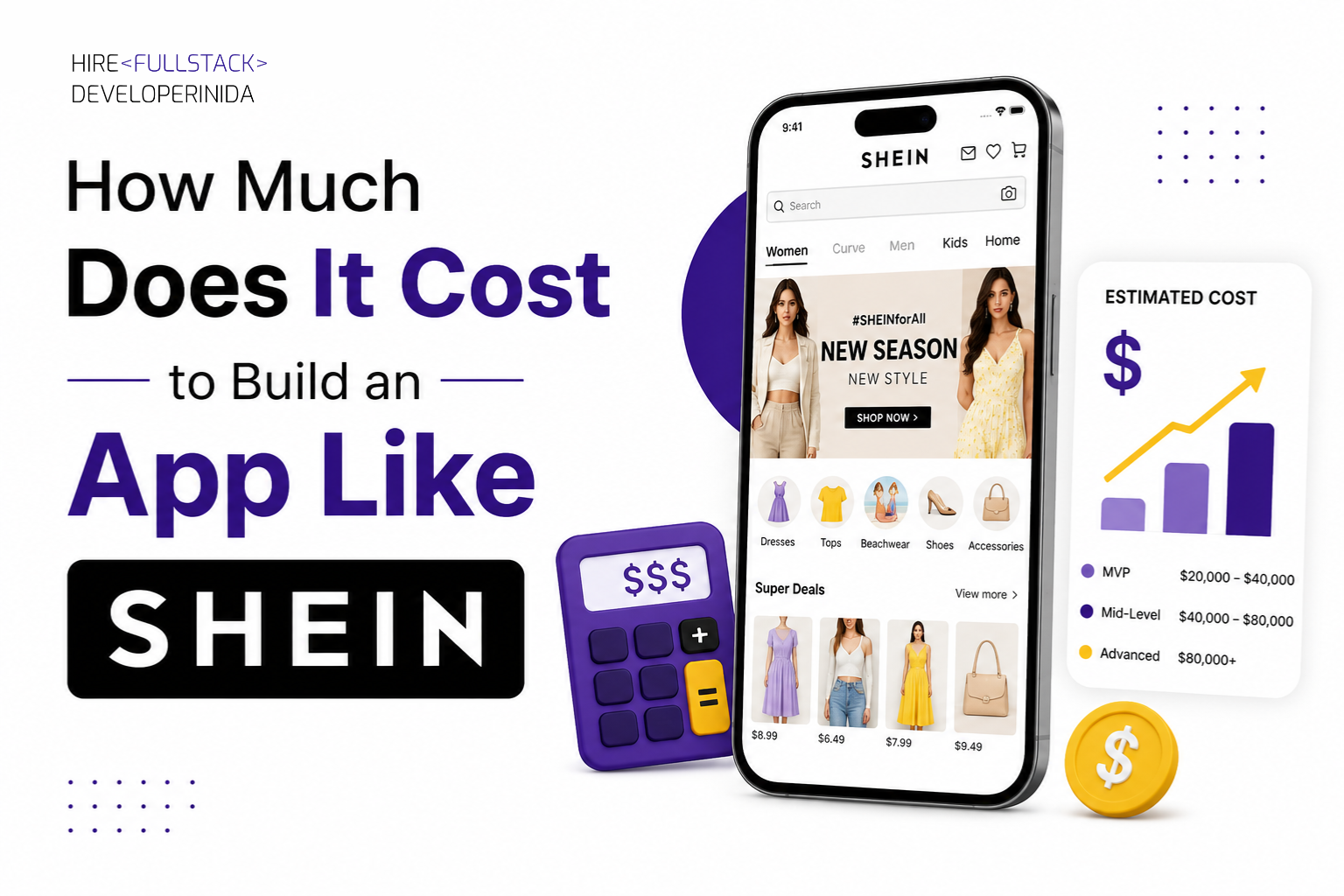

Let us be honest about something. Most people who search "cost to build an app like Shein" are not students doing research. They are founders with a business idea, product managers with a pitch deck ready, or CEOs who just got off a call with an investor and now need real numbers to plan their next move.
You already know Shein is not just a shopping app. It is a technology-driven, AI-powered, data-heavy platform that has redefined how fashion discovery works at a global scale. The real question is: what does it actually take to build something like that in 2026, and what will it cost your business?
The answer is not a single number. It is a combination of decisions you make about your team, your features, your tech stack, and your growth timeline. This blog breaks all of that down in a way that is honest, practical, and built for decision-makers who need clarity, not marketing fluff.
What Makes a Shein-Like App Different From a Regular eCommerce App
Before we get into numbers, this context matters. A lot of founders underestimate what they are actually building when they say they want an app like Shein. This is not a standard Shopify theme with a mobile wrapper.
Shein operates as a fast fashion marketplace powered by real-time trend detection, hyper-personalized product recommendations, a deep supplier integration engine, and an AI-based pricing and demand forecasting system. Replicating even a portion of this requires a much more deliberate technical architecture than a typical retail app.
Here is what separates a Shein-like app from a basic eCommerce build:
- AI-driven product recommendations and personalized feeds
- Real-time inventory syncing across thousands of SKUs
- Flash sales, limited-time deals, and dynamic pricing logic
- Multi-region shipping and logistics integrations
- Loyalty programs, referral engines, and gamified rewards
- A robust admin panel for vendors, products, orders, and analytics
- Social proof features like user reviews with photo and video uploads
- Size recommendation tools powered by user data
The Full Cost to Build an App Like Shein: What You Are Really Paying For
The cost to build an app like Shein in 2026 typically ranges from $40,000 to $300,000 or more, depending on the complexity of features, the development team you hire, and the region they are based in. Let us break this down stage by stage.
Stage 1: Discovery and Planning ($3,000 to $8,000)
This is the phase most founders skip and then regret. Discovery involves defining your product scope, mapping your user journeys, identifying technical requirements, and creating a clear project roadmap. A proper discovery phase saves you far more money than it costs because it prevents expensive pivots mid-build.
What this includes: product workshops, competitor analysis, feature prioritization, tech stack recommendation, wireframe review, and a timeline estimate.
Stage 2: UI/UX Design ($8,000 to $25,000)
Design is not decoration. For a fashion app, it is a core part of your conversion strategy. Poor UX is the number one silent killer of mobile commerce apps. Users abandon carts, skip onboarding, and uninstall apps because of bad design, not bad products.
A Shein-like app requires multiple design deliverables:
• High-fidelity wireframes for all key screens
• Interactive prototype for user testing
• Design system with components, typography, and color tokens
• Onboarding flow and style preference quiz UX
• Product listing, detail, cart, and checkout screen designs
• Admin panel design for back-end team use
Junior UI/UX designer: $25 to $45/hour. Senior UX specialist: $60 to $120/hour. Design agency retainer: $10,000 to $25,000 for full project scope.
Stage 3: Frontend Development ($15,000 to $45,000)
Frontend is everything the user sees and interacts with. For a fashion eCommerce app like Shein, this includes building every screen, animation, transition, and interactive element across both iOS and Android.
Cost difference by platform:
Cross-platform development using Flutter or React Native is the most popular choice for startups and early-stage products in 2026. It reduces cost by 35 to 45 percent compared to building separate native apps, and the performance gap has narrowed significantly over the past few years.
Stage 4: Backend Development ($20,000 to $60,000)
The backend is your engine. It handles everything the user never sees but always feels: product data, order management, user accounts, payments, notifications, and more. For a Shein-like platform, the backend is especially complex because of the scale and variety of data it needs to manage.
Key backend components and their individual cost estimates:
Stage 5: API Integration ($8,000 to $30,000)
Modern apps do not build everything from scratch. You integrate third-party services for payments, shipping, communication, and analytics. Each integration adds cost, but it also adds functionality that would take months to build natively.
Here is a breakdown of common integrations for a Shein-like app:
Stage 6: Testing and Quality Assurance ($5,000 to $18,000)
Skipping QA is like opening a restaurant without a health inspection. You might get away with it for a while, but the cost of one bad experience, one broken payment flow, one crash on launch day, is far greater than the cost of proper testing.
Testing for a Shein-like app includes:
• Functional testing across all user flows
• Performance and load testing at scale (simulating thousands of concurrent users)
• Security testing, especially around payment and user data
• Cross-device and cross-OS compatibility testing
• Accessibility testing for inclusivity compliance
• User acceptance testing before launch
Manual QA rates: $20 to $50/hour. Automated testing setup: $3,000 to $8,000 one-time cost. Full QA cycle for a complex app: $5,000 to $18,000.
Stage 7: App Store Launch and Deployment ($1,500 to $5,000)
Getting your app live is not just hitting a publish button. There are configuration, compliance, and review processes involved. Apple App Store submission requires a $99/year developer account and a review cycle that can take 1 to 7 days. Google Play requires a one-time $25 fee and typically has a faster review process.
Launch-related costs include: app store optimization (ASO) setup, server configuration, SSL certificates, CDN setup for media content, staging to production migration, and monitoring tool configuration.
Cost Based on App Complexity: Basic, Medium, and Advanced
Most funded startups in the fashion-tech space launch with a medium-complexity build in 2026. A lean, well-designed MVP helps you validate your market before committing to the full platform build.
Team Structure and Developer Hiring Costs
Who you hire, from where, and how you engage them is often a bigger cost lever than the features you build. Here is what a typical Shein-like app project team looks like and what each role costs in 2026.
You can engage teams through three models: in-house hiring, freelancers, or a dedicated development agency. Agencies based in South Asia and Eastern Europe offer rates 40 to 60 percent lower than US or UK-based teams, with comparable quality when you vet them properly.
The Tech Stack Explained in Simple Language
A tech stack is just the set of programming languages, frameworks, databases, and cloud tools your team uses to build your app. Here is what a modern Shein-like app typically uses in 2026, explained without the jargon.
AI Features and Their Individual Cost Impact
Artificial intelligence is not a buzzword in fashion eCommerce anymore. It is a core competitive lever. In 2026, users expect personalized experiences, and apps that deliver generic feeds are already at a disadvantage. Here is what AI features actually cost to build.
You do not need to build all of these at once. A smart launch strategy involves starting with a personalized feed and AI search, then adding sizing and trend detection in phase two once you have real user data to train your models on.
Hidden and Ongoing Costs Most Blogs Do Not Tell You About
This is where most budgets break down. Founders plan for the development cost and forget that the real cost of running a platform like Shein is an ongoing commitment, not a one-time investment.
- Server and Infrastructure Costs
Cloud hosting for a medium-traffic app starts at $500 to $1,500/month and scales quickly. A high-traffic fashion platform with thousands of daily active users and large product image libraries can easily cost $3,000 to $10,000/month in infrastructure alone. - App Maintenance and Updates ($2,000 to $8,000/month)
Every major iOS or Android OS update requires you to test and sometimes update your app. New device sizes, deprecated APIs, and security patches all require developer time. Budget 15 to 20 percent of your initial development cost annually for maintenance. - Content Delivery and Media Storage
Shein-like apps are image-heavy. Storing and serving thousands of high-resolution product images globally is not free. AWS S3 and CloudFront or equivalent services can cost $200 to $2,000/month depending on traffic volume. - Payment Gateway Transaction Fees
Stripe charges 2.9 percent plus $0.30 per successful transaction. PayPal charges similar rates. On a $100,000 monthly transaction volume, you are losing $2,900 to $5,000/month in gateway fees alone. This needs to be factored into your unit economics. - Third-Party Service Subscriptions
Push notification services, email marketing platforms, customer support tools, analytics software, and fraud detection services all have monthly fees. Combined, these can add $500 to $3,000/month to your operating costs. - Customer Acquisition and Marketing
This is the cost most development-focused blogs ignore completely. Building the app is step one. Getting users to it is a separate and often larger investment. Budget at minimum $5,000 to $20,000/month for paid acquisition, influencer partnerships, and SEO-driven content if you want meaningful growth.
Maintenance and Scaling Costs Over Time
These figures cover server infrastructure, maintenance developer time, third-party tools, and basic marketing spend. They do not include a full product team or new feature development, which would be additional.
Factors That Increase or Reduce Your Development Cost
Factors That Increase Cost
- Building native iOS and Android apps separately instead of using cross-platform
- Adding AI and ML features from day one without validated user data
- Hiring a full in-house team in the US, UK, or Australia
- Rushing timelines, which leads to technical debt and rework
- Building custom infrastructure instead of using managed cloud services
- Adding multi-vendor marketplace features in version one
Factors That Reduce Cost
- Starting with a well-scoped MVP instead of trying to replicate all of Shein at once
- Using cross-platform development (Flutter or React Native)
- Partnering with an experienced development agency in South Asia or Eastern Europe
- Leveraging existing third-party APIs instead of building everything custom
- Investing in proper discovery and planning to reduce mid-project pivots
- Using open-source tools and frameworks where possible
Monetization Models of Shein-Like Apps
Understanding how to make money from your platform is directly tied to what features you build and therefore what you spend on. Here are the primary monetization strategies for fashion eCommerce apps in 2026.
Estimated Total Cost Summary for 2026
For a well-scoped MVP with core shopping features, AI recommendations, and a solid admin panel, most teams land in the $75,000 to $120,000 range with a 6 to 8 month timeline. Full-scale platform builds with multi-vendor support and advanced AI capabilities push toward $200,000 to $300,000 over 12 to 18 months.
How to Choose the Right Development Partner
Choosing who builds your app is arguably more important than what you build. A great team will help you make smart feature trade-offs, catch expensive mistakes early, and deliver something your users actually want to use. Here is what to look for.
- A portfolio that includes eCommerce or marketplace apps, not just landing pages
- Experience with mobile-first development and cross-platform frameworks
- A structured discovery process, not just a jump-straight-to-code approach
- References or case studies from past clients who you can actually speak to
- Transparent pricing models, milestone-based billing, and a fixed-scope option
- Post-launch support and maintenance capabilities
- In-house design capabilities so you are not managing two separate vendors
Final Thoughts
Here is the honest truth about the cost to build an app like Shein. The number on the invoice is not your biggest cost. Your biggest cost is building the wrong thing, too fast, with the wrong team, without a plan to keep evolving it after launch.
The most successful fashion eCommerce platforms in 2026 did not out-spend their competitors. They out-thought them. They invested in discovery before development. They launched an MVP that was genuinely useful, not just technically complete. And they built relationships with development partners who were invested in their success, not just their project budget.
If you are serious about building in this space, the numbers in this blog give you a real foundation for planning. The next step is having a detailed conversation with a team that has actually built at this level before and can help you turn your vision into a roadmap that makes financial sense.