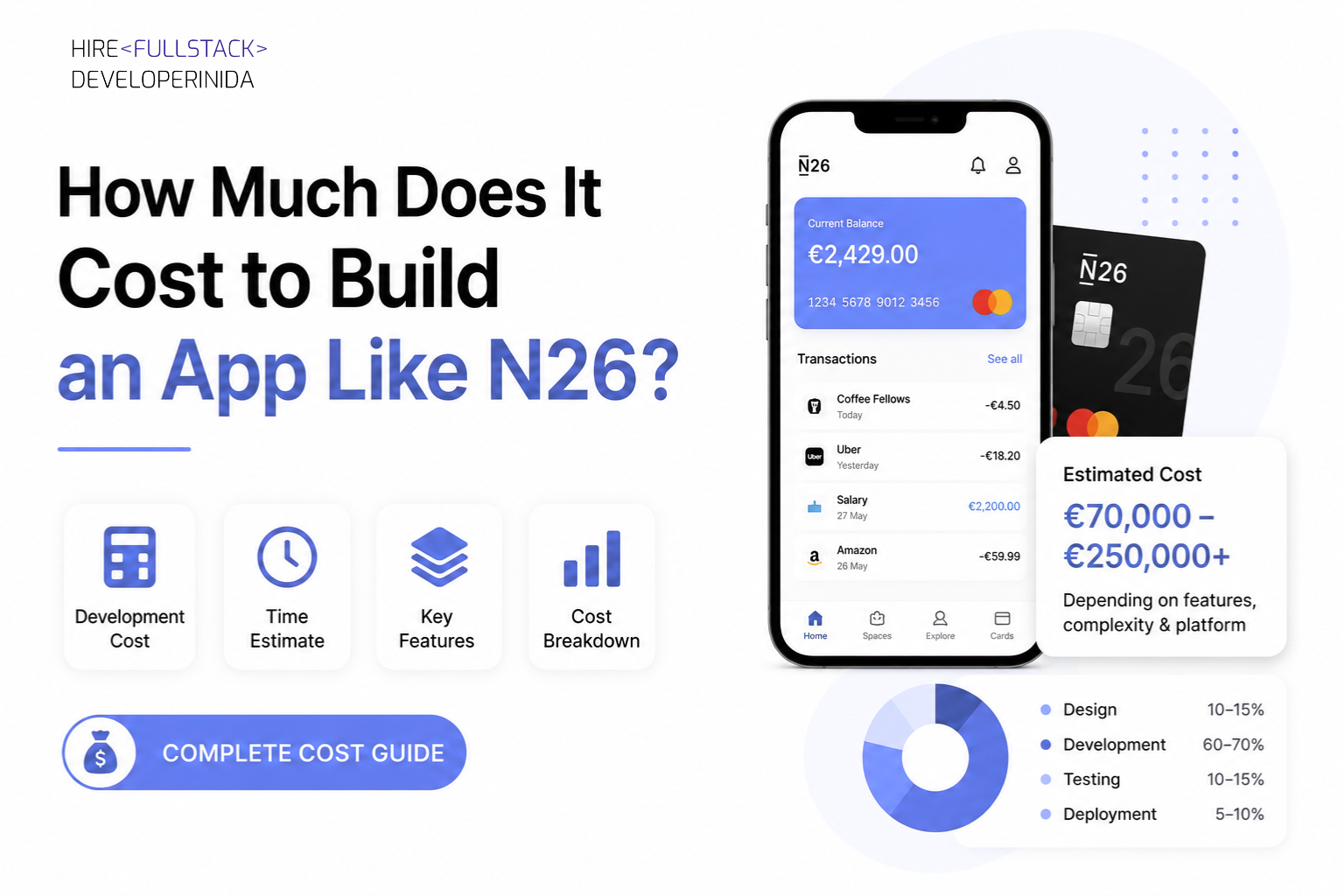

You open your phone, tap an app, and in seconds you have sent money across borders, frozen your card, and checked your spending breakdown. No queue at the bank. No paperwork. Just clean, fast, and smart. That is exactly what N26 delivers to its millions of users, and that is exactly why founders and product teams everywhere are asking the same question: how much does it actually cost to build something like this?
If you are planning to enter the digital banking space in 2026, you are stepping into one of the most exciting and competitive markets in fintech. But before you start sketching wireframes and writing pitch decks, you need a real number to work with. Not a vague range, not a guess; a proper breakdown.
This guide walks you through everything. What features you actually need, what the cost to build digital banking app looks like in 2026, what factors push that number up or down, and how you can make smart decisions to keep your budget in check without cutting corners on what matters.
Who Is N26 and Why Does It Matter?
N26 is a Berlin-based neobank that launched in 2015 and has since grown into one of Europe's most recognized digital-first banks. It operates without physical branches, runs entirely on mobile and web, and offers features like real-time transaction notifications, instant money transfers, smart budgeting tools, multi-currency accounts, and an integrated marketplace for third-party financial products.
What makes N26 a reference point for builders is not just its feature set. It is the way the product feels to use. Everything is intentional, fast, and built to reduce friction. The UX is sleek, the security is tight, and the onboarding is designed to take less than eight minutes.
Building something with that level of polish requires serious investment. But here is the good news: you do not need to replicate N26 entirely on day one. A phased approach can get you to market faster and smarter.
Core Features That Define a Digital Banking App Like N26
Before we get into numbers, let us talk about what you are actually building. The cost to build digital banking app is directly tied to the features you include. Here is a breakdown of what a competitive MVP looks like in 2026.
- User Onboarding and KYC Verification
This is the first thing your users experience and it sets the tone for everything that follows. A modern digital banking onboarding flow includes identity verification through document scanning, selfie matching, and liveness detection. In 2026, AI-powered KYC tools have made this faster and more accurate than ever. You will integrate with providers like Onfido, Sumsub, or Jumio to handle the compliance-heavy lifting. - Accounts and Card Management
Users expect to open an account in minutes, get a virtual card instantly, and order a physical card with just a tap. They also want to freeze and unfreeze their card, set spending limits, and manage multiple accounts from one place. These are baseline expectations, not premium features, in 2026. - Real-Time Payments and Transfers
Instant SEPA transfers in Europe, ACH or real-time payments in the US, and international wire transfers with transparent fees. Your payment infrastructure is the backbone of your app. This is where you will spend a meaningful chunk of your technical budget because latency, reliability, and fraud detection all live here. - Spending Analytics and Budgeting
N26 built its reputation partly on helping users understand their money. Automatic transaction categorization, monthly spending breakdowns, and savings goals are features users genuinely use. In 2026, AI-driven categorization has become accurate enough that manual correction is rarely needed. - Push Notifications and Alerts
Every transaction, every login, every unusual activity triggers a notification. This is not just a nice-to-have. It is a core part of the security and transparency promise your app makes to its users. - Security and Fraud Detection
Biometric authentication, two-factor authentication, device fingerprinting, and real-time fraud detection are all standard in 2026. Machine learning models that flag unusual spending patterns before the user even notices anything is off. This layer is non-negotiable if you want banking licenses and user trust. - In-App Customer Support
Live chat, AI-powered chatbots for common queries, and escalation to human agents. Your support stack has to be embedded in the app itself. Users of digital banks expect support without leaving the app and without waiting on hold. - Marketplace and Third-Party Integrations
One of N26's revenue pillars is its marketplace where users can access insurance, investment products, and premium account tiers. You do not need this on day one, but it is worth building your architecture with these integrations in mind from the start.
The Real Cost to Build Digital Banking App in 2026
Now for the part you have been waiting for. The honest answer is that the cost to build digital banking app varies significantly based on your team location, feature scope, and the tech choices you make. But here is a realistic breakdown based on what teams are actually spending in 2026.
This is for a well-built MVP with all the core features. If you are building a full-scale product with a marketplace, multi-currency support, investment features, and advanced AI models, you are looking at $600,000 to $1.2 million or beyond.
Keep in mind that this is development cost alone. Licensing fees, banking partnerships, compliance costs, cloud infrastructure, and ongoing maintenance are separate line items you need to plan for.
Factors That Significantly Affect Your Budget
Two teams can try to build the exact same app and end up with costs that are hundreds of thousands of dollars apart. Here is what actually drives that gap.
- Development Team Location
Where your team is based is one of the biggest cost levers you have. A senior mobile developer in North America costs between $120 and $180 per hour. The same skill level in Eastern Europe runs $45 to $75 per hour. In India and Southeast Asia, you are looking at $25 to $50 per hour. Many teams in 2026 are using hybrid models where a small onshore team handles strategy and client communication while offshore engineers handle execution. - In-House vs. Agency vs. Freelancers
Building in-house gives you the most control but front-loads your costs significantly. You are hiring, onboarding, and managing a full team before a single line of code is written. Agencies give you speed and structure but charge a premium for it. Freelancers are flexible and affordable but managing a distributed freelance team across banking-grade security standards is genuinely hard. Most founders in 2026 are working with specialized fintech development agencies for their initial build. - Platform Choice: iOS, Android, or Both
Building natively for both platforms from day one adds roughly 40 to 60 percent to your development cost compared to starting with just one. Cross-platform frameworks like Flutter and React Native have matured significantly, and many digital banks launched in 2024 and 2025 are using Flutter to maintain a single codebase. Performance gaps that existed a few years ago have largely closed. This is a legitimate way to reduce your initial cost without sacrificing user experience. - Banking License and Compliance Requirements
This is where many founders underestimate the real cost. Getting a banking license or partnering with a licensed bank through a Banking as a Service (BaaS) provider like Railsr, Synapse, or Treasury Prime adds cost but also opens up significant capabilities. Compliance with regulations like PCI-DSS, GDPR in Europe, or various US state money transmission laws requires legal counsel and sometimes dedicated compliance engineers. Budget anywhere from $50,000 to $200,000 just for your compliance and regulatory setup depending on your target market. - Tech Stack and Third-Party API Choices
Your choices in the tech stack affect both build cost and ongoing operational cost. Using managed cloud infrastructure on AWS or Google Cloud versus building and managing your own servers. Paying for a premium fraud detection API versus building a lighter internal model. These choices compound over time. Getting your architecture right in the design phase saves significant money down the road.
What Does the Tech Stack Look Like for a Banking App in 2026?
If you are working with a development team, it helps to know what a modern, production-ready stack looks like for this type of product.
- Frontend: React Native or Flutter for mobile, React or Next.js for web
- Backend: Node.js or Python (FastAPI or Django), microservices architecture
- Database: PostgreSQL for core financial data, Redis for caching and real-time features
- Cloud: AWS or Google Cloud with Kubernetes for container orchestration
- Payments: Stripe, Adyen, or Railsr for BaaS and payment processing
- KYC: Sumsub, Onfido, or Jumio for identity verification
- Fraud Detection: AWS Fraud Detector or custom ML models via AWS SageMaker
- Security: End-to-end encryption, OAuth 2.0, biometric auth, HSM for key management
This stack in 2026 gives you scalability, strong security standards, and enough flexibility to add features without major rewrites. It also has the best talent pool available, which matters when you are hiring or bringing in contractors.
Hidden Costs That Catch Founders Off Guard
The development quote you get from a team is rarely the final number. Here are the costs that show up after you sign the contract.
- Ongoing cloud infrastructure: $3,000 to $15,000 per month depending on user volume
- Third-party API fees: KYC, fraud detection, and payment APIs charge per transaction or per verification
- Bug fixes and post-launch patches: Budget 15 to 20 percent of your initial development cost annually for maintenance
- Security audits: Penetration testing and third-party security audits cost $10,000 to $40,000 and are often required by banking partners and regulators
- Customer support tooling: Intercom, Zendesk, or similar tools add $500 to $5,000 per month
- App store fees and compliance updates: OS updates and new regulatory requirements require ongoing engineering time
How to Build Smart and Reduce Your Costs Without Cutting Corners
You do not need to spend a million dollars to get a great digital banking product to market. Here is how smart founders are managing costs in 2026.
- Start with a Focused MVP
Pick your core value proposition and build that exceptionally well. If your differentiator is budgeting tools for freelancers, do not spend six months building a full marketplace. Launch with accounts, cards, payments, and category analytics. Add everything else after you have users and feedback. - Use BaaS Instead of Building Banking Infrastructure From Scratch
Banking as a Service providers have made it genuinely possible to launch a digital banking product without a banking license. In 2026, providers like Railsr, Synapse, Column, and Treasury Prime handle the licensed banking infrastructure while you build the product layer on top. This can cut your time to market by six to twelve months and your compliance burden significantly. - Leverage Existing Fintech APIs
Do not build what you can buy. KYC, fraud detection, currency conversion, and push notification services all have mature, well-priced APIs in 2026. Using them gets you to market faster and lets you focus your engineering budget on the things that actually differentiate your product. - Build for Scale From Day One, But Do Not Over-Engineer
There is a difference between designing your architecture to scale and actually building all that infrastructure before you have users. Use managed services, write clean APIs, and avoid tight coupling between services. This keeps your initial build cost reasonable while making future scaling straightforward. - Maintenance and Scaling Costs After Launch
Your app going live is not the end of the financial commitment. It is the beginning of the ongoing cost to build digital banking app infrastructure into a sustainable business. In year one post-launch, teams typically spend 20 to 30 percent of the original build cost annually on maintenance, feature additions, and infrastructure scaling.
As your user base grows, your infrastructure costs scale with it. A product serving 10,000 active users costs very differently to run than one serving 500,000. Build your cost model with this growth curve in mind from the start.
Is 2026 a Good Time to Build a Digital Banking App?
Absolutely. The market conditions in 2026 are among the most favorable they have ever been for fintech founders. Development tools have matured, BaaS providers have expanded their geographic reach, AI integration into financial products has moved from experimental to standard, and user acceptance of digital-only banking has reached mainstream levels globally.
The competitive landscape is more crowded than it was in 2019, but so is the total addressable market. Underserved segments including gig workers, immigrants, small business owners, and Gen Z users who have never used a traditional bank are all actively looking for better financial products.
The opportunity is real. The cost to build digital banking app is significant but manageable with the right planning. And the potential return for a product that genuinely solves a problem is substantial.
Final Thoughts
Building an app like N26 is one of the most complex and rewarding things a product team can take on. The cost to build digital banking app sits between $218,000 and $420,000 for a well-scoped MVP in 2026, with full-featured products pushing well beyond that.
The key is not finding the cheapest way to build it. The key is building the right version of it for your target users, with the right team, using the right infrastructure, and with a clear plan for how you recover that investment.
Know your users, know your differentiation, choose your BaaS and tech partners carefully, and build in phases. The neobanks that win in the next five years will not be the ones with the biggest budgets. They will be the ones with the clearest product vision and the most disciplined execution.