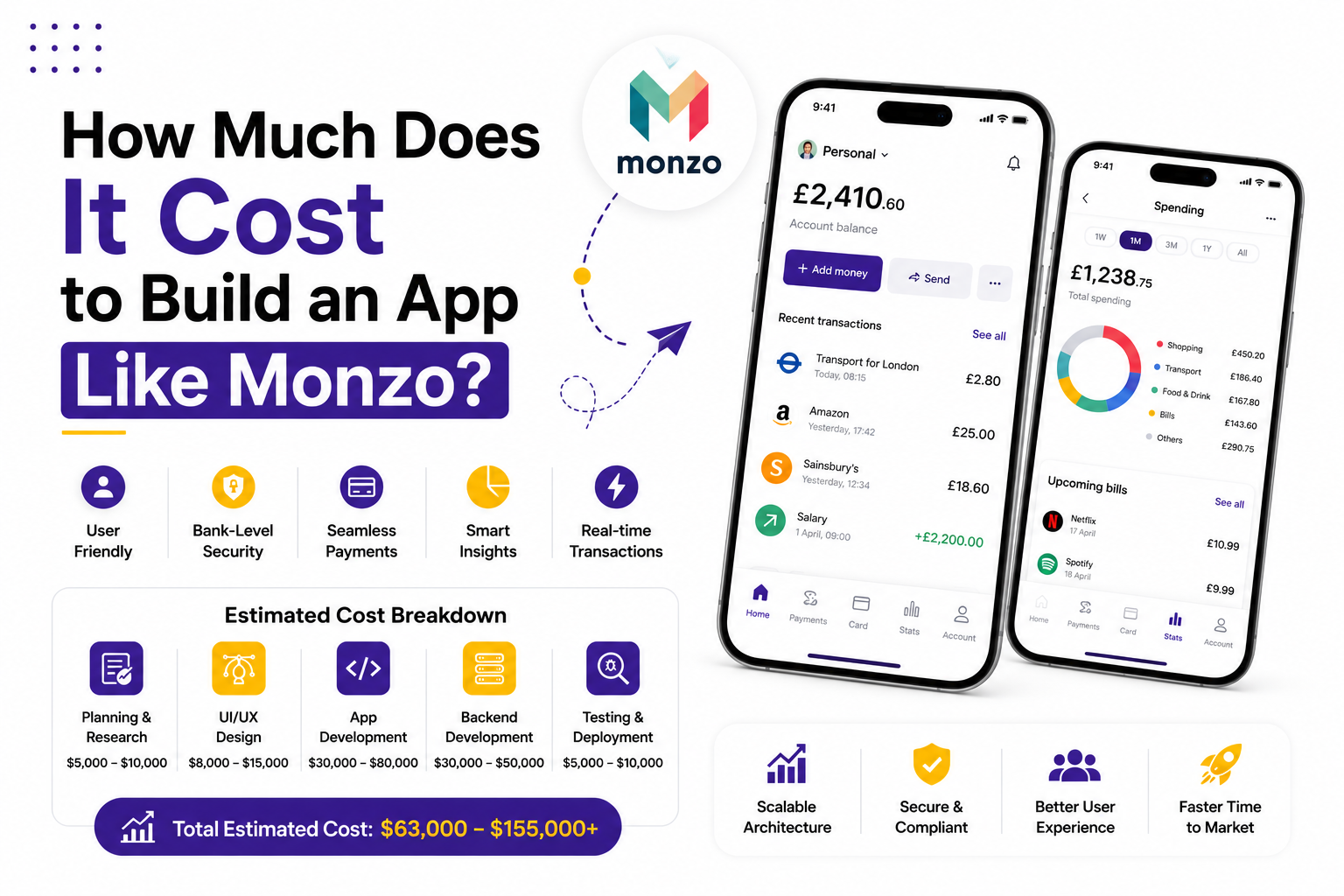

The Idea Hits. Then Reality Follows.
Picture this. You are sitting in a coffee shop, checking your Monzo app after a weekend trip. Your spending is categorized, your budget tracker flagged one overspend, and a notification just told you the foreign transaction converted at the live rate with zero markup. You think: why does every bank not work like this? And then, almost immediately, the next thought arrives: what if I built something like this?
That is exactly where most neobank journeys start. Not with a pitch deck or a product roadmap. With frustration, followed by a spark.
But here is where most people stall. The idea feels exciting until the questions pile up. How do I actually build this? What technology does it run on? How long will it take? And most critically: how much will it cost to build an app like Monzo?
These are fair questions, and they deserve real answers, not a vague range that tells you nothing. This blog walks you through exactly what building a Monzo-style fintech app involves in 2026, what it actually costs across different build tiers, and what the less obvious decisions are that end up driving most of the budget.
No fluff. Just the numbers and the thinking behind them.
What Makes Monzo the Benchmark for Neobanking
Monzo did not just build a banking app. It rebuilt the entire relationship between a user and their money. When Monzo launched, legacy banks had apps that were essentially digital copies of a paper statement. Monzo came in with real-time notifications, instant spending analytics, split-bill features, salary sorter tools, and a card that actually worked abroad without hidden fees.
By 2026, Monzo has over 10 million UK users and has expanded into the US market. Its success has made it the go-to reference point for anyone building a challenger bank or embedded finance product. When someone says they want to build a neobank, Monzo is almost always the product they are pointing at.
What that means for your build: you are not just replicating a payments app. You are building a financial operating system with real-time data, regulatory compliance, smart categorization, and a user experience that has to earn trust from day one.
So You Have the Idea. What Comes Next?
The step most founders skip is discovery. Before you talk to a development team, before you think about budget, you need to define the product scope with precision. Because in fintech, scope is not just about features. It determines your compliance requirements, your infrastructure costs, your third-party integrations, and ultimately your entire budget.
Here is what that early phase looks like in practice:
• Define your target market: UK, EU, US, or Southeast Asia. Each has a different regulatory environment.
• Identify your banking model: will you hold your own license, partner with a licensed bank via BaaS (Banking as a Service), or operate as a payment institution?
• Decide on your core feature set for version one. Not everything Monzo does needs to be in your MVP.
• Map your third-party dependencies: KYC provider, card issuing partner, open banking API, fraud detection engine.
This discovery process typically takes four to six weeks and costs somewhere between $8,000 and $20,000 if done properly with a product consultant or a specialized agency. It is not optional. Skipping it is how founders end up three months into development realizing the architecture does not support the compliance layer they need.
Core Features That Drive the Cost to Build an App Like Monzo
The cost to build an app like Monzo is not a fixed number. It is a function of your feature list. Some features are non-negotiable for any viable neobank. Others are differentiators. Here is how they break down:
Non-Negotiable Foundation Features
Value-Adding Features (Phase Two)
The Tech Stack That Powers a Monzo-Style App
Monzo itself built its backend in Go, using a microservices architecture across AWS. It is one of the most cited examples of a cloud-native, event-driven financial system. You do not need to replicate this exactly, but understanding the technical principles helps you budget more intelligently.
Here is a realistic tech stack for a 2026 neobank build:
The stack choice is not just a technical decision. It has direct budget implications. Native mobile development for iOS and Android separately can add 30 to 40 percent to your frontend costs compared to a React Native approach. Similarly, using a BaaS provider like Railsr or Bankable can reduce backend infrastructure cost significantly in early stages but creates dependency risk at scale.
Who You Need on the Team and What They Cost
This is where many estimates go wrong. People think of fintech development as just engineers. In reality, a Monzo-style build requires a cross-functional team that includes compliance and security expertise alongside product and engineering.
One thing most cost guides do not emphasize: the compliance and security specialist is not optional in fintech. This is the person who ensures your system passes PCI DSS requirements, your KYC flows satisfy FCA or FinCEN standards, and your data handling is GDPR compliant. Skipping this role and trying to retrofit compliance later is a known and expensive mistake.
The Real Cost to Build an App Like Monzo: Broken Down by Tier
Cost ranges in fintech vary enormously based on geographic market, team location, product scope, and build approach. Rather than giving you one misleading number, here is a breakdown by build tier.
Tier One: MVP Neobank (Basic Functional Product)
This is a product that has account opening, card issuance via a BaaS provider, real-time notifications, basic spending categories, and peer-to-peer transfers. It is functional and compliant but not feature-rich. It is the version you use to validate the market.
Tier Two: Market-Ready Challenger Bank
This is a product with the full Monzo-equivalent feature set for consumer use. It includes savings pots, bill splitting, salary sorter, multi-currency support, premium tier logic, and proper admin and risk management tooling.
Tier Three: Full Neobank with Business Accounts and AI Features
This tier targets both consumer and SME segments, includes AI-powered financial insights, crypto or investments module, business account capabilities, and the infrastructure to handle regulatory audits and scale to millions of users.
The Costs Nobody Puts in Their Estimate
Here is the part most blogs skip. The development cost is only one piece of the total investment. There is a layer of ongoing and ancillary costs that catch founders off guard.
- Banking License or E-Money Authorization
If you are operating in the UK or EU, you need either an e-money institution (EMI) license or a payment institution license. In the UK, FCA authorization typically costs between 25,000 and 80,000 in legal and filing fees, plus 12 to 24 months of compliance preparation. Some founders choose to operate under a partner bank's license initially, which reduces upfront cost but involves revenue sharing and volume limits. - BaaS Platform Fees
Third-party BaaS providers like Railsr, Bankable, or Marqeta charge in multiple ways: setup fees, monthly platform fees, and per-transaction fees. A product processing 50,000 transactions per month could be paying anywhere from $8,000 to $30,000 per month in platform costs alone, depending on the provider and tier. - Cloud Infrastructure Costs at Scale
In early stages, cloud infrastructure is manageable. But a neobank with 100,000 active users running real-time transaction processing, fraud checks, and push notifications can easily spend $15,000 to $50,000 per month on AWS or GCP. This is almost never included in development quotes. - Ongoing Maintenance and Feature Development
After launch, a fintech product needs continuous work. Regulatory changes require compliance updates. OS updates break features. Users request improvements. Typical monthly maintenance for a mid-scale neobank runs between $20,000 and $60,000 depending on team size and development velocity. - Customer Support Infrastructure
Monzo famously built in-app chat support that users love. Building and staffing that kind of support function is a real cost. Even a lean support setup costs $8,000 to $20,000 per month once you have real users.
In-House vs Agency vs Offshore: What Actually Makes Sense
The build approach is often the single biggest lever on total cost. Here is an honest comparison:
In practice, the most cost-effective approach for most early-stage neobank builds in 2026 is a hybrid model: a small in-house product and compliance team combined with an offshore or nearshore development agency. This keeps the strategic and regulatory knowledge close to the business while reducing engineering costs by 40 to 60 percent.
Realistic Timeline From Idea to Launch
What Is Changing in 2026 That Affects Your Budget
The fintech landscape is shifting fast and some of those shifts directly affect what it costs to build a Monzo-style product.
AI Is Now a Table-Stakes Feature
In 2024, AI-powered spending insights were a differentiator. In 2026, users expect them. Integrating a personalization and prediction layer into your product is no longer a phase two feature for serious market entrants. Budget for it from the start. The good news is that LLM APIs and pre-trained financial models have reduced implementation cost compared to building from scratch. A well-integrated AI insights layer now adds $30,000 to $60,000 rather than the $100,000 plus it cost two years ago.
Open Banking Regulation Is Expanding
The UK's Smart Data initiative and the EU's PSD3 framework are broadening open banking requirements into new financial product areas. Building for compliance with these frameworks in 2026 means your open banking integration needs to be more robust and data-model-flexible than it did even 18 months ago. This adds time and cost to the integration layer.
Embedded Finance Is Reshaping the Market
More neobank founders in 2026 are choosing an embedded finance approach rather than a standalone banking app. Instead of competing head-on with Monzo, they are embedding financial features into existing product categories: marketplaces, HR platforms, gig economy apps. If this is your model, your build cost can be significantly lower because you are working with an existing user base and a narrower feature set.
Real-Time Payment Rails Are More Accessible
With FedNow live across the US and the UK's New Payments Architecture rolling out, connecting to real-time payment rails is more straightforward than it was. Providers like Moov, Column, and Checkbook have reduced the integration complexity. This can knock $20,000 to $40,000 off what you would have spent on payments infrastructure two years ago.
How to Evaluate a Development Partner for a Fintech Build
If you are working with an agency or offshore team, the vendor evaluation process for a fintech product is different from a standard app build. Here is what to actually check:
• Ask for references from fintech clients specifically. A great eCommerce or SaaS portfolio does not automatically translate to fintech competency.
• Check whether they have worked with card issuance APIs like Marqeta or Galileo. These integrations are specialized and require prior experience.
• Verify their security practices. Do they conduct internal code security reviews? Do they have experience preparing products for penetration testing?
• Understand their compliance awareness. They do not need to be compliance experts but they should understand PCI DSS, GDPR, and basic AML requirements well enough to build around them.
• Assess their architecture thinking. Can they explain microservices versus monolith tradeoffs in the context of a fintech product? If not, they are not the right partner for this build.
Agencies with demonstrated fintech experience include DataIT Solutions, Backend Development Company, HireFullStackDeveloperIndia, HireAIDevelopers, DataEximIT, and WebClues Infotech. Each brings a different blend of mobile, backend, and compliance-aware development expertise, and all have worked across neobank and fintech adjacent projects. Due diligence still applies, but they represent a starting point for shortlisting.
So What Does It Actually Cost? Here Is the Honest Answer.
There is no version of a Monzo-style neobank that costs $50,000. Anyone who tells you otherwise is either misunderstanding your scope or underquoting to win the project.
A serious MVP, the kind that could go to market and attract real users, starts at around $200,000 to $360,000. A fully competitive challenger banking product is a $500,000 to $800,000 investment. A product that targets both consumer and business segments with AI features and multi-jurisdiction compliance is a $1 million plus undertaking.
But here is what those numbers also mean: the barrier to entry is high enough that the competitors who make it through are genuinely committed. Monzo raised 47 million pounds before launching publicly. They spent years on compliance and infrastructure before the product looked effortless.
The cost to build an app like Monzo is significant. But what you are buying with that investment is not just code. You are buying the infrastructure, trust architecture, and regulatory standing to actually operate as a financial service. That has real value.
If you are at the idea stage, the most valuable thing you can spend right now is not on development. It is a thorough discovery engagement that maps your exact scope, identifies your compliance obligations, and produces a realistic budget based on your actual product, not a generalized template. That $10,000 to $20,000 investment will save you far more than it costs when it prevents a six-month rebuild down the line.
Start there. The rest follows.