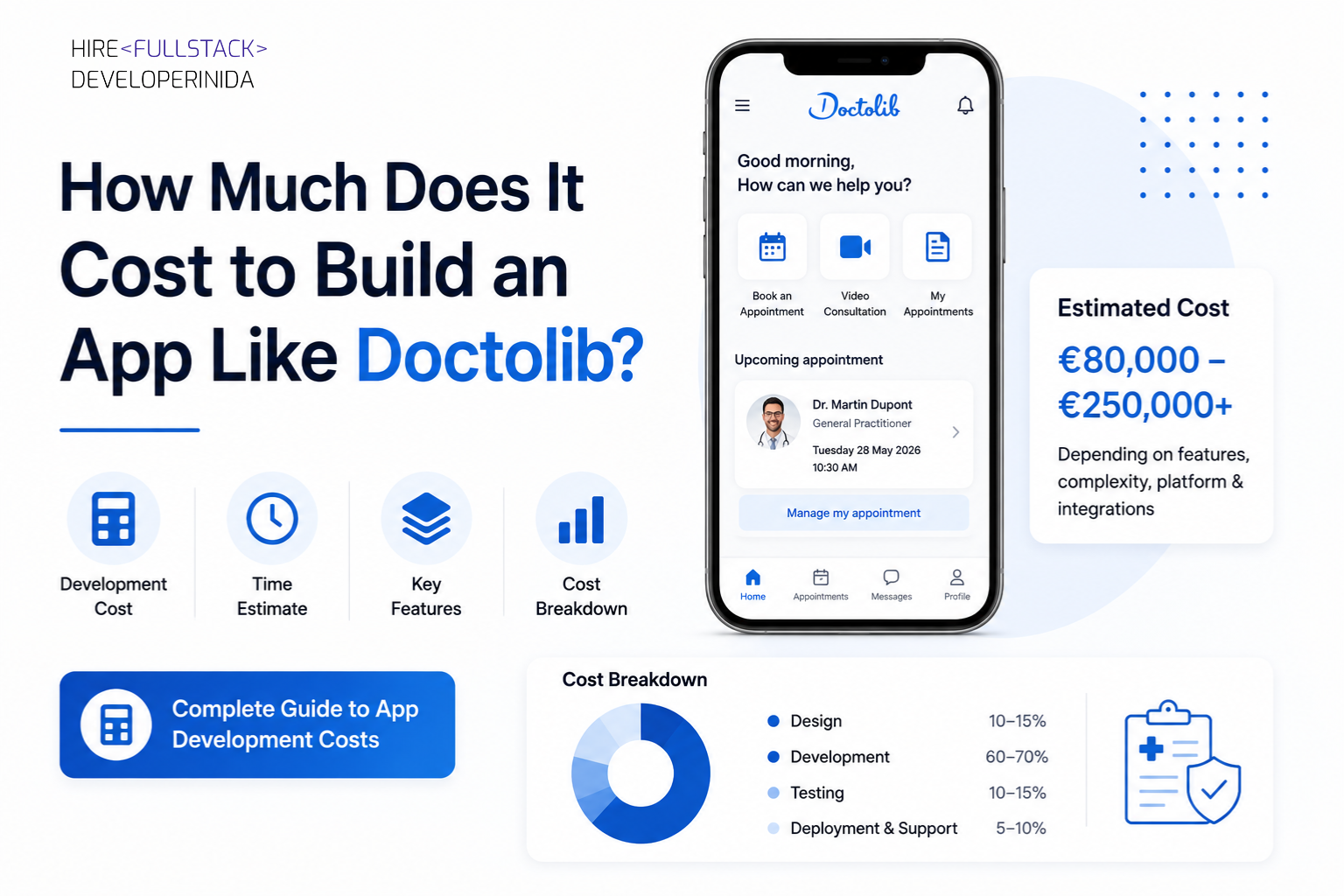

Let me guess. You searched 'cost to build healthcare booking app' and got flooded with articles giving you a range somewhere between $30,000 and $300,000 with a shrug emoji at the end.
Those articles are not wrong. They are just incomplete. The range is real, but what lives inside that range is where all the interesting stuff happens and that is exactly what we are going to talk about today.
Doctolib did not become a 6.4 billion euro company by accident. It started as a simple appointment booking tool in France and grew into a full healthcare operating system used by over 80 million patients across Europe. If you are building something in the same space, the cost question is genuinely complex and knowing the full picture before you start can save you from some very expensive surprises.
So let us get into it in a way that most cost guides will not.
First, Stop Thinking About This as an App Cost
This is the reframe almost no one gives you. When people ask about the cost to build a healthcare booking app, they are usually picturing a front end with a calendar, a search bar, and maybe a payment button.
But Doctolib is not an app. It is an ecosystem. What you are actually pricing is a combination of a patient-facing mobile and web product, a practitioner-facing management dashboard, a real-time scheduling engine, a telemedicine layer, a health data compliance infrastructure, and an integration layer that talks to hospital systems and electronic health records.
The moment you start thinking about it that way, the cost conversation changes completely. You are not budgeting for a feature list. You are budgeting for a platform. And platforms have very different cost structures than apps.
What Doctolib Actually Built (And Why It Matters for Your Budget)
Here is something most cost blogs skip entirely. Doctolib did not build everything in one go. They launched with a lean version in 2013, focused entirely on one feature done really well, online booking for doctors in Paris. The rest came later.
By 2026, they have over 400,000 healthcare professionals on the platform, video consultation tools, a vaccine management module used during the COVID rollout, a patient health record feature, and active operations across France, Germany, and Italy.
Why does this matter for you? Because how you stage your build has a massive impact on your costs. A staged approach can help you launch for $80,000 to $120,000 and validate the market before committing to a full platform build that could run to $400,000 or more.
Most cost guides give you a single number. The smarter question is: what do you need on day one, and what can wait for version two?
The Real Cost Drivers Nobody Talks About
1. Healthcare Data Compliance Is Not a Feature, It Is a Foundation
This one gets wildly underestimated. Building a cost to build healthcare booking app means you are handling personal health data, and that puts you inside some of the strictest regulatory frameworks in the world.
In Europe, you are dealing with GDPR plus country-specific health data laws. In France for example, health data must be stored on HDS-certified (Hebergeur de Donnees de Sante) infrastructure. In the US, you have HIPAA. In the UK post-Brexit, you have UK GDPR with NHS Digital standards on top.
Getting compliance right can add $15,000 to $50,000 to your budget depending on your target market. This is not optional. A single data breach in healthcare carries fines that can be existentially damaging to an early stage company. Budget for it seriously.
2. Real-Time Scheduling Is Technically Harder Than It Looks
The calendar widget on a booking app looks deceptively simple. But what is happening underneath it is not. You need to handle concurrent booking requests, prevent double bookings, sync with practitioners' existing calendars like Google Calendar, Outlook, and sometimes proprietary hospital systems, and update availability in real time across multiple time zones if you are building for more than one country.
This is a non-trivial engineering problem. A naive implementation will fail under moderate traffic. A robust scheduling engine typically takes two to three senior backend developers about eight to twelve weeks to build properly, and it needs to be tested extremely carefully. If you are budgeting for this feature, do not assume it is a week of work.
3. The Practitioner-Side Product Costs as Much as the Patient Side
Most people think about the patient experience when they picture a healthcare booking app. But Doctolib's secret weapon has always been how good the experience is for doctors and medical staff.
Your practitioner dashboard needs appointment management, patient history access, reminders and no-show tracking, billing and payment tools, and in most cases an integration with whatever software the practice already uses. Building this properly can account for 40 to 45 percent of your total development budget.
Skimping here is a common mistake. If doctors hate using your tool, they will switch back to their old system and you lose your supply side completely.
4. Telemedicine Is a Separate Technical Scope
Adding video consultation to your app is not just dropping in a WebRTC library. You need to handle end-to-end encrypted video sessions that meet healthcare privacy standards, waiting room flows, connection quality fallbacks, screen sharing for reviewing documents or test results, session recording options where legally permitted, and billing integration for video vs in-person appointments.
If telemedicine is in your version one scope, add $30,000 to $60,000 to your estimate depending on how sophisticated the feature set needs to be.
A More Honest Cost Breakdown for 2026
Let us look at this by development phase rather than by a magic number.
Phase 1: Lean Launch (MVP)
This gets you a working product with core booking functionality, a basic practitioner dashboard, patient profiles, appointment reminders, and a clean mobile experience.
- Estimated range: $70,000 to $130,000
- Timeline: 4 to 6 months with a team of 4 to 6 people
Phase 2: Growth Build
This adds telemedicine, advanced search and filtering, ratings and reviews, payment processing, and compliance hardening.
- Estimated range: $120,000 to $220,000
- Timeline: 6 to 9 months cumulative
Phase 3: Platform Scale
This is where you add EHR integrations, multi-country support, advanced analytics, insurance verification, and the kind of infrastructure that supports hundreds of thousands of practitioners.
- Estimated range: $250,000 to $500,000 plus
- Timeline: 12 to 24 months cumulative
These ranges assume a mid-market development agency or a mixed team of in-house and outsourced talent. A top-tier European or North American development studio will cost more. An offshore team in Eastern Europe or Southeast Asia can bring Phase 1 down to $40,000 to $70,000 but you should factor in longer QA cycles and closer project management.
The Hidden Costs That Actually Hurt Startups
Here is where cost to build healthcare booking app discussions tend to fail people. They focus on the build cost and forget the ongoing costs that hit you immediately after launch.
- Cloud Infrastructure and Compliance Hosting
Healthcare data requires certified cloud infrastructure. AWS, Azure, and Google Cloud all have HIPAA-eligible and GDPR-compliant configurations, but they cost more than standard hosting. Expect $2,000 to $8,000 per month in infrastructure costs at early scale, scaling up significantly as you grow. - Third Party Services
You are going to integrate with SMS and email providers for appointment reminders, payment processors, video call APIs, mapping services for clinic discovery, and possibly insurance verification APIs. These add up to $500 to $3,000 per month in operational costs even at modest user volumes. - Security Audits and Penetration Testing
If you are handling health data, you need regular security audits. Budget $5,000 to $20,000 per year for this. It is non-negotiable if you are serious about operating in this space. - Customer Support Infrastructure
Healthcare is not a space where you can get away with a chatbot and a FAQ page. Practitioners have real operational needs and they expect real support. Budget for at least two dedicated support staff from the moment you have meaningful practitioner adoption.
Where Geography Changes Your Budget Dramatically
This is another area most guides gloss over. Where you build and where you launch are two different variables that both affect cost significantly.
Where You Build
Development rates vary enormously by geography. Senior full-stack developers in Western Europe or North America charge $100 to $200 per hour. In Eastern Europe, Poland, Ukraine, or Romania, you are looking at $40 to $80 per hour for comparable quality. In Southeast Asia or Latin America, $25 to $55 per hour.
For a Phase 1 build that requires roughly 2,000 development hours, the difference between a Western European team and an Eastern European team can be $120,000.
Where You Launch
Different markets have different regulatory costs. Launching in France means navigating HDS certification requirements. Launching in Germany means dealing with the Digital Health Applications (DiGA) framework if you want to qualify for insurance reimbursement. The UK has its own set of NHS standards.
If you are building for the US market, HIPAA compliance is your primary cost driver. If you are building for multiple markets simultaneously, budget compliance costs for each market separately because they do not overlap as cleanly as you might hope.
Build vs Buy: The Conversation You Should Have Before Writing Any Code
One thing that has changed significantly in 2026 is the quality of white-label and API-first healthcare platforms available to builders.
Solutions like Healthie, Pabau, Nabla, and several others now offer configurable platforms that can get you to something Doctolib-like faster and cheaper than a full custom build. Some of these platforms offer API access and white-labeling at a cost of $15,000 to $50,000 for setup plus ongoing SaaS fees.
This is not always the right answer. If your differentiation is in the product itself, you probably need to build. If your differentiation is in the network of practitioners or the specific specialty you are targeting, a white-label foundation might give you a faster path to validating the business model before you invest in custom development.
Have this conversation explicitly with your technical advisors before you default to building from scratch.
What Does Doctolib Spend Today?
Here is a number that might recalibrate your thinking. Doctolib employs around 3,000 people across Europe as of 2026. Their engineering team alone is several hundred strong. Their annual operating costs run into hundreds of millions of euros.
You are not competing with that version of Doctolib. You are competing with the 2013 version of Doctolib, a focused product in one market solving one specific problem really well.
That version cost them roughly 1 million euros to build and launch. In 2026 money and with modern tooling, a comparable lean product in a specific market can be built for $80,000 to $150,000 if you are disciplined about scope.
The mistake is trying to build the 2026 version of Doctolib as your version one. Nobody needs that on day one.
Team Structure That Actually Works for This Kind of Build
The team you put together matters as much as the budget you set. Here is what a realistic team looks like for a Phase 1 healthcare booking app:
- 1 Product Manager who has worked in healthcare tech before. This is worth paying a premium for.
- 2 Frontend developers with mobile experience, ideally React Native or Flutter so you get iOS and Android from one codebase.
- 2 Backend developers with experience in healthcare APIs, calendar integrations, and data security.
- 1 UI/UX designer who understands healthcare user flows. Patient and practitioner journeys are different from typical consumer apps.
- 1 QA engineer who understands HIPAA or GDPR testing requirements depending on your market.
- 1 Part-time security consultant to review your data handling from day one, not as an afterthought.
This team of eight, running for five to six months, will typically cost between $120,000 and $200,000 depending on the geography and seniority of the team.
The Questions You Should Ask Any Development Partner
If you are working with an agency or freelance team, these are the questions that reveal whether they actually understand healthcare app development or whether they are treating it like any other booking app:
- Have you built with HDS or HIPAA compliance before and can you show us the implementation?
- How do you handle real-time calendar sync and conflict resolution at scale?
- What is your approach to data residency requirements for health information?
- Have you integrated with any EHR systems like Epic, Medispring, or Daktela before?
- How do you handle the practitioner onboarding flow and what does your admin panel look like?
If the answers are vague or they pivot to talking about their general healthcare experience without specifics, that is a signal to keep looking.
Final Thought: The Cost That Actually Matters
Every cost guide on the internet wants to give you a number you can put in a spreadsheet. Here is the honest version: the number matters less than the decision-making framework you use to arrive at it.
The real cost to build a healthcare booking app like Doctolib is not just the development invoice. It is the cost of getting compliance right from day one rather than retrofitting it later. It is the cost of building a practitioner experience that people actually want to use. It is the cost of thinking in phases rather than trying to build everything before you have proven the market.
Get those decisions right and the number in your spreadsheet becomes manageable. Get them wrong and no budget estimate in the world will save the project.
If you are serious about building in this space in 2026, start with a tight scope, a realistic budget, and a team that has done this before. The rest is iteration.