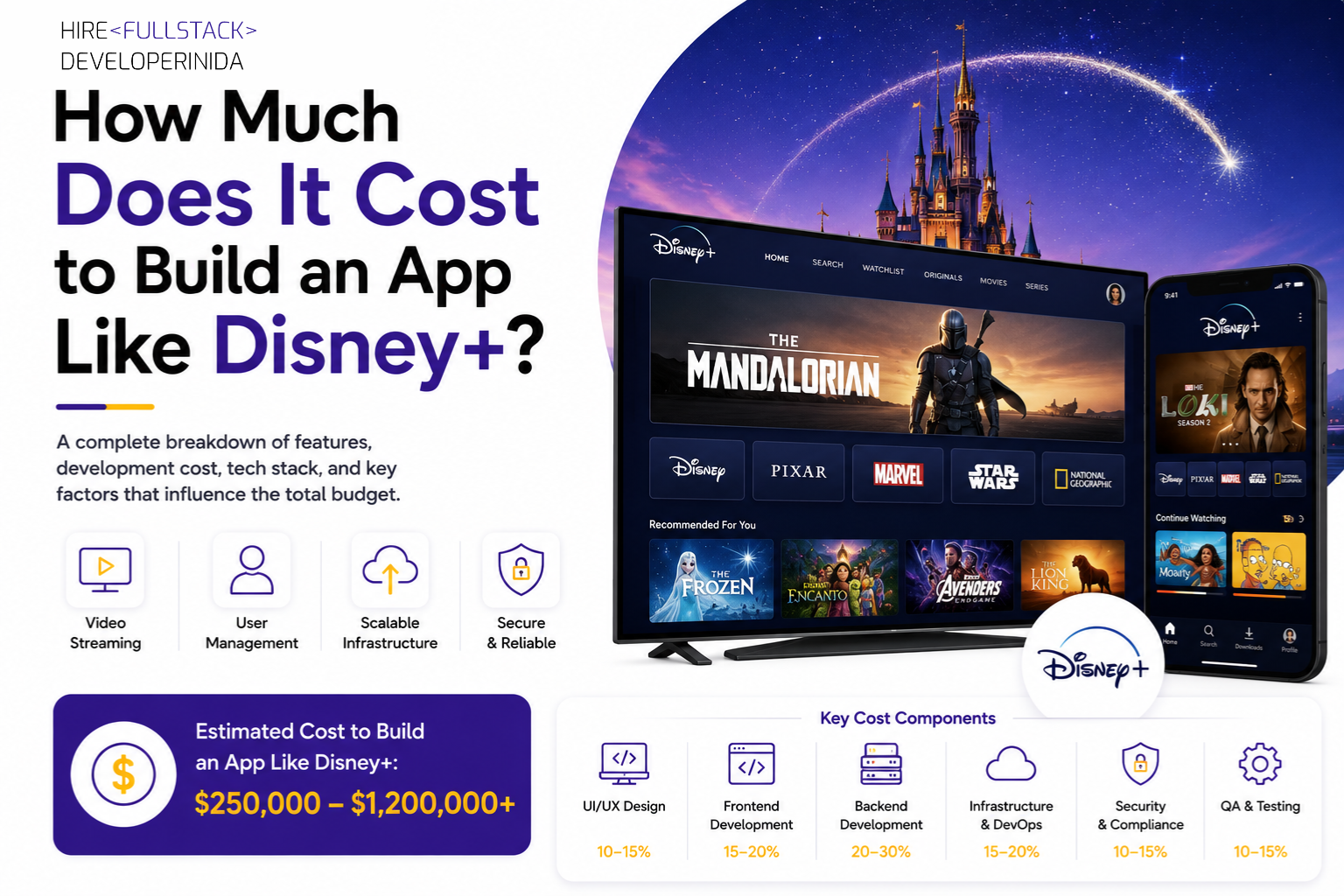

So You Want to Build the Next Disney+
Here is a scenario worth thinking about. You have a content library, a solid business model in mind, and people keep telling you that streaming is the future. You start researching, and then the big question lands on your screen: what is the actual cost to build an app like Disney+?
The internet will throw a range at you. Some articles say $50,000. Others say $5 million. Both could be technically correct depending on what you are building and where. But neither number is very useful without context. That is exactly what this blog is here to fix.
Disney+ did not happen overnight. It launched in 2019 after years of infrastructure work, licensing deals, and platform engineering. By 2026, the standard for a premium streaming app has shifted significantly. Audiences expect ultra-low latency, AI-powered recommendations, offline downloads, multi-device sync, and content that feels native to whatever screen they are on.
This guide walks you through every real cost driver, the ones most blogs skip over, and gives you a clear-eyed view of what it actually takes to build a streaming platform at different budget levels in 2026.
Understanding What Disney+ Actually Is (From an Engineering Perspective)
Before you can estimate costs, you need to understand the product you are trying to replicate or build in the same category. Disney+ is not just a video player with a subscription wall. It is a distributed system that handles millions of concurrent streams across dozens of device types, content delivery networks spanning multiple continents, and a recommendation engine trained on billions of viewing data points.
The core components of a platform like Disney+ include:
- A content delivery infrastructure with CDN integration for adaptive bitrate streaming
- A backend system that manages user accounts, subscriptions, and billing
- A content management system for uploading, encoding, categorizing, and publishing media
- Native or cross-platform apps for iOS, Android, web, smart TVs, and gaming consoles
- An AI recommendation engine that personalizes the content feed
- A digital rights management system to protect licensed content
- Analytics dashboards for internal teams to monitor performance and engagement
Each of these components has its own development cost, maintenance cost, and scaling cost. When someone quotes you a flat number for building a streaming app, they are almost certainly leaving several of these components out.
The Real Cost to Build an App Like Disney+: A 2026 Breakdown
There is no single number that fits every situation, but there is a practical framework for thinking about it. Here is how costs typically stack up based on the scope of the platform you are building.
Tier 1: MVP Streaming Platform ($80,000 to $200,000)
This gets you a functional product with basic streaming, user accounts, subscription billing, and a simple content library. You are working with a cross-platform framework like Flutter or React Native, a cloud-based backend on AWS or GCP, and third-party tools for payment processing and basic analytics.
What you are NOT getting at this tier: advanced DRM, personalized recommendations, multi-profile support, offline downloads, or smart TV and console apps. This is a proof-of-concept tier. It tells you whether your content and model have legs before you go all in.
Tier 2: Mid-Scale Streaming App ($300,000 to $800,000)
This is where most serious streaming startups land. At this tier, you get native iOS and Android apps, a solid web experience, smart TV support for at least two major platforms, a proper content management system, DRM integration, and basic personalization. You are also building a backend that can handle real traffic spikes without falling over.
The cost jumps here because you need a larger team, more specialized engineers for video encoding and CDN setup, and licensing costs for the tools and services that make premium streaming work reliably.
Tier 3: Full-Scale Platform ($1,000,000 to $5,000,000+)
This is enterprise-grade. You are talking about a custom recommendation engine, support for all major device categories including gaming consoles and set-top boxes, multi-region CDN infrastructure, advanced analytics, localization for multiple languages and regions, and a team that stays on to maintain and improve it all.
Disney+ itself reportedly cost well over $100 million to build and launch, though that number includes content acquisition, marketing, and licensing. The technology platform alone was a multi-million dollar investment over several years. You are not replicating that at Tier 3, but you are building something serious.
The Hidden Cost Drivers Most Blogs Never Mention
This is the section that actually matters if you are making real decisions. The obvious costs like design and development are easy to research. The hidden ones are where projects go over budget.
Video Encoding and Transcoding Infrastructure
Every piece of content you upload needs to be converted into multiple resolutions and formats so it plays smoothly on every device and connection speed. This is called adaptive bitrate streaming, and it requires either a significant engineering effort to build in-house or ongoing costs with a service like AWS MediaConvert or Bitmovin.
For a mid-scale platform, encoding costs alone can add $30,000 to $80,000 to your build, plus ongoing per-minute processing fees as you scale your library.
Content Delivery Network Costs
Streaming video is bandwidth-heavy. A CDN distributes your content across servers worldwide so users get it fast from wherever they are. This is not a one-time cost. CDN expenses scale directly with your usage. Early-stage platforms often underestimate this by a factor of three or four when they start getting real traction.
Digital Rights Management
If you are licensing content from studios or distributors, they will require DRM. Widevine, FairPlay, and PlayReady are the three dominant standards, and supporting all three across device types is a non-trivial engineering problem. DRM integration can cost anywhere from $20,000 to $100,000 depending on implementation complexity.
App Store Fees and Revenue Share
Apple takes 30% of subscription revenue from iOS users in the first year and 15% after that. Google Play has a similar structure. This is not a development cost, but it is a direct hit to your unit economics and needs to factor into your financial model from day one.
Compliance, Accessibility, and Regional Requirements
If you plan to operate in the EU, you need to comply with GDPR. In the US, accessibility standards under the ADA mean your platform needs to support closed captions and screen readers. Many regions have their own requirements around content moderation, data localization, and age verification. Legal and compliance costs are routinely underestimated and can run $50,000 to $150,000 for a platform operating across multiple markets.
QA and Performance Testing at Scale
Load testing a streaming platform is different from testing a standard app. You need to simulate thousands of concurrent streams, test across a matrix of devices and operating systems, and validate performance under real-world conditions. Dedicated QA for a streaming platform adds 15% to 25% to your overall development budget.
Team Composition and What It Actually Costs in 2026
The biggest variable in any app development estimate is the team. Location, seniority, and whether you hire in-house, use a development agency, or build a hybrid team all dramatically affect your final number.
In-House Team (US or Western Europe)
A senior full-stack engineer in the US costs between $130,000 and $180,000 per year in salary. A senior mobile engineer runs $120,000 to $170,000. A DevOps engineer with streaming infrastructure experience can command $150,000 to $200,000. Building a core team of 8 to 12 people in the US for a 12-month build means your personnel costs alone will exceed $1.5 million before you write a single line of product code.
Offshore or Nearshore Development Agency
Eastern European teams, particularly from Poland, Ukraine, and Romania, offer strong technical talent at rates between $45 and $80 per hour. South Asian teams in India and Vietnam range from $25 to $55 per hour. A well-managed 12-person team in Eastern Europe building a Tier 2 platform over 12 to 14 months will typically cost between $400,000 and $700,000 in development fees alone.
The trade-off is not just cost. Time zone differences, communication overhead, and quality variance are real. The best offshore teams deliver excellent results. The worst can cost you more in rework than you saved. Due diligence on the agency matters more than the hourly rate.
Hybrid Model (Recommended for Most Startups)
A product lead and one or two senior engineers in your home market, with an offshore team handling volume work, is a structure that works well for most streaming startups in 2026. It gives you technical oversight and strategic control without paying US rates for every engineer on the project.
Technology Choices That Significantly Impact Your Budget
The technology stack you choose affects both your build cost and your long-term operating cost. Here are the decisions that matter most.
Build vs Buy for Core Infrastructure
Video encoding, CDN, payment processing, and push notifications all have mature third-party solutions. Using services like Mux or api.video for video infrastructure, Stripe for billing, and OneSignal for notifications can save 6 to 12 months of engineering time. The trade-off is vendor dependency and higher operating costs at scale.
For a startup, buying almost always makes sense early on. The goal is to validate your product, not to build infrastructure from scratch. You can always rebuild critical components in-house as you scale.
Cross-Platform vs Native Development
Building native apps for iOS and Android separately gives you the best performance and platform integration but roughly doubles your mobile development cost. Cross-platform frameworks like Flutter and React Native have matured significantly by 2026 and can deliver 90% of the experience at around 60% of the cost for most streaming use cases.
The exception is high-stakes video performance on lower-end Android devices. If your audience is in markets where mid-range Android hardware is common, native development for Android may be worth the investment.
Cloud Infrastructure Decisions
AWS, GCP, and Azure all have strong offerings for streaming platforms. AWS has the most mature ecosystem for media workloads with services like CloudFront for CDN, MediaLive for live streaming, and Elastic Transcoder for encoding. GCP has stronger AI and machine learning tooling, which matters if personalization is central to your product.
Reserved instance pricing and spot instance strategies can reduce your cloud bill by 40% to 60% compared to on-demand pricing, but they require upfront commitment and capacity planning expertise.
Ongoing Costs After Launch: The Number Nobody Puts in the Blog Post
Building the app is phase one. Running it is phase two, and in the streaming world, phase two costs often exceed phase one within two to three years.
Here is what ongoing operations look like for a mid-scale streaming platform:
- Cloud infrastructure and CDN: $8,000 to $40,000 per month depending on library size and active users
- Engineering team for maintenance, updates, and new features: $50,000 to $150,000 per month
- Third-party service fees (DRM, analytics, notifications, payments): $5,000 to $20,000 per month
- Content licensing or production (if applicable): highly variable
- Customer support tooling and operations: $3,000 to $15,000 per month
A mid-scale platform with 50,000 active subscribers can expect to spend $80,000 to $200,000 per month on operations before accounting for content costs. This is the number that catches founders off guard. Your build budget gets you to launch. Your operating budget determines whether you survive the first year.
Decisions That Shape Your Budget Before You Write a Single Spec
Most founders think about the budget after they have already decided what to build. The smarter move is to let your budget shape your scope before you commit. Here are the decisions with the biggest cost implications
Will You License Content or Produce It?
Licensing existing content is expensive, particularly for premium titles. Producing original content gives you ownership but requires a completely different organizational capability. Many successful streaming platforms launched on niche licensed content and moved to originals once they had audience data to justify the investment. This decision affects your launch timeline, burn rate, and the type of team you need to hire.
How Many Device Platforms Do You Need at Launch?
Every additional device platform you support at launch adds development time and testing complexity. iOS, Android, and web is a reasonable starting point for most consumer streaming platforms. Smart TV support is valuable but can wait for a v2 release. Gaming console support is meaningful for certain audiences but rarely necessary in a first version.
Each platform you defer saves not just development cost but ongoing maintenance cost. A platform that runs on three surfaces is significantly cheaper to maintain than one that runs on seven.
Do You Need Live Streaming?
Live streaming adds a meaningful layer of infrastructure complexity and cost. It requires different encoding pipelines, lower latency CDN configurations, and more robust failover systems. If live content is not central to your core value proposition, leave it out of v1. Adding it later is straightforward. Including it unnecessarily in v1 adds $100,000 to $300,000 to your build.
What 2026 Changes About Building a Streaming Platform
A few developments in 2026 are genuinely changing the cost calculus for streaming app development, and they are worth paying attention to.
AI-powered development tools have meaningfully accelerated the speed of frontend development and boilerplate backend work. Teams that used to take 14 months for a Tier 2 platform are now delivering in 10 to 11 months using AI-assisted coding tools. This shows up in lower project fees from development agencies and faster time to market for in-house teams.
Video AI is also making content personalization significantly more accessible. Recommendation engines that used to require a dedicated ML team can now be stood up using API-based services that cost a few hundred dollars per month for most startup-scale platforms. This democratizes personalization in a way that was not practical two or three years ago.
On the infrastructure side, edge computing adoption has grown substantially. Platforms are now able to push processing closer to users, which improves streaming quality in regions with historically poor CDN coverage and can reduce infrastructure costs for global platforms by 20% to 35%.
The downside of 2026 is that user expectations are higher than ever. Audiences that have used Disney+, Netflix, and Apple TV+ know what good looks like. A platform that buffers, has a confusing interface, or delivers impersonal recommendations will lose subscribers fast. The bar for quality has risen even as some of the tools to meet it have gotten cheaper.
The Bottom Line
If you came here looking for a single number, here is the honest answer: the cost to build an app like Disney+ ranges from $80,000 for a stripped-down MVP to well over $5 million for a full-featured, multi-region platform. Most serious streaming startups with a real content strategy and a plan to acquire paying subscribers should budget between $350,000 and $900,000 for a first-version platform and have a clear picture of their monthly operating costs before they start building.
The founders who struggle most are not the ones who run out of development budget. They are the ones who hit launch without a plan for the $80,000 to $200,000 per month it costs to keep the lights on and grow. Build your operating model alongside your product roadmap, not after it.
Streaming is a competitive space, but it is not a closed one. Niche platforms with loyal audiences and smart content strategies are still being built successfully in 2026. The technology is more accessible than it has ever been. The question is whether your business model can support the infrastructure required to deliver it well.
If the answer is yes, the path forward is clearer than you might think. Start with a well-scoped MVP, pick your technology decisions deliberately, and build a team you trust. The platform follows from there.