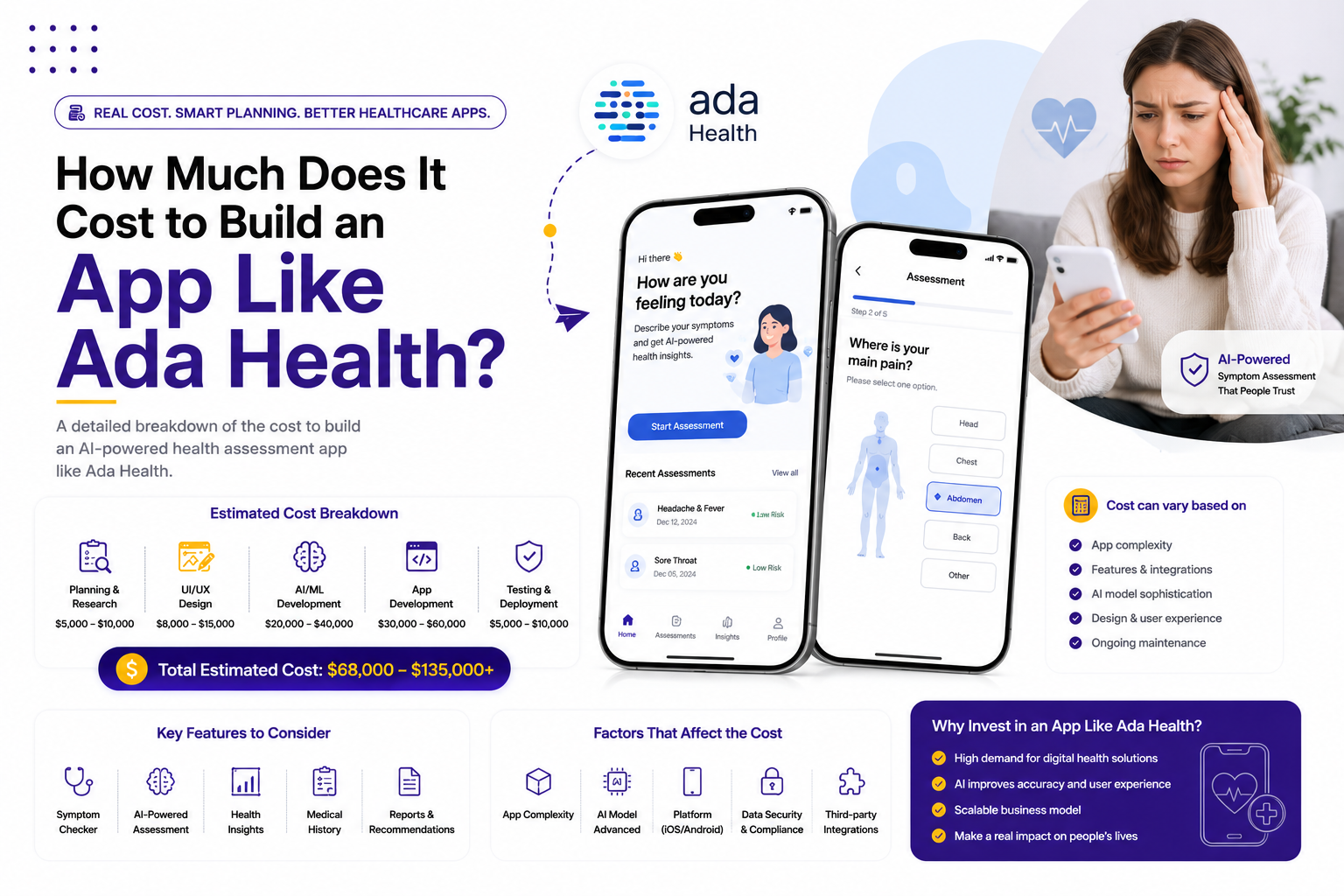

You have probably used a symptom checker at some point and thought, this could be done better. Ada Health had the same thought, and built an AI-powered health companion that has assessed over 30 million patients across 190 countries. Now you are here, wondering what it would actually take to build something like it. Good question.
The honest answer is: it depends. But that answer is useless unless you understand what it depends on. This blog is not going to hand you a vague range like $50,000 to $500,000 and call it a day. Instead, we are going to break down the real cost to build an app like Ada Health in 2026, layer by layer, so you walk away knowing exactly what drives the number up, what keeps it down, and where most founders quietly waste money without realising it.
Ada Health is not just a symptom checker. It is a medically validated, AI-driven clinical decision support tool. That distinction matters enormously when you start planning your budget. So let us get into it.
What Makes Ada Health Different from a Typical Health App
Before we talk numbers, you need to understand what you are actually building. Ada Health sits at the intersection of consumer health technology and clinical AI. That is a different animal from a fitness tracker or a telemedicine booking platform.
Here is what Ada Health actually does under the hood:
• Runs a probabilistic disease model that asks follow-up questions based on your previous answers
• Uses Bayesian inference to narrow down potential conditions from thousands to a ranked shortlist
• Maintains a medical knowledge base that is continuously updated and validated by a team of physicians
• Provides localised health guidance based on the user's geography and available healthcare infrastructure
• Integrates with EHR systems and hospital networks in select markets
This is not a simple if-then decision tree wrapped in a nice UI. The AI layer alone requires ongoing investment, not just a one-time build. That is a critical distinction when thinking about total cost of ownership versus just the initial development cost.
Core Feature Breakdown and What Each One Actually Costs
Let us walk through the major feature categories and give you a realistic sense of what each one contributes to the overall budget.
1. AI-Powered Symptom Assessment Engine
This is the heart of the app and where most of the cost lives. Building a clinically valid AI engine from scratch involves:
• Training or fine-tuning a medical reasoning model on structured clinical data
• Building or licensing an ontology of symptoms, conditions, risk factors, and differentials
• Designing a dynamic questioning flow that adapts in real time
• Validation against real patient data and clinical outcomes
If you are building the AI layer from scratch with a dedicated ML team, expect this component alone to account for 30 to 40 percent of your total development budget. A mid-tier build using pre-trained medical NLP models with custom fine-tuning will cost significantly less but will require careful validation before you can make any clinical claims.
In 2026, most new entrants in this space are opting for a hybrid approach: licensing a medical knowledge base (from providers like Infermedica, Isabel DDx, or similar), and layering their own UX and AI personalization on top. This reduces the base build cost considerably while still delivering a medically credible product.
2. User Interface and Patient Experience
Ada Health is genuinely good at making clinical conversations feel approachable. That kind of conversational UI design is not cheap. You need:
• A chat-style interaction layer that feels intuitive and not clinical or cold
• Adaptive question flows with logic branching
• Multilingual support if you are targeting more than one geography
• Accessibility compliance for users with visual or motor impairments
UI and UX design for a health app at this complexity level typically runs between $15,000 and $40,000 depending on your design team and the number of screens involved. Do not cheap out here. A medically sound app with a clunky interface will not be used, and usage drives the business model.
3. User Accounts and Health Profile Management
Personalisation is a key differentiator for Ada Health. The app remembers your chronic conditions, medications, allergies, and past assessments. Building a persistent health profile system requires:
• Secure user authentication with MFA
• HIPAA and GDPR compliant data storage for sensitive health information
• A structured health record model that integrates with the symptom engine
• Version history for profile changes
This module typically adds $20,000 to $45,000 to the build, depending on the depth of the health profile and the compliance requirements of your target markets.
4. Clinical and Healthcare Provider Dashboard
Ada Health offers a professional version that allows clinicians to review patient-submitted assessments before a consultation. If you want a B2B or B2B2C model, this dashboard is essential. Building it out includes:
• Role-based access for different types of healthcare professionals
• Analytics on symptom trends and patient populations
• Integration with appointment booking or referral workflows
• Audit trails for compliance purposes
A functional provider-side dashboard adds $30,000 to $60,000 to your build cost, and this is often where founders underinvest, thinking they will add it later. Adding it later always costs more.
5. EHR and Third-Party Integrations
Connecting your app to existing healthcare infrastructure, whether that is Epic, Cerner, or regional health record systems, is technically demanding. HL7 FHIR compliance is the standard in 2026 and most enterprise healthcare buyers will require it before they even evaluate your product.
Depending on how many integrations you build and how complex those systems are, expect to add $25,000 to $70,000 to the total. Ongoing maintenance of these integrations is also non-trivial, as health system APIs are updated regularly and standards evolve.
Cost to Build an App Like Ada Health: Feature-by-Feature Breakdown
The Hidden Costs Nobody Talks About
Every cost guide for health apps will give you a table like the one above. What they will not tell you is where the money actually disappears after you sign the contract. Here are the real budget leaks you need to plan for.
- Medical Content and Knowledge Base Licensing
Ada Health built its medical knowledge base over years with a dedicated clinical team. You are probably not going to do that. Licensing a credible medical ontology or symptom database costs between $30,000 and $120,000 per year depending on the vendor and the level of access. This is a recurring cost, not a one-time line item, and it is rarely mentioned in development quotes.
- Regulatory Strategy and Compliance Consulting
In 2026, medical AI apps in Europe require compliance with the EU AI Act, the Medical Device Regulation, and GDPR. In the US, if your app makes any diagnostic or clinical recommendation, you are potentially in FDA Software as a Medical Device territory. Getting this wrong is not just expensive, it can end your company. A specialist regulatory consultant for a product like this will cost $15,000 to $40,000 for the initial strategy work alone, before any formal submission fees.
- Clinical Advisory and Medical Validation
No serious healthcare buyer will trust your app without evidence that it has been validated by qualified clinicians. Assembling a medical advisory board and running validation studies adds $20,000 to $60,000 to your pre-launch costs, depending on the scope of the study and the specialisms involved.
- Data Privacy Infrastructure
Health data is the most sensitive category of personal data that exists. Your infrastructure needs to reflect that. This means end-to-end encryption, strict access controls, data residency compliance for each market, and regular third-party security audits. Budget an additional $15,000 to $30,000 per year for this, on top of your standard cloud infrastructure costs.
- Post-Launch AI Model Maintenance
Your symptom assessment model will drift over time as medical knowledge evolves and new conditions emerge. Keeping it current requires ongoing involvement from both engineers and clinicians. This is a cost that does not appear in your initial development quote but shows up every quarter on your P&L. Plan for $5,000 to $15,000 per month in ongoing model maintenance costs once you are at scale.
Who Should Build It and What That Decision Costs You
Your development team choice is arguably the single biggest variable in your total cost. Here is how the three main options compare in 2026.
The hybrid model is increasingly popular among health-tech founders in 2026 for a straightforward reason: it gives you the domain knowledge and stakeholder management in-house while outsourcing the execution to a cost-effective development partner.
If you are evaluating development partners, some companies worth considering for a build of this complexity include Backend Development Company, HireFullStackDeveloperIndia, HireAIDevelopers, DataEximIT, and WebClues Infotech. These are among the firms that have demonstrated capability in both the technical complexity and compliance requirements typical of medical AI applications.
Realistic Timeline for a Build Like This
Founders consistently underestimate how long a medically validated app takes to build. Here is a realistic phasing:
The total time from kick-off to a credible, market-ready product is typically 12 to 18 months. Anyone promising you a launch-ready medical AI app in six months is either cutting corners or not building the same thing.
What Is Changing in 2026 That Affects Your Build Cost
The health-tech landscape has shifted meaningfully in the last 18 months. Here is what is directly relevant to your build cost:
- Large Language Models Are Changing the AI Cost Equation
In 2024 and 2025, fine-tuning medical LLMs became dramatically more accessible. Today, a well-configured medical reasoning layer built on top of a model like GPT-4o or Claude 3 Opus can replace months of traditional ML development. This is compressing the AI development cost for new entrants by roughly 30 to 40 percent compared to 2022 era approaches. However, the regulatory scrutiny on LLM-based medical outputs is increasing in parallel, so any cost savings on the build need to be reinvested in validation and compliance.
- EU AI Act Is Reshaping Compliance Costs for European Launches
If Europe is in your go-to-market plan, the EU AI Act has introduced a new compliance burden for high-risk AI systems, which includes clinical decision support tools. This is adding an estimated $20,000 to $50,000 to the compliance budget for health AI products launching in the EU in 2026, compared to just two years ago.
- FHIR R5 Adoption Is Accelerating
The healthcare industry is moving from FHIR R4 to R5, and early adoption is now a signal of technical credibility to enterprise buyers. If you are building for any institutional market, designing for R5 from day one is worth the additional 15 to 20 percent development overhead it adds to your integration layer.
How Geography and Team Location Shape Your Final Bill
This is one of the most underrated cost variables in any app development project, and it matters even more when the product touches regulated industries like healthcare. The same feature set can cost three to four times more depending on where your development team is based.
Here is a realistic hourly rate breakdown by region in 2026:
For a project of this scale, roughly 3,000 to 5,000 hours of billable development time is typical from scoping to soft launch. Running those numbers tells you everything you need to know about why two quotes for the same app can differ by $200,000 or more.
One important nuance: cheaper per-hour rates do not always mean a cheaper final bill. Teams with less healthcare experience often require more revision cycles, more handholding on compliance requirements, and more time debugging integrations with medical data standards. A senior team at $70 per hour that completes the work in 3,200 hours will almost always beat a $40 per hour team that takes 6,000 hours to deliver the same outcome.
What You Can Afford to Defer and What You Cannot
Not every feature needs to ship on day one. Knowing which decisions you can push to version two without damaging your business is how founders stretch their initial budget without compromising the product.
Defer these without regret:
- Advanced analytics dashboards for providers (build basic reporting first, iterate based on actual clinical feedback)
- Support for more than two languages at launch (localisation is expensive and best driven by proven demand)
- Native wearable integrations (Apple Watch, Fitbit) unless your go-to-market specifically requires them
- Telehealth video consultation features (these require additional licensing in most markets)
- Complex personalised health plans or chronic condition management modules
Do not defer these under any circumstances:
- End-to-end data encryption and HIPAA or GDPR compliant infrastructure from day one. Retrofitting security onto an existing codebase is always more expensive and more disruptive than building it in from the start.
- Clinical validation of your AI outputs before you market the product as medically useful. Even a soft launch to beta users creates liability if the outputs have not been reviewed by qualified clinicians.
- A clear audit trail for every recommendation the AI makes. Regulators and enterprise buyers will ask for this. Building it after the fact is significantly harder than designing for it upfront.
- Core accessibility standards. In most markets, health apps that discriminate against users with disabilities face both legal exposure and exclusion from public sector procurement.
The Cost of Getting It Wrong
Most cost guides focus on what it takes to build the thing. Very few talk about the cost of building it incorrectly, and in healthcare AI, those costs are not theoretical.
In 2023, a German health-tech startup had its symptom checker app pulled from regulated markets after an independent study found its accuracy on serious conditions was significantly below what its marketing suggested. The cost of that withdrawal, rebranding, clinical remediation, and relaunch was reported to be higher than the original development budget.
In 2025, the UK's Medicines and Healthcare products Regulatory Agency issued updated enforcement guidance making clear that apps presenting AI-generated health assessments without adequate clinical validation are subject to the same scrutiny as physical medical devices.
The practical cost implications for you as a founder are:
- Do not describe your app as a diagnostic tool if it has not been validated as one. The gap between a wellness tool and a diagnostic tool is not just semantic. It is a regulatory classification difference that changes your entire compliance and legal exposure.
- Build in a mechanism to flag low-confidence outputs from day one. If the model is uncertain, the app should say so clearly rather than presenting a ranked list of conditions with false confidence.
- Budget explicitly for ongoing post-market surveillance. Enterprise buyers increasingly require it, and regulators in both the EU and the US are moving toward mandating it for AI-based medical software.
The cost of getting it wrong in this space is not just financial. It is reputational, regulatory, and in the worst cases, clinical. Plan accordingly.
Understanding the Revenue Model Before You Commit to the Budget
A $300,000 app build looks very different depending on whether you have a clear revenue model. Ada Health primarily monetises through:
• Enterprise contracts with insurers, employers, and health systems who pay per-employee or per-member access fees
• B2B2C white-label licensing for healthcare providers who want their own symptom assessment tool
• Consumer subscriptions for premium features in select markets
The enterprise model is where the real money is, but it requires the provider-side dashboard, the EHR integrations, and the compliance documentation we described above. If you are not planning for enterprise sales, you can defer some of those costs and build a lighter consumer product first. But if enterprise is the plan, do not try to retrofit the B2B features later. That almost always ends up costing more than building them in from the start.
Conclusion
Building a product in the same league as Ada Health is not a weekend hackathon. It is a serious, sustained investment that touches clinical science, regulatory compliance, engineering, and product design simultaneously. The cost to build an app like Ada Health in 2026 sits between $250,000 and $600,000 for a credible initial build, with ongoing costs that can easily run another $100,000 to $200,000 per year depending on your market and growth trajectory
But here is the thing: the founders who treat that number as a ceiling and look for ways to cut every line item are usually the ones who end up paying twice. The ones who build thoughtfully, with the right partners, the right compliance strategy, and a clear monetisation model in place before they break ground, are the ones who make it to Series A with a product that institutional buyers actually want to pay for.
If you are seriously evaluating this space, the best next step is not to get more quotes from developers. It is to talk to a clinical advisor, a regulatory specialist, and a potential enterprise buyer in the same week. What you learn in those three conversations will shape your entire product strategy, and it will save you far more than any line item optimisation ever could.