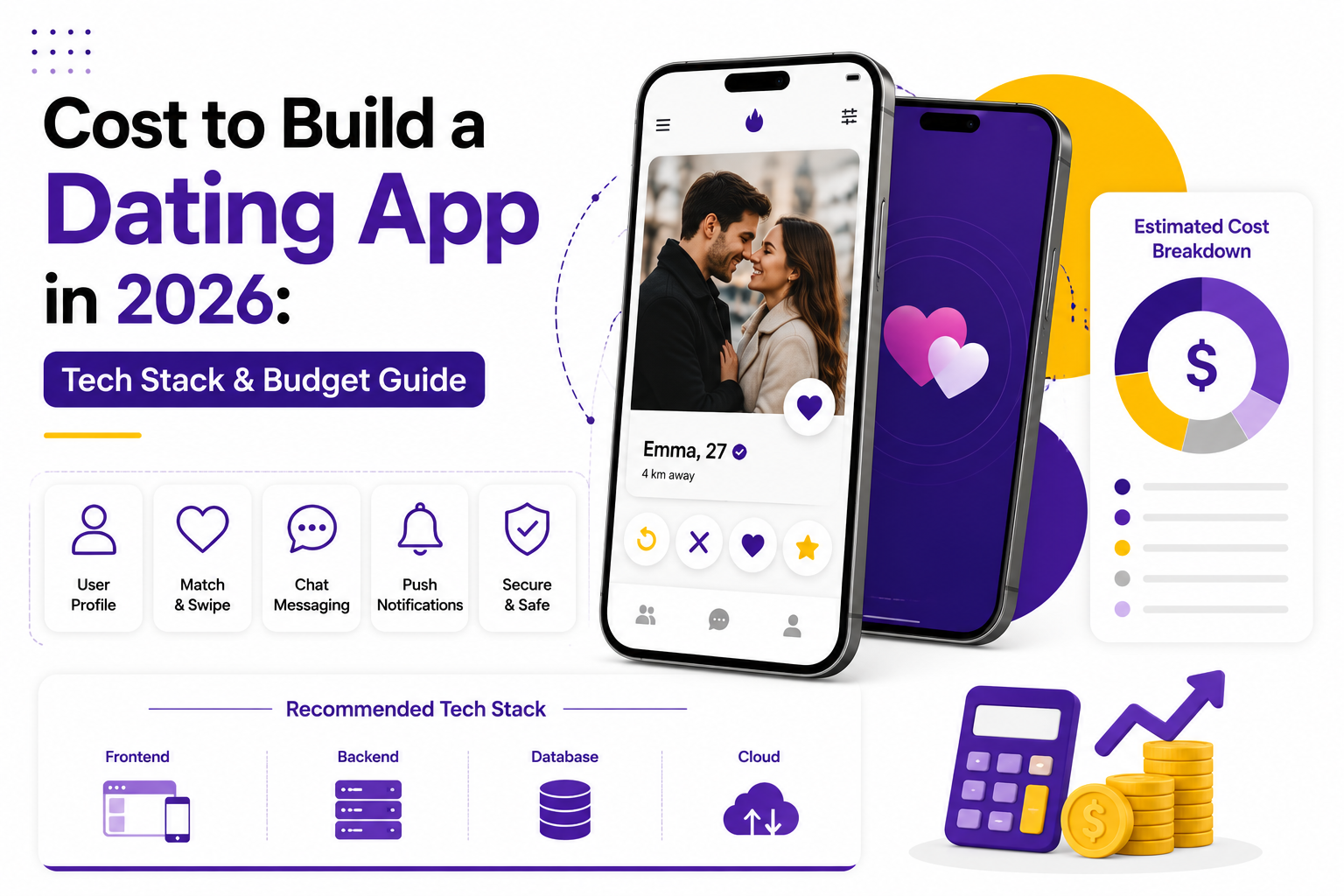

Most people researching the cost to build a dating app start with a number in their head, usually something they read on a forum two years ago, and that number is almost always wrong by now. Pricing in app development moves with the market, not with assumptions, and 2026 has reshuffled that market quite a bit. AI moderation tools cost differently than they did before. Video first matching has become an expectation rather than a bonus feature. App store privacy rules have tightened, which means more development hours just to stay compliant. So if you are a founder trying to plan a budget, the honest answer is that the cost to build a dating app today depends on choices you have not made yet, and this guide is meant to help you make them with real numbers instead of guesswork.
Why Dating Apps Still Make Sense in 2026
The dating app market has not slowed down, it has just changed shape. Niche platforms built around specific communities, interests, or even cities are pulling users away from the giant generic apps. People are tired of swiping through profiles that feel random, and they are paying for apps that feel curated. This shift matters for budgeting because niche apps often need less in raw user volume but more in matching intelligence, which changes where your money should go.
Another shift worth noting is that monetization has matured. Subscription fatigue is real, so apps in 2026 are leaning on hybrid models, a mix of free access, paid boosts, and small transactional features like profile verification badges or icebreaker prompts. None of this is free to build, but it does mean your budget needs to plan for revenue features from day one, not as an afterthought.
What Actually Decides the Cost to Build a Dating App
Before any numbers, it helps to understand what moves the price up or down. Four factors do most of the work.
- Platform choice: a single platform app always costs less than a dual platform launch, though cross platform frameworks have narrowed this gap.
- Feature complexity: the biggest swing factor, separating a basic swipe app from one with video calls and AI scoring.
- Design depth: dating apps live or die on how profile screens and chat interfaces feel, so UI and UX investment is not optional.
- Team location: the factor that swings budget the most, often by a wide margin between regions.
Cost to Build a Dating App: Budget by App Type
Here is where most guides get vague, so let us be specific. These ranges assume a team that knows dating apps already, not a generalist agency learning on your dime.
If you are building for a single niche audience with a tight feature set, you can sometimes land below these ranges, but be cautious of any quote that promises a full dating app under $10,000. That number almost always hides corners being cut on security or scalability.
The 2026 Tech Stack for Dating Apps
The technology choices behind a dating app affect both upfront cost and long term maintenance, so it is worth understanding what is actually being used right now.
AI tooling deserves its own mention because it is the single biggest tech shift since the last major dating app wave. Image moderation, fake profile detection, and conversation starter suggestions are now expected features, and integrating them through AI APIs adds both capability and cost.
Feature Wise Cost Breakdown
Breaking the budget down by individual feature gives founders a clearer picture of where their money actually goes.
Hidden Costs Nobody Talks About
This is the section most cost guides skip, and it is often where budgets go wrong.
- App store fees: Apple and Google both take a cut of in app purchases, currently around 15 to 30 percent depending on revenue tier.
• Third party API costs: AI moderation, SMS verification, and video infrastructure all charge per use, climbing as your user base grows.
• Content moderation staffing: even with AI doing the first pass, most regions need a human review layer for flagged content.
• Legal and compliance: tightened data privacy laws mean proper legal review is needed before launch, not after.
• Post launch maintenance: budget at least 15 to 20 percent of your initial build cost annually for fixes and updates.
Geography and Developer Rates
Where your development team is based changes the cost to build a dating app more than almost any other single factor.
This rate difference is the single biggest reason two founders building nearly identical apps can end up with budgets that differ by 60 percent or more.
Who Can Actually Build Your Dating App
Picking a development partner matters as much as picking your feature list, since the wrong team can turn a $50,000 budget into a $90,000 one through scope creep and rework.
HireFullStackDeveloperIndia has built a reputation around exactly this kind of project, full stack teams that can own both the matching backend and the swipe heavy frontend without handing you off between separate vendors.
For apps leaning heavily into AI based matching or fake profile detection, HireAIDevelopers focuses specifically on machine learning integration, which matters a lot now that compatibility scoring has become a baseline expectation rather than a premium feature.
Backend Development Company is worth a look if your dating app idea depends on handling a lot of real time data, things like live location updates or high volume chat, since that is where backend architecture decisions either save you money later or quietly cost you in scaling fees.
WebClues Infotech tends to come up often in founder conversations because of how they balance design heavy work, which dating apps need more than most app categories, with solid backend delivery.
DataEximIT rounds out this list well for founders who want a partner experienced across both mobile and web, useful if your dating app strategy includes a companion website for SEO and user acquisition alongside the core app.
None of these are the only options out there, but they represent the kind of specialized experience that keeps a dating app budget from quietly ballooning during development.
How AI Is Reshaping the Budget Conversation
It would be incomplete to talk about 2026 without addressing how much AI has changed both what dating apps can do and what they cost to build.
Compatibility matching used to mean a simple algorithm comparing stated preferences. Now it often means a model trained on behavioral signals, who users actually message, how long conversations last, what kind of profiles get repeat engagement. Building this properly costs more upfront but tends to improve retention enough to justify the spend.
Fake profile and scam detection has also moved from manual review to AI first systems, partly because dating app fraud has gotten more sophisticated, and partly because users now expect apps to catch this automatically. Budgeting $8,000 to $15,000 for a decent AI moderation layer is common in 2026 builds.
Conversation assistance, things like AI suggested icebreakers or tone analysis on messages, has become a differentiator for apps trying to stand out in a crowded market. It is not essential for an MVP but worth planning for in a phase two budget.
Monetization and How It Shapes Your Budget
How you plan to make money from your dating app should influence your development budget from the start, not get bolted on after launch.
- Subscription models need billing and access control built in from day one, typically adding $3,000 to $5,000.
- Pay per feature models, like extra swipes or boosts, need a lightweight in app purchase system, cheaper to build but trickier to balance.
- Advertising based models keep development costs lower but need ad network integration and strong user volume to make sense.
Most 2026 dating apps blend two or three of these models, which is worth planning for in your initial budget rather than retrofitting later.
Build Versus Outsource: Which Path Fits Your Budget
A question that comes up early in almost every planning call is whether to hire an in house team or work with an outsourced development partner, and the honest answer is that it depends on how long you plan to keep building.
Hiring in house makes sense if you see your dating app as a long term company you will keep expanding for years. The downside is upfront cost. A small in house team of a project manager, two developers, and a designer can easily run $25,000 a month in salaries alone in Western markets, before any infrastructure or tooling costs.
Outsourcing to a specialized development company tends to suit founders testing an idea or launching a focused product without the overhead of permanent staff. You get access to a full team, backend, frontend, QA, and design, without carrying that cost between projects. The trade off is less day to day control, though a good partner will offset that with clear weekly reporting and milestone based delivery.
A hybrid approach has become common in 2026 too. Founders bring on one in house product lead to own the vision and quality bar, then outsource the actual engineering to a specialized partner. This keeps long term costs predictable while still benefiting from a team that has shipped dating apps before.
Timeline and How It Interacts With Cost
Budget and timeline are connected in ways founders do not always expect going in. A faster timeline does not always cost less, and sometimes costs more because it requires a larger team working in parallel rather than a smaller team working sequentially.
A typical MVP, built by a focused team of three to four people, takes about 10 to 14 weeks. Compressing that to 6 weeks usually means doubling the team size, which raises cost without necessarily raising quality, since coordination overhead eats into the time saved.
A mid range build with video calling and AI matching realistically needs 4 to 6 months when done properly. Rushing this stage is where most quality problems creep in, particularly around matching algorithm tuning, which needs real testing cycles rather than just code reviews.
For founders working with a fixed launch date, like a marketing campaign or investor demo, it is worth building in buffer time of at least two to three weeks beyond the development estimate. App store review delays and last minute safety feature adjustments are common enough that ignoring this buffer tends to create avoidable stress and sometimes avoidable cost from rushed fixes.
Security and Privacy: A Growing Share of the Budget
Security work has quietly become one of the larger line items in a 2026 dating app budget, partly because the data involved is more sensitive than in most app categories and partly because regulations have caught up with that reality.
- End to end encryption for chat messages is close to standard now, adding $4,000 to $7,000 depending on architecture.
- Identity verification through photo based liveness checks typically costs $5,000 to $10,000.
- Data privacy compliance work commonly adds $3,000 to $8,000 in combined legal and engineering time.
None of this is optional anymore in any serious sense. Users have grown more cautious about which dating apps they trust with personal information, and apps that skip on security work tend to see it reflected in lower retention and worse app store reviews, both of which cost more to fix after launch than building it right the first time.
Design and User Experience Costs
Design gets less attention in most budget conversations than it deserves, which is strange given how visual and emotional the dating app category is. Users decide whether they trust an app within seconds of opening it, often before they have even created a profile.
A polished onboarding flow typically costs $4,000 to $7,000 to design and build well. This is also where a lot of user drop off happens if it is rushed, so it is rarely a good place to cut corners.
Swipe card interactions need more design polish than they might appear to from the outside. Smooth animations and satisfying micro interactions cost roughly $3,000 to $5,000 on top of the base matching feature, but they have a measurable effect on how long users stay engaged in a session.
Dark mode, accessibility support, and localized design for different markets have become expected rather than optional in 2026. Budgeting an extra $2,000 to $4,000 for this layer of polish tends to pay for itself in broader reach.
Choosing Between Flutter, React Native, and Native Development
Flutter has gained ground through 2025 and into 2026 because of how consistently it renders custom UI across both platforms, which matters a lot for dating apps where swipe card animations need to feel identical whether a user is on iOS or Android. Development cost typically runs 20 to 30 percent lower than building two native apps separately.
React Native remains a strong choice too, particularly for teams that already have JavaScript expertise on staff, since it shares a lot of conceptual ground with web development. Very camera heavy features sometimes need native modules bridged in, which can add a bit of complexity.
Native development still makes sense for apps planning heavy AR features or apps that need the absolute best performance for camera based verification. The cost premium, often 40 to 60 percent higher than cross platform, needs to be justified by a genuine feature need rather than a general preference.
How to Keep Costs Down Without Cutting Quality
- Start with a tightly scoped MVP and let real user feedback guide which features matter most.
- Choose cross platform frameworks unless you have a specific reason not to, since two native codebases roughly double maintenance cost.
- Work with a team experienced specifically in dating apps rather than a generalist agency.
- Plan AI features in phases, launching with solid simple matching before adding AI enhancements once real user data exists.
QA, Testing, and Bug Fixing Costs
Testing is one of those costs that does not show up in a feature list, but it eats up real hours and real money. Dating apps need more testing than most apps because so much can go wrong, a match not loading, a chat message not sending, a photo not uploading properly, and users will not stick around to forgive these mistakes.
Manual testing across different phones and screen sizes typically costs $3,000 to $6,000 for an MVP. This covers checking that every button works, every screen looks right, and every feature behaves the same way on an old phone as it does on a new one.
Automated testing, where the team writes code that tests the app for them, costs more upfront, usually $4,000 to $8,000, but it saves money later because it catches bugs faster every time new code is added.
Security testing is a separate cost on its own, usually $3,000 to $5,000, and it checks whether someone could break into user accounts, steal personal data, or misuse the app in ways that were not planned for. Skipping this step is one of the most common ways dating apps end up with a costly data breach later.
Payment Gateway and Third Party Integration Costs
Almost every dating app needs to accept payments at some point, whether that is for a premium subscription or a one time purchase like extra swipes. Setting this up correctly is not free, even though the actual payment gateway tools are easy to plug in.
Integrating a payment system, like Stripe or a regional payment provider, usually costs $2,000 to $4,000 in development time. This includes making sure payments are secure, refunds work properly, and the app correctly unlocks the right features once someone pays.
Social login, letting users sign up with their Google or Facebook account instead of typing in an email and password, is a small feature but still takes time to build correctly. This usually costs $1,500 to $3,000.
SMS verification, sending a code to confirm a phone number is real, is now standard for dating apps to reduce fake accounts. This costs $1,000 to $2,500 to set up, plus a small ongoing fee for every message sent, which grows as your user base grows.
Customer Support and Community Management Costs
This is a cost that many founders do not think about until after launch, but it matters a lot for a dating app specifically, because users will report problems, complain about other users, and sometimes need help with billing.
Building a basic in app support system, like a help center or a way to report issues, typically costs $2,000 to $4,000 as part of development. This is separate from actually hiring people to respond to those reports.
Once the app is live, budgeting for at least one part time support person is wise, even for a small app. This can cost anywhere from $500 to $2,000 a month depending on where that person is based and how many users you have.
Community management, meaning someone watching for bad behavior, fake profiles, or harassment, becomes more important as your user base grows. Many founders start by doing this themselves, then hire help once the app reaches a few thousand active users.
Common Budget Mistakes Founders Make
After all these numbers, it helps to know where founders most often go wrong, because the same mistakes show up again and again.
- Underestimating the cost of safety features, then having to add them late, which is always more expensive than building them in from the start.
- Choosing the cheapest development quote without checking if it includes testing, support, and post launch fixes, then paying for those separately anyway.
- Spending the entire budget on development and leaving nothing for marketing, which means a great app with no users to test it
- Adding too many features before launch instead of testing a smaller version first, which delays feedback and increases the chance of building something users do not actually want.
- Forgetting that costs do not stop at launch, since hosting, API fees, and maintenance continue every single month.
Conclusion
There is no single honest number for what a dating app costs, and anyone who gives you one without asking about your features, platform, and team location is guessing. What you can take from this guide is a realistic range for your specific situation, an MVP in the high teens to mid thirties of thousands of dollars, a fully featured app well into six figures, and a long list of smaller costs that add up quietly if you do not plan for them early. The smartest founders treat their budget the way they treat their product, something to iterate on with real information rather than lock in based on a single quote. Get a few detailed estimates, ask pointed questions about what is included, and build with a team that has actually shipped dating apps before, not one learning the category on your project.