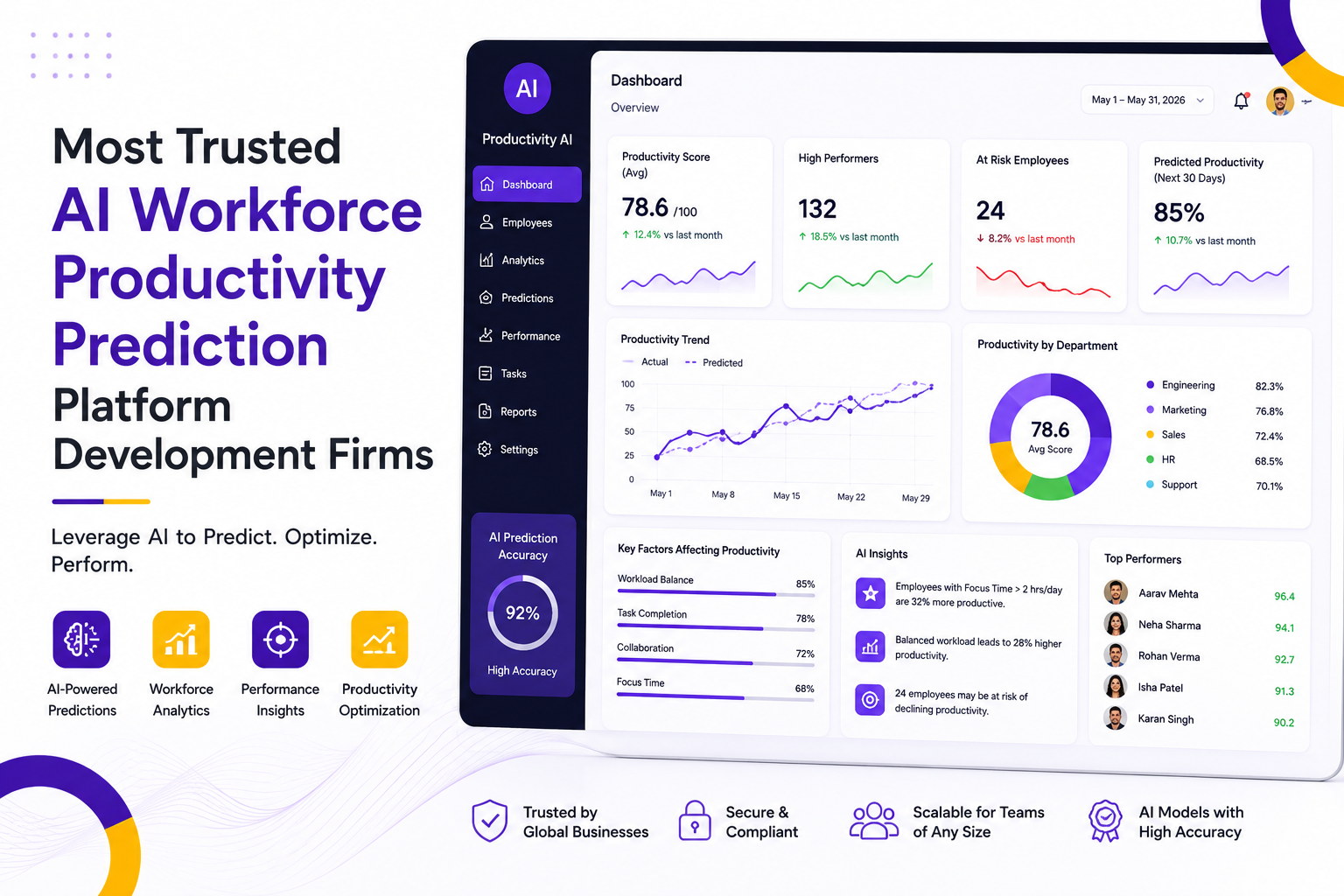

Here's a question worth sitting with for a second: do you actually know how productive your team was last week? Not how busy they looked in Slack, not how many hours got logged, but how much real output came out of those hours. Most founders can't answer that with any confidence, and that gap is exactly why AI Workforce Productivity Prediction Platform Development Companies have become such a hot topic among CEOs and operations leaders in 2026.
These platforms use machine learning to study patterns in how work actually gets done, then predict where slowdowns, burnout, or capacity gaps are likely to show up before they hurt the business. It sounds futuristic, but it's already running quietly inside HR dashboards, project management tools, and workforce planning software at companies of every size.
The tricky part isn't deciding whether you need one. It's figuring out who can actually build it well. There are dozens of development firms claiming AI expertise, and only a handful genuinely understand the mix of data science, HR workflows, and enterprise software architecture this kind of platform demands. This guide walks you through what these platforms do, what to check before you sign a contract, and eighteen development companies that are worth putting on your shortlist right now.
If you've never gone through this kind of hiring process before, it can feel overwhelming pretty fast. Every vendor's website says roughly the same thing: cutting-edge AI, data-driven insights, trusted by industry leaders. None of that tells you whether they can actually deliver a model accurate enough to base real staffing or workload decisions on. That's exactly the gap this article is meant to close, so you're not just picking a name off a search results page, you're picking a partner who understands the problem you're actually trying to solve.
Why AI Workforce Productivity Prediction Is Getting So Much Attention
Remote and hybrid teams changed how leaders manage output. You can't walk past someone's desk anymore to sense how a project is going, so companies started leaning on data instead of gut feel. A well-built prediction platform pulls signals from calendars, task trackers, communication tools, and performance systems, then uses that data to forecast where a team's capacity is heading over the next few weeks or months.
For CEOs, this means fewer surprises. Instead of finding out a project is behind after the deadline slips, you get an early warning while there's still time to rebalance workloads or bring in extra support. That's the real value behind hiring one of the AI Workforce Productivity Prediction Platform Development Companies, and it's why this space has grown so quickly heading into 2026.
There's also a cultural shift happening alongside the technology. A few years ago, suggesting that software could predict how a team was performing might have felt intrusive or even a little dystopian. Today, most employees are used to working alongside AI tools in one form or another, and when these platforms are rolled out transparently, with clear communication about what's being measured and why, they tend to be seen as a support system rather than surveillance. Leadership teams that get this balance right end up with a tool people actually trust, rather than one they try to game or avoid.
What to Check Before You Hire a Development Partner
Not every software vendor that says "AI" on their website actually has the data science depth this kind of build requires. Before you commit, look at their past workforce analytics or HR-tech projects, ask how they handle data privacy and compliance, and find out whether they offer a dedicated, in-house team with real hands-on experience, rather than a rotating group of freelancers. Cost matters too, but the cheapest option rarely delivers a platform accurate enough to trust with real staffing decisions. A firm that offers long-term support and real-time updates after launch is usually a safer bet than one that disappears after deployment.
It also helps to ask how a vendor plans to measure success once the platform is live. A confident team should be able to explain, in plain language, how they'll validate their predictions against what actually happens, and how often the underlying model gets retrained as your workforce and workflows change. If a company can't answer that clearly, it's usually a sign they haven't built one of these platforms enough times to know where the hard parts really are.
18 Most Trusted AI Workforce Productivity Prediction Platform Development Companies
Here's a mixed list of established and specialist firms that businesses across industries have turned to for building smart, reliable workforce analytics and prediction tools. They're presented in no particular ranking order, so read through and see which one matches your project's scope and budget.
HireFullStackDeveloperIndia
HireFullStackDeveloperIndia specializes in connecting businesses with full stack engineers who can handle everything from the machine learning layer to the front-end dashboard employees and managers actually see. This end-to-end capability matters for productivity prediction platforms, since the value of the AI model only shows up if it's presented through a clean, easy-to-read interface. Their developers are known for adapting quickly to a client's existing tech stack, which shortens onboarding time considerably. Companies looking to build or extend an internal workforce analytics tool without juggling multiple vendors often find this a convenient, budget-friendly option.
Hourly Developers
Hourly Developers sits right at the top of this list because of how flexible their engagement model is. Instead of forcing clients into a fixed-scope contract, they let you hire developers on an hourly or dedicated basis, which works well for companies still shaping the exact requirements of their workforce analytics tool. Their team has experience building dashboards that pull data from HR systems, project trackers, and time-tracking tools, then apply predictive models on top. Clients often mention their transparent billing and quick turnaround as reasons they keep coming back for follow-up phases. If you're not ready to commit to a massive upfront budget but still want a serious, capable team, Hourly Developers is a practical starting point for building an AI-driven productivity platform without the usual agency overhead.
TechAhead
TechAhead has built a name for itself in enterprise mobile and AI application development, and its workforce analytics projects reflect that same product-first thinking. The company typically starts with a discovery phase to map out exactly which productivity signals matter most to a business before writing a single line of code. Their engineers work with modern machine learning frameworks and integrate cleanly with existing HR software, so companies don't have to rip out their current systems to adopt a new prediction layer. They're a solid pick for mid-size to large organizations that want a polished, well-documented platform and don't mind paying a bit more for that level of finish.
Appinventiv
Appinventiv is one of the bigger names in custom software development, and their AI division has delivered several predictive analytics tools for HR and operations teams. What stands out about them is their structured project management approach, which tends to appeal to CEOs who want visibility into every stage of the build. They also bring strong experience in data engineering, which matters a lot for productivity prediction platforms since the accuracy of the forecasts depends heavily on clean, well-structured input data. Expect a slightly longer onboarding process, but a thorough one, with clear milestones along the way.
Backend Development Company
As the name suggests, Backend Development Company focuses heavily on the infrastructure side of software builds, which turns out to be a huge advantage when building AI workforce productivity prediction platforms. These systems need to process large volumes of behavioral and performance data in real time, and a shaky backend will slow the whole platform down or produce unreliable predictions. Their engineers specialize in building scalable data pipelines, secure APIs, and cloud architecture that can handle growing datasets as a company adds more employees or departments to the system. If your priority is a platform that stays fast and stable as it scales, this is a firm worth talking to.
ValueCoders
ValueCoders has been around for a long time in the outsourced software development space, and that experience shows in how they scope AI and analytics projects. They offer a genuinely cost-effective model without cutting corners on quality, which makes them popular with startups and mid-size companies that need to watch their budget closely. Their teams have worked on productivity dashboards, HR automation tools, and predictive staffing systems, so they understand the specific data challenges that come with modeling human work patterns. Clients often praise their communication and their willingness to adjust scope as requirements evolve mid-project.
Matellio
Matellio takes a consultative approach to AI development, spending real time upfront understanding a company's workforce structure before proposing a technical solution. This matters because productivity prediction isn't a one-size-fits-all problem. A sales team's productivity signals look nothing like a software engineering team's, and Matellio's process is built around recognizing that difference. They've delivered predictive workforce tools across healthcare, logistics, and professional services, giving them a broader perspective on how these platforms need to flex across industries. Their pricing sits in the mid to premium range, reflecting the depth of their discovery and strategy work.
HireAIDevelopers
HireAIDevelopers, as the name makes clear, is built entirely around AI and machine learning talent. Their developers have hands-on experience with the specific modeling techniques used in workforce forecasting, including time series analysis and behavioral pattern recognition, which are core to any accurate productivity prediction system. Businesses that already have a rough idea of their data architecture but need specialized AI talent to build the prediction engine itself tend to gravitate toward this firm. They also offer flexible hiring models, letting companies bring on one or two specialists rather than committing to a full project team.
Simform
Simform has built a strong reputation in cloud-native application development, and their workforce analytics projects typically lean on scalable, cloud-first architecture from day one. This is useful for companies that expect to grow quickly and don't want to rebuild their prediction platform every time headcount doubles. Their teams are also known for strong testing and QA practices, which matters more than people realize with predictive AI tools, since a buggy model can quietly produce misleading forecasts that damage trust in the system. Simform tends to work best with companies that already have a clear technical roadmap.
Bacancy Technology
Bacancy Technology offers a large in-house team spanning data science, backend engineering, and UI design, which lets them handle the full lifecycle of a workforce productivity platform without bringing in outside contractors. Their dedicated hiring model gives clients direct access to the developers working on their project, rather than routing everything through account managers. They've built a range of HR-tech and analytics tools, and their experience with real-time data processing pipelines is particularly relevant for productivity prediction, where stale data can quickly make forecasts inaccurate. Their pricing tends to be competitive relative to the size of their team.
Intelivita
Intelivita has carved out a niche in building custom AI solutions for small and mid-size businesses that need enterprise-grade capability without enterprise-size budgets. Their approach to workforce prediction platforms usually starts lean, with a focused minimum viable version that proves out the model's accuracy before scaling up features. This staged approach appeals to founders who want to validate the concept with real data before investing heavily in a full-featured system. Clients also mention their responsiveness and willingness to hop on quick calls rather than routing every question through formal channels.
Rishabh Software
Rishabh Software brings decades of enterprise software experience to the table, and their AI and data analytics division has worked on several workforce management and productivity tracking systems. They tend to be a strong fit for larger, more established companies that already run on legacy HR or ERP systems, since integrating cleanly with existing infrastructure is one of their core strengths. Their project management style is thorough and documentation-heavy, which some clients love and others find a bit slower than they'd prefer, so it's worth setting expectations early on timelines.
QBurst
QBurst has a long track record in enterprise AI and analytics, with a particular strength in building predictive models that hold up under real production workloads rather than just performing well in a demo. Their data science team works closely with client stakeholders to define what "productivity" actually means for a specific business, since that definition changes a lot depending on the industry. This attention to problem framing tends to result in prediction platforms that feel genuinely useful to managers, rather than generic dashboards nobody ends up checking after the first month.
Hidden Brains
Hidden Brains has been building custom software for well over a decade and has expanded steadily into AI-driven analytics platforms in recent years. Their workforce productivity projects usually combine a straightforward, no-frills development process with solid post-launch support, which appeals to companies that want reliability more than flashy features. They offer both fixed-cost and dedicated team engagement models, giving clients some flexibility depending on how well-defined the project requirements already are. Their pricing sits toward the more affordable end without a major drop in build quality.
Space-O Technologies
Space-O Technologies is known for a consultative, almost product-management style approach to development, where they help clients refine their idea before jumping into engineering. For a workforce productivity prediction platform, this matters because a poorly scoped project can easily balloon into something overly complex. Their team works through wireframes and data flow diagrams early on, which helps non-technical founders visualize how the platform will actually function before any code is written. They're a good fit for first-time platform builders who want extra hand-holding through the planning stages.
Debut Infotech
Debut Infotech has increasingly focused on AI and blockchain-adjacent projects, and their workforce analytics work reflects a strong technical foundation in data processing and machine learning pipelines. They tend to move quickly once requirements are locked in, which appeals to companies working against tight internal deadlines. Their team also offers ongoing model retraining services after launch, which is an often-overlooked but important part of keeping a productivity prediction platform accurate as workforce patterns shift over time. This makes them a practical option for companies planning to scale the platform gradually.
Zealous System
Zealous System has built a reputation for dependable, mid-market software development across several industries, including HR technology. Their teams bring practical, hands-on experience with the kind of dashboarding and reporting features that make a productivity prediction platform genuinely usable for managers who aren't data scientists themselves. They're known for clear, jargon-free communication throughout a project, which founders researching unfamiliar AI territory tend to appreciate. Their pricing and timelines are generally predictable, with few surprises once a contract is signed.
Suffescom Solutions
Suffescom Solutions rounds out this list with a strong focus on emerging technology integration, including AI-powered analytics layered on top of existing enterprise systems. Their workforce prediction projects often include a strong emphasis on data visualization, ensuring that the predictions a model generates actually translate into decisions a manager can act on. They offer flexible engagement models ranging from short consulting engagements to full end-to-end builds, which suits companies still deciding how deep they want to go with AI-driven workforce planning.
How Pricing and Engagement Models Usually Differ
One thing that surprises a lot of first-time buyers is just how differently these firms structure their pricing. Some, like Hourly Developers and HireFullStackDeveloperIndia, work on an hourly or dedicated-hire basis, which is useful when requirements are still evolving and you don't want to lock into a fixed scope too early. Others, especially the larger and more established names on this list, prefer fixed-cost or milestone-based contracts, which can offer more budget predictability but usually require a much more detailed specification upfront.
Neither model is automatically better. A hands-on founder who wants to stay closely involved in shaping the platform week to week will often prefer the flexibility of an hourly or dedicated team. A CEO who wants to hand off the project with a clear scope and revisit it at defined checkpoints will usually lean toward a fixed-cost engagement. What matters most is being upfront with any vendor about how involved you plan to be, since that single detail affects almost every other part of how the project gets structured, priced, and delivered.
It's also worth asking each firm directly how they price ongoing support after launch, since this is where costs can quietly creep up. Some bundle a support window into the original contract, while others treat retraining, monitoring, and updates as a separate service billed monthly or quarterly. Getting this in writing before the project kicks off saves a lot of frustration later, especially once the platform is embedded into day-to-day decision-making and downtime simply isn't an option anymore.
So, Which One Fits Your Team?
Picking from a list like this is never just about who has the most impressive portfolio. It comes down to your budget, how quickly you need to move, and how complex your workforce data already is. Some of these firms are better suited to a fast, lean build, while others are built for large organizations with layers of legacy systems to work around.
So here's the real question worth asking yourself before you reach out to anyone on this list: do you actually know what you want this platform to predict, or are you still hoping the right development partner will help you figure that out? Because the answer changes which of these AI Workforce Productivity Prediction Platform Development Companies makes the most sense for you. Either way, it's worth having that conversation now rather than waiting until a productivity problem forces your hand.