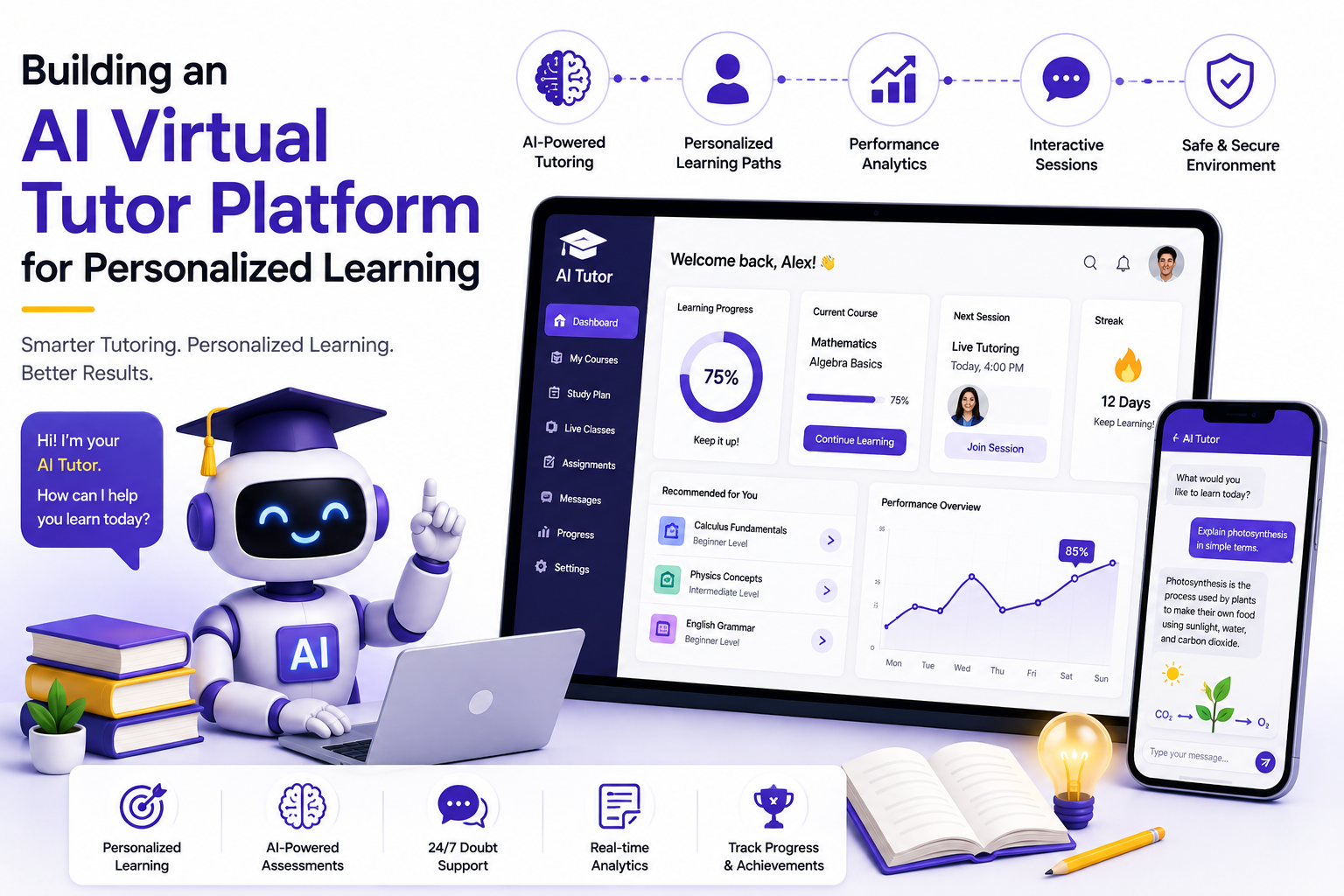

A student in Bengaluru struggling with quadratic equations at 11 PM has very different needs than a corporate employee brushing up on Python between meetings in Toronto. Traditional e-learning content cannot flex to meet both of them where they are, but an AI virtual tutor platform can. It watches how someone learns, notices where they stumble, and quietly reshapes the lesson around them instead of forcing them to follow a fixed script.
That shift from static courses to responsive, one-on-one style guidance is why founders across ed-tech, corporate training, and test-prep are racing to build one. If you are a founder or decision-maker weighing whether to build this kind of product in 2026, this guide walks through what actually goes into it. We will cover the features that matter, the technology choices you will have to make, realistic costs, the compliance issues nobody warns you about, and how to pick a development partner without getting burned.
Why Personalized Learning Is Having Its Moment in 2026
Personalized learning is not a new idea. Teachers have tried to individualize instruction for decades, but doing it at scale for thousands or millions of learners was never realistic without help. Large language models and adaptive algorithms changed that math entirely.
The global AI in education market was valued at roughly $7.05 billion in 2025 and is projected to grow at a CAGR above 34% through the mid-2030s, according to Precedence Research. Separately, Grand View Research pegs the global AI tutors market specifically at $2.7 billion for 2026, climbing toward $17.7 billion by 2033. Whichever forecast you look at, the direction is the same. Institutions, parents, and enterprises are pouring money into tools that adapt to the individual learner rather than the average one.
Part of this is defensive. University AI usage among students has jumped sharply in the past year, and institutions are scrambling to rebuild how they teach and assess. Part of it is offensive too, because companies and schools that offer genuinely personalized learning see better retention, better outcomes, and a real competitive edge over anyone still shipping generic video courses.
There is also a quieter driver behind the numbers, which is patience. Human tutors are expensive and their availability is limited to a handful of hours a week, but a well designed AI virtual tutor platform can sit with a learner at midnight, repeat an explanation a fourth time without any hint of frustration, and never run out of practice problems. That kind of unlimited patience is genuinely difficult to replicate with people alone, no matter how good the tutoring staff is.
The corporate training side of this story deserves its own mention. Reskilling budgets have grown steadily as companies deal with skill gaps created by automation and shifting job requirements, and professional learners are now the fastest growing user segment in the broader tutoring market. A sales team learning a new product line, or an engineering team ramping up on a new framework, benefits from the same kind of adaptive pacing that a school student does, just with different content.
What Exactly Is an AI Virtual Tutor Platform?
An AI virtual tutor platform is software that simulates one-on-one tutoring using machine learning, natural language processing, and adaptive content delivery. Instead of pushing the same lesson to every user, it builds a live model of each learner's strengths, gaps, and pace, then adjusts explanations, difficulty, and practice problems in real time.
This is a meaningfully different product from a generic AI-powered e-learning app. A typical e-learning app hosts video lessons, quizzes, and maybe a chatbot bolted on for support. A true virtual tutor platform goes further. It holds a running memory of what the learner already knows, predicts where they are likely to struggle next, and can hold a natural back and forth conversation about a concept the way a human tutor would, complete with follow up questions and worked examples.
Think of the difference this way. An e-learning app teaches a class. A virtual tutor platform teaches a person.
There is also a memory component that separates the two. A generic app might remember that a user completed module three, but a true AI virtual tutor platform remembers that this particular learner tends to rush through word problems, needs an extra visual example whenever fractions come up, and responds better to encouragement than to blunt correction. That layer of behavioral memory is what makes the experience feel personal rather than automated, and it is genuinely difficult to build well.
Core Features Every AI Virtual Tutor Platform Needs
Founders often come to us with a feature wishlist that reads like a hackathon pitch. In practice, a handful of capabilities separate a platform that actually improves learning outcomes from one that just looks impressive in a demo.
Adaptive Learning Engine
This is the core of any serious AI virtual tutor platform. It tracks performance data across every interaction, quiz attempt, and hesitation, then dynamically adjusts the difficulty and sequence of content. A well built engine should be able to identify not just that a student got a question wrong, but why, whether it was a conceptual gap, a careless mistake, or a prerequisite skill that was never solid to begin with.
Conversational AI Tutor
Powered by large language models, this is the chat or voice interface where learners ask questions in plain language and get explanations tailored to their level. The best implementations do not just answer, they probe. If a student asks for the answer outright, a good conversational tutor nudges them toward reasoning it out instead, the same way a patient human tutor would.
Progress Analytics and Dashboards
Learners, parents, and teachers all need visibility, but they need different views of the same data. A student wants to know what to study next. A parent wants a plain language summary of progress. An instructor wants to spot which students across a class are quietly falling behind before it becomes a bigger problem.
Content Library and Curriculum Mapping
The AI is only as good as what it has to teach. Mapping content to established standards, whether that is a national curriculum, a certification body's syllabus, or an internal corporate training framework, is unglamorous work that determines whether the platform is actually usable in the real world.
Multi-Modal Learning Support
Text, voice, diagrams, and interactive simulations all serve different learning styles and different subjects. A platform teaching calculus needs strong visual and step by step problem solving support, while one teaching conversational Spanish leans much more heavily on voice interaction.
Gamification and Motivation Layers
Streaks, badges, and light competitive elements sound like an afterthought, but they measurably improve completion rates, especially for younger learners and self-paced adult learners who have no external accountability pushing them to keep going.
Assessment and Diagnostic Tools
Before a learner even begins a course, a strong platform runs a short diagnostic to build an initial picture of their knowledge level. This baseline matters enormously because it determines the starting point for everything that follows, and getting it wrong means the first few weeks of personalization are built on a shaky foundation.
Human Handoff and Escalation Paths
No matter how capable the AI is, there will be moments when a learner needs a real person, whether that is a confusing edge case the model cannot handle well or a student who seems to be struggling emotionally rather than academically. Building a clear, simple path to escalate to a human teacher or support staff is not optional in a responsible platform.
How an AI-Powered E-Learning App Fits Into the Bigger Picture
It is worth pausing here because founders sometimes conflate the two products, and that confusion shapes budgets and timelines in the wrong direction. An AI-powered e-learning app is often the front door, the place where users browse courses, watch content, and track completion. The virtual tutor sits inside or alongside that experience as the intelligence layer that personalizes what happens once someone actually starts learning.
Some businesses genuinely only need the former. If your product is built around structured, instructor-led courses with light AI recommendations, a well built AI-powered e-learning app may be all you need, and it will cost less and ship faster. But if your value proposition depends on learners getting truly individualized instruction that adapts moment to moment, you are building a virtual tutor platform, and that changes almost every technical decision that follows, from data architecture to model selection to how you structure your engineering team.
The Technology Stack Behind a Modern Virtual Tutor
There is no single correct stack, but most successful builds in 2026 share a similar shape.
Large Language Models
Most teams now build on top of existing foundation models such as GPT, Claude, or Gemini rather than training a model from scratch, which is prohibitively expensive for all but the largest ed-tech companies. The real engineering work happens in prompt design, retrieval systems that ground the model in verified curriculum content, and guardrails that stop the tutor from confidently stating something incorrect.
Machine Learning for Adaptive Pathing
Separate from the conversational layer, most platforms run lighter weight machine learning models specifically for predicting mastery and sequencing content. These models are trained on interaction data and tend to be faster and cheaper to run than routing every decision through a large language model.
Cloud Infrastructure
Cloud-based deployment now accounts for the large majority of new AI tutoring builds, largely because it offers the elastic compute needed to handle unpredictable usage spikes, such as the week before exams, without institutions having to manage their own servers.
Data Layer and Learner Profiles
A well designed data architecture stores granular interaction history without turning into an unmanageable mess. This is also where privacy engineering has to be built in from day one rather than added later, since learner data, particularly for anyone under 18, carries strict legal obligations.
Step by Step: How Development Actually Unfolds
Most founders underestimate how much groundwork happens before any AI model gets touched.
1. Discovery and Curriculum Scoping
Before any code is written, teams need to define exactly which subjects, age groups, or skills the platform will cover. Trying to be everything to everyone at launch is one of the most common ways early stage products stall.
2. UX and Learning Flow Design
Good tutoring UX design is different from typical app design because the interface has to support extended, focused sessions rather than quick task completion. Small friction points that would be minor annoyances elsewhere can meaningfully hurt learning outcomes here.
3. AI Model Selection and Fine Tuning
Teams decide which foundation model to build on, then layer in retrieval augmented generation against verified curriculum content so the tutor stays accurate and does not wander off into confidently wrong territory.
4. MVP Build
A focused minimum viable product, usually covering one subject or skill track end to end, lets teams validate that the adaptive engine actually improves outcomes before investing in a full content library.
5. Testing With Real Learners
Simulated testing only goes so far. Real students behave unpredictably, ask off-topic questions, and try to trick the system, all of which needs to be accounted for before a wider launch.
6. Compliance Review
Data privacy, accessibility, and content accuracy all need formal review, particularly for platforms serving school-age children, before the product can go live in most markets.
7. Launch and Continuous Iteration
Unlike a traditional app, an AI tutor genuinely gets smarter the more it is used, so launch is the beginning of a long tuning process rather than the finish line.
What Does It Actually Cost to Build One?
Costs vary widely depending on scope, but a few rough benchmarks help set expectations for 2026 budgets.
A narrow, single subject MVP with basic adaptive logic and a chat-based tutor typically runs somewhere in the $40,000 to $80,000 range when built by an experienced offshore or nearshore team. A fuller platform with multi-subject support, voice interaction, parent and teacher dashboards, and deeper analytics generally lands between $120,000 and $250,000. Enterprise-grade platforms built for large school districts or corporate training divisions, with strict compliance, single sign-on integrations, and custom curriculum mapping, can climb well past $400,000.
What surprises most founders is not the initial build cost but the ongoing model inference costs. Every conversational exchange with a large language model has a real, metered cost attached to it, and at scale this can rival or exceed your engineering budget if the system is not architected efficiently. Smart teams cache common explanations, route simple queries to cheaper smaller models, and reserve the most capable models for genuinely complex reasoning.
Compliance and Data Privacy You Cannot Skip
This is the section founders most often underestimate. If your platform serves anyone under 18 in the United States, COPPA and FERPA obligations apply, governing exactly what data you can collect, how it must be stored, and who can access it. In the European Union, GDPR requirements sit alongside newer EU AI Act provisions, and 2026 has brought tighter scrutiny of ed-tech platforms specifically, following several high-profile data handling investigations.
Build compliance into the architecture from the start rather than retrofitting it. That means clear data retention policies, parental consent flows where required, and audit trails showing how the AI arrived at any assessment of a student's ability. Retrofitting compliance after launch is dramatically more expensive than designing for it up front, and a compliance failure can shut down access to entire markets overnight.
Choosing the Right Development Partner
Building this in-house is possible if you already have a strong AI engineering team, but most founders end up working with one of the specialized AI virtual tutor platform development companies that have already solved the hard problems around adaptive logic, LLM integration, and ed-tech compliance.
When evaluating AI virtual tutor platform development companies, look past the portfolio screenshots. Ask specifically about their experience with retrieval augmented generation for factual accuracy, since a tutor that hallucinates a wrong formula is worse than no tutor at all. Ask how they handle model cost optimization at scale, because a beautiful demo built on the most expensive model available will not survive real usage economics. And ask directly about their track record with COPPA or GDPR compliant builds if you are serving minors, since this is not something that can be bolted on after the fact.
A short paid discovery engagement before committing to a full build is one of the most reliable ways to judge whether a partner actually understands adaptive learning systems or is simply repackaging a generic chatbot with an education skin on top.
The Team You Actually Need to Build This
Founders often assume this is purely an AI engineering problem, and that misconception leads to lopsided teams that struggle once the project moves past the demo stage.
AI and Machine Learning Engineers
This team handles model integration, prompt design, retrieval systems, and the adaptive pathing logic that decides what a learner sees next. They are the most visible part of the build, but they are only one piece of it.
Instructional Designers
Someone with a genuine background in pedagogy needs to shape how concepts are broken down and sequenced. Engineers can build the delivery mechanism, but they are rarely the right people to decide the best order to teach fractions or how to scaffold a difficult grammar concept.
Backend and Data Engineers
The system storing learner interaction history, managing user profiles, and feeding data back into the adaptive engine needs to be built for scale from the start, since retrofitting a data architecture after thousands of users have joined is painful and expensive.
Compliance and Legal Support
Even a small startup needs someone, whether in-house or an external advisor, actively tracking COPPA, FERPA, GDPR, and regional education data laws as the product evolves, because these requirements shift frequently and ignorance is not a viable defense.
QA and Learner Experience Testers
Testing an AI tutor is not the same as testing a typical app. Testers need to actively try to confuse the model, ask edge case questions, and evaluate whether explanations actually make sense pedagogically, not just whether the interface functions correctly.
Measuring Success After Launch
Shipping the product is the easy part compared to knowing whether it is actually working. A handful of metrics matter more than the rest once real learners are using the platform.
Mastery velocity, meaning how quickly learners move from struggling with a concept to demonstrating consistent understanding, is a far better signal than simple completion rate, since a learner can finish a module without actually learning anything. Session depth and return frequency tell you whether the experience is genuinely engaging enough that people come back voluntarily rather than only when required. And escalation rate, or how often the AI has to hand a learner off to a human, is worth tracking closely, because a rate that is too low might mean the escalation triggers are poorly calibrated rather than that the AI is simply excellent.
It is also worth tracking correction rate, which is how often learners or reviewers flag an answer from the tutor as wrong or unclear. A healthy platform treats this number as an ongoing quality signal rather than an embarrassment to hide, feeding flagged interactions back into retraining and content review cycles.
Common Mistakes Founders Make
A few patterns show up again and again in projects that stall or overrun budget.
Trying to Cover Every Subject at Launch
Depth beats breadth early on. A platform that genuinely masters one subject area builds more trust and better case studies than one that offers ten subjects poorly.
Treating the AI as a Chatbot Feature
Bolting a chat window onto an existing course library is not the same as building genuine adaptive personalization, and users notice the difference quickly.
Ignoring Model Cost at Scale
Founders who test with a handful of users and extrapolate their inference costs linearly are often shocked by real usage numbers, since heavy users can generate far more queries than average.
Underinvesting in Content Accuracy
An impressive conversational interface built on a thin or unverified content base will eventually give a student wrong information, and in education, trust is very hard to rebuild once lost.
Where This Is Heading in 2026 and Beyond
Voice-first tutoring is accelerating quickly, driven partly by improvements in real time speech models and partly by how naturally younger learners take to talking rather than typing. Multimodal tutors that can look at a handwritten math problem or a diagram and respond conversationally are moving from research demos into production products this year.
There is also a growing emphasis on tutors that know when to step back. The strongest platforms in 2026 are being designed to recognize when a learner needs human intervention, whether that is a teacher, a counselor, or a parent, rather than trying to handle every situation with AI alone. That balance between automation and appropriate human handoff is quickly becoming a real differentiator, not just a compliance checkbox.
Conclusion
Building an AI virtual tutor platform is not a weekend project, and it is not simply a matter of wrapping a chatbot around a course library either. It demands real thought about adaptive learning design, careful model selection, honest cost planning, and compliance work that has to start on day one, not after a legal complaint forces the issue.
Done well, though, the payoff is significant. You are not just shipping another app, you are building something that genuinely changes how effectively someone learns. Whether you build with an in-house team or partner with one of the experienced AI virtual tutor platform development companies now active in this space, the founders who succeed are the ones who treat personalization as the actual product, not a feature bullet point on a pitch deck.