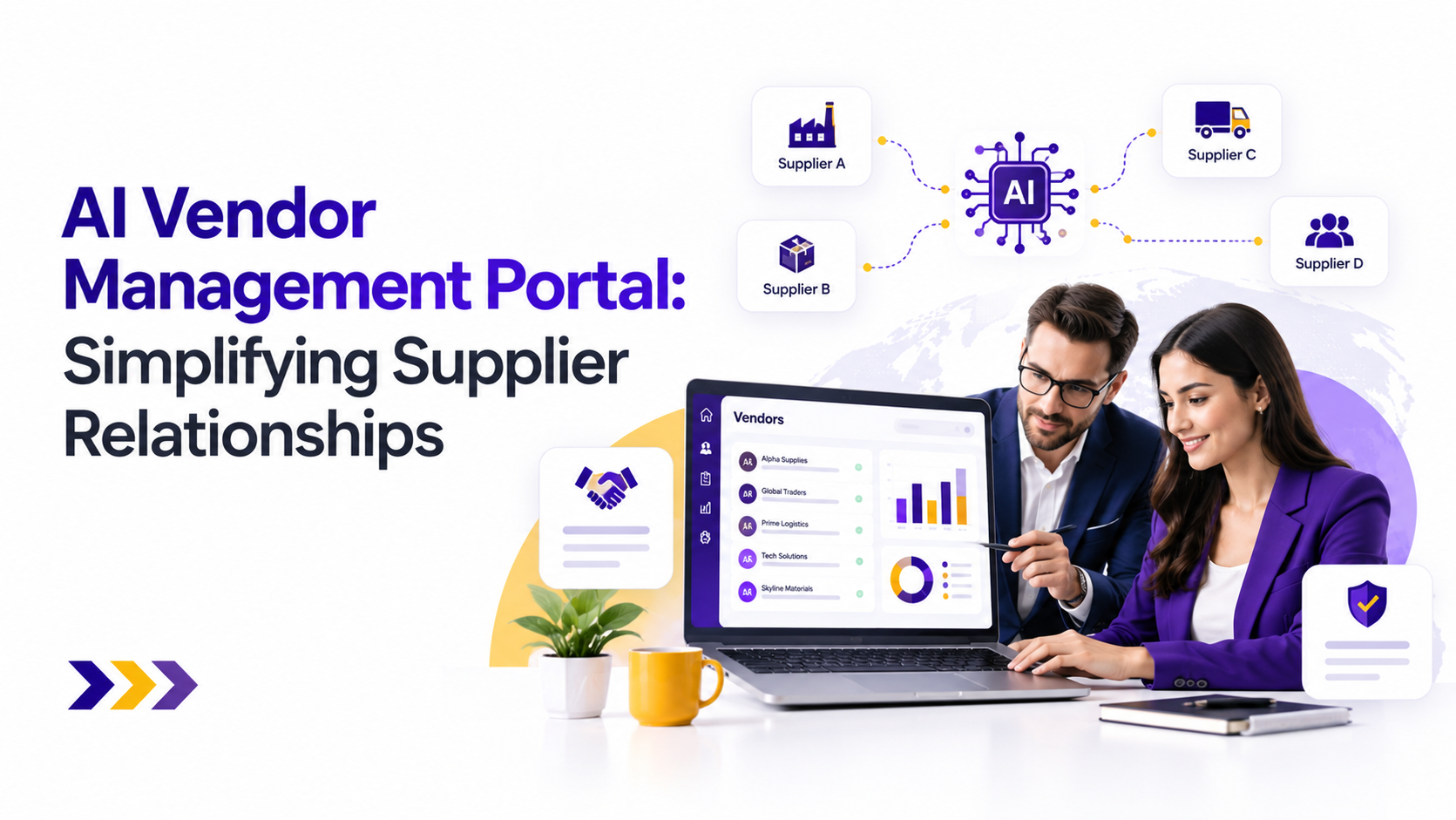

If you have ever tried to keep track of forty different suppliers across a dozen spreadsheets, you already know the problem. Emails get lost, contract renewal dates slip past unnoticed, and nobody can say with certainty which vendor is actually performing well and which one is quietly costing the company money. An AI vendor management portal exists to fix exactly that. It brings every supplier record, contract, invoice, and performance score into one place, and then uses machine learning to flag risk, predict delays, and recommend which vendors deserve more of your business.
For a founder or CEO comparing options, though, the real question isn't whether this technology helps. It clearly does. The harder question is who should build it, what it should include, and how much it will realistically cost. This guide walks through both: what a modern AI vendor management portal actually does, and a researched, unbiased look at the companies capable of building one for you.
What Is an AI Vendor Management Portal?
An AI vendor management portal is a centralized software platform that helps organizations manage the entire lifecycle of their supplier relationships, from onboarding and contract negotiation to performance monitoring and payment processing. Unlike a traditional vendor database, it uses artificial intelligence to analyze vendor data in real time. That means it can flag a supplier whose delivery times are quietly slipping, predict which contracts are at risk of non-renewal, and even suggest alternate vendors based on cost and reliability patterns it has learned from your own procurement history.
The distinction matters because plenty of companies still run vendor operations through a mix of spreadsheets, email threads, and generic project management tools. That approach works until the vendor list grows past a handful of names. An AI vendor management portal replaces that patchwork with a single source of truth, one that gets smarter the longer it is used.
Why Businesses Are Moving to AI Vendor Management Software
The shift toward AI vendor management software isn't just a technology trend, it is a response to real operational pain. Procurement teams are managing more vendors across more geographies than ever, and manual oversight simply cannot scale at that pace. A handful of practical drivers explain why adoption has picked up so quickly.
• Faster onboarding: automated document verification and risk scoring can cut vendor onboarding time from weeks to days.
• Reduced compliance exposure: automated checks against regulatory requirements, including data protection rules such as the EU's GDPR, catch gaps before they become liabilities.
• Spend visibility: consolidated dashboards make it obvious where money is going and which vendors offer the best value.
• Predictive risk detection: machine learning models flag underperforming or high-risk vendors before a disruption actually happens.
• Less manual admin: renewal reminders, invoice matching, and routine approvals are handled automatically, freeing up procurement staff for higher-value work.
None of this replaces human judgment in vendor relationships. What it does is give decision-makers better information, faster, so the judgment calls they make are grounded in current data rather than a spreadsheet that was last updated two months ago.
Signs Your Business Is Ready for an AI Vendor Management Portal
Not every company needs to build a dedicated portal right away. A small business working with three or four suppliers can usually get by with a well-organized spreadsheet for a while longer. The calculus changes once vendor relationships start creating real operational friction. A few signals tend to show up consistently in businesses that are ready to make the move.
• Your team spends more time chasing vendor updates over email than actually evaluating vendor performance.
• Contract renewal dates are tracked informally, and at least one has been missed or renewed on unfavorable terms as a result.
• Different departments maintain separate, inconsistent vendor lists with no shared source of truth.
• You've had at least one supply disruption that, in hindsight, should have been visible earlier.
• Procurement decisions are based on gut feel rather than actual historical performance data.
If two or more of these sound familiar, the conversation about building an AI vendor management portal is probably overdue rather than premature.
Common Implementation Challenges and How to Avoid Them
Even a well-planned build runs into friction. Knowing where that friction usually shows up makes it easier to plan around it rather than be surprised by it midway through the project.
Messy or incomplete historical data
AI risk scoring is only as good as the data feeding it. Vendor records scattered across spreadsheets, old CRMs, and email attachments need to be consolidated and cleaned before any meaningful prediction model can be trained. Budget real time for this step. It is rarely as quick as it sounds in a kickoff meeting.
Underestimating integration work
A vendor portal that doesn't talk to your accounting or ERP system quickly turns into just another silo. Integration work, particularly with older or heavily customized enterprise systems, is often the single biggest source of scope creep in these projects.
Low adoption from vendors themselves
A portal only helps if suppliers actually use it. Complicated onboarding flows or a confusing interface will push vendors back toward email, undoing the entire point of the investment. Usability testing with a handful of real vendors before full rollout catches most of these problems early.
Treating AI as a one-time feature instead of an ongoing process
Risk-scoring models need periodic retraining as vendor behavior and market conditions change. A development partner who disappears after launch, rather than offering a maintenance plan, leaves you with a model that gets less accurate every quarter.
Key Features to Look for in an AI Vendor Management Portal
Not every platform sold as an AI vendor management portal actually uses AI in a meaningful way. Some simply bolt a chatbot onto an old database. Before committing to a build or a vendor, it is worth checking that the following capabilities are genuinely part of the plan.
• Automated vendor onboarding with document verification and compliance checks.
• Real-time performance scoring based on delivery, quality, and cost metrics.
• Predictive risk analytics that flag potential supply disruptions before they occur.
• Contract lifecycle management with automated renewal and expiry alerts.
• Centralized communication logs so nothing important lives only in someone's inbox.
• Role-based access control and audit trails for internal governance.
• Integration with existing ERP, accounting, and procurement systems.
• Custom reporting dashboards built around the metrics your leadership team actually cares about.
A portal that covers most of this list is doing more than digitizing paperwork. It is giving procurement and operations teams a genuine decision-support tool, which is the entire point of investing in AI vendor management software in the first place.
How to Choose the Right AI Vendor Management Portal Development Company
Once the decision is made to build rather than buy an off-the-shelf tool, the next challenge is picking a development partner. This is where a lot of founders get stuck, because most agencies describe themselves in almost identical terms. A few concrete criteria make the comparison easier.
Proven experience with data-heavy platforms
Vendor management portals live and die on data quality and integrations. A development company that has already built procurement, CRM, or ERP-adjacent platforms will understand the data modeling challenges long before they become expensive mistakes.
Real AI and machine learning capability, not just API calls
Ask specifically how they plan to build the risk scoring and prediction features. A team that can only wire up a third-party API is not the same as one that can design and train models around your own vendor data.
Security and compliance awareness
Vendor and contract data is sensitive. Look for a partner who talks about encryption, role-based access, and recognized compliance frameworks, such as ISO/IEC 27001 for information security management, without being prompted.
Transparent engagement models
Whether you are hiring a dedicated team or contracting a fixed-scope build, pricing, timelines, and communication cadence should be spelled out clearly from the first conversation.
If you are also evaluating your options for the broader engineering work behind the portal, it helps to understand the difference between hiring dedicated web application developers for the core platform and specialist JavaScript developers for the interactive dashboards vendors and procurement teams will use daily. The right mix of skills often matters as much as the AI layer itself.
Top AI Vendor Management Portal Development Companies in 2026
The list below reflects companies with a genuine track record in building data-intensive, AI-enabled business platforms. It includes both boutique specialists and larger IT services firms, so you can compare based on scale, budget, and how hands-on you want the engagement to be.
1. HireFullStackDeveloperIndia
HireFullStackDeveloperIndia works with founders who want a dedicated engineering team rather than a large agency layered with account managers. For an AI vendor management portal, that usually means a small, senior team covering backend architecture, AI-driven risk scoring, and front-end dashboards under one roof. The company offers vetted full stack and AI-driven developers on hourly, part-time, or full-time contracts starting around $15 an hour, which makes it a practical option for startups and mid-sized companies that want direct control over their build without the overhead of a large consultancy. Clients typically work with the same team from architecture through deployment, which shortens the usual back-and-forth of larger outsourced projects. Their broader portfolio of past projects spans web applications, e-commerce platforms, and custom SaaS builds, which is a reasonable proxy for how they would approach a vendor portal build.
2. Accenture
Accenture is one of the largest professional services firms in the world, with a long-standing procurement and supply chain consulting practice. Its scale means it can support very large, multi-country vendor management rollouts, often bundled with broader digital transformation work. Companies considering Accenture for an AI vendor management portal should expect an enterprise-grade engagement model, with the pricing and timelines that come with it.
3. Tata Consultancy Services (TCS)
TCS is a global IT services leader headquartered in India, with deep experience delivering large-scale enterprise software for procurement, supply chain, and vendor risk management. Its size and established delivery frameworks make it a common choice for large enterprises that need an AI vendor management portal integrated across multiple business units and legacy systems.
4. Infosys
Infosys brings a strong enterprise software and AI consulting practice, with particular strength in integrating new platforms into existing ERP and finance systems. For organizations that already run on SAP or Oracle, Infosys's experience bridging legacy infrastructure with newer AI capabilities is a genuine advantage when building a vendor management portal that needs to talk to systems that are already in place.
5. Capgemini
Capgemini, headquartered in France, has a well-established procurement and supply chain technology division and has delivered vendor and supplier management platforms for manufacturing and retail clients across Europe and North America. Its consulting-led approach tends to suit organizations that want strategic input on process redesign alongside the actual software build.
6. Cognizant
Cognizant's digital engineering arm has built AI-driven procurement and vendor risk tools for enterprise clients, particularly in banking, healthcare, and manufacturing. Its combination of domain consulting and engineering delivery makes it a reasonable fit for companies that need industry-specific compliance built into their AI vendor management software from day one.
7. Wipro
Wipro offers enterprise application development and AI integration services at scale, with existing procurement and supply chain accelerators that can shorten development time for common vendor management workflows. Mid-sized and large enterprises already working with Wipro on other engagements often extend that relationship to cover a vendor portal build.
8. IBM Consulting
IBM Consulting pairs its enterprise AI research background with a long history in supply chain and procurement technology. Its watsonx AI tooling is frequently positioned as the analytics layer behind vendor risk scoring and predictive insights, which is worth exploring for organizations that want a recognizable enterprise AI stack under the hood.
9. Intellectsoft
Intellectsoft is a mid-sized custom software development company with a track record in building enterprise platforms across logistics, healthcare, and finance. Its project teams tend to be smaller and more hands-on than the larger consultancies, which can suit a company that wants closer collaboration during the design and build phases of an AI vendor management portal.
10. ScienceSoft
ScienceSoft has delivered custom procurement, supply chain, and vendor management systems for over two decades, with a specific practice around applying machine learning to operational data. Its longevity in this specific niche, rather than general enterprise software, is worth weighing if vendor risk analytics is the priority.
Every company on this list mentioned above brings something different to an AI vendor management portal build, larger firms offer scale and integration depth, while smaller and mid-sized teams tend to offer closer collaboration and faster iteration. The right fit depends less on brand recognition and more on how closely a company's past work matches the scale and complexity of what you're building.
What Does It Cost to Build an AI Vendor Management Portal?
Cost varies enormously based on scope, but a few patterns hold across most projects. A minimum viable version, covering vendor onboarding, a central database, and basic reporting, typically takes a small team a few months to build. Adding AI-driven risk scoring, predictive analytics, and deep ERP integrations extends both the timeline and the budget considerably, since these features depend on clean historical data and careful model tuning rather than just interface design.
Ongoing costs matter just as much as the initial build. Annual maintenance, covering bug fixes, security patches, and small enhancements, typically runs in the range of 15 to 20 percent of the original development cost.
If your portal will also need a companion mobile experience for suppliers in the field, budgeting for mobile app developers separately from the core web platform is usually more accurate than assuming a single team can efficiently cover both from the start.
For companies with existing supplier catalogs or e-commerce-style ordering built into their vendor relationships, it's also worth talking to a partner with specific experience in e-commerce and CMS development, since that overlaps with a good portion of what a supplier-facing ordering module needs to do.
On security and data handling specifically, it is worth grounding any vendor conversation in recognized frameworks rather than marketing language. The NIST AI Risk Management Framework is a useful, vendor-neutral reference for what responsible AI governance should look like inside a platform handling vendor and financial data, and it's a reasonable checklist to hold any development partner against during scoping conversations.
A Quick Checklist Before You Sign
Before committing to a development partner, it helps to have a short, concrete list to work through rather than relying on gut feel from a single sales call. Run through the following before any contract gets signed.
• Have they shown you a past project with genuinely comparable data complexity, not just a similar industry label?
• Can they explain their approach to AI risk scoring in plain language, without deflecting to buzzwords?
• Is there a clear maintenance and model-retraining plan included after launch, not just a one-time handoff?
• Do they ask detailed questions about your existing vendor workflows before quoting a price?
• Are data security and compliance practices discussed specifically, rather than mentioned only in passing?
A partner who answers all five clearly, without hesitation, is usually one worth moving forward with.
Conclusion
At this point, you've seen what an AI vendor management portal actually does, the features worth insisting on, and a fair look at the companies capable of building one. So where does that leave you? Probably closer to a shortlist than you were at the start of this article. The next move is usually a short scoping call, not a signed contract, just enough conversation to see which of these teams actually understands your vendor workflows rather than reciting a generic pitch. Who's on your list so far?