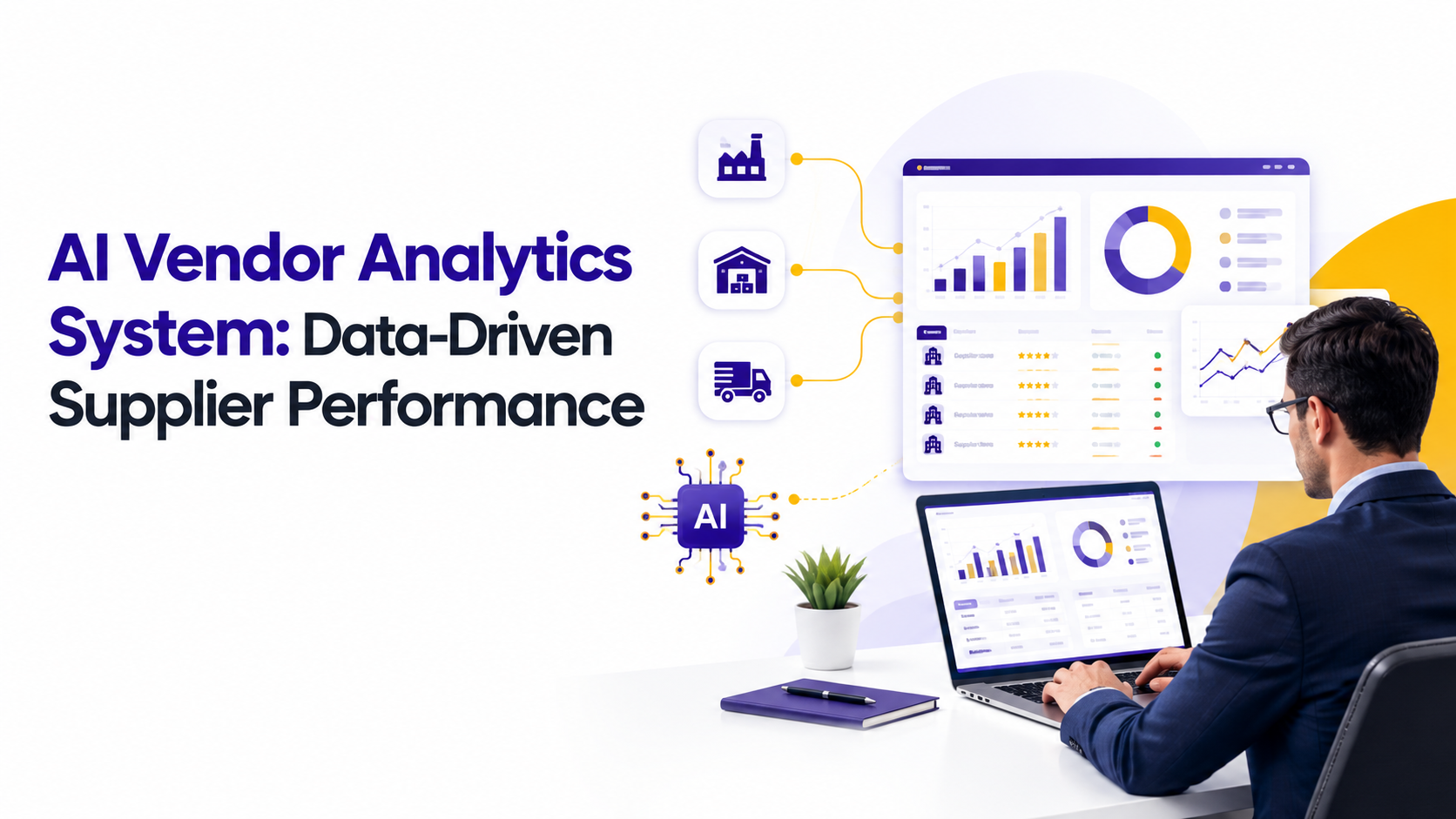

Most procurement teams do not lack data. They lack a way to see it all at once. Contracts sit in one folder, delivery timelines live in a spreadsheet, and support tickets get logged in a completely separate tool. By the time someone pulls all of it together for a quarterly review, half the numbers are already stale, and the supplier issue that mattered three weeks ago has already turned into a missed shipment.
That gap is exactly why an AI vendor analytics system has moved from a nice-to-have to something CEOs are actively budgeting for. The global vendor management software market is expected to reach USD 12.93 billion in 2026, up from USD 11.59 billion in 2025, and analytics and reporting features now make up the single largest slice of that spend, holding an estimated 68.6 percent share of the vendor management systems market in 2026.
The pull toward this technology is not just about tidier dashboards either. It reflects a harder truth: supplier relationships have become one of the least visible risk areas inside most companies, and the businesses that get ahead of that visibility gap tend to negotiate better contracts, avoid more disruptions, and spend noticeably less time firefighting.
This guide walks through what an AI vendor analytics system actually does, what to look for in AI supplier analytics software, what it realistically costs, and how to avoid the mistakes that turn a promising analytics rollout into an expensive dashboard nobody opens.
What Is an AI Vendor Analytics System?
An AI vendor analytics system is a platform that pulls supplier data from procurement, finance, logistics, and communication tools into one place, then applies machine learning to spot patterns a human reviewer would take weeks to notice. Instead of a static spreadsheet that tells you what happened last quarter, it gives you a live read on what is happening right now and, in many cases, a reasonable prediction of what happens next.
The distinction between this and a traditional vendor scorecard matters. A scorecard is backward looking and manually updated. An AI vendor analytics system is forward looking, continuously refreshed, and built to flag problems, such as a supplier's delivery times creeping upward, before they show up as a missed shipment or a client complaint.
It also changes who actually uses the information. A quarterly scorecard usually lives with one procurement analyst who compiles it and a handful of people who glance at it once. A well-built dashboard, by contrast, becomes something finance checks before a renewal call, something operations checks before committing to a new production run, and something the CEO checks before a board update, because the numbers are trustworthy enough to build a decision on without a follow-up email asking whether they are current.
• Consolidates data from ERP, CRM, procurement, and support platforms into a single supplier view
• Scores vendors automatically using cost, quality, delivery, and compliance signals
• Flags risk indicators such as financial stress, late payments, or contract breaches before they escalate
• Learns from historical patterns to forecast delivery delays or price volatility
• Replaces manual quarterly reviews with continuous, always-on monitoring
Why the Market Is Moving This Direction
The shift toward automated supplier intelligence is not a trend chasing headlines. It is a response to how expensive manual vendor tracking has become as supply chains stretch across more regions and more third parties. Procurement leaders are under pressure to justify every dollar spent on a vendor relationship, and spreadsheets simply cannot keep pace with the volume of contracts most mid-sized companies now manage.
Risk is a large part of the story too. Deloitte's 2025 Global CPO Survey found that 42 percent of risk leaders believe AI alone could reduce third-party financial exposure by at least 20 percent, which is a meaningful number when a single missed red flag on a key supplier can disrupt an entire product line. On the operations side, McKinsey research cited across supply chain industry reports shows that AI-enabled procurement functions see spend reductions in the 5 to 15 percent range, savings that come directly from catching pricing anomalies and underperforming vendors earlier.
Data readiness remains the honest catch. Gartner research shows that 74 percent of procurement leaders say their own data is not yet AI ready, which is worth remembering before assuming an analytics rollout will be instant. The technology works, but it works best once the underlying data has been cleaned up enough to trust.
For a CEO weighing this investment, the honest takeaway is that the value is real but not automatic. Companies that treat data quality as step one, rather than an afterthought, tend to see meaningful results inside two or three quarters. Companies that skip straight to the dashboard often end up rebuilding the whole system a year later once someone finally notices the numbers were never quite right to begin with.
What AI Supplier Analytics Software Actually Tracks
Not every platform tracks the same things, but most mature AI supplier analytics software products organize their scoring around four categories.
A well-configured system weighs these categories differently depending on the vendor's role. A single-source raw material supplier deserves heavier weighting on delivery reliability, while a marketing agency vendor is judged more on responsiveness and cost predictability. Getting these weightings wrong is a common early mistake, since a generic scoring model treats every vendor the same way and ends up flagging low-stakes issues with the same urgency as genuine supply chain risks, which trains the team to start ignoring alerts altogether.
How an AI Vendor Analytics System Works, Step by Step
1. Data integration
The platform connects to existing systems, ERP, procurement software, accounting tools, and communication platforms, through APIs so vendor data does not need to be manually re-entered. This step alone often takes longer than founders expect, particularly when a company has grown through acquisitions and inherited three or four different procurement tools that were never meant to talk to each other.
2. Data cleaning and normalization
Duplicate vendor records get merged, inconsistent date formats get standardized, and gaps from retired tools get flagged so the analytics layer is not built on shaky ground. This is the least glamorous part of the process and also the one most likely to get rushed, which is exactly why it deserves the most attention.
3. Scoring and benchmarking
Machine learning models assign each vendor a composite score and benchmark it against category peers, so a supplier is judged against realistic expectations rather than an arbitrary target. A logistics vendor operating in a region with known infrastructure delays, for instance, should not be scored against the same delivery benchmark as one operating in a market with predictable, well-established shipping lanes.
4. Predictive alerts
The system watches for early warning signals, a slipping on-time rate, an unusual invoice pattern, a sudden change in communication responsiveness, and pushes an alert to the procurement team well before the issue becomes a crisis. The goal is a conversation with the vendor while there is still room to fix things, not a scramble after a shipment has already missed its window.
5. Continuous learning
As more transaction and outcome data flows in, the models recalibrate, so the accuracy of forecasts and risk scores improves the longer the system runs. This is also why the first few months after go-live tend to be the least accurate stretch of the entire deployment, and why patience during that window matters more than most teams expect.
How Much Does an AI Vendor Analytics System Actually Cost?
Pricing varies more than most vendors are willing to admit upfront, largely because the real cost driver is not the software license itself but the state of the data feeding it. A company with three clean, well-structured data sources will spend far less on setup than one with a dozen disconnected legacy systems, even if both end up buying the same platform.
Licensing for established platforms typically scales with the number of tracked vendors and active users, while a custom-built system shifts more cost toward development and less toward recurring seat fees. Neither approach is inherently cheaper. The right choice depends on how specific your reporting needs are and how long you expect to run the system before requirements change significantly.
A realistic budget conversation separates the one-time build cost from the year-one running cost, since licensing, data storage, and the engineering time needed to keep pipelines working as source systems change all add up well after launch day. Any vendor unwilling to walk through that second number honestly is worth a second look before signing anything.
Core Capabilities Worth Shortlisting For
When comparing vendors for your own build or your purchase decision, these are the capabilities that separate a genuinely useful AI vendor analytics system from a repackaged reporting tool wearing an AI label because that is what sells demos this year.
Key Metrics Every Dashboard Should Surface
A dashboard overloaded with fifty metrics is as useless as one with none. Most procurement leads narrow it down to a working set like this.
• ☐ On-time delivery rate, tracked as a rolling average, not a single snapshot
• ☐ Cost variance against the original contracted price
• ☐ Vendor risk score, updated continuously rather than quarterly
• ☐ Average response time to inquiries or issue escalations
• ☐ Contract renewal timeline with automated advance notice
• ☐ Compliance and certification expiration alerts
What This Means for CEOs and Procurement Leaders
For a founder or CEO, the appeal of an AI vendor analytics system is rarely the technology itself. It is what the technology removes: the guesswork in vendor negotiations, the blind spots that turn into supply chain fires, and the hours procurement staff spend compiling reports that are outdated the moment they are printed.
Decision makers evaluating this investment tend to ask a narrower question than the one they start with. It is less about whether AI can analyze supplier data and more about whether the resulting insight actually changes a decision, a renewal negotiation, a risk escalation, a sourcing choice. If it does not change what happens next, the dashboard is decoration.
There is also a quieter benefit that rarely shows up in a sales pitch. Once vendor performance data is centralized and trusted, cross-functional friction tends to drop. Finance stops questioning procurement's numbers, operations stops maintaining its own shadow spreadsheet to double-check things, and the conversation in vendor review meetings shifts from arguing about whose data is correct to actually discussing what to do about it.
• ☑ Faster, evidence-backed vendor negotiations instead of gut-feel renewals
• ☑ Early warning on supplier risk before it disrupts operations
• ☑ Fewer hours spent compiling manual vendor reports
• ☑ A single source of truth that finance, procurement, and operations can all trust
• ☑ Stronger leverage when renegotiating contracts, backed by real performance data
Common Mistakes That Derail an Analytics Rollout
The most common failure point has nothing to do with the AI itself. It is skipping the data cleanup phase because it feels slow compared with just turning the dashboard on. Feeding messy, duplicated, or outdated vendor records into a scoring model produces confident-looking numbers that are quietly wrong, which is arguably worse than having no dashboard at all, because a wrong number that looks authoritative gets trusted longer than a spreadsheet everyone already knows to double-check.
The second most common mistake is underestimating change management. The best analytics system in the world fails quietly if the procurement team was never walked through why the old process, the one they trust because they built it, is being replaced. Adoption, not accuracy, is usually what determines whether a rollout actually sticks six months after launch.
• Treating the rollout as a one-time project instead of an ongoing relationship with the data
• Onboarding every vendor at once instead of piloting with a critical subset first
• Ignoring change management and expecting procurement staff to adopt new tools without training
• Choosing a platform based on demo polish rather than how it handles your actual, messy data
Build vs Buy: Working With AI Vendor Analytics System Development Companies
Some businesses are well served by an off-the-shelf platform. Others, especially companies with unusual data structures or industry-specific compliance needs, get more long-term value from a custom build. This is where working with experienced AI vendor analytics system development companies tends to pay off, since a tailored system can be shaped around the exact metrics your leadership team actually cares about instead of a generic template.
A custom build usually starts with the same foundation as a strong AI Business Intelligence Dashboard Development project: a clean data pipeline, a warehouse layer that can scale, and a visualization front end that non-technical stakeholders can actually navigate. From there, the AI layer, the forecasting models, the anomaly detection, the natural language querying, gets layered on top.
Because this kind of build leans heavily on machine learning expertise rather than general software development, it is worth choosing a team with a specific track record here. Businesses that hire AI developers with hands-on experience in predictive modeling tend to avoid the common trap of a dashboard that displays historical numbers well but cannot actually forecast anything useful.
The infrastructure question matters just as much as the analytics layer. Vendor data volumes grow quickly once a company starts logging event-level transaction history instead of monthly summaries, so working with a team that understands cloud storage architecture from the start avoids a costly re-platforming exercise eighteen months into the project.
Whichever route a business takes, the sequencing tends to matter more than the specific vendor chosen. Getting the data foundation right first, then layering scoring and prediction on top, produces a far more reliable system than building the AI layer first and hoping the underlying data catches up later. Teams that reverse that order almost always end up redoing work they thought was finished, which costs more in the long run than simply doing the foundational work properly the first time around.
Where This Is Heading in 2026 and Beyond
The next wave of AI vendor analytics system development is moving past dashboards entirely and toward agents that act on the insight rather than just displaying it. Gartner's 2026 predictions describe procurement functions adopting task-specific AI agents at scale, with the firm expecting roughly 40 percent of enterprise applications to carry embedded agents by the end of the year. In practice, that means a system that does not just flag a supplier's rising defect rate but drafts the escalation email and schedules the review meeting automatically.
Supplier risk monitoring is also getting sharper. AI-enabled platforms have already improved supplier performance visibility by close to 49 percent across the organizations using them, according to recent industry market research, and that number is expected to climb as more vendors feed structured data into these systems rather than relying on periodic manual surveys.
None of this replaces human judgment in vendor relationships. It just removes the guesswork from the parts of the job that were never really about judgment in the first place, chasing down spreadsheets, reconciling conflicting numbers, and hoping nobody missed a red flag buried in an email thread.
The companies that adopt this early are not necessarily chasing the newest feature set. Most are simply tired of finding out about a supplier problem after it has already cost them a client relationship, and they have decided that continuous visibility is cheaper, in every sense, than periodic surprise.
Final Thoughts
The businesses getting the most out of an AI vendor analytics system right now are not necessarily the ones with the biggest budgets. They are the ones that started small, cleaned up their data honestly instead of rushing past that step, and expanded the system as their team actually used it day to day.
That pattern holds regardless of company size. A twenty-person startup piloting the system on its ten most critical vendors gets more real value in month one than a large enterprise that onboards its entire supplier base at once and spends the next year untangling data quality issues nobody flagged during setup.
If you are comparing platforms or evaluating a custom build, judge every option against one question: does this change what your team actually does on a Tuesday afternoon when a supplier's numbers start slipping? A genuinely useful AI vendor analytics system answers that clearly. Anything that does not is just a prettier spreadsheet.