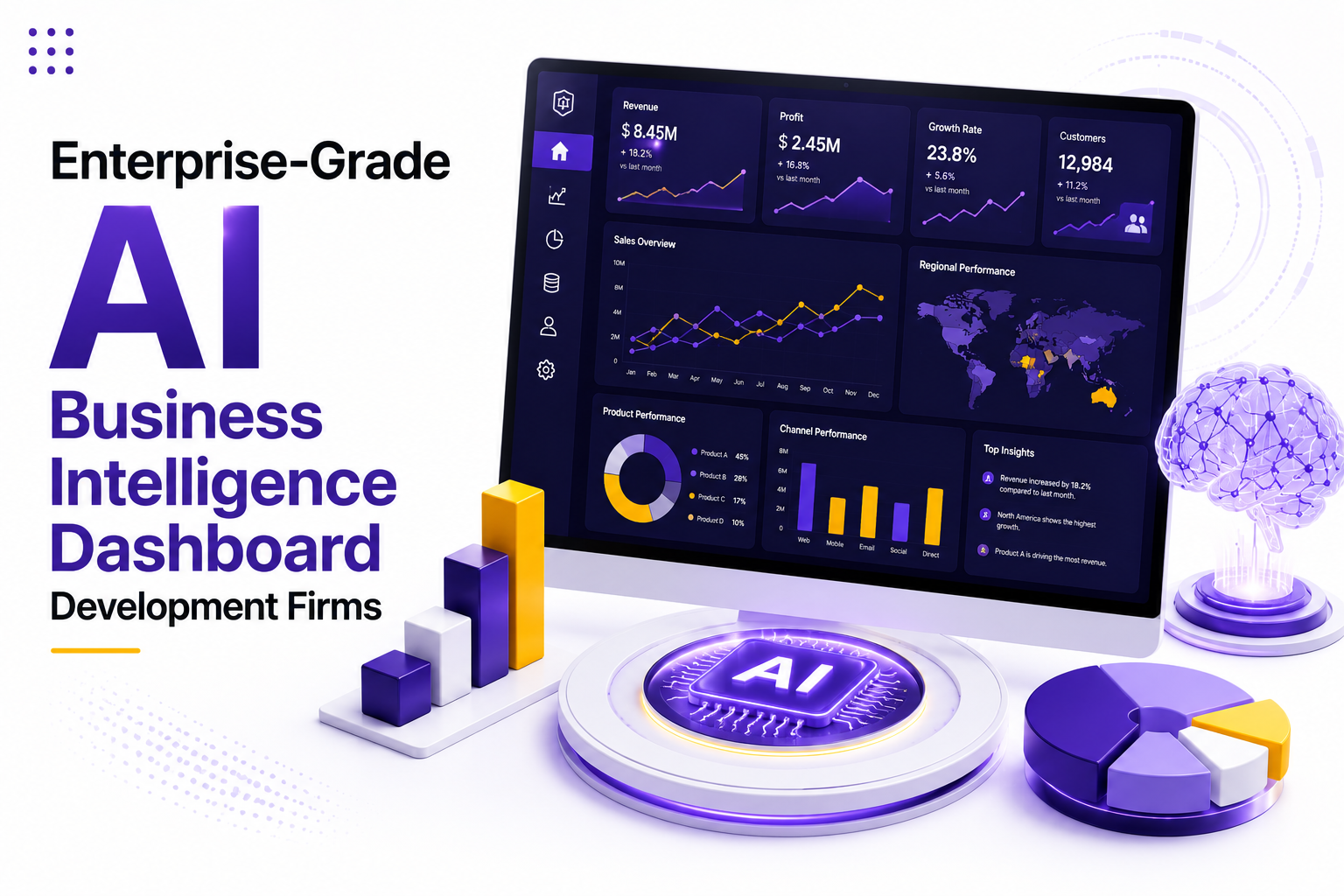

Most executives do not wake up thinking about dashboards. They wake up thinking about a decision they cannot make confidently because the numbers behind it live in five different systems that do not talk to each other. That gap between having data and actually trusting it is exactly why demand for a well built AI Business Intelligence Dashboard has grown so quickly heading into 2026. It is not about pretty charts anymore. It is about whether your leadership team can open one screen and know, without a second guess, what is actually happening in the business right now.
The problem is that picking a development partner for this kind of work is harder than picking one for a marketing website or a mobile app. A dashboard touches your finance data, your customer data, your operational data, and often your compliance obligations, all at once. This is exactly where the right AI Business Intelligence Dashboard Development Firms earn their fee: get the vendor wrong and you end up with a beautiful interface sitting on top of numbers nobody trusts, which is arguably worse than no dashboard at all. Get it right and you get a system that quietly makes every planning meeting shorter and every forecast sharper.
This list is built for CEOs, founders, and decision makers who are already comparing AI Business Intelligence Dashboard Development Firms and want more than a logo wall and a generic pitch. We have grouped 20 companies that consistently show up in enterprise BI and AI dashboard projects, and we have written each profile from a different angle on purpose, because the reasons you would hire one of these firms rarely look the same twice.
What Actually Separates These Vendors From Each Other
Before jumping into the list, it helps to know what we filtered for. We looked at companies with a genuine track record in data engineering, not just front end chart libraries, because a dashboard is only as reliable as the pipeline feeding it. We also looked at how each company handles the AI layer, meaning forecasting, anomaly detection, or natural language querying, since that is increasingly what separates a modern AI Business Intelligence Dashboard from a static reporting tool built five years ago. Pricing model, team structure, and industry depth mattered too, because a fintech company and an early stage startup should not be shopping the same way.
The 20 Firms Worth Shortlisting
1. Hourly Developers
Hourly Developers built its entire model around flexibility, and it shows. Instead of locking clients into fixed scope contracts, they let you bring on data engineers, BI developers, or AI specialists on an hourly or part time basis, which is unusually rare for this category of work. Their biggest strength is speed of onboarding. We have seen teams go from first call to an assigned developer inside a week, which matters a lot when a founder needs a working prototype before a board meeting rather than before a fiscal quarter. Their AI dashboard work tends to be strongest on small to mid sized data sets where quick iteration matters more than massive scale.
Takeaway: Best suited for founders who need a working dashboard fast and want to control cost by paying only for hours actually used.
2. ScienceSoft
ScienceSoft has been doing enterprise data and analytics work long enough that its BI practice reads more like a consultancy than a typical dev shop. Enterprises tend to choose them because of the depth of their healthcare and manufacturing data experience, industries where a wrong number in a dashboard is not just embarrassing, it can be a compliance issue. Their process usually starts with a data audit before anyone touches a chart, which slows the first few weeks down but tends to prevent the expensive rework we see with vendors that jump straight to visualization. Compared with smaller shops on this list, ScienceSoft is less about speed and more about getting the architecture right the first time.
Takeaway: Choose this company when your data sources are messy, regulated, or spread across legacy systems that need real cleanup before dashboards make sense.
3. Netguru
Netguru's edge shows up in how the dashboard actually feels to use, not just what it reports. While several firms on this list treat the interface as an afterthought bolted onto a data warehouse, Netguru's product design background means stakeholders who are not analysts, think sales leads or operations managers, can navigate the tool without training. This matters more than most buyers expect, because a technically correct dashboard that nobody opens twice a week has failed regardless of how clean the underlying data pipeline is. Unlike ScienceSoft, which leans heavily into architecture first, Netguru leans into adoption first, then hardens the pipeline underneath once usage patterns are clear.
Takeaway: Worth considering because low adoption, not bad data, is the more common reason BI dashboard projects quietly die inside companies.
4. HireAIDevelopers
HireAIDevelopers focuses specifically on AI talent, which means when a project needs someone who actually understands forecasting models or anomaly detection rather than a generalist who read about it, this is where founders tend to land. Their hiring model gives clients a choice between a dedicated AI engineer, a small pod of two to three specialists, or project based delivery, and pricing shifts accordingly rather than being locked into one packaged rate. This flexibility makes them a reasonable fit whether you are building your first AI Business Intelligence Dashboard prototype or scaling an existing one with predictive features. Compared with Hourly Developers, the talent pool here skews more specialized in machine learning specifically rather than general purpose development.
Takeaway: Ideal project size ranges from a single predictive module bolted onto an existing dashboard to a full AI driven analytics build from scratch.
BUYER WARNING
Here is a mistake we see founders make constantly. They shortlist a vendor almost entirely based on how good the dashboard demo looks in a sales call, then discover three months into the project that the demo was running on clean, pre prepared sample data. Your actual data is not clean. It has duplicate customer records, inconsistent date formats across systems, and gaps from whatever tool your team stopped using two years ago. Before signing anything, ask every vendor on your shortlist to look at a real, unfiltered sample of your data and give you an honest estimate of how many weeks of cleanup that alone will require. Any company that skips this question, or answers it too quickly, is telling you something important about how the rest of the project will go.
5. EPAM Systems
EPAM operates at a scale most companies on this list simply cannot match, with engineering capacity that lets them run parallel workstreams across data engineering, machine learning, and dashboard delivery simultaneously rather than sequentially. This matters for enterprises with genuinely large and messy data estates, where a smaller shop would need to sequence the work over a much longer timeline. Their technology leadership shows up in how early they adopt newer approaches to real time analytics and embedded AI, often ahead of mid sized competitors. The tradeoff is that engagement minimums and onboarding processes are built for enterprise procurement cycles, so a small startup may find the relationship heavier than necessary.
Takeaway: Best suited for large enterprises with multiple data domains that need to move in parallel rather than one team working through a queue.
6. Backend Development Company
The name gives away the specialty. While most firms on this list lead with design or AI capability, Backend Development Company leads with the plumbing, meaning the data pipelines, APIs, and warehouse architecture that every dashboard ultimately depends on. This is where they consistently outperform more design led competitors on projects involving high transaction volumes or multiple source systems that need to be reconciled in near real time. A dashboard is only as trustworthy as the pipeline underneath it, and this is the layer that breaks silently, often for weeks, before anyone notices the numbers have drifted. Unlike Netguru's adoption first approach, this firm's philosophy is closer to get the foundation right and the interface will follow.
Takeaway: Skip this company if you already have a solid internal data engineering team and only need the visualization layer built on top.
7. Iflexion
Iflexion has quietly built dashboard and analytics solutions across a wider spread of industries than most competitors on this list, from logistics to retail to financial services. That breadth is genuinely useful if your business does not fit neatly into one vertical, since their teams tend to bring cross industry patterns into a new engagement rather than treating every project as a first attempt. The tradeoff of breadth is depth. A firm this broad may not have the healthcare specific compliance muscle that ScienceSoft has built, or the AI specialization that HireAIDevelopers offers, so the fit works best when your requirements are more operational than deeply regulated or research heavy.
Takeaway: Not recommended if your dashboard needs are dominated by a single, highly regulated vertical with specific compliance requirements.
8. Innowise
Innowise has invested heavily in machine learning and computer vision work, which spills over usefully into BI dashboards that need more than static reporting, think demand forecasting, churn prediction, or automated anomaly flags surfaced directly inside the interface. Their AI teams tend to work closely with the BI developers rather than as a separate bolted on unit, which reduces the awkward handoff problems we sometimes see when a company outsources the predictive layer to a different vendor than the one who built the dashboard itself. This integration matters because a forecast that lives in a separate tool from the dashboard rarely gets checked consistently by the people who need it most.
Takeaway: Choose this company when the project genuinely needs predictive intelligence built in, not just a dashboard that displays historical numbers well.
HIDDEN COST
Almost every proposal we have reviewed quotes the cost of building the dashboard. Very few quote the ongoing cost of keeping it accurate. Licensing for the underlying BI tool, whether that is Power BI, Tableau, or an embedded analytics library, is usually recurring and scales with user seats. Data warehousing costs scale with volume, and they climb faster than most founders expect once a company starts logging event level data instead of just daily summaries. Then there is the maintenance layer nobody budgets for. Source systems change their schemas, APIs get deprecated, and someone has to keep the pipeline working when that happens. A realistic budget conversation should separate build cost from year one running cost, and any vendor unwilling to estimate that second number honestly is underpricing the relationship on purpose.
9. HireFullStackDeveloperIndia
The value proposition here is straightforward. India based full stack teams at a meaningfully lower hourly rate than Western European or North American shops, without necessarily sacrificing technical quality on the dashboard and backend work itself. For a founder watching runway closely, this cost gap can be the difference between building the AI Business Intelligence Dashboard this quarter or waiting a year. Delivery typically runs on a dedicated team model with overlapping working hours arranged for client communication, which reduces the coordination friction some buyers worry about with offshore engagements. Compared with HireAIDevelopers, the AI specialization here is thinner, so complex predictive modeling work may need a supplementary specialist.
Takeaway: Ideal for budget conscious teams that need solid full stack execution on a standard dashboard build without paying premium regional rates.
10. Grid Dynamics
Grid Dynamics built its reputation on retail and enterprise data platforms, and that heritage still defines its strongest work today. Their biggest strength is handling high volume, high velocity data, the kind generated by ecommerce transactions or supply chain systems moving constantly, and turning it into dashboards that update close to real time rather than the next morning. This is a meaningfully different technical challenge than building a dashboard on top of a monthly finance export, and it shows in how their architecture is designed from day one for scale rather than retrofitted later. The ideal project here involves genuinely large, continuously flowing data rather than a modest internal reporting need.
Takeaway: Best suited for retail, ecommerce, or logistics businesses generating high volume transactional data that needs near real time visibility.
11. N-iX
N-iX operates differently from most firms on this list in that their default engagement model embeds engineers directly into a client's existing team rather than delivering a separate finished product handed over at the end. For companies that already have some internal data capability but need more hands, this embedded approach tends to work better than a fully outsourced build, because knowledge stays inside the organization as the dashboard evolves rather than living entirely with an external vendor. Compared with Backend Development Company's foundation first philosophy, N-iX is less about which layer gets built first and more about who is doing the building alongside your own people.
Takeaway: Skip this company if you want a fully hands off vendor relationship rather than engineers working closely inside your existing team structure.
12. DataEximIT
DataEximIT's practice is built specifically around data, which is a narrower and more useful specialization than it sounds. Enterprises choose them when the hard part of the project is genuinely the data layer itself, meaning consolidating scattered sources, designing a warehouse schema that will still make sense in three years, and only then building the AI Business Intelligence Dashboard on top of that foundation. This sequencing mirrors ScienceSoft's audit first approach, though DataEximIT tends to move through that phase faster for mid sized data estates that are messy but not massive. Their dashboard layer itself is solid rather than flashy, which is the correct tradeoff when the real risk in the project lives in the data, not the interface.
Takeaway: Worth considering because the project's real risk is almost always in the data layer, and this is a team built to handle exactly that risk.
COMMON MISTAKE
The single most common mistake we see is skipping a proof of concept and going straight to a full build. It feels efficient on paper, one contract, one timeline, one invoice, but it removes the checkpoint where you would otherwise discover that a metric everyone assumed was simple, say customer lifetime value, actually has three different definitions across your finance, sales, and product teams. A two to four week proof of concept focused on one or two critical metrics forces that disagreement into the open early, when it costs a conversation to fix, instead of late, when it costs a rebuild. The second most common mistake is underestimating change management. The best dashboard in the world fails if the people who are supposed to use it daily were never walked through why the old spreadsheet they trust is being replaced.
13. Itransition
Itransition has been building business intelligence solutions specifically, not general software with BI as one offering among many, for long enough that their consulting layer feels more mature than most competitors on this list. That legacy shows up in how their teams approach requirements gathering, usually starting with the specific business decisions the dashboard needs to support rather than jumping to which tool or chart type to use. This decision first approach is a meaningful contrast to firms that lead with design or with raw engineering capacity, since it keeps the project anchored to actual business value throughout rather than technical elegance for its own sake.
Takeaway: Choose this company when your team is not yet sure which metrics actually matter and needs structured help defining that before any build begins.
14. Yalantis
Yalantis brings a strong visualization and mobile first design sensibility to dashboard work, which stands out on a list where several firms are stronger on the backend than the interface. For executives who will be checking key metrics from a phone between meetings rather than sitting at a desktop, this focus on responsive, clean visual design translates into a tool that actually gets opened throughout the day instead of once a week during a scheduled review. Compared with Netguru, both firms prioritize usability, but Yalantis leans more specifically into mobile and cross device experience as its differentiator.
Takeaway: Best suited for leadership teams who need to check dashboard metrics on the go rather than exclusively at a desk.
15. WebClues Infotech
WebClues Infotech has carved out a niche delivering cost effective dashboard and full stack projects for small and mid sized businesses that do not need enterprise scale infrastructure but still want a genuinely functional AI Business Intelligence Dashboard rather than a stripped down reporting tool. Their pricing tends to sit below the large enterprise firms on this list while still covering integration with common data sources like CRM platforms and payment processors. This makes them a realistic option for a growing business that has outgrown spreadsheets but is not yet ready for the scale of engagement that Grid Dynamics or EPAM typically handle.
Takeaway: Ideal project size is a small to mid sized business replacing spreadsheet reporting with a proper dashboard for the first time.
16. Belitsoft
Belitsoft leans into long term support contracts rather than one off builds, with a client base that includes healthcare and fintech companies that need a dashboard partner sticking around for years, not months, as regulations and data sources shift. This matters because a dashboard is never really finished. New data sources get added, metrics get redefined as the business evolves, and someone needs to own that ongoing maintenance relationship rather than treating the initial launch as the finish line. Compared with a project based firm like WebClues Infotech, Belitsoft's model assumes the relationship continues well past go live.
Takeaway: Not recommended if you are looking for a single fixed price project with no ongoing relationship afterward.
TECHNICAL DEEP DIVE
A few numbers are worth knowing before you negotiate scope with any vendor. Real time dashboards built on properly indexed data warehouses typically return query results in under two seconds even at millions of rows, while dashboards querying live transactional databases directly, without a warehouse layer in between, often see latency climb past ten seconds once data volume grows, which is usually the point where users quietly stop trusting the tool and go back to exporting spreadsheets. On the AI side, forecasting models for demand or revenue typically reach 80 to 90 percent accuracy once they have at least twelve to eighteen months of clean historical data to train on, and accuracy drops meaningfully below that history threshold, something worth asking any AI focused vendor about directly rather than accepting a generic accuracy claim. Typical mid sized dashboard projects run 8 to 14 weeks from kickoff to launch, and any quote significantly faster than that for a genuinely multi source project deserves a second look at what is being cut to hit that timeline.
17. Sigma Software
Sigma Software has built deep pockets of expertise in aerospace, automotive, and media data, industries with their own particular data structures and compliance quirks that a generalist firm would need to learn from scratch. If your business sits in one of these verticals, that existing familiarity can meaningfully shorten the discovery phase of a dashboard project, since the team already understands the kind of data your systems produce. Outside those specific verticals, the advantage narrows considerably, and a broader firm like Iflexion may be a more natural fit.
Takeaway: Best suited for aerospace, automotive, or media companies where industry specific data patterns genuinely benefit from prior vendor experience.
18. Concise Software
Concise Software has concentrated much of its engineering work on fintech clients, which means their dashboard builds tend to arrive with an instinct for compliance heavy reporting, audit trails, and the kind of data security expectations that regulators in financial services take seriously. This is a narrower focus than most firms on this list, but for a fintech founder, that narrowness is exactly the point. Unlike Belitsoft, which spans healthcare and fintech together, Concise Software's concentration is specifically financial services, and it shows in how quickly their teams anticipate compliance questions before a client even raises them.
Takeaway: Choose this company when compliance and audit trail requirements around financial data are as important as the dashboard itself.
19. Ideas2IT
Ideas2IT approaches dashboard work as product engineering first, meaning the analytics layer is treated as a core product feature to be iterated on continuously rather than a one time deliverable handed off and left alone. This mindset tends to produce dashboards that evolve meaningfully over the following year as usage data reveals which metrics people actually check and which ones get ignored. Compared with a more traditional delivery firm, this iterative approach asks more of the client in terms of ongoing feedback, but tends to reward that involvement with a tool that keeps improving rather than aging in place.
Takeaway: Worth considering because dashboards built with a product mindset tend to stay relevant longer than those treated as a one time deliverable.
20. Andersen
Andersen frequently gets called in specifically to modernize dashboard and reporting systems that were built years ago on outdated infrastructure and have become slow, brittle, or simply impossible to extend with new AI features. Their strength lies less in greenfield builds and more in carefully migrating an existing reporting environment onto modern architecture without disrupting the daily operations that already depend on it, a delicate balancing act that newer firms without this specific experience sometimes underestimate. For a company sitting on a legacy BI tool that leadership has quietly stopped trusting, this migration specific experience is genuinely valuable.
Takeaway: Ideal project size is a legacy dashboard or reporting system migration rather than a brand new build from a blank page.
A Practical Decision Framework, Not a Summary
Reading twenty company profiles is only useful if it turns into an actual shortlist. Here is how the companies above tend to map to specific situations, based on what we have seen work in practice.
- Startups building a first dashboard: Hourly Developers or HireFullStackDeveloperIndia, since both offer flexible engagement models that scale with a limited early stage budget.
- Large enterprises with multiple data domains: EPAM Systems or Grid Dynamics, given the engineering capacity needed to run several workstreams in parallel.
- Healthcare organizations: ScienceSoft or Belitsoft, both of which bring specific experience with regulated health data and long term compliance obligations.
- Fintech companies: Concise Software for audit heavy financial reporting, or DataEximIT when the core challenge is consolidating messy financial data sources first.
- Budget conscious teams: WebClues Infotech or HireFullStackDeveloperIndia, both structured around cost efficient delivery without cutting core functionality.
- Rapid MVP timelines: Hourly Developers or Ideas2IT, since both are built around fast iteration rather than long, sequential project phases.
- Long term AI driven products: HireAIDevelopers or Innowise, where the predictive and machine learning layer is treated as core to the product rather than an add on feature.
Final Word
There is no single best vendor on this list, and any blog that told you otherwise would be lying to make the article easier to write. The right choice depends on whether your bottleneck is dirty data, low adoption, tight budget, or a genuine need for predictive intelligence, and those four problems call for meaningfully different partners among AI Business Intelligence Dashboard Development Firms.
What we would push back on is treating this decision as a one afternoon exercise. Spend the time asking each shortlisted vendor to look at a real sample of your data before you sign anything, because that single conversation tends to reveal more about how a project will actually go than any proposal document. A well built AI Business Intelligence Dashboard pays for itself many times over in faster, more confident decisions. A poorly matched vendor relationship costs you that same year in confusion instead. Choose based on your actual bottleneck among AI Business Intelligence Dashboard Development Firms, not the vendor with the best looking demo.