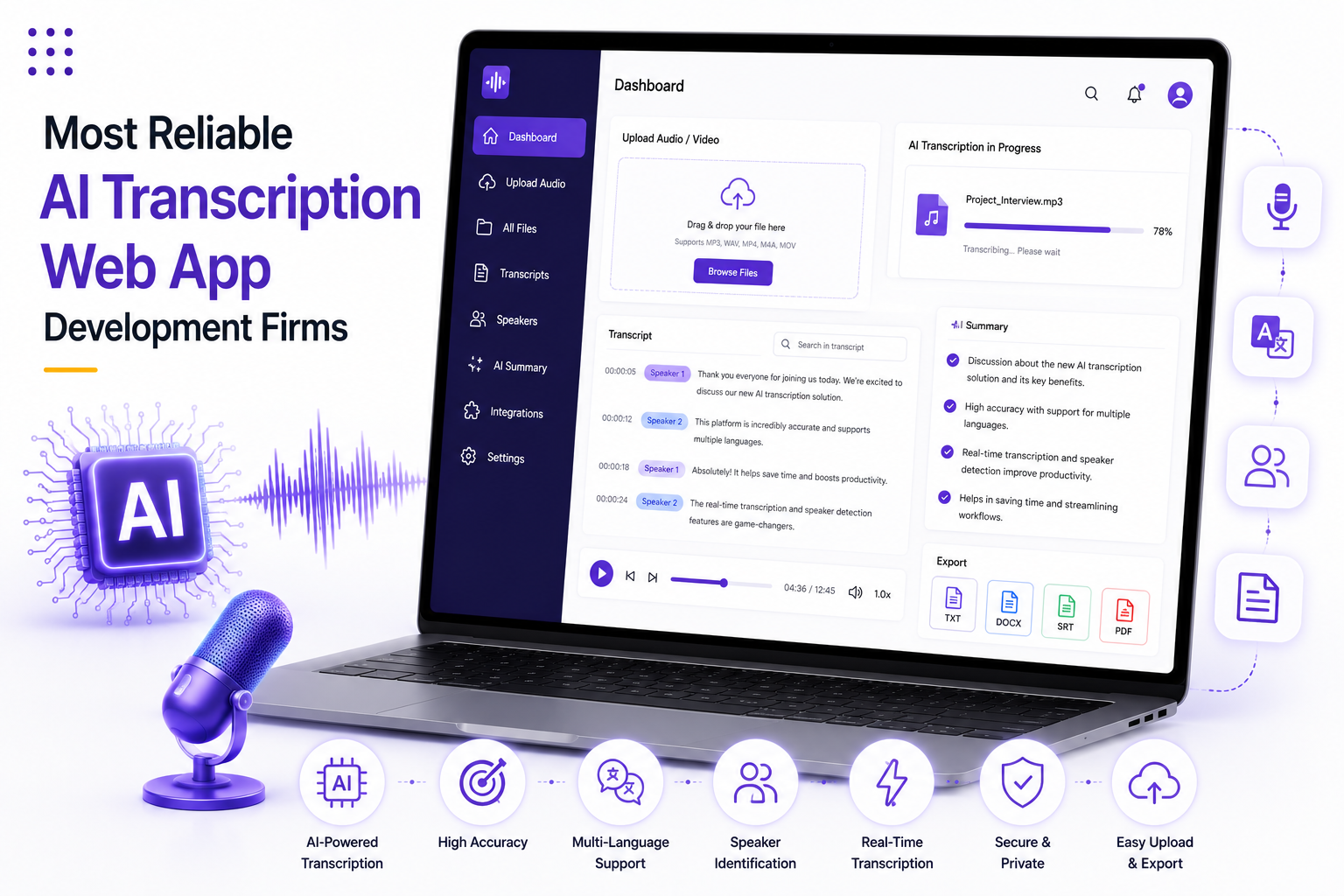

If you have ever tried to type out a one hour meeting recording by hand, you already know why transcription software turned into one of the fastest growing categories in AI. What used to take a human typist half a day now happens in minutes, and businesses in healthcare, legal, media, and education are racing to build their own version of it, whether that means a tool for transcribing patient consultations, court proceedings, podcast episodes, or classroom lectures. The catch is that building an AI Transcription Web App is not just about plugging in a speech to text API. You need clean audio handling, accurate speaker separation, solid data security, and a UI people actually enjoy using. That combination is harder to get right than most founders expect, which is exactly why picking the right development partner matters so much.
This guide is not another recycled list of "top 10 AI Transcription Web App development companies" copied from a directory site. It is a practical rundown of the AI Transcription Web App development companies that businesses actually hire when they need a working, reliable product, along with what each one brings to the table so you can shortlist with confidence instead of guessing.
What to Actually Look for Before You Hire
Before jumping into the list, it helps to know what separates a firm that can talk about AI from one that can ship it. Look for real experience with speech to text models such as Whisper, Deepgram, or AssemblyAI, not just a general mention of "AI expertise" on a homepage. Ask how they handle accuracy for accents, background noise, and multiple speakers, since that is where most transcription products fall apart in real use. Check whether they have built full web applications before, including user accounts, file uploads, and export features, rather than just backend scripts. And always ask about data privacy practices, because transcription tools often handle sensitive conversations, medical notes, or legal recordings.
It also helps to ask how a firm prices its work before you fall in love with their portfolio. Some charge hourly, which suits smaller or evolving projects, while others prefer fixed-price contracts for well-scoped builds, or a dedicated-team model if you expect the transcription product to grow into something bigger over the next year or two. None of these models is automatically better, but the wrong one for your situation can slow a project down or blow past a budget without anyone noticing until the invoice arrives. A five minute conversation about billing structure early on saves a lot of friction later. Finally, do not skip references. A quick call with a past client, even a short five minute one, usually tells you more about how a firm handles delays, scope changes, and honest communication than any case study on their website ever will.
1. Hourly Developers
Hourly Developers, known online as HourlyDeveloper.io, is one of the more flexible names in this space and a natural starting point if budget predictability matters to you. Instead of locking you into a large fixed-price contract, the firm lets you hire developers on an hourly, part time, or full time dedicated basis, which works well for teams that want to test a transcription MVP before committing to a bigger build. Their engineers work across Node.js, Python, Laravel, and cloud-native stacks, and the team has experience wiring AI APIs into existing backends, including speech-to-text pipelines and data processing layers that a transcription tool depends on. What clients tend to mention is the speed of onboarding, developers are typically matched to a project within a couple of days, along with transparent hourly billing that avoids the surprise invoices common with larger agencies. If you are a startup founder who wants to move fast on a transcription MVP without signing a six month retainer, this is a sensible firm to get a quote from. They also tend to offer a short risk-free trial period, so you can see how a developer handles your codebase and communication style before locking into a longer engagement, which is a reasonable way to de-risk your first hire with any outside team.
2. ScienceSoft
ScienceSoft has been around since 1989, which is a long time in software years, and that history shows up in how methodically they approach AI projects. The company has actually shipped speech recognition work in production, including ASR-based transcription and voice AI systems for healthcare clients that need to stay HIPAA compliant. With more than 750 engineers and ISO 9001 and ISO 27001 certifications, ScienceSoft leans toward larger, more regulated projects where documentation, security audits, and long-term support matter as much as the initial build. Their AI team has hands-on experience with natural language processing, named entity recognition, and model fine-tuning, so a transcription app that also needs to summarize notes or flag keywords is well within their range. This is not the cheapest option on the list, but for healthcare, legal, or finance companies that cannot afford compliance mistakes, the extra structure is worth paying for. Their delivery process typically includes a dedicated project management office, formal risk assessments, and documented testing cycles, which larger organizations often need to satisfy internal procurement or audit requirements before signing off on a vendor.
3. Intellectsoft
Intellectsoft is a mid-to-large software development company that has built a name working with enterprise clients across automotive, healthcare, and manufacturing sectors. Their engineering teams combine full stack web development with a dedicated AI and data science practice, which means a transcription project gets both the app-building skill and the machine learning depth in one place instead of being split across vendors. They tend to run projects through a structured discovery phase first, mapping out exactly how audio will be captured, processed, and stored before writing a line of code, which reduces the chances of rebuilding core pieces halfway through. Intellectsoft is a strong fit for businesses that already have a rough product idea and want a partner capable of taking it from a workshop through to a polished, scalable release. Their prior enterprise work also means they are comfortable with longer procurement cycles, legal review, and the kind of documentation larger companies expect before signing a development contract, which smaller boutique agencies sometimes struggle to accommodate.
4. HireFullStackDeveloperIndia
HireFullStackDeveloperIndia does exactly what the name suggests, it connects companies with a bench of over 200 vetted full stack developers who can be hired hourly, part time, or as a dedicated team. Their developers work across the JavaScript ecosystem including Node.js, React, and Angular, along with Python and PHP frameworks, which covers the full technical surface a transcription tool needs, from the audio upload interface down to backend processing queues. Clients sign an NDA upfront and retain full control over the development team, which is helpful if you want daily visibility rather than handing a project over and waiting for a demo weeks later. Because the model leans toward cost-effective hiring out of India, it tends to suit startups and small to mid-sized businesses that want experienced hands without enterprise-agency pricing. Developers can typically be onboarded within 48 hours, and clients can request a replacement at no extra cost if a particular developer is not the right fit, which reduces the risk of getting stuck with a mismatch partway through a build.
5. Netguru
Netguru is a European software house with a strong reputation in product design as much as engineering, which matters more than people expect for a transcription tool since the interface is where users actually judge accuracy and trust. Their teams have delivered AI-driven products across fintech, healthtech, and media, and they typically pair a product designer with backend and AI engineers from day one rather than treating design as an afterthought. For a transcription app, that shows up in details like how transcripts are edited, how speaker labels are displayed, and how easy it is to search through long recordings. Netguru works mostly with mid-market and enterprise clients in the US and Europe, and their process tends to include closer collaboration through workshops and iterative sprints rather than a single fixed handoff. If your transcription product is meant to be a customer-facing SaaS tool rather than an internal utility, the extra attention to interface polish tends to pay off once real users start relying on it daily.
6. Matellio
Matellio has built a reputation specifically around AI and machine learning product development, which makes them a natural fit for teams that see transcription as the first feature in a bigger AI roadmap. Their engineers have experience integrating speech recognition models, building custom NLP pipelines, and layering features like automatic summarization or sentiment tagging on top of raw transcripts. Matellio tends to offer both a discovery workshop to validate the idea and a full development track afterward, which can be useful if you are not yet certain which transcription model or architecture fits your use case best. They serve clients across healthcare, legal, and media verticals, all industries where transcription accuracy genuinely affects the end product's usefulness. Matellio also spends time upfront comparing different speech recognition providers against your specific audio conditions, rather than defaulting to a single vendor, which can meaningfully change accuracy once real-world recordings replace clean test files.
7. Backend Development Company
As the name signals, Backend Development Company focuses purely on server-side engineering rather than spreading itself across design, marketing, and every other service an agency might bundle in. For an AI transcription tool, that specialization matters because the hardest technical problems, queuing large audio files, managing transcription job status, storing and indexing text output, and scaling API calls to a speech-to-text provider, all live on the backend. Their developers work with Node.js, Python, Java, and cloud infrastructure, and the team is often brought in either to build a backend from scratch or to audit and strengthen one that already exists but struggles under load. If your frontend and product design are already sorted and what you actually need is a rock-solid engine behind the scenes, this is the kind of firm worth a conversation. Their engagement models include hourly hiring and dedicated backend teams, and clients often bring them in specifically to fix performance bottlenecks in an existing transcription pipeline rather than to start a project completely from scratch.
8. Space-O Technologies
Space-O Technologies is an app and web development company based in India with a long track record building custom software for startups and small businesses across the US, UK, and Australia. They typically work in cross-functional teams that include a project manager, designers, and both frontend and backend developers, which suits clients who want a single point of contact rather than juggling multiple vendors. Space-O has experience across a wide range of industries and has taken on projects that involve real-time data processing and third-party API integrations, both relevant to a transcription tool that needs to talk to speech recognition services and deliver results back to users quickly. Their engagement models include fixed price for well-defined projects and dedicated team hiring for ongoing work, giving founders some flexibility depending on how clear the requirements already are. Space-O has also published detailed guides on AI app development costs and timelines, which is a useful sign that they are comfortable being transparent about budgeting rather than leaving pricing as a mystery until after the first call.
9. Konstant Infosolutions
Konstant Infosolutions has been building web and mobile applications for over two decades, and that longevity generally means a firm has survived by actually delivering rather than just marketing well. Their development stack spans PHP, Node.js, Python, and native mobile frameworks, and they have handled projects requiring file processing, cloud storage integration, and API-driven architectures, all of which map directly onto what a transcription platform needs behind the scenes. Konstant works with clients ranging from early-stage startups to established enterprises, and their process usually includes a requirement analysis phase before development starts, which helps catch scope gaps early rather than after the budget is half spent. They are a reasonable middle-ground option for businesses that want an experienced team without the premium pricing of the largest global consultancies. Konstant also offers post-launch support packages, which matters for a transcription tool since accuracy tuning and small feature requests tend to continue well after the initial release goes live.
10. HireAIDevelopers
HireAIDevelopers, sometimes seen online as HireAIDeveloper.io or hireaidevelopers.io, is built specifically around AI-first hiring rather than general software development, with a bench that includes AI engineers experienced in machine learning integration, generative AI, and natural language processing. For an AI Transcription Web App, that focus is directly useful, since the team is used to wiring large language models and speech processing systems into working products rather than treating AI as a side feature bolted onto a standard web app. They offer flexible hiring models including dedicated AI developers, staff augmentation for existing teams, and full project-based delivery, which suits both companies that already have engineers and just need AI specialists, and those starting from zero. Given how new most businesses are to hiring specifically for AI roles, having a firm that vets purely for that skill set removes a fair amount of guesswork from the process. If your priority is finding engineers who can genuinely evaluate different transcription models against your data rather than defaulting to whichever API is easiest to plug in, that specialization becomes the deciding factor over a generalist web development shop.
11. ValueCoders
ValueCoders is an established Indian outsourcing firm that has been building custom software since the early 2000s, with a client base that spans North America, Europe, and Australia. Their teams cover full stack web development, mobile apps, and increasingly AI and machine learning integration, and they offer flexible models including dedicated teams, fixed price contracts, and time-and-material billing depending on how well-scoped your transcription project already is. ValueCoders tends to be a comfortable choice for businesses that want an established outsourcing partner with a long paper trail of delivered projects rather than a newer, less-tested agency, and their size means they can usually scale a team up if a transcription product needs to move from MVP to full production faster than expected. They also carry ISO certifications around quality and information security, which is worth checking for if your transcription platform will eventually need to pass a client or partner's own vendor security review.
12. Prismetric
Prismetric rounds out this list as a software development company known for combining mobile and web app expertise with a growing focus on AI-powered features. Their engineers have worked on apps that require real-time data handling and third-party integrations, both relevant when a transcription tool needs to process audio through an external speech recognition engine and return results without lag. Prismetric typically assigns a dedicated project manager alongside the development team, which helps keep communication centralized instead of scattered across multiple points of contact. They serve startups and mid-sized businesses primarily, and tend to be a good fit for founders who want a single accountable team managing the project from initial wireframes through to a live, working transcription app. Prismetric also tends to offer maintenance retainers after launch, which is worth negotiating upfront if you expect to keep refining transcription accuracy based on real user feedback rather than treating launch day as the finish line.
Making the Final Call
There is no single "best" firm on this list, because the right choice depends on what stage you are at and what you actually need to build. If you want to test an idea quickly without a big commitment, hourly and staff-augmentation models make more sense than signing a large fixed-price contract. If your transcription tool is going into healthcare, legal, or finance, compliance experience should outweigh almost everything else, including price. And if AI integration is the hardest part of your roadmap rather than the web app itself, a firm that specializes in AI hiring will likely save you more time than a generalist agency learning as they go. Whichever direction you take, spend an hour on a discovery call with two or three shortlisted firms before signing anything. Among the many AI Transcription Web App development companies out there, the right team for your project should be able to explain, in plain language, exactly how they would handle your audio pipeline, your data privacy requirements, and your timeline, not just tell you that they "do AI."
It is also worth asking each shortlisted firm for a small paid proof of concept before committing to a full build. A one or two week engagement, where the team processes a sample of your actual audio files and shows you the raw transcription output, tells you more about their real capability than any portfolio page or sales call ever will. You get to see firsthand how they handle background noise, overlapping speakers, and accents specific to your industry, and you get a much clearer sense of communication style and turnaround speed before larger money is on the line. Most of the firms on this list are used to this kind of request, and a team that hesitates to prove itself on a small scale before asking for a bigger commitment is telling you something useful on its own.
Building a genuinely useful AI Transcription Web App in 2026 is no longer a question of whether the underlying speech recognition technology is good enough. It generally is. The real differentiator has shifted to execution, how well a development partner handles edge cases, protects sensitive data, and builds an interface people actually want to use every day. When you compare AI Transcription Web App development companies directly against your specific requirements rather than picking whichever name shows up first in a generic search result, you end up with a far better product — and a partner who actually understands what you're building.