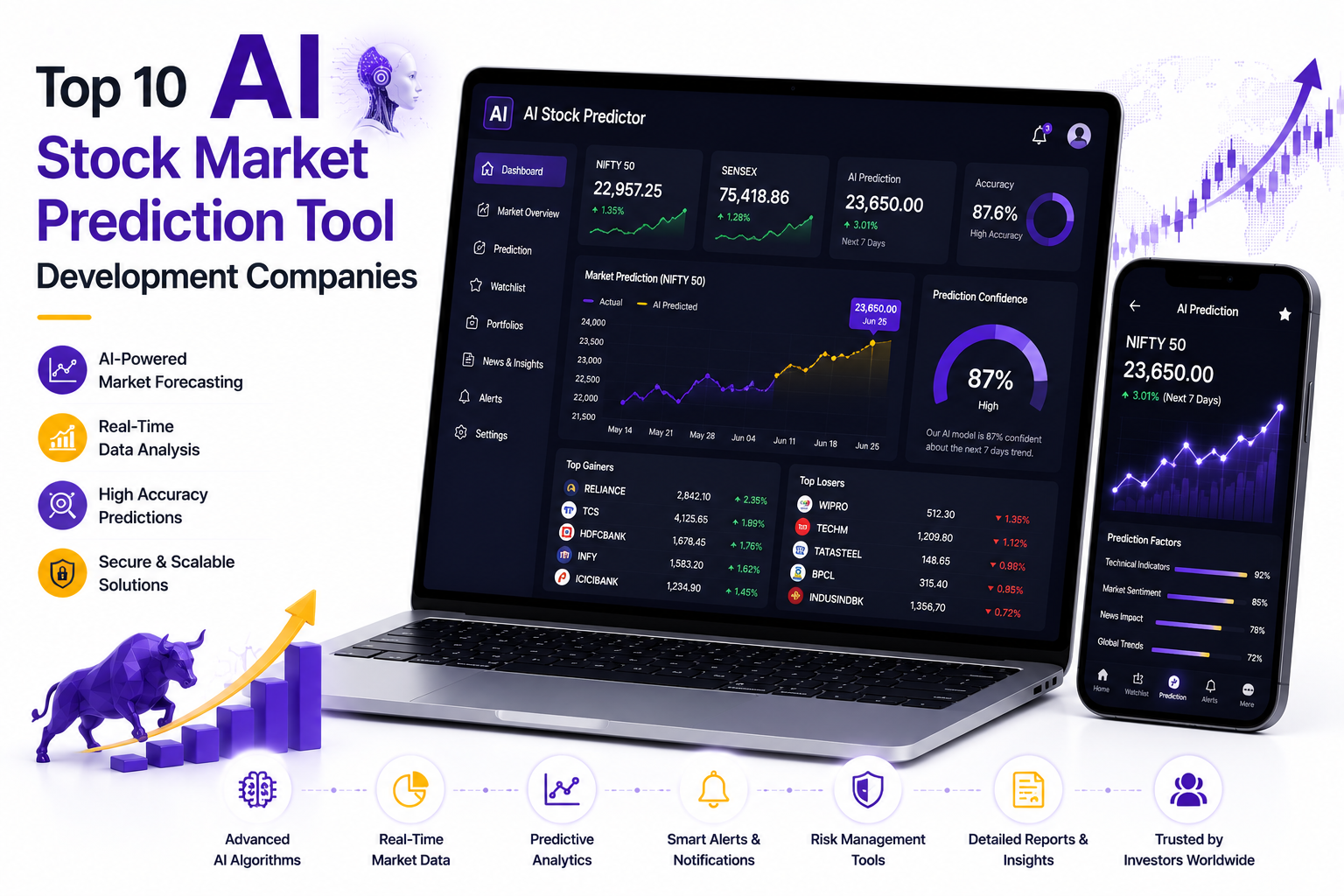

Open any trading app today and you will notice something. The buy and sell signals, the risk scores, the sudden alert about an earnings surprise, none of that is written by a person anymore. Behind almost every serious trading platform in 2026 sits a piece of software quietly doing the heavy lifting, an AI Stock Market Prediction Tool.
For CEOs and founders exploring this space, the real challenge is not convincing anyone that AI belongs in trading. That argument is already over. The challenge is picking the right AI Stock Market Prediction Tool Development Companies as a partner, someone who understands machine learning, financial data, compliance, and the messy realities of live markets, all at the same time.
The market itself is moving fast. Wealth management firms, brokerages, and even individual traders are pouring money into predictive analytics, and the companies that can deliver accurate, explainable, and compliant models are the ones winning the bigger contracts this year.
That is exactly what this list is for. We looked at ten companies that specialize in building prediction platforms, from early-stage MVPs to enterprise-grade trading systems, and broke down what each one actually brings to the table. No fluff, no recycled marketing copy, just the details a decision maker actually needs before picking up the phone.
The AI Behind Modern Stock Prediction Platforms
Most people assume stock prediction software is a single algorithm quietly guessing what a stock will do next. In reality, a modern AI Stock Market Prediction Tool is closer to a stack of specialized models working together.
There is usually a forecasting layer trained on historical price movements, a natural language layer reading news and earnings calls, and a separate model scoring risk and portfolio exposure. Large language models have added another layer in 2026, letting platforms explain why a prediction was made instead of just returning a number.
None of this works well without clean, real-time market data feeding it. That is why the companies on this list spend as much time on data pipelines and infrastructure as they do on the models themselves. A brilliant algorithm fed bad data will still give bad answers.
Features That Separate Basic Prediction Apps from Professional Trading Platforms
Not every app that claims to predict stock prices is built the same way. Here is what actually separates a hobby project from a platform institutions are willing to trust their money to.
Prediction Engine
• Price forecasting: short and long-term price movement predictions based on historical and live data
• Trend prediction: identifying whether a stock is entering a bullish or bearish phase
• Buy, sell, or hold signals: clear, actionable recommendations instead of raw probability scores
• Volatility forecasting: estimating how sharply a stock's price is likely to swing
Intelligence Layer
• News sentiment: scanning financial news in real time to gauge market mood
• Earnings analysis: parsing earnings calls and reports for hints on future performance
• SEC filing interpretation: automatically reading regulatory filings for red flags or opportunities
• Social media sentiment: tracking retail investor sentiment across platforms like X and Reddit
Portfolio Layer
• Portfolio optimization: suggesting asset allocation based on risk tolerance and goals
• Risk scoring: quantifying how risky a position or portfolio currently is
• AI recommendations: personalized suggestions based on a user's trading history and preferences
Analytics Layer
• Technical indicators: RSI, MACD, moving averages, and other classic tools rebuilt with AI assistance
• Pattern recognition: spotting chart patterns like head and shoulders or double bottoms automatically
• Custom dashboards: letting users build the exact view of the market they want to see
Evaluation Criteria Used to Rank These Development Companies
Ranking development companies is only useful if the criteria behind it actually mean something. Here is what we weighed before putting this list together:
• AI expertise, including how deep their machine learning and data science teams actually go
• FinTech experience, since building for banks and brokerages is very different from building a to-do list app
• Stock market domain knowledge, meaning they understand candlesticks and order books, not just APIs
• ML engineering capability, from model training to deployment at scale
• Cloud infrastructure, because prediction platforms need to process enormous volumes of live data
• Security and compliance, especially around financial regulations like SOC 2 and GDPR
• Team strength, including how experienced their developers, data scientists, and QA engineers are
• Enterprise projects, or proof they have delivered large-scale platforms before, not just prototypes
• Client reviews, pulled from platforms like Clutch and GoodFirms
• Innovation in Generative AI, since 2026 platforms are expected to explain predictions in plain language, not just output numbers
Companies that scored well across most of these categories made the final list.
Top 10 AI Stock Market Prediction Tool Development Companies
Below is the full list, in no particular order beyond the first spot. Each entry covers what the company actually specializes in, the kind of clients they tend to work with, and who they are the best fit for, so you can shortlist based on your own priorities rather than a generic star rating.
1. Hourly Developers
Hourly Developers tops this list for a reason. The company has carved out a niche in building custom AI Stock Market Prediction Tool solutions for startups and mid-size FinTech firms that need a working product without the overhead of a massive in-house team. Their hourly hiring model is what makes them stand out. Instead of committing to a fixed-cost contract, clients can bring on AI engineers, data scientists, and full-stack developers on an hourly or dedicated basis, scaling the team up or down as the project evolves.
Their engineers have hands-on experience with time series forecasting, sentiment analysis models, and integrating live market data feeds from providers like Alpha Vantage and Polygon. What clients seem to appreciate most is the transparency, you know exactly what you are paying for and what stage the model is at, week over week.
They also tend to move quickly on discovery calls, often turning around a scoped project plan within days rather than weeks, which matters a lot for founders trying to hit an investor deadline or a specific launch window.
Best for: Founders who want flexible, cost-effective access to AI talent without long-term lock-in.
2. Matellio
Matellio has built a reputation as a broad enterprise software development company, and their FinTech division has increasingly focused on predictive analytics for trading platforms. They typically work with mid-size to large enterprises that need custom-built prediction platforms integrated into existing infrastructure rather than a standalone app.
Their team leans heavily on cloud-native architecture, usually AWS or Azure, and has experience wiring together data pipelines that pull from multiple market data vendors at once. Where Matellio tends to shine is in bigger, more complex projects, ones that involve legacy system integration alongside new AI capabilities.
They also run a fairly formal discovery and solutioning process upfront, which can feel slower than working with a smaller shop but tends to reduce surprises once development actually starts.
Best for: Enterprises that already have existing systems and need AI prediction capabilities layered on top without a full rebuild.
3. Backend Development Company
As the name suggests, Backend Development Company specializes in the infrastructure side of prediction platforms, the part most users never see but that determines whether the whole system actually works under load. Their strength lies in building the data ingestion pipelines, APIs, and server architecture that feed machine learning models with clean, real-time market data.
For a stock prediction platform, this matters more than most people realize. A forecasting model is only as good as the data reaching it, and their engineers focus heavily on low-latency architecture, database optimization, and secure API design. They often partner with front-end and AI specialist teams to deliver a complete platform.
Their pricing model tends to be project-based rather than hourly, which some founders prefer when the scope of the backend work is already fairly well defined.
Best for: Teams that already have a data science or AI partner and need rock-solid backend infrastructure to support it.
4. ValueCoders
ValueCoders is one of the more established outsourcing names in the custom software space, and their FinTech portfolio includes trading dashboards, portfolio management tools, and AI-driven analytics platforms. They offer flexible engagement models, from dedicated teams to fixed-scope projects, which makes them a reasonable fit for both startups and established financial firms.
Their developers have experience with Python-based machine learning stacks, along with the usual FinTech requirements around data security and API integrations with brokerages. Clients often mention their project management process as a strong point, since financial software projects tend to involve a lot of moving parts and stakeholders.
Because they have been in the outsourcing business for well over a decade, they also tend to have established QA and testing processes that smaller newer shops are still building out.
Best for: Businesses that want an experienced outsourcing partner with a long track record in FinTech, not just AI.
5. HireAIDevelopers
HireAIDevelopers focuses squarely on one thing, giving companies access to specialized AI engineers without the long hiring cycles of building an in-house team. For an AI Stock Market Prediction Tool, this usually means getting machine learning engineers with direct experience in time series models, natural language processing for sentiment analysis, and reinforcement learning for trading strategy optimization.
Their model works well for founders who already have a product roadmap and just need the right technical talent to execute it quickly. Because the developers work on a hire-as-needed basis, companies can bring in niche expertise, like an NLP specialist for earnings call analysis, only when the project actually needs it.
This setup works less well for founders who need heavy hand-holding on strategy, since the model assumes you already know roughly what you want built.
Best for: Founders with a clear technical vision who need to move fast on hiring specialized AI talent.
6. Osiz Technologies
Osiz Technologies has built its name primarily in blockchain and AI development, and their FinTech work has expanded to include AI-powered trading and prediction platforms. They tend to attract clients building newer, more experimental products, including platforms that combine traditional stock prediction with crypto market analysis.
Their team works across the full stack, from model development to mobile app front-ends, which makes them a reasonable one-stop option for startups that do not want to coordinate multiple vendors. Data security and regulatory compliance are areas they highlight prominently in their FinTech projects.
Their blockchain background also comes in handy for founders exploring tokenized assets or on-chain settlement alongside a traditional prediction engine.
Best for: Startups building a broader financial platform that spans both stock and crypto prediction features.
7. HireFullStackDeveloperIndia
HireFullStackDeveloperIndia offers a straightforward value proposition, experienced full-stack developers at competitive rates, based in India, available for both short-term and long-term engagements. For an AI Stock Market Prediction Tool, this typically means a team that can handle everything from the React or Angular front-end dashboard down to the Python-based prediction models and database architecture.
Their developers are generally well versed in integrating third-party market data APIs, building real-time charting interfaces, and connecting prediction models to a usable front-end. Because the pricing tends to be lower than Western agencies, this option often appeals to bootstrapped startups watching their runway closely.
As with most India-based hiring platforms, results vary a fair bit between individual developers, so it is worth asking for a paid trial task before committing to a longer engagement.
Best for: Budget-conscious founders who need a full-stack team without sacrificing too much on technical capability.
8. Debut Infotech
Debut Infotech has positioned itself as an AI and blockchain focused development company, with a growing portfolio in FinTech and predictive analytics. Their approach to stock prediction platforms usually starts with a discovery phase to map out data sources, compliance requirements, and the specific prediction outputs a client needs, before moving into development.
They work with a mix of proprietary and open-source machine learning frameworks, and their team includes data scientists who focus specifically on financial time series modeling. Clients building their first AI trading product often mention their structured onboarding process as a helpful starting point.
That structured approach does add a bit of lead time before development actually starts, which is worth factoring into your timeline if speed is the top priority.
Best for: First-time founders who want more hand-holding through the discovery and planning phase of the project.
9. Konstant Infosolutions
Konstant Infosolutions is a long-standing custom software development company that has expanded into AI and machine learning services over the past few years. Their FinTech work includes trading platforms, robo-advisory tools, and analytics dashboards, often built for small and mid-size financial firms rather than large enterprises.
What stands out about Konstant is their in-house team structure, they avoid heavy subcontracting, which tends to keep communication more consistent throughout a project. For a stock prediction platform, they typically handle everything from initial model prototyping to full deployment and post-launch support.
Their pricing sits in the middle of the market, not the cheapest option available but noticeably more predictable than agencies that rely heavily on freelance subcontractors.
Best for: Small to mid-size financial firms that want a stable, in-house team throughout the entire project.
10. Antino Labs
Antino Labs rounds out the list with a strong focus on product design alongside AI development, something that is easy to overlook when evaluating a prediction platform. A model can be technically accurate and still fail if traders find the dashboard confusing or cluttered, and this is where Antino's UX-first approach tends to add real value.
Their engineering team builds custom machine learning models for price forecasting and sentiment analysis, while their design team focuses on making complex financial data easy to read at a glance. It is a combination that works particularly well for consumer-facing trading apps rather than backend enterprise systems.
Founders who have tried building a trading app without a dedicated design function often end up circling back to firms like Antino once user complaints about a cluttered interface start piling up.
Best for: Companies building a consumer-facing trading app where user experience is as important as prediction accuracy.
Side-by-Side Comparison Table
Here is a quick side-by-side view of all ten companies, useful if you are shortlisting a few to contact directly.
Build vs Buy: Should You Develop Your Own Prediction Platform?
One question comes up in almost every conversation with founders exploring this space. Should you build a custom AI Stock Market Prediction Tool from scratch, or start with a white-label solution and customize it later? There is no universally right answer, it depends on budget, timeline, and how differentiated you need your prediction engine to be.
Custom development gives you full ownership of the model, the data pipeline, and the roadmap, but it takes longer and costs more upfront. A white-label solution gets you to market faster and cheaper, but you are often limited in how much you can customize the underlying prediction logic, and you do not own the core technology.
If your business model depends on prediction accuracy as a real competitive advantage, custom development is usually worth the extra time and cost. If you are validating a broader product idea and the prediction engine is just one feature among many, a white-label option can get you moving faster while you figure out product-market fit.
Questions to Ask Before Hiring an AI Development Company
Before signing a contract with any development company, it helps to ask a few pointed questions. Here is a practical checklist:
• Have they built FinTech AI products before, or would this be their first attempt at financial data?
• How do they validate prediction models, through backtesting, live paper trading, or both?
• What market data providers do they integrate with, and do those cover the assets you care about?
• Can they explain model predictions in plain language, or is the model a black box even to them?
• How frequently are models retrained, since stale models lose accuracy fast in volatile markets?
• What security certifications do they follow, particularly around handling financial and personal data?
• Can the platform scale to millions of predictions per day if your user base grows quickly?
Getting clear answers to these questions before signing anything will save a lot of frustration six months into the project.
Conclusion
Picking a development partner from the list of AI Community Platform development companies above is not really a matter of finding the cheapest quote or the flashiest portfolio. It comes down to whether a team has actually built and shipped something similar before, whether they can explain their AI approach in plain terms, and whether their pricing model fits how you plan to grow the product after launch. The 18 companies above cover a wide range of budgets and specialties, from backend heavy teams to AI first specialists to full service agencies that can handle the entire build.
Before you sign with anyone, it is worth having a direct conversation about your specific use case, whether that is a creator community, a professional network, or an internal collaboration tool, and asking how they would approach the AI layer for exactly that scenario. A generic answer is a warning sign. A specific, thought out answer usually means you are talking to a team that has actually done this work before, which is ultimately what you are paying for.
It also helps to think a year or two beyond launch rather than only focusing on the initial build. The team that gets your first version out the door is not always the same team you will want maintaining and expanding the platform once real users are active, so ask upfront how each company handles longer term support and whether the same engineers who built the core AI features will still be available when you need to iterate on them. Taking the time to compare a handful of these companies properly, rather than picking the first one that responds quickly, tends to save both money and frustration later on.