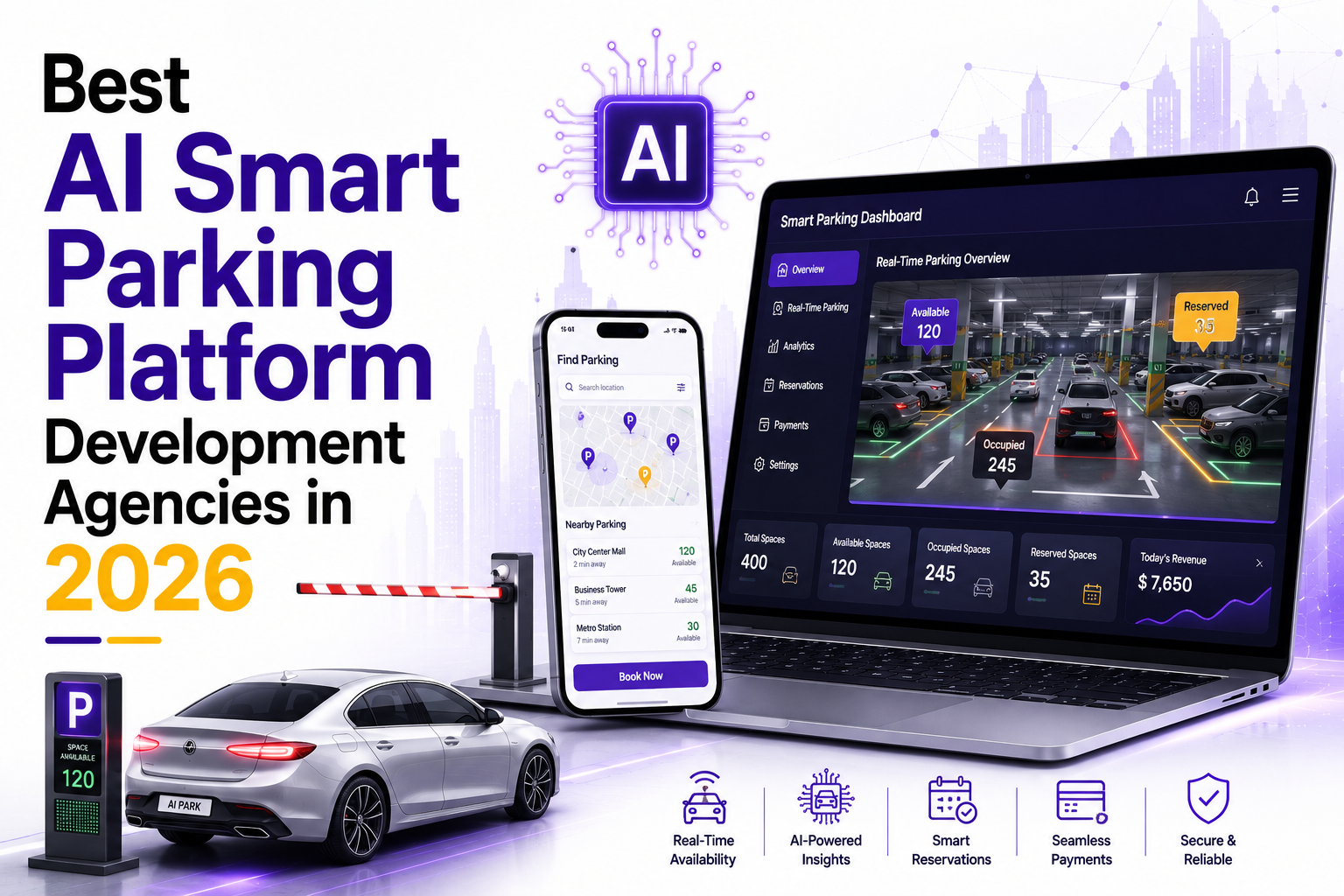
Finding a parking spot still eats up more time than most drivers would like to admit, and cities are tired of watching traffic crawl while empty spaces sit unused a few blocks away. That gap between demand and visibility is exactly what a well-built AI Smart Parking Platform is meant to close, and it is why so many municipalities, mall operators, and airport authorities are now shortlisting development partners for 2026 projects instead of relying on the manual counting and paper permits that used to pass for parking management.
Building one of these platforms is not the same as building a generic parking app. It involves sensor networks, computer vision, license plate recognition, dynamic pricing engines, and predictive occupancy models that all have to work together in real time. Picking the wrong development partner means months lost to rework and a system operators end up abandoning within a year, while picking the right one means a platform that actually reduces congestion, cuts staffing overhead, and pays for itself through better space utilization and fewer disputes over parking fees.
This list covers 20 development agencies worth evaluating in 2026, starting with teams that focus on fast, hands on delivery and moving through firms with deeper enterprise and AI specializations. Each profile covers what the company actually does well, along with the kind of project they tend to suit best, so you can compare them against your own scope and budget rather than a generic sales pitch that reads the same for every vendor on the internet and tells you very little about how the actual build will go.
What Actually Goes Into an AI Smart Parking Platform
Before comparing vendors, it helps to know what you are actually buying. A modern AI Smart Parking Platform typically combines IoT sensors or camera based detection, a backend that processes occupancy data in real time, a driver facing mobile app for reservations and payments, and an admin dashboard operators use to manage pricing, enforcement, and reporting. Some projects also need integration with existing barrier gates, license plate recognition cameras, and city traffic management systems that were installed years before anyone planned an AI layer on top of them, which means compatibility testing often takes longer than the AI development itself.
The agencies below vary in how they approach this. Some are generalist app development shops that bring in AI specialists as needed for a specific project. Others have built parking or smart city products before and already understand the sensor calibration, edge computing constraints, and false positive rates that trip up teams building this kind of system for the first time. Knowing which category a vendor falls into before you sign a contract saves a lot of back and forth later, and it is worth asking directly rather than assuming based on their website copy.
How to Shortlist a Development Partner
Look past the portfolio screenshots and ask a few direct questions. Has the team shipped a computer vision or IoT product before, not just a standard mobile app? Can they explain how they would handle occupancy prediction when sensor data is incomplete or a camera goes offline mid shift? Do they offer ongoing support after launch, since parking platforms need tuning once real world traffic patterns show up and the model trained on pilot data meets actual drivers who do not behave the way test data assumed they would? A team that answers these clearly, with specifics rather than reassurance, is usually a safer bet than one that only talks about timelines and cost.
It also matters whether the team has worked with hardware vendors before. A parking platform lives or dies on the reliability of its sensors, and an agency that has never had to debug a flaky IoT device in the field will learn those lessons on your budget instead of theirs, often at the exact moment your pilot is being evaluated by the people who approved funding for it.
The 20 Best AI Smart Parking Platform Development Agencies
HireFullStackDeveloperIndia provides full stack teams that can own both the driver facing app and the backend logic behind an AI Smart Parking Platform in a single engagement. This reduces the coordination overhead of managing separate frontend and backend vendors, since one team understands the full data flow from sensor input to the screen a driver actually taps. Their India based delivery model keeps costs more predictable for startups and mid sized operators working with a defined budget, and they typically offer flexible team sizing so a project can start small with two or three developers and expand once the pilot proves out, which suits founders who are still raising funding alongside the build. Time zone overlap with US and European clients is another practical advantage worth checking upfront.
2. Appinventiv
Appinventiv has built a reputation for scalable, security focused mobile and AI products for large enterprise clients across several industries. Their teams have experience with IoT integrations and real time data processing, both of which matter for occupancy detection and dynamic pricing in a parking system, and their AI practice covers machine learning model development that can be tuned specifically for vehicle detection accuracy. They tend to suit organizations that need a partner comfortable managing complex, multi stakeholder rollouts across several cities at once, where compliance, data security, and coordination between city departments matter as much as the underlying technology itself, and where a slow, careful rollout is worth more than a fast one. Their case studies span healthcare, retail, and logistics, which shows a comfort level with regulated industries.
As the name suggests, this firm specializes in the backend architecture that keeps a parking platform reliable under load. For an AI Smart Parking Platform, that means designing systems that can ingest sensor data from thousands of parking bays, run occupancy models with low latency, and stay stable during peak hours like event days or holiday weekends when a system failure is most visible and most costly. They are a strong fit for teams that already have a frontend or app partner and need dependable backend engineering, database architecture, and API design that will not buckle once real traffic replaces test data. Their focus on scalability also helps operators who plan to expand from a single site to a regional network without rebuilding core infrastructure later on. That same architecture discipline also makes disaster recovery planning far less painful.
4. Intellectsoft
Intellectsoft has a track record in IoT and digital transformation projects across transportation and logistics, which overlaps closely with what smart parking systems need. Their engineers are comfortable with sensor networks, edge computing, and enterprise system integration, making them a reasonable option for operators who need the platform to talk to existing city infrastructure rather than replace it entirely. They have also worked on fleet and asset tracking products, so concepts like geofencing and real time location data are already familiar territory for their teams rather than something learned on your project, which tends to shorten the early architecture phase considerably. Clients working with multiple hardware vendors at once often find this experience directly useful.
5. WillowTree
WillowTree focuses on consumer facing digital products with strong design and user experience standards, built for large brands that care about polish as much as function. For a parking platform, that translates into a driver app that actually feels easy to use, with smooth reservation flows, clear payment screens, and onboarding that does not require a tutorial. Teams that want the underlying technology to be excellent but also want the end user experience to stand out from competing apps often lean toward design led firms like this one, particularly for consumer facing deployments in malls, stadiums, and airports where first impressions shape whether drivers keep using the app after their first visit. Their portfolio also includes accessibility work, which matters for public facing municipal apps.
Hourly Developers works on an hourly engagement model, which suits teams that want to build or extend an AI Smart Parking Platform without committing to a large fixed scope upfront. Their developers cover mobile apps, backend systems, and AI integrations, and clients can scale the team up or down as the project moves from pilot to full rollout. This flexibility makes them a practical choice for parking operators still validating demand in a new location before investing in a citywide system, since you only pay for the hours the project actually needs rather than a fixed retainer regardless of workload. Their process typically starts with a short discovery call to map out sensor requirements and app features before any code is written, which keeps early stage budgets predictable and gives founders a clear cost estimate before committing to a full build. Operators who value transparency in billing tend to appreciate this model most.
7. Fueled
Fueled built its name on polished consumer apps with clean interfaces and dependable backend infrastructure, working with recognizable brands across entertainment, retail, and hospitality. Their past work shows they can handle payment integration and GPS based navigation cleanly, two features every parking app depends on regardless of how sophisticated the underlying AI is. They are a solid pick for operators who want a premium feeling app without necessarily needing deep AI research capability in house, and their design process tends to involve close collaboration with the client rather than a handoff after initial requirements are gathered, which some operators find easier to manage through a multi month build. Their New York based team also brings strong stakeholder communication habits to longer engagements.
8. Chetu
Chetu offers custom software development across a wide range of industries, including transportation and logistics technology, with a large enough bench to staff specialized roles quickly. Their broad pool of specialists means they can staff a parking project with people who understand both the AI and IoT layers and the business logic around ticketing, invoicing, and compliance reporting that operators need for audits and municipal contracts. This range makes them useful for projects with unusual requirements, like integrating a parking system with an existing property management platform or a legacy billing system that cannot easily be swapped out without disrupting operations that a city or landlord already depends on daily. Their large staff also makes it easier to add specialists mid project as requirements shift.
9. HireAIDevelopers
HireAIDevelopers focuses specifically on artificial intelligence talent, which is useful when the hardest part of your project is the model, not the app around it. For an AI Smart Parking Platform, that means developers who can fine tune object detection models for vehicle recognition, build occupancy prediction algorithms that account for weather and local events, and optimize computer vision pipelines to run efficiently on edge devices installed at the parking site itself rather than relying entirely on cloud processing. This specialization matters most for operators whose main technical risk is detection accuracy rather than the surrounding app features, and it is worth pairing them with a design focused partner if the app interface also needs serious attention. They are also a sensible choice for retrofitting AI onto a parking system that already exists.
10. ValueCoders
ValueCoders has delivered software across multiple domains with an emphasis on cost effective offshore delivery and a large, established engineering team. They tend to work well for operators who need a full development lifecycle, from initial architecture through long term support, without the overhead of a large enterprise consultancy or the premium pricing that comes with it. Their teams have handled IoT and mobility projects before, which shortens the learning curve on a parking build, and their long operating history means they have processes in place for handoff and documentation that smaller shops sometimes lack, which matters if you plan to bring development in house eventually. Clients who value a large support bench after launch tend to rate this team highly.
11. Debut Infotech
Debut Infotech works across blockchain, AI, and mobile development, and their AI practice includes computer vision and predictive analytics work that applies directly to occupancy forecasting for a parking network. They are worth considering if your platform roadmap includes future features like token based loyalty programs, automated dispute resolution for parking fines, or smart contract based payment settlement between operators and third party validators, since those are areas where their blockchain background gives them a head start most generalist agencies do not have, even if you do not plan to use those features at launch. Their smaller team size can mean closer attention from senior engineers throughout the build.
12. ScienceSoft
ScienceSoft has decades of experience in enterprise software and has published detailed case studies on IoT and predictive maintenance projects across manufacturing and transportation. Their process tends to be more structured and documentation heavy than smaller shops, which suits government agencies and large operators that need compliance paperwork, formal testing cycles, and detailed technical specifications alongside the actual build. That structure can slow early stage projects down slightly, but it pays off for organizations that need to justify the investment to a board or a city council later and cannot afford ambiguity about what was actually delivered and tested. Their industry specific consulting arm can also help justify budget to non technical stakeholders.
13. Iflexion
Iflexion brings enterprise software engineering experience to industries including transportation, and their teams are used to integrating new systems with legacy infrastructure that many cities still rely on for billing, permitting, and enforcement. That skill matters when a parking platform has to connect to older barrier gate hardware or municipal billing systems that cannot simply be replaced without a lengthy procurement process that can take longer than the software build itself. Their experience working within these constraints, rather than around them, is often more valuable than raw AI capability for a public sector deployment where existing contracts and hardware cannot be ignored. Their nearshore and offshore delivery mix gives clients some flexibility in how they staff a project.
14. Konstant Infosolutions
Konstant Infosolutions has built a wide range of mobile applications across industries and offers reasonably priced development for startups entering the smart parking space for the first time. Their strength is speed to market, which suits founders who want a working pilot app in front of a property owner or city official quickly, then iterate based on real feedback rather than spending months in planning before writing a line of code. This approach works well for smaller pilots but is worth pairing with a more experienced AI partner once the project scales beyond a proof of concept and needs more rigorous testing across multiple sites. Their pricing transparency also makes early budgeting conversations noticeably easier for first time founders.
15. Space-O Technologies
Space-O Technologies has experience building on demand and location based apps, both of which share technical ground with parking platforms, particularly around real time GPS tracking, map based navigation, and geofenced notifications. They are a practical option for smaller operators who need a functional, well tested app without an oversized enterprise budget, and their prior work on booking and reservation systems translates reasonably well to the reservation and payment flows a parking app requires from day one, without needing to design those core interactions completely from scratch. Their fixed price packages for smaller builds can also simplify approval within a lean organization.
16. Simform
Simform runs a product engineering model that pairs closely with client teams rather than working as a detached vendor, which some operators prefer for long running platforms that need continuous iteration after launch rather than a one time delivery. Their cloud and DevOps expertise also helps when an AI Smart Parking Platform needs to scale from a single lot pilot to citywide coverage without major re architecture, since infrastructure decisions made early with proper scaling in mind avoid costly rebuilds once traffic and data volume grow significantly beyond what the original pilot was designed to handle. Clients who want a long term technology partner rather than a one off vendor often choose this model.
17. Matellio
Matellio positions itself around digital transformation and AI consulting, often working with clients from the discovery phase onward to define exactly what the platform needs to do before writing code. That upfront planning can save real money on a parking project, where sensor placement and data architecture decisions made early are expensive to reverse later once hardware is installed and a data pipeline is already built around it. Their consulting first approach suits operators who are still refining requirements rather than those who already have a locked specification ready to hand off and simply need execution. Their AI advisory work also extends to helping clients evaluate whether AI is even the right tool for a given feature.
18. Openxcell
Openxcell offers dedicated development teams across mobile, AI, and enterprise software, with flexible engagement models similar to a staff augmentation setup rather than a fixed project contract. This works well for operators who already have a product manager in house and just need engineering capacity to execute the roadmap for their parking system, filling specific skill gaps like computer vision or backend scaling without hiring full time employees for a project with a defined end date and an uncertain need for that headcount afterward. This model also tends to be easier to wind down cleanly once a project reaches a stable, mature phase.
19. Hyperlink InfoSystem
Hyperlink InfoSystem has delivered a large volume of mobile apps across categories, giving them broad exposure to the kind of location based, payment enabled features a parking app requires regardless of industry. Their scale means they can typically staff a project quickly, which matters for operators working against a tight launch deadline tied to a new facility opening or a contract renewal that depends on showing working technology by a specific date rather than an open ended timeline that a board or investor is unlikely to accept without pushback. Their large existing codebase library can also shorten development time for standard app features.
20. Cubix
Cubix works across AI, IoT, and mobile app development, and their portfolio includes smart device integrations that translate reasonably well to parking sensor networks and connected hardware more broadly. They are a fair option for operators who want one vendor handling both the hardware integration layer and the software on top of it, rather than coordinating two separate teams and troubleshooting whose responsibility a bug belongs to when a sensor and an app disagree about whether a space is occupied, which is a more common headache than most first time operators expect. Their hardware partnerships can also help operators avoid sourcing sensors and cameras from separate suppliers.
Making the Final Call
None of these agencies are a universal right answer. A city government running a pilot across three garages has different needs than a private mall operator who wants a polished driver app by next quarter, and a team that excels at one of those projects may be the wrong fit for the other. Match the agency's actual delivery model, whether that is hourly, fixed scope, or a dedicated team, to how your project is funded and staffed, and ask each shortlisted vendor for a reference client whose project scope actually resembles yours rather than their flagship case study, which is usually the most impressive project they have ever done and not a realistic preview of what your own build will look like.
It also helps to pilot small. Most experienced teams will happily scope a single lot or garage deployment first, prove the occupancy detection accuracy in real conditions, and then expand once the numbers hold up. That approach catches sensor placement and calibration issues before they get expensive across dozens of locations, and it gives you leverage in later contract negotiations since you will have real performance data instead of a vendor's projections to work from when the time comes to scale the platform further.
Conclusion
The parking technology space in 2026 is crowded with vendors who will say yes to anything, but the agencies that actually deliver a working AI Smart Parking Platform are the ones who ask hard questions about your sensor budget, your existing infrastructure, and your rollout timeline before they ever mention a price. Use this list as a starting point, request a small pilot from two or three teams whose specialties match your project, and let their answers to your specific questions, not their website copy, make the final decision. The right partner will tell you what will not work almost as readily as what will, and that honesty tends to be a better predictor of a successful launch than any polished portfolio or client logo wall.
Budget some extra time for the vendor selection process itself. Rushing this step to save a few weeks tends to cost far more later, once a poorly matched partner has already been paid for a first phase that has to be redone.
Nainesh is the marketing expert helping our clients and customers achieve success in terms of outreach and visibility. From understanding the complexities of value-chain and the impact of future technologies, Nainesh’s incredible understanding of digital marketing and online outreach helps create high-impact strategies.
Build Your Agile Team
We provide you with a top-performing extended team for all your development needs in any technology.
Hourly
$20
It Includes
Duration
Hourly Basis
Communication
Phone, Skype, Slack, Chat, Email
Hiring Period
25 Hours (MIN)
Project Trackers
Daily Reports, Basecamp, Jira, Redmime, etc
Methodology
Agile
Monthly
$2600
It Includes
Duration
160 Hours
Communication
Phone, Skype, Slack, Chat, Email
Hiring Period
1 Month
Project Trackers
Daily Reports, Basecamp, Jira, Redmime, etc
Methodology
Agile
Team
$13200
It Includes
Team Members
1 (PM), 1 (QA), 4 (Developers)
Communication
Phone, Skype, Slack, Chat, Email
Hiring Period
1 Month
Project Trackers
Daily Reports, Basecamp, Jira, Redmime, etc
Methodology
Agile
Frequently Asked Questions
How long does it take to build a smart parking app?
A basic pilot covering one lot or garage, with sensor integration and a driver app, usually takes 10 to 14 weeks depending on hardware availability. Adding predictive occupancy modeling or multi-city support extends that timeline, often to 5 or 6 months, since those features require more testing against real traffic data before a stable launch.
Do I need custom hardware or can I use existing cameras?
Many operators reuse existing CCTV or entry gate cameras for license plate recognition instead of installing new sensors, which cuts upfront cost significantly. The tradeoff is that older camera hardware sometimes lacks the resolution needed for reliable detection in low light, so a vendor audit of your current setup before development starts is worth doing.
What ongoing costs come after launch?
Beyond hosting and app store fees, budget for model retraining as traffic patterns shift with seasons or nearby construction, plus sensor maintenance since outdoor hardware degrades faster than office equipment. Many agencies bundle a support retainer covering these tasks, which is usually more predictable than paying for fixes on an ad hoc basis.
Can a smart parking platform work without full AI capability?
Yes, a simpler version using rule based occupancy counting and manual pricing can launch faster and cost less, then AI features like demand prediction or automated dynamic pricing can be added once you have real usage data to train models on. Many successful rollouts start this way rather than building every AI feature on day one.
How do I compare pricing between these agencies?
Request itemized quotes covering discovery, hardware integration, app development, and post launch support separately rather than one bundled number, since bundled quotes make it hard to see where your budget is actually going. Also ask whether pricing is fixed scope or hourly, since that changes how cost risk is shared if requirements shift mid project.