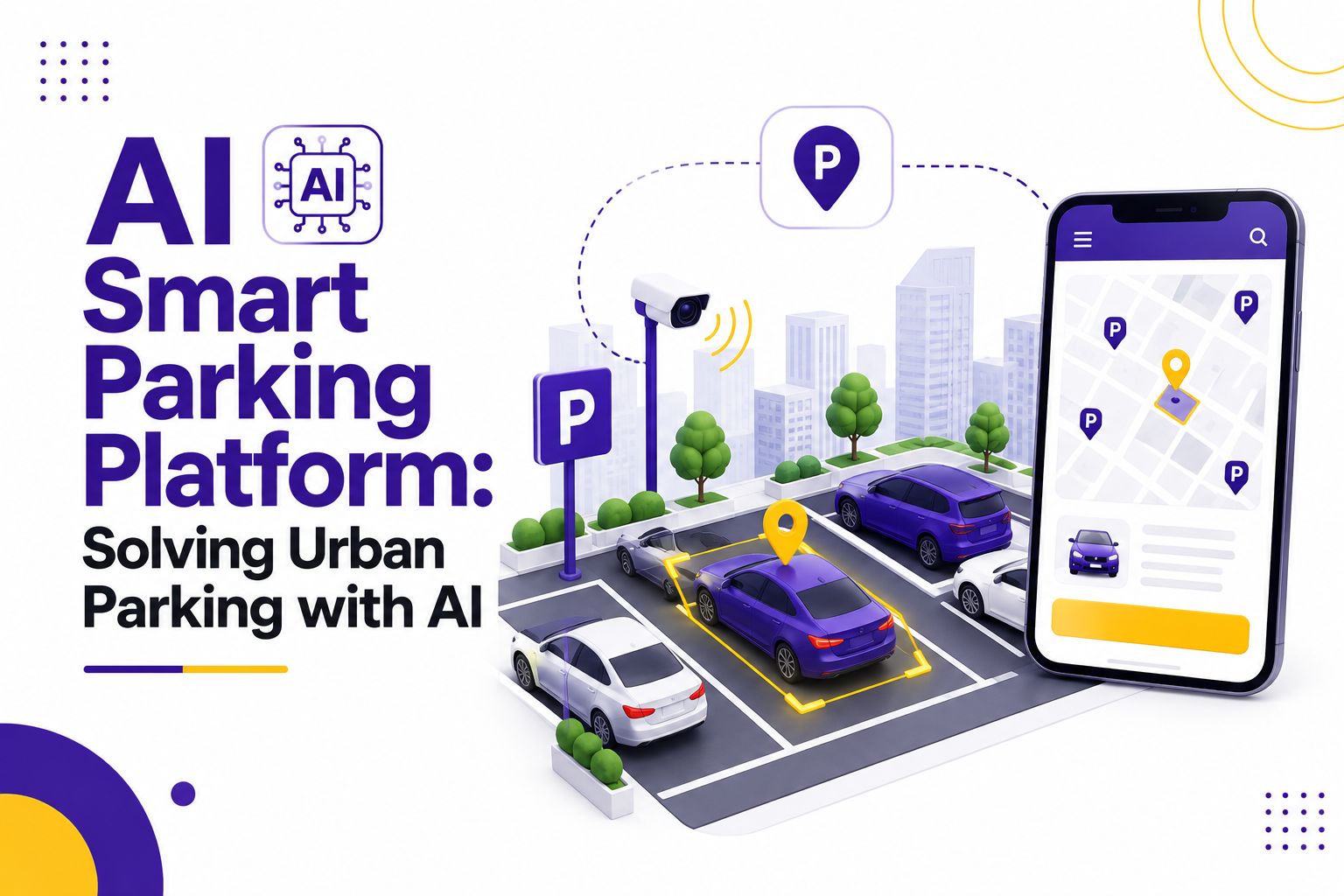

Anyone who has circled a downtown block three times looking for a spot knows the frustration. Multiply that by a few thousand cars an hour, and you get the mess most cities call rush hour parking.
An AI smart parking platform is quietly changing that picture. It uses sensors, cameras, and machine learning to tell drivers exactly where a space is open, before they even turn onto the street.
The numbers back up why this matters. The global smart parking systems market is projected to reach USD 53.38 billion by 2033, growing at a compound annual rate of over 23% from 2026 onward. That kind of growth does not happen without a real problem behind it, and urban parking has been that problem for decades.
This guide walks through what an AI smart parking platform actually does, how it is built, what it costs, and what to look for if you are evaluating AI smart parking platform development companies for your own city or business. No jargon, no sales pitch, just a clear look at the technology.
What Exactly Is an AI Smart Parking Platform?
At its core, an AI smart parking platform is a software and hardware system that tracks parking availability in real time and uses artificial intelligence to predict, guide, and manage how spaces get used.
Think of it as three layers working together:
• Sensing layer: cameras, ground sensors, or license plate recognition units that detect whether a space is occupied.
• Intelligence layer: AI models that process that data, predict demand, and flag patterns like overstay or misuse.
• Experience layer: the app, dashboard, or signage that shows drivers, operators, and city staff what is happening in real time.
Unlike a basic parking app that just shows a static map, an AI smart parking platform learns. It adjusts pricing during peak hours, predicts where spots will free up next, and flags maintenance issues before they become expensive problems.
The Urban Parking Problem in 2026
Cities have added more roads, more towers, and more transit lines over the years. Parking infrastructure, for the most part, has not kept pace with how many vehicles are actually on the road.
In the United States alone, the average driver spends about 17 hours a year searching for parking, at an estimated cost of $345 per driver once wasted fuel, time, and emissions are factored in. In dense cities, that number climbs far higher.
A few things make this worse every year:
• Vehicle ownership keeps rising faster than new parking capacity.
• Drivers circling for a spot add unnecessary traffic and pollution to already congested roads.
• Operators lose revenue from spaces that sit unmonitored, underpriced, or misused.
• Manual enforcement, think parking wardens with ticket books, simply cannot scale to cover every street.
On average, drivers searching for parking spend close to nine minutes per trip circling for a space, and that number is worse in cities with limited real-time visibility into open spots. This is exactly the gap AI parking management software is built to close.
It also helps to understand why this is not just a hardware upgrade. Cities that have piloted connected parking zones report fewer complaints, faster turnover of spaces, and noticeably less traffic idling near busy commercial strips. None of that happens by accident. It comes from a system that watches, learns, and adjusts continuously instead of relying on fixed signage and static rules that stay the same regardless of what is actually happening on the street.
Types of AI Smart Parking Platforms You Can Build
Not every parking problem looks the same, and the right platform depends heavily on where it will be deployed. Here is a breakdown of the most common setups:
On-Street Parking Systems
These cover curbside spaces along city streets. They typically rely on ground sensors or overhead cameras and focus heavily on enforcement, since on-street spaces are the most prone to overstays and unpaid parking.
Off-Street Garages and Lots
Multi-level garages and large lots benefit from camera-based systems that can track entire rows of vehicles at once. Automated barrier integration and license plate recognition are especially useful here, since entry and exit points are limited and easier to monitor.
Residential and Community Parking
Apartment complexes and gated communities often need simpler systems focused on resident verification and guest access rather than dynamic pricing. The priority shifts toward convenience and security over revenue optimization.
Event Venues and Stadiums
Parking demand at stadiums and concert venues spikes for a few hours and then disappears. These platforms need to handle sudden surges gracefully, often combining pre-booking with real-time guidance to avoid gridlock before and after events.
Airports and Transit Hubs
These locations deal with long-duration parking, shuttle coordination, and higher security requirements. Platforms here often integrate with broader transit apps so travelers can plan parking alongside flights or train schedules.
Traditional Parking Management vs AI-Powered Systems
It is worth putting the two approaches side by side, since the difference explains why so many cities and operators are making the switch.
The gap between these two columns is exactly what drives adoption. Once operators see how much revenue and time were being lost to guesswork, going back to a purely manual system rarely makes sense.
How an AI Smart Parking Platform Actually Works
It helps to break the process down into steps rather than treating it as one black box. Here is the typical flow, from an empty space to a parked car:
1. Detection: Sensors or cameras identify whether a space is vacant or occupied, updating status within seconds.
2. Data processing: The AI engine cleans and analyzes this data alongside historical patterns, weather, and local events.
3. Prediction: Machine learning models forecast which areas will have availability in the next 10 to 30 minutes.
4. Guidance: Drivers receive real-time directions through an app, in-car system, or digital signage pointing them to open spots.
5. Payment and enforcement: Automated payment, dynamic pricing, and violation alerts are handled without manual checks.
6. Reporting: Operators get dashboards showing occupancy trends, revenue, and areas that need attention.
This entire loop runs continuously, which is what separates an AI smart parking platform from older, static systems that only tell you what was true five minutes ago.
Core Features of AI Parking Management Software
Not every platform on the market offers the same depth. Here is what a genuinely capable AI parking management software solution should include:
The Technology Behind the Platform
An AI smart parking platform is really an extension of broader IoT app development practices. Connected sensors, cloud infrastructure, and real-time data pipelines all have to work together without lag.
Typical Technology Stack
Getting this stack right takes more than stitching together off-the-shelf tools. It requires proper smart parking app development, where the mobile experience, backend logic, and hardware integration are designed to work as one system rather than separate add-ons.
Who Actually Benefits, and How
For City Governments and Municipalities
• Lower traffic congestion from cars no longer circling for spots.
• Better enforcement without expanding parking staff.
• Higher, more consistent parking revenue through dynamic pricing.
• Real data to plan future infrastructure instead of guesswork.
For Private Operators and Businesses
• Higher space utilization across malls, offices, and event venues.
• Reduced dependency on manual staff for entry, exit, and billing.
• Better customer experience, which directly affects repeat visits.
• Clear analytics to justify pricing and expansion decisions.
For Everyday Drivers
• Less time wasted searching, more time spent doing what they actually planned.
• Transparent pricing with no surprise tickets from misunderstood signage.
• Contactless entry, payment, and exit from start to finish.
The broader AI parking management software market reflects this shift. The global parking management market is projected to reach USD 16.74 billion by 2033, growing at more than 17% annually, largely driven by cities and private operators adopting connected, AI-based systems instead of manual ones.
What to Look For in AI Smart Parking Platform Development Companies
If you are planning to build or upgrade a parking system, the technology choice matters less than the partner building it. Here is a practical checklist to use when evaluating AI smart parking platform development companies:
• Proven IoT and hardware integration experience: ask for examples where sensors, cameras, and backend systems were connected successfully.
• AI and computer vision expertise: prediction accuracy depends heavily on how well the models were trained and tuned.
• Scalable cloud architecture: the system should handle a handful of spaces or an entire city grid without a redesign.
• Security and data compliance: license plate and payment data need proper encryption and access controls.
• Post-launch support: sensors fail, models drift, and software needs updates long after go-live.
• Transparent development process: clear milestones, timelines, and testing phases instead of vague promises.
Good AI smart parking platform development companies will walk you through their process openly rather than rushing straight to a proposal. If a vendor cannot explain how their sensors handle bad weather or poor lighting, that is worth asking about before signing anything.
Steps to Build a Smart Parking App
Whether you are a city planner or a private operator, the development journey for smart parking app development generally follows the same structure:
1. Discovery and site assessment: map out the parking area, traffic patterns, and existing infrastructure.
2. Hardware selection: choose sensors or cameras suited to the location, whether outdoor, underground, or multi-level.
3. Platform architecture: design the backend, cloud setup, and data pipelines that will support real-time updates.
4. AI model training: train prediction models on historical and live data specific to that location.
5. App and dashboard development: build the driver-facing app and the operator dashboard side by side.
6. Pilot testing: run the system on a small section before rolling it out citywide or across all properties.
7. Full deployment and monitoring: scale up with ongoing performance monitoring and regular model updates.
Reliable cloud infrastructure plays a bigger role here than most people expect. Every sensor update, payment transaction, and prediction request depends on backend systems that stay fast even during peak traffic hours.
What Does It Cost to Build an AI Smart Parking Platform?
Costs vary widely depending on scale, hardware choice, and how much customization is involved. Here is a general breakdown to set expectations:
These ranges are directional, not fixed quotes. The real cost driver is usually hardware, since ground sensors, cameras, and network infrastructure across a large area add up quickly compared to the software itself.
Common Challenges and How They Get Solved
Hardware Reliability in Harsh Weather
Outdoor sensors face rain, heat, and dust. Good platforms use IP-rated, weatherproof hardware and redundant sensors so one failed unit does not blind an entire zone.
Data Accuracy Over Time
AI models can drift as traffic patterns change. Platforms need scheduled retraining cycles, not a one-time setup, to keep predictions accurate months and years after launch.
Integration With Legacy Systems
Many cities already have older payment kiosks or barrier systems. A well-planned rollout integrates with what exists instead of ripping everything out at once.
User Adoption
Even the best system fails if drivers do not use the app. Clear onboarding, simple payment flows, and visible signage all help push adoption in the first few months.
How to Measure Success: Key Metrics to Track
Once an AI smart parking platform is live, the work is not over. Tracking the right numbers tells you whether the system is actually paying off or just running in the background.
• Average search time: how long it takes drivers to find and park in a space after entering the zone.
• Occupancy rate: the percentage of available spaces in use during peak and off-peak hours.
• Revenue per space: total earnings generated by each monitored space over a given period.
• Enforcement efficiency: how quickly violations are detected and resolved compared to manual patrols.
• App adoption rate: the share of drivers actively using the platform versus relying on old habits.
• Sensor uptime: the percentage of time hardware stays online and reporting accurate data.
Reviewing these metrics monthly, rather than only at the end of a quarter, makes it much easier to catch small issues, like a cluster of failed sensors or a pricing rule that is not working, before they turn into bigger revenue losses.
What's Next for Smart Parking in 2026 and Beyond
Momentum in this space is not slowing down. Some reports place the smart parking systems market at roughly USD 12.35 billion in 2026, growing toward $26.37 billion by 2030, with expansion tied directly to smart city projects and contactless parking demand.
A few trends worth watching over the next couple of years:
• Integration with autonomous and electric vehicles: parking systems that coordinate charging availability alongside space availability.
• Cross-city data sharing: regional platforms that let travelers check availability across multiple cities from one app.
• Deeper predictive analytics: models that factor in weather, local events, and public transit disruptions together.
• Sustainability reporting: dashboards that quantify reduced emissions from lower search-related driving.
None of this replaces the basics. An AI smart parking platform still has to get the fundamentals right first: accurate detection, fast updates, and a smooth driver experience. Everything else builds on top of that foundation.
Bringing It All Together
Parking is one of those problems that looks small until you actually measure it. Wasted fuel, wasted time, and streets clogged with cars looking for a spot add up to a real cost for cities, businesses, and drivers alike.
An AI smart parking platform does not solve this by adding more concrete. It solves it by using the space that already exists more intelligently, guiding drivers directly to open spots and giving operators the data to manage demand instead of guessing at it.
If you are weighing options right now, the technology itself is mature enough to trust. The harder decision is picking the right team to build it with you, one that understands hardware, AI, and everyday driver behavior in equal measure. Get that part right, and the rest of the system tends to fall into place.