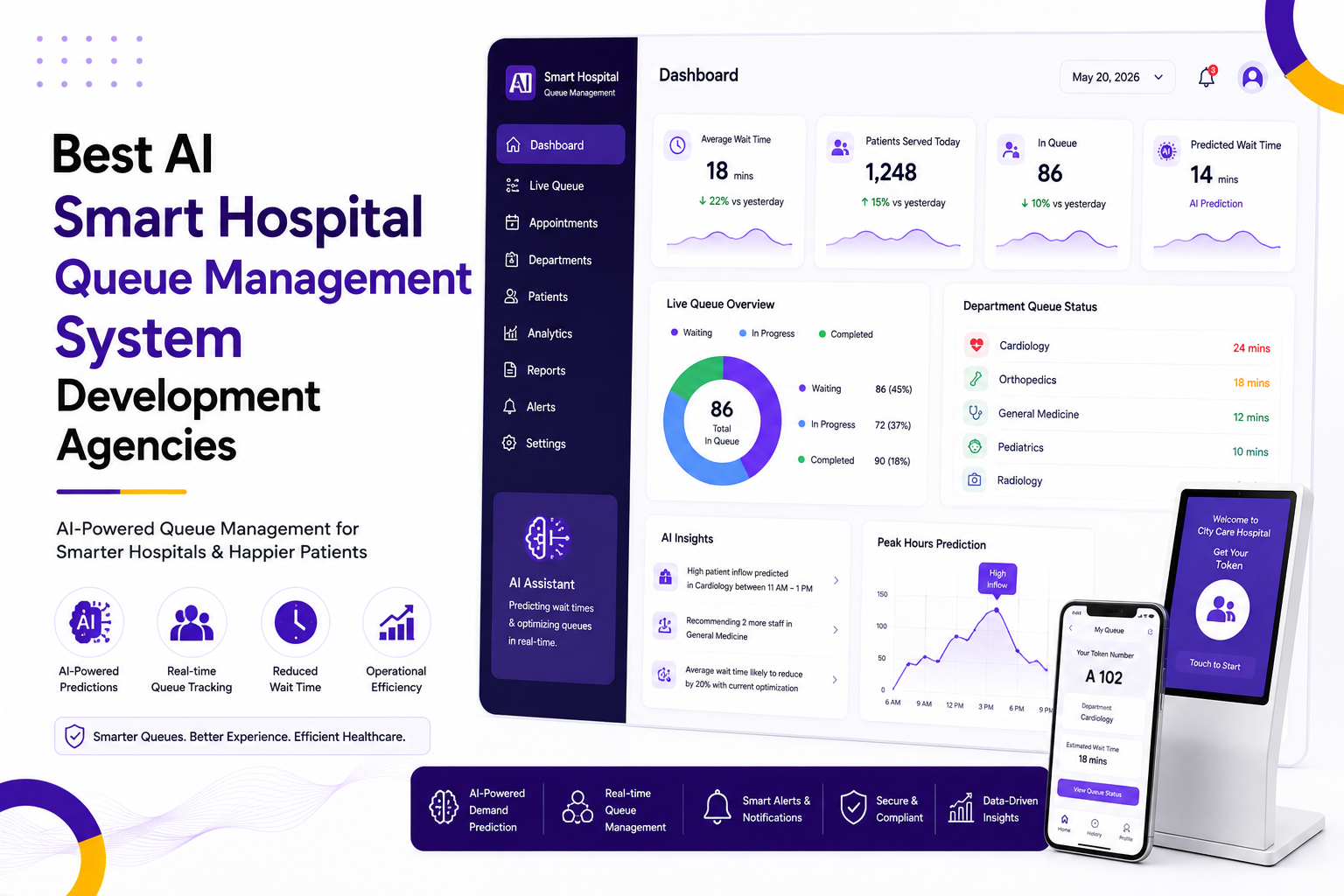

Walk into almost any hospital on a weekday morning and you will see the same scene. A packed waiting room, a printed token nobody can read from across the room, and a receptionist juggling three phone calls while patients ask, for the tenth time, how much longer it will be. That scene is exactly why AI Smart Hospital Queue Management System development has quietly become one of the busiest corners of healthcare technology this year.
If you are a hospital administrator, clinic owner, or healthtech founder trying to fix this problem, you already know the real challenge is not deciding whether you need one. It is figuring out who can actually build it well. This blog walks you through what these systems really do, why the old way of managing patient queues keeps failing hospitals, and which development teams are genuinely worth your time in 2026.
We have put together a practical, no-fluff list of AI Smart Hospital Queue Management System Development Companies so you can compare them the way you would compare any serious business decision, on expertise, technology, and real project experience.
What Is an AI Smart Hospital Queue Management System?
In simple terms, an AI Smart Hospital Queue Management System is software that manages how patients move through a hospital, from check-in to consultation to billing, using artificial intelligence instead of a first-come-first-served token counter.
Instead of a static number on a printed slip, patients get a live, updating estimate of their wait time based on doctor availability, appointment type, and how busy that specific department is right now. The AI part looks at patterns, like how long a cardiology consultation typically takes versus a general checkup, and adjusts the queue automatically instead of forcing staff to do it manually.
It usually includes a kiosk or app for check-in, a display screen for token calling, an admin dashboard for staff, and a prediction engine running quietly in the background that keeps everything moving in the right order.
Why Hospitals Are Adopting AI-Powered Queue Management Systems
- Shorter, more accurate wait times because the system adjusts in real time instead of relying on a fixed number sequence.
- Less crowding in waiting areas since patients can track their turn from a phone and arrive closer to their actual time.
- Fewer errors and complaints because staff are not manually managing multiple queues across departments by memory.
- Better use of doctor time, since the system can flag when a department is falling behind and reroute patients accordingly.
- Useful data for hospital management on peak hours, department bottlenecks, and staffing needs.
- A noticeably better patient experience, which matters more than ever for hospitals competing for patient trust.
Challenges With Traditional Patient Queue Management
Most hospitals still run on a mix of printed tokens, whiteboards, and staff intuition. It works, until the hospital gets even a little busy, and then it falls apart fast.
- Long, unpredictable waiting times with no real explanation given to patients.
- Overcrowded waiting rooms, which became an even bigger concern after recent years of heightened infection control awareness.
- Manual token calling that is easy to mishear, misread, or simply forget.
- No visibility for hospital management into where exactly the bottlenecks are happening.
- Staff spending hours on queue coordination instead of patient care.
How AI Smart Hospital Queue Management Systems Overcome These Challenges
- Real-time prediction models replace guesswork with actual, data-driven wait time estimates.
- Mobile and kiosk check-in removes the need for patients to physically stand in line.
- Automated department routing sends patients to the right queue instantly, without a staff member deciding manually.
- Live dashboards give administrators a clear view of every department's queue status at once.
- Smart notifications alert patients a few minutes before their turn, so waiting rooms stay less crowded.
- Historical data analysis helps hospitals plan staffing around actual peak hours instead of assumptions.
Best AI Smart Hospital Queue Management System Development Agencies
Here is our shortlist of the most capable AI Smart Hospital Queue Management System Development Companies worth reaching out to in 2026, starting with a team built specifically around flexible, hands-on hiring.
1. Hourly Developers
Hourly Developers is an India based software development company that hospitals and healthtech founders turn to when they need a hands-on team without the overhead of building an in-house department. They work on an hourly and dedicated hire model, which means you only pay for the actual development time your hospital queue project needs.
- AI Healthcare Expertise: Their engineers have built AI powered patient flow tools, appointment prioritization engines, and predictive wait time models for outpatient departments and diagnostic labs.
- Core Services: Custom AI development, hospital management software, patient queue and token systems, mobile app development, and long-term maintenance support.
- Technology Stack: Python, Node.js, React, TensorFlow, AWS, and HL7/FHIR integration tools for hospital record syncing.
- Healthcare Projects: They have delivered token management dashboards for multi-specialty clinics and a real-time queue tracker for a diagnostic chain handling thousands of daily patients.
- Industries Served: Hospitals, diagnostic labs, telemedicine startups, and healthcare SaaS companies.
- Why Choose Them: If you want an in-house feeling team at a fraction of the cost, with transparent hourly billing and quick onboarding, this is a solid starting point.
2. Ideas2IT
Ideas2IT is a US headquartered technology partner known for combining product engineering with applied AI, and healthcare is one of its strongest verticals. It works with hospital networks, payers, and digital health startups on large, compliance heavy builds.
- AI Healthcare Expertise: The team builds machine learning models for patient scheduling, no-show prediction, and resource allocation, alongside broader clinical AI work such as diagnostic support tools.
- Core Services: Product engineering, AI and data engineering, cloud modernization, and EHR integration services.
- Technology Stack: Azure, AWS, Python, Kubernetes, and FHIR based interoperability layers.
- Healthcare Projects: They have modernized care management platforms for senior care networks and built HIPAA compliant scheduling systems that cut administrative reporting time significantly.
- Industries Served: Hospitals, payers, life sciences, and long-term care networks.
- Why Choose Them: Choose Ideas2IT when your hospital needs an enterprise grade partner comfortable with strict compliance requirements and complex legacy system integration.
3. Backend Development Company
As the name suggests, Backend Development Company focuses on the engine room of hospital software, the part that keeps patient data accurate, queues synced across departments, and systems running without downtime.
- AI Healthcare Expertise: Their specialty is building the AI logic layer behind smart queue systems, including algorithms that reorder patients based on urgency, doctor availability, and appointment type.
- Core Services: API development, database architecture, AI algorithm integration, and system scalability audits for hospital software.
- Technology Stack: Java, Node.js, PostgreSQL, Redis for real-time queue caching, and Docker based deployments.
- Healthcare Projects: They have built the backend infrastructure for a government hospital token system and a real-time bed and queue tracking API used across several clinics.
- Industries Served: Hospitals, clinic chains, health insurance platforms, and government healthcare projects.
- Why Choose Them: If your existing hospital software works fine on the surface but struggles under real patient load, their backend first approach solves exactly that problem.
4. Leobit
Leobit is a full-cycle software development company with over a decade of healthtech experience and ISO certified processes, which matters a great deal when hospital data is involved.
- AI Healthcare Expertise: They build clinical decision support tools and workflow automation systems, and have applied similar AI models to patient flow and queue prediction problems.
- Core Services: EHR and EMR development, telemedicine platforms, patient engagement apps, and AI driven workflow automation.
- Technology Stack: .NET, Python, Angular, and cloud native architectures compliant with HIPAA and GDPR.
- Healthcare Projects: Their portfolio includes patient engagement tools and clinical decision systems delivered for hospital groups and healthtech startups across Europe and North America.
- Industries Served: Hospitals, healthtech startups, and pharmaceutical companies.
- Why Choose Them: A strong pick if compliance documentation and certified quality processes are non-negotiable for your board or investors.
5. HireFullStackDeveloperIndia
HireFullStackDeveloperIndia connects hospitals and clinics with dedicated full stack teams who build the complete queue management experience, from the patient facing kiosk screen to the admin dashboard.
- AI Healthcare Expertise: They integrate AI wait-time prediction and SMS or app based queue alerts so patients know exactly when their turn is approaching, cutting crowding in waiting areas.
- Core Services: Full stack web and mobile development, hospital dashboard design, third party API integration, and ongoing app support.
- Technology Stack: MERN stack, Flutter for mobile, Firebase, and machine learning models trained on historical footfall data.
- Healthcare Projects: They have delivered a queue and appointment app for a chain of eye hospitals and a token display system for a busy multi-specialty hospital.
- Industries Served: Multi-specialty hospitals, eye and dental clinics, and diagnostic centers.
- Why Choose Them: Good option when you want one team handling both the front-end patient experience and the back-end logic, without coordinating multiple vendors.
6. Dreamix
Dreamix is a Sofia based software company that hospital groups often bring in when several systems need to talk to each other securely, which is exactly the challenge behind a good queue management rollout.
- AI Healthcare Expertise: Their data engineering teams build the pipelines that feed AI dashboards and decision-support modules, including patient flow analytics used to reduce waiting room bottlenecks.
- Core Services: Patient portal development, telemedicine hubs, clinical back-office consoles, and secure data pipeline engineering.
- Technology Stack: Python, Java, cloud platforms including AWS and Azure, and HIPAA and GDPR aligned security frameworks.
- Healthcare Projects: They have built patient portals and back-office consoles for digital health platforms and hospital groups across Europe and the US.
- Industries Served: Digital health platforms, pharma organizations, and hospital groups.
- Why Choose Them: Best suited to hospitals looking for a long-term technology partner rather than a one-off project vendor.
7. HireAIDevelopers
HireAIDevelopers is built entirely around one idea, giving hospitals access to specialist AI engineers on demand rather than hiring a generalist agency for an AI-heavy queue system.
- AI Healthcare Expertise: Their entire focus is applied AI, including predictive queue algorithms, natural language chatbots for patient check-in, and computer vision based crowd monitoring in waiting rooms.
- Core Services: AI model development, chatbot and voice assistant integration, predictive analytics, and AI system maintenance.
- Technology Stack: Python, TensorFlow, PyTorch, OpenAI and other LLM APIs, and cloud based AI hosting.
- Healthcare Projects: They have built an AI check-in assistant for a diagnostic center chain and a predictive queue model for a vaccination drive that handled peak season volumes smoothly.
- Industries Served: Hospitals, diagnostic centers, vaccination programs, and telemedicine platforms.
- Why Choose Them: Ideal when your existing hospital software is fine, but you specifically need the AI layer built or upgraded by specialists.
8. Azumo
Azumo is a nearshore software company headquartered in San Francisco with engineering hubs across Latin America, which gives US hospitals a partner in a convenient time zone without paying US-only rates.
- AI Healthcare Expertise: Their AI practice covers LLM based assistants, medical document summarization, and AI powered triage bots, all built with HL7, FHIR, and DICOM standards in mind.
- Core Services: Practice management systems, revenue cycle tools, telemedicine platforms, and AI layers on top of EMR and lab data.
- Technology Stack: Python, React, cloud native infrastructure, and healthcare interoperability frameworks such as FHIR.
- Healthcare Projects: They have built triage bots and AI assistants for digital health startups and genomics companies needing extra AI and data engineering capacity.
- Industries Served: Health insurers, digital health startups, and genomics companies.
- Why Choose Them: A strong match for US hospitals that want nearshore convenience combined with genuine AI depth.
9. TechMagic
TechMagic is a healthtech focused development company that builds patient facing digital products with an emphasis on clean design and dependable performance under real hospital traffic.
- AI Healthcare Expertise: They apply machine learning to appointment scheduling, patient no-show prediction, and queue balancing across multiple hospital departments at once.
- Core Services: Healthtech product development, patient scheduling software, telehealth platforms, and quality assurance for medical software.
- Technology Stack: Node.js, React Native, AWS, and machine learning pipelines built with Python.
- Healthcare Projects: They have delivered scheduling and queue balancing modules for outpatient clinics and telehealth providers.
- Industries Served: Telehealth companies, outpatient clinics, and healthtech startups.
- Why Choose Them: Worth shortlisting if patient facing app quality and QA rigor matter as much as the backend logic to you.
10. Netguru
Netguru is a well-established digital product studio with a dedicated healthcare practice, working with hospital networks and health insurers on data heavy digital transformation projects.
- AI Healthcare Expertise: Their AI teams build predictive models for patient flow, resource planning, and automated intake processes that reduce manual queue management work for hospital staff.
- Core Services: Digital product design, AI and machine learning development, cloud engineering, and data platform modernization.
- Technology Stack: Python, React, cloud platforms including AWS and Google Cloud, and enterprise grade data security tooling.
- Healthcare Projects: They have built patient flow and intake automation systems for hospital networks and insurers across Europe and North America.
- Industries Served: Hospital networks, health insurers, and digital health platforms.
- Why Choose Them: A good fit for larger hospital groups that need both strong design thinking and serious engineering depth in one partner.
11. Indium
Indium is a data and AI engineering company that healthcare organizations bring in specifically for the analytics and machine learning side of hospital operations.
- AI Healthcare Expertise: They build predictive models that forecast patient inflow, staff requirements, and peak waiting times, which directly feeds into smarter queue management decisions.
- Core Services: Data engineering, AI and machine learning consulting, analytics dashboards, and cloud data platform development.
- Technology Stack: Python, Snowflake, AWS, and BI tools connected to hospital data warehouses.
- Healthcare Projects: They have built patient inflow forecasting dashboards used by hospital operations teams to plan staffing around expected queue volumes.
- Industries Served: Hospitals, payers, and life sciences companies.
- Why Choose Them: Choose Indium when your hospital already has a queue system in place but wants sharper, data-backed predictions behind it.
12. Forte Group
Forte Group pairs US based account management with engineering teams in Eastern Europe, a delivery model designed for US healthcare clients who need domestic compliance oversight without domestic pricing.
- AI Healthcare Expertise: Their clinical AI work is built around clinician trust and adoption, including workflow tools that use AI to manage patient movement through hospital departments.
- Core Services: Custom healthcare software development, AI model integration, cloud migration, and security compliance consulting.
- Technology Stack: .NET, Java, Azure, and HIPAA aligned security architecture.
- Healthcare Projects: They have delivered clinical AI tools for hospital innovation labs and digital health companies focused on real-world clinician adoption.
- Industries Served: Hospital innovation labs, digital health companies, and US payer organizations.
- Why Choose Them: Best for US hospitals that specifically need US-based security review processes combined with cost efficient offshore engineering.
13. Tateeda Global
Tateeda Global is a custom software development company that publishes deep research into the AI healthcare space, and backs that knowledge with its own hands-on delivery experience.
- AI Healthcare Expertise: They design AI layers that combine EMR, lab, and scheduling data into a single longitudinal view of the patient, which is the same foundation a smart queue system needs.
- Core Services: Custom healthcare software, AI consulting, EMR and lab system integration, and long-term product support.
- Technology Stack: Python, Java, cloud infrastructure, and FHIR based data integration tools.
- Healthcare Projects: They have built integrated patient data platforms that support scheduling and queue prioritization for hospital groups.
- Industries Served: Hospitals, medical groups, and health data platforms.
- Why Choose Them: Useful when your hospital wants a partner who understands both the technical build and the broader strategy behind healthcare AI adoption.
14. Keragon
Keragon focuses specifically on healthcare workflow automation, which makes queue management one of the more natural problems for their platform and engineering team to solve.
- AI Healthcare Expertise: Their automation engine uses AI to trigger queue updates, patient notifications, and staff alerts automatically as patients move through different stages of a visit.
- Core Services: Healthcare workflow automation, HIPAA compliant integrations, patient communication tools, and no-code to custom-code automation builds.
- Technology Stack: Cloud based automation infrastructure, HL7 and FHIR connectors, and secure messaging APIs.
- Healthcare Projects: They have automated patient intake and queue notification workflows for clinics looking to cut manual front desk work.
- Industries Served: Clinics, multi-location practices, and outpatient facilities.
- Why Choose Them: A practical choice if your hospital wants queue automation without a long, expensive custom build from the ground up.
Use Cases Across Healthcare Facilities
A good queue system is not one-size-fits-all. Here is how it typically plays out across different kinds of healthcare facilities.
- Multi-Specialty Hospitals: Manages multiple department queues at once, routing patients to the right specialist floor automatically.
- Clinics: Handles walk-ins alongside scheduled appointments without the two lists clashing.
- Emergency Departments: Prioritizes based on urgency rather than arrival time, which is critical when every minute counts.
- Diagnostic Centers: Coordinates queues across multiple test rooms so patients are not stuck waiting for one machine while another sits idle.
- Dental Hospitals: Manages longer, variable appointment durations without throwing off the entire day's schedule.
- Eye Hospitals: Handles pre-test, consultation, and post-procedure queues as separate but connected stages.
- Government Hospitals: Manages extremely high patient volumes where manual token systems tend to break down the fastest.
- Telemedicine Centers: Manages virtual waiting rooms so remote patients get a similar live update experience as in-person visits.
- Vaccination Centers: Handles high-volume, time-sensitive queues during seasonal drives or public health campaigns.
Healthcare Compliance and Security Standards Every AI Hospital Queue Management System Should Meet
Before signing off on any vendor, it is worth checking their system against these standards. This is the part CEOs and founders tend to skip, and it is usually the part that causes problems later.
Conclusion
So here is the real question worth sitting with. Your hospital's waiting room is already telling you something, whether it is calm and organized or genuinely chaotic on a Monday morning. The right AI Smart Hospital Queue Management System Development Companies will not just build you software. They will hand you a clearer picture of exactly where your patient experience is breaking down and why.
Before you shortlist anyone from this list, walk through your own waiting area one more time. Time how long a patient actually waits versus what they were told. Notice where staff seem to be improvising instead of following a system. That gap between the two is precisely the problem the right development partner should be hired to close.
The technology has clearly caught up. The only question left is which hospital moves on it first, and which one keeps handing out printed tokens for another year.