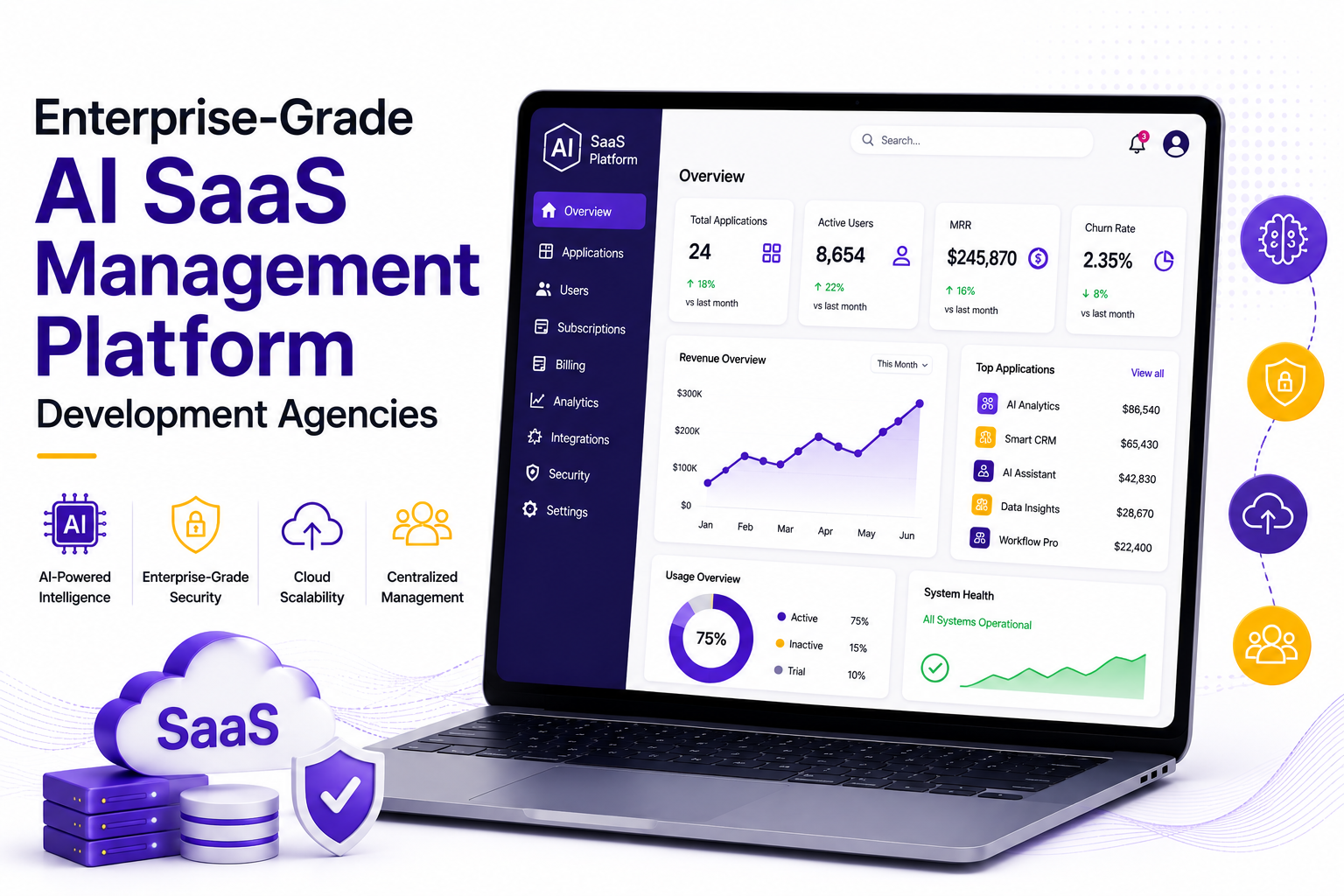

Somewhere between deciding to add AI to your SaaS product and actually shipping something enterprise clients trust sits a graveyard of half built dashboards, abandoned chatbot pilots, and burned runways. Most founders do not fail because the idea was weak. They failed because they picked a development partner that could write code but could not deliver an enterprise-grade AI product that holds up under real usage, real compliance pressure, and real scale.
That is the gap this list is meant to close. We looked at twenty agencies that specialize in building enterprise-grade AI SaaS management platforms, the kind of systems built on multi-tenant architecture, security compliance, and AI features that actually change how a business runs instead of just decorating a landing page. Some of these teams are also the ones founders turn to when they need an AI Project Management Tool built from the ground up instead of stitched together from three different plugins.
Whether you are comparing vendors for the first time or replacing one that did not deliver, this guide gives you enough detail to build a shortlist without spending three weeks reading review sites.
What "Enterprise-Grade" Actually Means Here
Before comparing names, it helps to agree on what the label actually means. An enterprise-grade AI SaaS platform has to handle multi-tenant data isolation properly, so one client's information never leaks into another's dashboard. It needs security certifications that actually matter to procurement teams, things like SOC 2 Type II or ISO 27001, not just a line on a homepage. And the AI inside it has to be doing real work, forecasting, classification, document processing, or automation, rather than sitting on top as a chatbot widget that answers three FAQ questions.
The agencies below were chosen because they have shipped platforms that meet that bar, not because they mention AI a lot in their marketing copy.
Why an AI Project Management Tool Keeps Coming Up in These Conversations
Here is something worth noticing before you start shortlisting. A large share of the enterprise buyers evaluating an agency for an AI SaaS platform are, underneath the branding, really asking for one specific thing: a system that manages projects, resources, and deadlines with AI doing the heavy lifting instead of a spreadsheet. If that sounds like your project, pay close attention to which agencies below have already built an AI Project Management Tool for a past client. It is a different build than a generic AI chatbot, and firms that have done it before will show you proof instead of a promise.
The 20 Agencies to Shortlist
1. Hourly Developers
Hourly Developers, running under the hourlydeveloper.io brand, positions itself as a flexible developer hiring platform rather than a traditional single project agency. Businesses can bring on AI and machine learning engineers, full stack developers, backend specialists, or mobile teams on an hourly, part time, or full time basis, and swap people in or out as the project changes shape. The company has built a reputation around fast onboarding, a replacement guarantee if a developer is not the right fit, and a genuinely wide bench that spans AI integration, React, Java, and cloud native backend work. For founders who are not sure yet whether they need a two person team or a fifteen person one, this kind of flexible model removes a lot of the upfront commitment risk, which is exactly why it tops this list.
Best fit for: Founders who want to scale a team up or down without renegotiating a contract every time.
2. Backend Development Company
As the name suggests, Backend Development Company does not try to be everything to everyone. Its entire practice is built around server side engineering, API architecture, database design, and the kind of infrastructure work that underpins a scalable SaaS product but rarely gets attention in a pitch deck. That focus makes it a strong fit for teams that already have a frontend, a designer, or an in house product lead, and just need a partner who can own the backend with precision. Its hiring model follows the same flexible structure common in this space, letting clients bring developers on hourly or dedicated contracts depending on project scope.
Best fit for: Teams that already have design and frontend covered and just need backend firepower.
3. Simform
Simform has built a strong reputation as a product engineering company rather than a pure staffing shop, which shows in how it approaches AI SaaS builds. The team leans on React, Next.js, and Python backed by TensorFlow and PyTorch to construct cloud native platforms meant to scale from day one, not get rebuilt eighteen months in. With more than 200 completed projects and consistently strong rankings on independent review platforms, Simform tends to attract startups and mid market enterprises that want architecture decisions made correctly the first time.
Best fit for: Startups and mid-market companies that want architecture done right the first time, not patched later.
4. HireFullStackDeveloperIndia
Founded in Ahmedabad, Gujarat back in 2004, HireFullStackDeveloperIndia has quietly built one of the longer track records on this list. The team, which sits in the 11 to 50 employee range, covers full stack, backend, frontend, mobile, and even blockchain development, all under NDA backed confidentiality agreements. Its hiring process is refreshingly transparent. A business shares its requirements, gets a shortlist of developer profiles, interviews them directly, and only then commits. For enterprise buyers who want visibility into exactly who is writing their code before signing anything, that level of transparency stands out.
Best fit for: Buyers who want full visibility into individual developer profiles before committing to anyone.
5. RaftLabs
With more than nine years in the SaaS space, RaftLabs has worked across web, mobile, and AI products for clients including Aldi and Vodafone. The firm's specialty sits in fintech, martech, healthcare, and streaming media, and it markets a full code ownership model, meaning clients keep complete control of what gets built rather than depending on the agency for future changes. RaftLabs also tends to move fast, often shipping usable software in a matter of weeks rather than months, which appeals to founders racing to validate a product before runway runs out.
Best fit for: Fintech, martech, and healthcare founders who want full code ownership from day one.
6. HireAIDevelopers
HireAIDevelopers built its identity around one specific promise, connecting businesses with vetted AI developers rather than general purpose coders who picked up machine learning on the side. With more than 180 professionals and over 120 AI projects delivered, the team leans heavily into generative AI, data engineering, chatbot development, and recommendation engine work. Clients describe a smooth onboarding process and consistent communication throughout, and the company reports a client retention rate above 95 percent. For companies whose AI SaaS platform genuinely needs the intelligence to be the core product rather than a bolt on feature, this is a natural agency to talk to.
Best fit for: Companies where the AI itself is the product, not a feature bolted onto one.
7. Apptunix
Apptunix positions itself as a US based AI development company that builds custom solutions specifically for SaaS businesses, spanning AI agents, predictive analytics, and chatbot systems designed to reduce support load rather than just look impressive in a demo. Its process runs from initial AI consulting through to deployment, which matters for founders who need help shaping the AI strategy itself, not just implementing a spec someone else wrote. Apptunix is frequently mentioned alongside larger firms despite its more boutique size, largely because of consistent delivery quality.
Best fit for: Founders who need AI strategy help before development even begins, not just implementation.
8. SoluLab
SoluLab operates a blended delivery model with teams across the US and India, covering AI, blockchain, and mobile development under one roof. That breadth makes it a flexible option for founders who are not entirely sure yet where their product will end up technically, since the same team can pivot across disciplines without bringing in a second vendor. SoluLab's pricing tends to be competitive relative to firms with a narrower focus, and its client base ranges from early stage startups to established enterprise accounts, giving it real experience at both ends of the SaaS lifecycle.
Best fit for: Teams that want one vendor covering AI, blockchain, and mobile without extra handoffs.
9. CMARIX
CMARIX has delivered more than 150 SaaS projects, giving it a depth of pattern recognition that shows up in how quickly its team can scope a new build. Its backend expertise spans Node.js, Python, ASP.NET, and Laravel, and its AI work focuses on automation, predictive analytics, and machine learning integration layered onto existing SaaS products. CMARIX also builds white label SaaS solutions that clients can rebrand and resell, which opens up a secondary revenue stream some founders had not considered until the conversation came up. Hourly, fixed cost, and dedicated team engagement models are all on the table.
Best fit for: Businesses that want a white-label SaaS option alongside standard custom development.
10. Bacancy Technology
Bacancy Technology runs a team of more than 1,050 developers, giving it the kind of bench depth that smaller agencies simply cannot match when a project needs to scale quickly. Its backend specialists work across Ruby on Rails, Golang, Node.js, and Laravel, building enterprise level architecture designed to stay stable under real production load. One detail worth knowing before signing anything is that Bacancy offers a free trial period so clients can evaluate code quality, communication, and delivery pace before committing to a longer engagement, which lowers the risk of a bad first hire.
Best fit for: Projects that need serious engineering scale fast, backed by a large developer bench.
11. Aglowid IT Solutions
Aglowid IT Solutions built its name as a web development company, but its dedicated backend division has become one of its stronger offerings, particularly for Ruby on Rails and Python projects. The team can onboard a backend developer within 24 to 48 hours of final confirmation, which matters when a scaling issue cannot wait for a normal recruitment cycle. Aglowid's client roster spans small and medium businesses through to larger multinational accounts, and its backend engineers follow Agile and Scrum methodology as a default rather than an add on.
Best fit for: Companies with an urgent backend hiring gap that cannot wait weeks to fill.
12. Xcelacore
Founded in Chicago in 2014 by Mansoor Anjarwala and Adnan Adamji, Xcelacore brings enterprise grade engineering capability to startups and growth stage companies without the overhead that usually comes with a large consultancy. Its work spans custom software development, cloud and data infrastructure, and AI integration across healthcare, financial services, ecommerce, manufacturing, and education. That cross industry range matters more than it sounds, because the architectural patterns that work for a regulated healthcare SaaS product look nothing like the ones built for a high throughput ecommerce platform, and Xcelacore has genuine experience in both.
Best fit for: Growth-stage companies that want enterprise-level engineering without a large consultancy's overhead.
13. TechAhead
TechAhead skips the one size fits all platform pitch entirely, designing custom AI systems around what a specific business actually needs, whether that is AI agents, generative AI tools, or workflow automation woven into existing enterprise software. In April 2026, the company became an official OpenAI Services Partner, a status reserved for firms recognized for designing and scaling production grade AI solutions on OpenAI's models. TechAhead also holds SOC 2 Type II certification and AWS Advanced Tier partner status, two credentials that enterprise procurement teams tend to check first before anything else.
Best fit for: Enterprises that specifically want an OpenAI-certified partner with governance built in.
14. NineTwoThree
NineTwoThree, based in Boston, has 13 years of experience and more than 150 completed projects behind it, with a client list that includes Consumer Reports, FanDuel, SimpliSafe, Experian, and Suffolk Construction. What sets the team apart is its composition, with PhD level machine learning engineers working alongside certified product managers, which shows in how the firm architects systems meant to handle millions of users rather than a few hundred pilot testers. NineTwoThree has been ranked the number one Boston agency by an independent review platform and has appeared on a fastest growing companies list for five consecutive years.
Best fit for: Organizations that need production-grade AI systems handling millions of real users.
15. Kodexo Labs
Kodexo Labs has been operating for more than 11 years and has completed over 135 projects across more than 25 industries, working with over 120 clients globally. Its focus sits squarely on conversational AI, generative AI, and custom LLM integration, building systems meant to streamline operations and improve customer engagement at scale. For enterprise buyers specifically looking for a partner who can also build the internal workflow layer, including something functioning as an AI Project Management Tool for coordinating teams and deadlines, Kodexo Labs has relevant experience worth asking about directly.
Best fit for: Buyers who also need the internal workflow or coordination layer built alongside the AI.
16. Technource
Technource operates as a product engineering company rather than a pure development shop, with a specific focus on building scalable SaaS platforms, AI powered applications, and workflow automation tools. The firm tends to work best with founders who want a partner involved in product strategy, not just execution, since its process leans into shaping the roadmap before a single line of code gets written. Technource's engagement models are structured to match different stages of a company's growth, from an early MVP through to a full enterprise platform build.
Best fit for: Founders who want a product strategy partner, not just an execution vendor.
17. Intellectyx
Intellectyx runs a matching model that can get AI developers in front of a client within 24 hours, considerably faster than the multi week interview cycles common at larger agencies. Its developers have built AI agent systems for ecommerce, healthcare, logistics, and finance clients, covering everything from customer support automation to fraud detection. Intellectyx has picked up recognition from global outsourcing industry bodies for its delivery quality, and it offers round the clock support for clients who need ongoing maintenance rather than a one time build.
Best fit for: Companies that need AI talent matched and onboarded in a single business day.
18. Innowise
Innowise operates as a broader software house with a genuinely strong backend development practice, building for fintech, healthcare, and ecommerce clients who need systems that will not buckle under real transaction volume. Beyond standard backend work, the team has experience with real time messaging and streaming infrastructure, along with machine learning driven analytics, natural language processing, and computer vision features layered into existing products. That range makes Innowise a reasonable fit for SaaS platforms that need more than one specialized capability under a single roof.
Best fit for: SaaS products that need more than one specialized capability under a single roof.
19. Prismetric
Prismetric has built a full service AI web and mobile development practice with a client footprint spanning the US, UK, and Australian markets. Its technical approach combines React and Flutter on the frontend with Python and TensorFlow on the backend, and the firm has picked up multiple awards from independent software review platforms for delivery quality. Prismetric also offers a fixed cost project model, which gives startups and small to medium businesses budget predictability that is genuinely hard to find elsewhere in this space, especially for AI features where scope tends to shift mid project.
Best fit for: Startups that want fixed-cost budget predictability on an AI-heavy build.
20. WebClues Infotech
WebClues Infotech started as a full service web development company and has steadily grown a genuine AI practice on top of that foundation, building AI features across mobile apps, SaaS platforms, enterprise software, and ecommerce systems. The team has become particularly known for marketplace and on demand app builds, the kind used in grocery delivery, fleet management, and food ordering, where AI driven demand forecasting has a direct and measurable impact on margins. For SaaS founders building anything with an on demand or marketplace component, that specific experience is worth asking about.
Best fit for: Marketplace and on-demand platforms that depend on accurate AI-driven demand forecasting.
A Quick Note on Pricing
Pricing across this list varies more with location and seniority than with the agency's reputation. Offshore-heavy teams in India and Eastern Europe tend to sit in the 25 to 60 dollar per hour range, while US and UK based senior AI talent often run 90 to 200 dollars per hour. Neither end is automatically the smarter choice. A lower rate only saves money if the team actually has the AI depth your project needs, and a premium rate only earns its price if it comes with real production experience, not just a polished sales deck. Ask every agency on this list for a breakdown by role, not a single blended number, since that is where hidden costs usually show up later in the project.
Final Thoughts
Picking a partner for something this important is not really about finding the agency with the shiniest case study page. It comes down to matching your actual constraints, your budget, your timeline, your compliance obligations, against what a firm has genuinely shipped before, not what it claims it can build.
Start narrow. Take the three or four names from this list that fit your industry and budget, and ask each one the same question: show me a live enterprise client running something close to what you need, right now, today. If they cannot produce that, treat it as a warning sign no polished pitch deck can cover.
And if what you are really building underneath the AI branding is an AI Project Management Tool, say that plainly on the first call. Agencies that have shipped that exact category of product will tell you within minutes. The ones that have not will start improvising, and that hesitation is exactly the signal you are listening for.