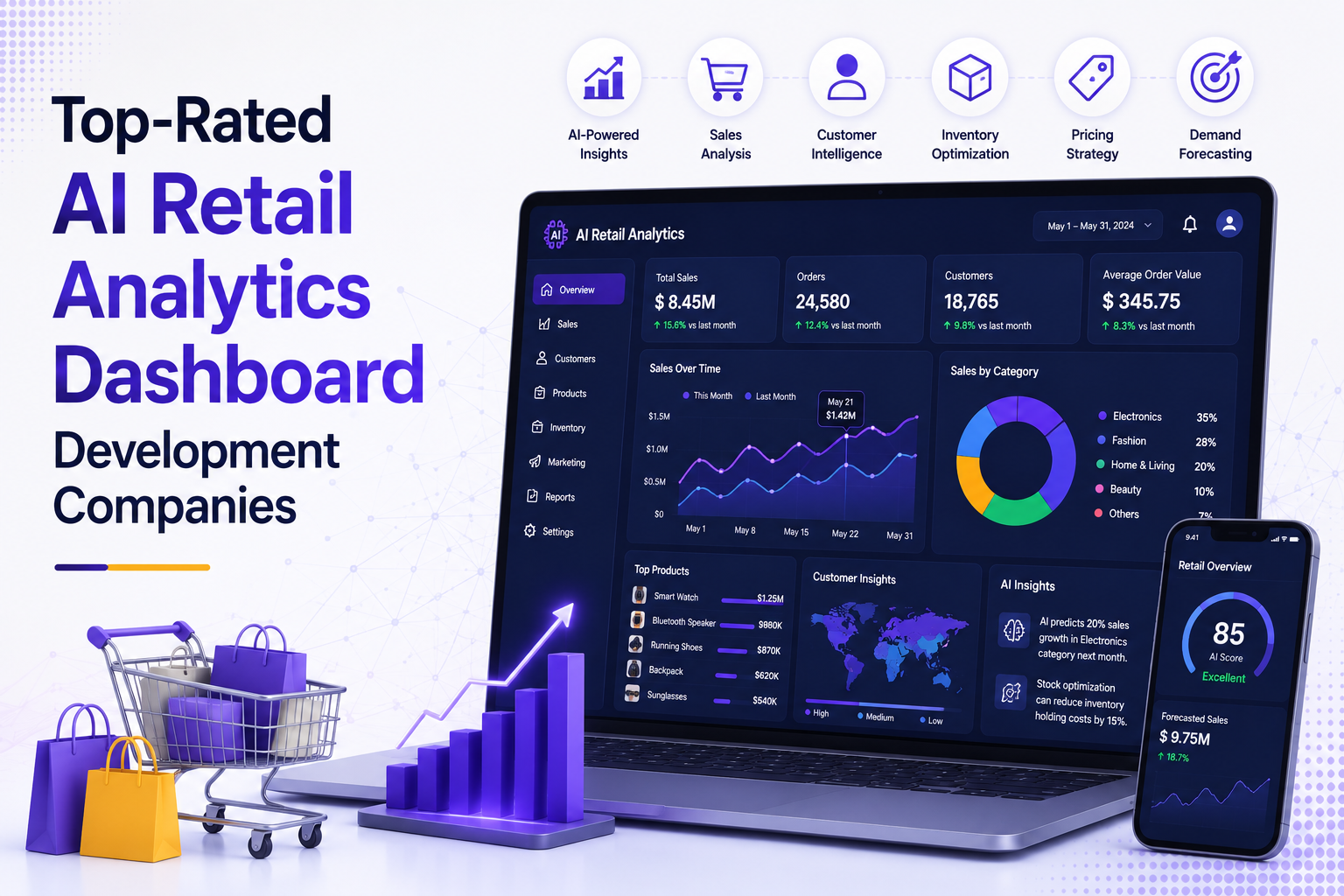

Retail leaders do not lose sleep over whether to use data. They lose sleep over which numbers to trust when three different reports say three different things about the same store on the same afternoon. That gap between having data and actually using it well is exactly why an AI Retail Analytics Dashboard has become such a practical priority for retail businesses heading into 2026, rather than just another item on a technology wishlist that never quite gets funded.
A dashboard sounds simple until you try to build one that pulls inventory counts, footfall numbers, pricing changes, and customer behavior into a single screen that a store manager can actually glance at during a lunch break and understand without a training session. That is a development problem, not a design problem, and it needs a team that has actually shipped this kind of system before, not one that is learning retail data on your budget and your timeline.
The market for this kind of work has also matured quickly. What used to require a six figure enterprise contract can now be built by a focused team of three or four developers within a couple of months, provided you pick a partner whose experience actually matches the size and complexity of your retail business. That is the whole point of comparing options carefully rather than going with whichever name comes up first in a search.
This guide walks through 18 AI Retail Analytics Dashboard Development Companies that build these systems for a living. Some are large consulting firms with retail practices going back decades and client rosters full of household names. Others are lean, focused development teams that move faster and charge considerably less. Both kinds show up on this list because both kinds get hired regularly, depending entirely on what a business actually needs at this stage of its growth.
What to Look For Before You Hire
Before comparing names, it helps to know what actually separates a good partner from an average one. Look for a team that has worked with retail data specifically, since inventory turnover, seasonal demand spikes, and multi-location reporting behave very differently from data in other industries like healthcare or finance. Ask to see a past dashboard, even just a screenshot or a short walkthrough video, because a company that has genuinely built one before will show you without hesitation and can usually speak fluently about the tradeoffs they made.
Communication style matters just as much as technical skill, especially for a project that will likely need adjustments after launch as you learn what the dashboard actually needs to surface. A team that explains its decisions in plain language, rather than burying everything in technical jargon, tends to produce a better end product because you can actually give useful feedback along the way instead of nodding along and hoping for the best.
Understanding Pricing Models
Pricing models vary quite a bit across this list, and none of them is automatically better than the others. Some companies charge a fixed project fee once the scope is locked in, which works well if you already know exactly what the dashboard needs to show. Others bill hourly, which suits projects where the requirements are likely to shift as the build progresses. A smaller number offer dedicated developers on a monthly retainer, which tends to make sense for retailers who expect ongoing feature requests well past the initial launch.
It is worth asking any shortlisted company how they handle scope changes, since this is where budgets tend to quietly balloon. A partner who has a clear, written process for handling new requests mid-project is usually more reliable than one who simply agrees to everything up front and figures out the details later.
With that groundwork in place, here are 18 companies worth putting on your shortlist for building an AI Retail Analytics Dashboard in 2026.
1. HireFullStackDeveloperIndia
HireFullStackDeveloperIndia offers dedicated full stack teams that handle both the data layer and the user-facing dashboard, which appeals to retail businesses wanting one team responsible for the entire build rather than juggling separate front-end and back-end vendors who may not communicate well with each other. Their developers commonly work with React, Node.js, and Python for the analytics layer, and the company is known for competitive rates without a heavy compromise on communication or project management, which is not always a given at this price point. This combination makes them a popular choice among mid-sized retailers building their first custom dashboard rather than relying on an off-the-shelf analytics tool that does not quite fit their specific store layout or product categories. Clients also mention that revisions during development tend to move quickly, since the same team owns both the data logic and the visual interface rather than passing feedback back and forth between two separate vendors.
2. Accenture
Accenture runs one of the largest retail technology practices in the world, and its data and AI division has delivered dashboard and analytics platforms for some of the biggest names in global retail, from grocery chains to luxury fashion houses. Its strength lies in end-to-end delivery, covering data strategy and warehouse architecture all the way down to the actual dashboard interface, backed by industry researchers who understand retail seasonality, supply chain patterns, and regional buying behavior in genuine depth. This breadth comes at a higher price point and longer engagement timelines, often stretching several months before the first working version reaches store managers. As a result, Accenture tends to suit large retail groups with complex, multi-region operations rather than single-location stores looking for a quick, budget-conscious build. Retailers who do choose Accenture usually value the access to its broader research arm, which regularly publishes consumer behavior studies that can quietly shape how a dashboard's metrics are chosen in the first place.
3. Backend Development Company
As the name suggests, Backend Development Company focuses heavily on the infrastructure side of analytics, building the data pipelines, APIs, and server architecture that keep a retail dashboard fast and reliable even under heavy transaction loads during peak shopping periods. Retail businesses with high daily order volumes often need this kind of backend attention more than flashy front-end design, and this team specializes in exactly that, handling database optimization and real-time data syncing as core parts of every engagement. They frequently partner with in-house design teams or smaller front-end shops, acting as the engine behind the dashboard rather than delivering the whole visual package themselves. This arrangement works well for businesses that already have a design direction in mind but need the technical build handled by people who genuinely understand how to keep systems stable at scale. Retailers running flash sales or holiday traffic spikes tend to notice the difference here, since a dashboard that lags or crashes during the busiest hour of the year defeats the entire point of building one.
4. IBM
IBM's retail analytics offering leans on its long history in enterprise data systems, and its dashboards are typically built around IBM Cognos or Watson-powered analytics engines that have been refined across thousands of enterprise deployments. The company is well suited to retailers who already run other IBM infrastructure, since integration tends to be noticeably smoother within its own ecosystem compared to bolting on a third-party analytics layer. IBM's dashboards are known for strong predictive modeling capabilities, particularly around demand forecasting, inventory optimization, and identifying early warning signs of stock shortages before they actually happen. Onboarding and setup can take longer compared to smaller, more agile development teams, so retailers in a genuine hurry should factor that timeline into their decision before signing anything. On the other hand, retailers willing to invest the setup time often end up with a system that keeps improving on its own as it processes more historical sales data over successive seasons.
5. Hourly Developers
Hourly Developers has built a solid reputation by offering flexible, hourly hiring models for retail and e-commerce data projects, which makes it a practical starting point for businesses that are not yet ready to commit to a large fixed-price contract. Their teams work on inventory dashboards, demand forecasting tools, and customer analytics panels, and they are comfortable integrating with POS systems like Shopify, Square, and Lightspeed as well as more niche inventory platforms used by specialty retailers. What stands out is the transparency in billing, since clients can scale developer hours up or down as the project matures, without renegotiating an entire contract every time priorities shift. This flexibility, combined with genuinely responsive project managers, makes them a strong fit for small and mid-sized retail chains testing out their first analytics dashboard before deciding whether to expand into a bigger, more ambitious build later on. Their project managers also tend to check in weekly rather than waiting for a client to chase updates, which small retail teams juggling multiple vendors at once genuinely appreciate.
6. Google Cloud
Google Cloud's retail analytics tools, built around BigQuery and Looker, give retailers a strong foundation for building dashboards that can handle massive datasets without slowing down, even when pulling years of historical sales data alongside live transaction feeds. Their strength is in real-time data processing, which matters considerably for retailers tracking live footfall, dynamic pricing changes, or flash sale performance as it happens rather than in a report the next morning. Businesses that choose Google Cloud usually need an implementation partner to actually build the dashboard interface on top of the raw infrastructure, since Google's own team focuses more on the underlying platform than on custom front-end development tailored to a specific retail brand. Retailers already comfortable with cloud infrastructure tend to get the most value here, since Google Cloud's tools reward teams that can maintain and query the underlying data warehouse themselves after the initial build wraps up.
7. Capgemini
Capgemini brings a consulting first approach to retail analytics, often starting engagements with a discovery phase that maps out exactly what data a retailer already has and what a dashboard should realistically surface before writing a single line of code. This tends to result in dashboards that are well aligned with actual business questions rather than generic templates copied from a previous client's project. Capgemini's retail clients span grocery chains, fashion retailers, and specialty stores across multiple continents, and the company is known for strong project documentation throughout every phase, which matters considerably for retailers that need to hand off the finished system to an internal team eventually rather than staying dependent on the vendor indefinitely. This documentation habit tends to pay off two or three years down the line, when a retailer's internal IT team needs to modify a report or add a new store without calling Capgemini back in for a small change.
8. HireAIDevelopers
HireAIDevelopers specializes specifically in the machine learning components that sit behind a modern retail dashboard, including demand prediction models, customer segmentation algorithms, and anomaly detection systems built to flag fraud or inventory shrinkage before it becomes a real financial problem. Rather than building the whole dashboard from scratch, they often plug into an existing front-end or partner with another development shop to handle the AI layer alone, working as a specialist rather than a generalist. Retailers who already have a working dashboard but want to add smarter forecasting, personalized product recommendations, or better anomaly detection tend to bring this team in for that specific upgrade rather than commissioning a full rebuild from the ground up. Because the team works across multiple existing platforms rather than one proprietary system, they tend to be comfortable adapting their models to whatever data structure a retailer already has in place.
9. Deloitte Digital
Deloitte Digital pairs its retail industry research with a dedicated technology arm, which means the dashboards it builds tend to come with a fair amount of strategic thinking behind them, not just a technical build handed over at the end of a contract. The firm often works with retailers on broader digital transformation projects, where the AI Retail Analytics Dashboard is one piece of a much larger initiative involving supply chain modernization, customer experience redesign, and store operations overhaul. This makes Deloitte a natural fit for retailers already engaged in a bigger transformation effort rather than those simply wanting a standalone dashboard built quickly and cheaply. Retailers who go this route often describe the process as slower to start but more thorough overall, since the dashboard ends up reflecting decisions made earlier in the broader transformation plan.
10. Tata Consultancy Services
Tata Consultancy Services, widely known as TCS, has decades of experience serving retail clients across North America, Europe, and Asia, and its analytics division has built dashboards for grocery chains, apparel brands, and large online marketplaces operating at genuinely massive scale. TCS is known for its ability to scale teams quickly for large projects, sometimes bringing on dozens of developers within weeks when a client's timeline demands it, and it often brings pre-built retail data models that speed up the early phases of a build considerably. The tradeoff for some smaller retailers is that TCS engagements are structured around larger, longer-term contracts rather than quick, tightly scoped projects with a short turnaround. Retailers with operations spanning several countries tend to benefit most, since TCS has existing experience navigating regional data regulations that can otherwise slow down an international rollout considerably.
11. DataEximIT
DataEximIT has carved out a genuine niche serving small and mid-sized retail businesses that want custom dashboards without the overhead and cost of a large consulting engagement. The team handles everything from data cleaning and warehouse setup to the final dashboard interface, and they are known for being unusually responsive during the build process, which matters for retailers who are new to working with a development team and need a bit of extra hand holding along the way without feeling like a low priority account. Their pricing tends to be more accessible than the larger firms on this list, making them a sensible option for businesses testing their first serious analytics investment before scaling up further. Clients frequently mention that the same core team stays involved from the first call through to launch, which cuts down on the miscommunication that can happen when a project gets passed between departments partway through.
12. Cognizant
Cognizant's retail and consumer goods practice has built analytics dashboards for supply chain visibility, in-store behavior tracking, and omnichannel sales reporting across a wide range of retail formats, from big box stores to boutique chains. The company tends to work well with retailers that already have a fairly mature data setup and want a partner to build a more sophisticated analytics layer on top of it, rather than starting the entire data infrastructure from scratch. Cognizant's global delivery model also means retailers can often get round the clock support during a build, which genuinely helps with projects that need fast turnaround on bug fixes or last minute feature requests before a launch date. Retailers operating across several time zones often single this out as one of the more practical reasons to work with a larger global delivery firm rather than a smaller regional team.
13. WebClues Infotech
WebClues Infotech builds custom web and mobile dashboards for retail clients, with a particular focus on e-commerce businesses that need to track sales, inventory, and customer behavior across multiple online storefronts at once. The team is known for clean, easy to navigate dashboard interfaces, which matters considerably for store managers and business owners who are not particularly technical and just need to glance at the numbers and understand what is happening without a manual. WebClues also offers post-launch support packages, which is useful for retailers who want ongoing maintenance and periodic feature updates rather than a one-time build that gets neglected the moment the contract ends. Small retail teams without a dedicated in-house developer tend to find this ongoing relationship reassuring, since someone is always available to fix an issue or tweak a report without starting a fresh vendor search.
14. Infosys
Infosys runs a dedicated retail analytics unit that has worked with department stores, grocery chains, and specialty retailers on building dashboards tied closely to demand forecasting and inventory planning at scale. The company's strength is in combining its own AI platform, Infosys Topaz, with custom dashboard development, giving retailers access to pre-trained retail models rather than starting entirely from zero on the machine learning side. Infosys engagements tend to suit retailers who want a single partner capable of handling both the AI modeling work and the dashboard build under one unified contract, rather than coordinating between two or three separate vendors on the same project. This tends to reduce the back and forth that often slows down projects where the AI modeling and the dashboard interface are built by entirely different teams working from separate briefs.
15. Wipro
Wipro's retail technology division builds analytics dashboards with a strong focus on supply chain and inventory visibility, which tends to appeal to retailers with complex distribution networks spanning multiple warehouses or geographic regions. The company has invested heavily in AI powered forecasting tools over the past few years, and its dashboards often include built-in alerts for stock shortages, slow moving inventory, or unusual sales patterns that might otherwise go unnoticed until it is too late to act. Wipro's project timelines and pricing structures are generally geared toward mid-sized to large retail businesses rather than small independent stores working with a tighter budget and a shorter timeline. Retail groups managing several regional warehouses in particular tend to appreciate how the alerts are tuned to flag issues before they cascade into a full stockout at the store level.
16. Persistent Systems
Persistent Systems focuses heavily on the engineering side of retail analytics, building dashboards that are designed to scale as a retail business grows from a handful of locations to hundreds without needing a complete rebuild along the way. Their teams are comfortable working with cloud platforms like AWS and Azure, and they are often brought in specifically for the technical architecture behind a dashboard rather than the strategic planning around what it should ultimately show. Retailers with an in-house product team looking for strong engineering support, rather than a full service consulting relationship, tend to work particularly well with Persistent on these kinds of projects. Their engineers are also known for writing clear technical documentation as they go, which matters a great deal once a retailer's internal team eventually takes over day to day maintenance of the system.
17. Softweb Solutions
Softweb Solutions, an Avnet company, specializes in AI and IoT powered retail analytics, including dashboards that pull in data from in-store sensors, foot traffic counters, and smart shelves alongside more traditional sales and transaction data. This makes them a strong choice for retailers with a genuine physical store presence looking to combine online and offline data into a single, coherent view rather than managing two separate reporting systems. Softweb's dashboards are known for visually clear layouts that make it easy to spot trends without digging through raw numbers or exporting endless spreadsheets just to answer a simple question about last week's sales. Backed by Avnet's broader hardware and IoT supply relationships, Softweb is also well positioned to help retailers who need to add new sensors or smart shelving as part of the same project.
18. Grid Dynamics
Grid Dynamics works primarily with larger retail and e-commerce brands, building analytics platforms that handle everything from personalized product recommendations to pricing optimization dashboards used across thousands of SKUs. The company has a strong engineering culture and is known for building systems that hold up under heavy traffic, which matters considerably for retailers with high volume online stores during peak shopping seasons like the winter holidays. Grid Dynamics tends to be a better fit for established retail brands with dedicated technical teams already in place, rather than for smaller businesses building their very first dashboard without existing engineering support. Their background in large-scale e-commerce platforms also means they tend to design dashboards with future growth in mind, rather than building something that needs to be rearchitected the moment a retailer doubles its store count.
Final Thoughts
Picking a development partner for an AI Retail Analytics Dashboard really comes down to matching a company's strengths to what your business actually needs right now, not what looks impressive on a polished agency website. A single-location boutique and a 200-store chain are not shopping for the same thing, even if both end up typing a nearly identical search into Google late on a Tuesday night.
The AI Retail Analytics Dashboard Development Companies on this list range from large global consultancies to focused, affordable development teams, and every one of them has a genuine place in the market depending on your budget, timeline, and how complex your retail data already is. Take the time to ask a few of them for a short call before committing to anything. The right partner should be able to explain, in plain language, exactly how they would approach your specific dashboard and your specific data, rather than simply reciting a list of past clients and hoping that is enough to win the business.