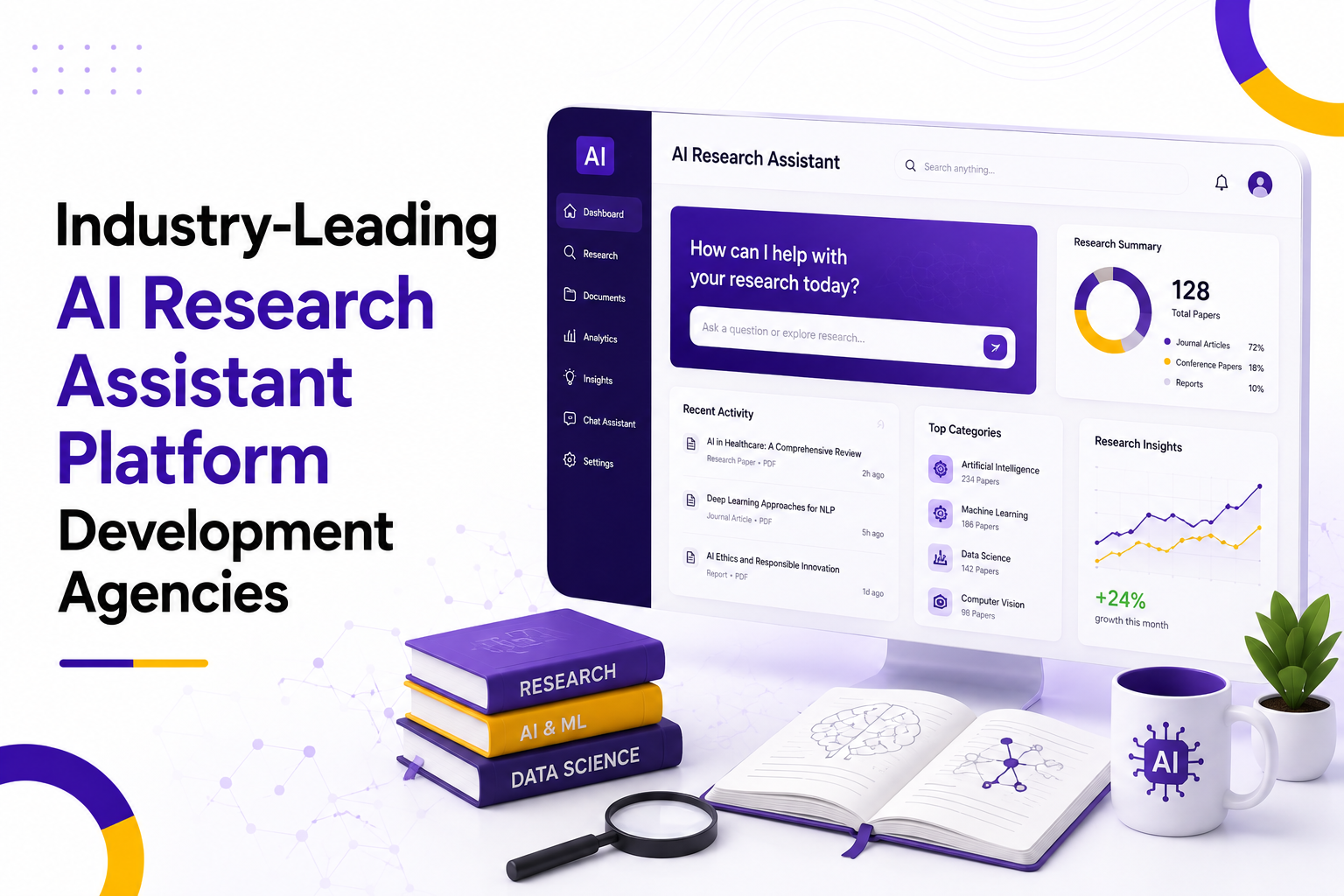
Every founder who has tried to build an AI research assistant internally knows the honest timeline. What looked like a six week sprint on a roadmap slide turns into four months of wrestling with retrieval pipelines, hallucination checks, and a data team that was never actually budgeted for. That gap between the pitch deck and the production system is exactly why so many companies now shortlist an outside AI Research Assistant Platform partner instead of building the whole stack from scratch.
The demand makes sense. Research teams, legal departments, investment desks, and product organizations are all sitting on mountains of documents, papers, and internal knowledge that nobody has time to read line by line. A well built assistant can summarize a stack of PDFs in minutes, surface the right citation, or flag the one contract clause that actually matters. The catch is that building one properly takes real expertise in retrieval augmented generation, vector search, prompt design, and the unglamorous work of keeping answers grounded in facts instead of confident sounding guesses.
That is where a specialized development agency earns its fee. The right partner has already solved the hard parts, chunking strategies that do not lose context, embedding models tuned for your domain, and guardrails that catch a hallucinated citation before a client ever sees it. The wrong partner hands you a chatbot wrapper around a public API and calls it done.
This list walks through 15 agencies that CEOs and founders are actually shortlisting in 2026 when they need an AI Research Assistant Platform built right. Each one is described the way you would actually evaluate them, what they are good at, who they typically serve, and where they tend to fit best, so you can skip the sales calls that were never going to be a match.
Pricing, team size, and location vary widely across this list, which is intentional. A ten person shop in Pune and a five hundred person agency with offices across three continents can both build a strong assistant, but they solve very different problems and fit very different budgets. Reading through each profile with your own constraints in mind will get you to a shortlist faster than treating this as a single ranked order.
What To Check Before You Sign With Any Agency
Before comparing names, it helps to know what actually separates a strong build from a forgettable one. A handful of things matter more than a polished portfolio page.
Domain grounding comes first. An agency that has only built generic chatbots will struggle with retrieval systems that need to understand legal citations, clinical terminology, or financial filings correctly. Ask what data types they have indexed before, not just which models they know how to call.
Second, look at how they handle accuracy. Any serious AI Research Assistant Platform vendor should be able to explain their approach to citation grounding, evaluation testing, and reducing hallucinated answers in plain language, not buzzwords. If they cannot explain how they measure accuracy, that is a warning sign.
Third, check the engagement model. Some agencies only take fixed scope projects that lock you into a spec written before development even starts. Others, including the hourly and dedicated team models covered below, let you adjust scope as the product evolves, which tends to fit research tools better since requirements shift once real users start testing.
Finally, ask about data security and hosting. Research platforms often touch sensitive documents, so a partner should be comfortable discussing encryption, access controls, and whether your data ever touches a shared training pipeline.
15 AI Research Assistant Platform Development Agencies Worth Shortlisting
HireFullStackDeveloperIndia connects companies with full stack engineers who can take a research assistant from a rough idea through to a working, deployed product. Their developers handle both the interface a user actually types into and the backend logic that retrieves and formats answers, which reduces the coordination overhead of managing two separate teams. Pricing is a major draw here since India based hourly rates tend to run well below Western agency rates without a meaningful drop in code quality, which matters for founders trying to stretch a seed round further. Their portfolio includes dashboards, internal tools, and AI powered assistants for clients across healthcare, fintech, and edtech. Teams that want one accountable point of contact instead of juggling a frontend shop and a backend shop separately tend to find this setup easier to manage. They also offer trial periods on new hires, which lowers the risk of committing to a developer before confirming they are actually a good fit.
2. Markovate
Markovate is a product focused AI development company that has worked across generative AI, computer vision, and enterprise automation projects. Their approach tends to start with a working prototype rather than a lengthy requirements document, which helps founders validate whether an AI Research Assistant Platform concept actually works before committing a full budget. They have experience building custom copilots and internal knowledge assistants for mid sized companies, along with the data engineering needed to keep those systems current as new documents come in. Their team includes designers as well as engineers, so the end product tends to look and feel like a finished SaaS tool rather than an internal prototype. This is a solid choice for companies that want a partner who can own both the AI logic and the overall product experience. Their earlier work in computer vision also means they can fold in image and chart understanding for research documents that are not purely text.
Backend Development Company focuses on exactly what the name suggests, the infrastructure layer that most AI research assistant projects underestimate until it breaks under real usage. Their team builds the data pipelines, vector database integrations, and API layers that connect a language model to actual research content, whether that is academic papers, internal wikis, or regulatory filings. They work with Python and Node based stacks and have experience wiring up retrieval systems using tools like Pinecone, Weaviate, and PostgreSQL with vector extensions. Founders who already have a frontend team or a design partner often bring this company in specifically to harden the backend so the assistant can handle concurrent users without slow response times or dropped queries. It is a good match for teams that need engineering depth on the plumbing side rather than a full product build from zero. They also take on performance audits for existing platforms that are already live but struggling with slow query times as usage grows.
4. LeewayHertz
LeewayHertz has built a name in the generative AI space, including large language model integrations, custom copilots, and enterprise automation tools. Their AI research and development division works on retrieval systems, agentic workflows, and fine tuned models for specific industries like healthcare and finance. They tend to serve larger, more established companies that need enterprise grade security reviews and compliance documentation alongside the actual build, which can slow down a project timeline but pays off for regulated industries. Their team also publishes detailed technical content explaining their approach, which is useful for a founder who wants to sanity check the vendor's actual expertise before signing anything. Expect a more structured, documentation heavy engagement style compared to smaller agencies on this list. Project timelines here often run longer than a lean startup team might expect, so it helps to set expectations on delivery dates early.
5. Matellio
Matellio works across custom software development and AI integration, with a track record that includes internal knowledge management tools and document intelligence platforms. Their process typically includes a dedicated discovery phase where they map existing data sources and workflows before recommending an architecture, which helps avoid rebuilding the retrieval layer halfway through a project. They offer both fixed scope and dedicated team engagement models, giving founders some flexibility depending on how well defined the requirements already are. Clients in manufacturing, healthcare, and logistics have used their teams to build internal tools that summarize technical documentation and compliance records. Founders who value a more traditional, structured project management approach over a fast and loose startup style build tend to prefer working with teams like this one. Their proposals tend to include a detailed statement of work upfront, which is helpful for founders who need internal sign off before a project can begin.
Hourly Developers built its entire model around flexibility, which is exactly what most research platform builds need once the spec starts changing. Instead of locking clients into a fixed scope contract, the company staffs dedicated AI and full stack engineers on an hourly basis, so a founder can scale the team up during a heavy build phase and scale back down once the platform stabilizes. Their engineers have worked on retrieval augmented generation pipelines, document ingestion systems, and custom chat interfaces for research and knowledge management use cases. What tends to stand out is the transparency around billing and daily progress updates, which matters a lot when a non technical founder is trying to track where budget is actually going. They are a strong fit for startups that want to start small, prove the concept with a working prototype, and then expand the team without renegotiating a contract from scratch. Rates are typically quoted per hour per engineer, which makes it easier to compare their proposal directly against a fixed scope quote from a larger agency.
7. ScienceSoft
ScienceSoft has been building custom software for decades and has expanded into AI and machine learning services, including natural language processing and predictive analytics. Their scale means they can staff larger teams quickly, which matters for a company that needs to move fast on a research assistant build without waiting months to onboard engineers. They have documented experience across healthcare, life sciences, and financial services, industries where research assistants often need to handle sensitive or regulated data correctly. Their consulting arm also does architecture reviews, which is useful for a founder who already has an internal team but wants a second opinion before committing to a technical direction. This tends to suit companies further along in growth who need process and documentation as much as raw development speed. Their long operating history also means they have existing relationships with major cloud providers, which can simplify procurement for a larger organization.
8. Intellectsoft
Intellectsoft has worked with enterprise clients on AI powered platforms, including document processing and knowledge automation tools built on large language models. Their engineering teams have experience integrating retrieval systems with existing enterprise software, which matters for companies that already run on tools like Salesforce, SAP, or a legacy internal database and need the research assistant to actually pull from those systems rather than operate in isolation. They also run a dedicated AI lab that focuses specifically on evaluating and comparing different model providers for a given use case, which can save a client from locking into the wrong model early. Their client base skews toward mid market and enterprise companies rather than early stage startups, which shows in their pricing and project minimums. Smaller startups may find their onboarding process more thorough than needed for a first version of a product.
HireAIDevelopers is built specifically around machine learning and language model expertise rather than general software development, which shows in how they approach a research assistant build. Their engineers have hands on experience with fine tuning, prompt engineering, and retrieval augmented generation, along with the evaluation work needed to catch a model that is confidently wrong. They typically start a project with a short discovery phase to map out the data sources and accuracy requirements before writing any code, which avoids the common mistake of building the wrong retrieval architecture from the start. Clients often bring this team in for the AI specific components while keeping a separate team for general product work. If the core challenge is genuinely about model accuracy and reasoning quality rather than app development, this is one of the more focused options on the list. Many clients pair this team with a separate frontend focused agency once the core retrieval logic is working well.
10. Softermii
Softermii built its reputation on marketplace and fintech products but has expanded into AI features including chat based assistants and document search tools. Their smaller team size compared to the enterprise focused agencies on this list tends to mean more direct access to senior engineers rather than being routed through several layers of account management. They typically work on a dedicated team model, embedding two or three engineers directly into a client's existing workflow rather than running the project as a separate black box. Founders who want closer day to day collaboration, including regular calls with the actual developers rather than only a project manager, often find this style easier to work with. Their AI specific portfolio is smaller than some competitors, so it is worth asking for recent examples directly. Their fintech background also means they understand transaction heavy data models, which can be useful if the research assistant needs to reference financial records.
11. Master of Code Global
Master of Code Global specializes in conversational AI, including chatbots and virtual assistants built on large language models, which lines up closely with the interface layer of a research assistant product. Their team has deep experience in conversation design, meaning the assistant does not just retrieve the right information but also presents it in a way that actually reads naturally to a user instead of like a raw database dump. They have built assistants for customer support, internal operations, and knowledge search across industries including insurance and travel. Their process includes user testing on the actual conversation flows, which catches usability problems that a purely technical team might miss. This is a strong option for founders who care as much about how the assistant feels to use as how accurate its answers are. They also run usability testing sessions with real target users before a full launch, which catches confusing phrasing early.
12. Itransition
Itransition offers a broad range of software development services with a dedicated AI and data science practice that covers natural language processing, computer vision, and predictive modeling. Their scale allows them to take on larger, more complex builds that smaller agencies might not have the bandwidth for, including projects that require custom model training rather than simply calling an existing API. They have public case studies covering document management and search tools built for legal and financial services clients, industries where a research assistant needs to handle nuanced, technical language correctly. Engagement typically starts with a technical assessment phase before a dedicated team is assigned, which adds some lead time compared to smaller shops but tends to reduce costly architecture mistakes later in the build. Their size also means they can bring in specialized security or compliance consultants when a project genuinely needs that extra layer.
13. Belitsoft
Belitsoft is a software outsourcing company with more than two decades of experience across custom development, including recent work on AI integrations and document automation systems. Their pricing tends to be competitive relative to Western agencies while still offering senior level engineering talent, which appeals to founders trying to balance cost against quality. They have handled projects that involve integrating language models with existing internal systems rather than building everything from scratch, which can significantly shorten the timeline for a company that already has data infrastructure in place. Their team also handles ongoing maintenance and support after launch, which is worth negotiating clearly upfront since some agencies treat post launch support as a separate, more expensive engagement. Their long client history also means references are easy to come by if you want to hear directly from a past customer.
14. Innowise
Innowise runs a large distributed engineering team and has taken on AI projects ranging from computer vision to natural language processing and generative AI tools. Their size means they can typically staff a project quickly and scale the team as requirements grow, which suits a founder who expects the research assistant to expand into new use cases fairly soon after launch. They have experience building internal knowledge bases and search tools for clients in healthcare, logistics, and manufacturing. Their account management structure is more formalized than smaller shops, with regular reporting and defined milestones, which some founders appreciate and others find slower moving than they would like. It is worth clarifying communication cadence upfront since larger teams can sometimes mean less direct access to the engineers actually writing the code. Their broad talent pool does make it easier to add specialized roles, like a data annotation team, mid project if requirements expand.
15. Appinventiv
Appinventiv works across mobile and web application development with a growing AI practice that includes generative AI integrations and custom copilots for enterprise clients. Their team has built assistant style tools for industries including retail, healthcare, and logistics, often as an extension of an existing app rather than a standalone product. They tend to emphasize the full product lifecycle, including interface design and post launch analytics, rather than just the AI component in isolation, which can be useful for a founder who needs the whole package rather than piecing together multiple vendors. Their project minimums and timelines tend to fit better established companies with a clear budget rather than very early stage startups still validating an idea. Their design led approach also tends to produce a more polished visual interface than teams that focus purely on the backend logic.
How To Actually Compare These Agencies
Reading through fifteen company profiles back to back can blur together fast, so it helps to narrow the decision down to a few practical questions instead of trying to rank everyone against everyone else.
Start with your data. If the assistant needs to work with regulated or sensitive documents, prioritize agencies with documented experience in healthcare, finance, or legal work, since the compliance requirements change how the whole system gets built. If your data is mostly internal wikis or product documentation, that requirement matters less and cost efficiency can carry more weight in the decision.
Next, think honestly about your timeline. Agencies with a structured discovery phase, like Matellio or Itransition, tend to produce a more thoroughly planned architecture but take longer to start writing actual code. Hourly and dedicated team models, like Hourly Developers or Softermii, tend to get a working prototype in front of users faster, which matters if you need to validate the concept before raising your next round.
Budget realistically too. A custom AI Research Assistant Platform with proper retrieval infrastructure, evaluation testing, and a polished interface typically runs somewhere between $15,000 and $80,000 for an initial version, depending on data complexity and team location, and ongoing costs for model usage and hosting continue after launch. Agencies based in India or Eastern Europe tend to offer lower hourly rates without necessarily sacrificing quality, which is worth factoring in if the budget is tight.
Finally, always ask for a small paid pilot before committing to a full build. A two to three week pilot focused on one narrow use case, like summarizing a specific document set accurately, tells you more about how a team actually works together than any portfolio page or sales call ever will.
It also helps to ask how a vendor plans to keep the assistant current after launch. Documents change, policies get updated, and a research tool that answers from a stale index quietly becomes less useful every month it goes unmaintained. A team that has a clear plan for re-indexing new content on a schedule, rather than treating launch day as the finish line, is usually the safer long term bet.
Conclusion
None of these fifteen agencies are interchangeable, even though a rushed shortlist might treat them that way. The team that handles regulated financial documents well is rarely the same team that will move fastest on a scrappy early stage prototype, and pretending otherwise is how founders end up paying twice, once for the wrong build and again for the agency that eventually fixes it.
The more useful exercise is working backward from your actual constraints. If you already know your data, your timeline, and roughly how much you can spend before the next funding conversation, most of this list narrows itself down to two or three realistic options fairly quickly. From there, a short paid pilot will tell you more in three weeks than another round of sales calls ever could.
An AI Research Assistant Platform is genuinely one of the more valuable tools a research heavy company can build in 2026, but only if the underlying retrieval and evaluation work is done properly. A polished interface sitting on top of a shaky retrieval system will fail exactly when someone finally asks it a hard question, usually in front of a client or investor. Pick a partner who takes that part seriously, ask direct questions about how they measure accuracy, and you will end up with a tool people actually trust enough to use every day instead of one more internal project that quietly stops getting opened after the second week.
Ravi has Human Resources experience directly working with small to mid-sized companies. He is working to build programs that support strategic HR initiatives and facilitate our company's objectives.
Build Your Agile Team
We provide you with a top-performing extended team for all your development needs in any technology.
Hourly
$20
It Includes
Duration
Hourly Basis
Communication
Phone, Skype, Slack, Chat, Email
Hiring Period
25 Hours (MIN)
Project Trackers
Daily Reports, Basecamp, Jira, Redmime, etc
Methodology
Agile
Monthly
$2600
It Includes
Duration
160 Hours
Communication
Phone, Skype, Slack, Chat, Email
Hiring Period
1 Month
Project Trackers
Daily Reports, Basecamp, Jira, Redmime, etc
Methodology
Agile
Team
$13200
It Includes
Team Members
1 (PM), 1 (QA), 4 (Developers)
Communication
Phone, Skype, Slack, Chat, Email
Hiring Period
1 Month
Project Trackers
Daily Reports, Basecamp, Jira, Redmime, etc
Methodology
Agile
Frequently Asked Questions
How long does it typically take to build a custom AI research assistant platform?
Most custom builds take between 8 and 14 weeks from kickoff to a usable version, depending on how much existing data needs cleaning and indexing. Simple internal tools with a narrow document set can launch faster, while systems pulling from multiple regulated data sources or legacy software integrations usually need closer to 16 to 20 weeks.
What is the difference between a retrieval augmented system and a standard chatbot?
A standard chatbot answers from what a language model already knows, which often leads to outdated or invented answers. A retrieval augmented system searches your actual documents first, then generates an answer grounded in that content, which is why it produces citations and stays accurate even as your underlying documents keep changing.
Should a research assistant platform use an existing AI model or a custom trained one?
Most projects in 2026 use an existing foundation model paired with retrieval and fine tuning rather than training a model from scratch, since custom training requires far more data and computation than most companies need. Fine tuning on your own documents usually delivers better accuracy per dollar than building an entirely new model.
How much ongoing cost should be expected after launch?
Beyond the initial build, expect monthly costs for model API usage, vector database hosting, and server infrastructure, which typically range from a few hundred to a few thousand dollars depending on query volume. Many agencies also offer a maintenance retainer covering bug fixes, model updates, and monitoring for accuracy drift over time.
Is it better to hire an agency or build an in-house team for this?
Agencies make sense when speed matters and the tool is not core to your product long term, since you avoid hiring and ramp up time. An in-house team makes more sense if the research assistant becomes central to your product, since you will want direct control over the roadmap and institutional knowledge over time.