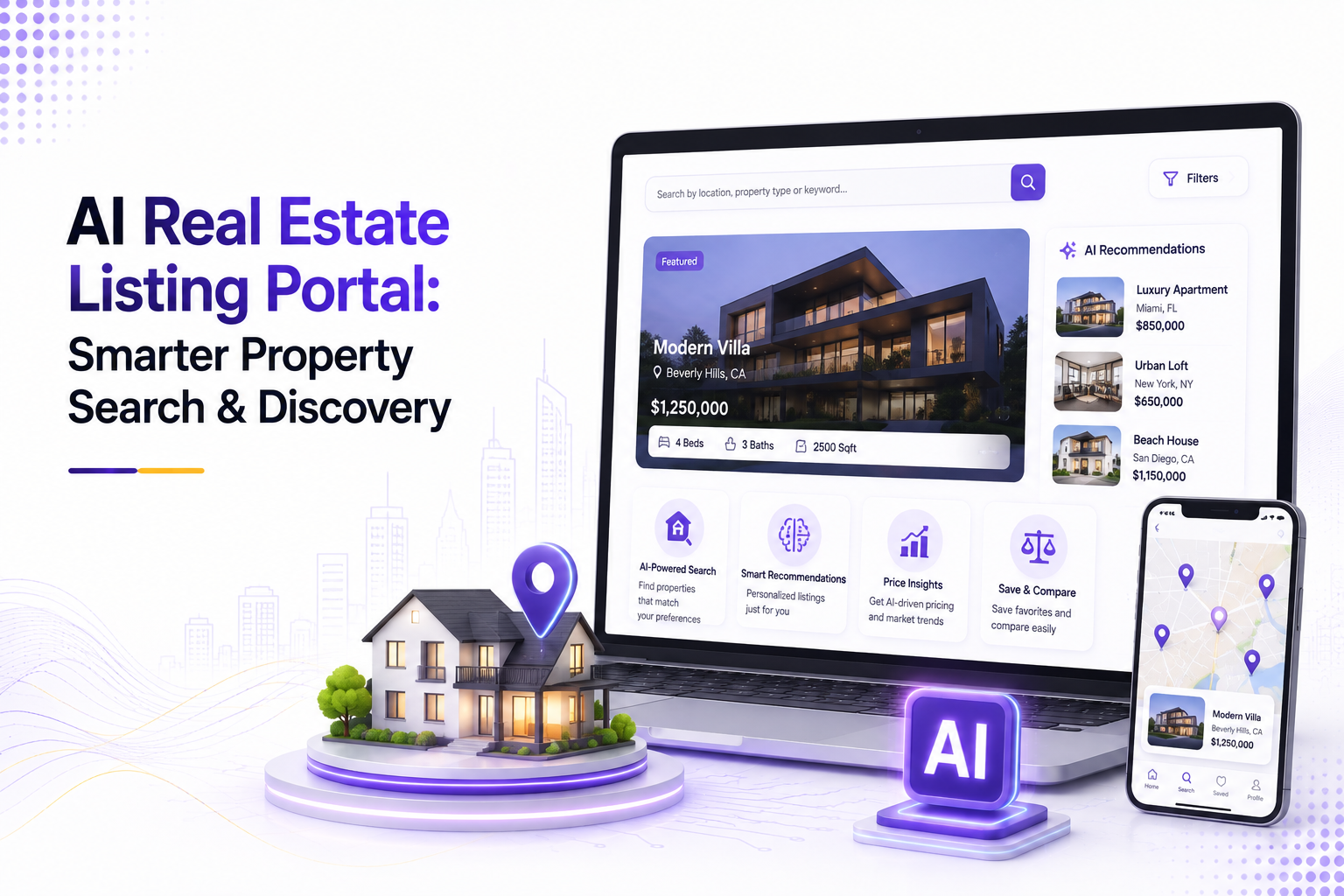

A buyer opens five different property apps before lunch. By evening, they had forgotten which listing had the balcony they liked and which one had the noisy road outside. This is not a buyer problem. It is a search problem, and it is exactly what an AI real estate listing portal is built to solve.
Real estate has always been about matching people to places. What has changed is how fast that matching needs to happen and how much data sits behind every decision. Static listing pages with basic filters no longer hold attention, and businesses that rely on them are quietly losing leads to competitors who search smarter.
This blog walks through what an AI property search platform actually does, why companies are investing in one right now, and what decision makers should know before greenlighting a build. No rankings, no vendor lists. Just the practical detail you need to have an informed conversation with your team or your development partner.
What Is an AI Real Estate Listing Portal?
An AI real estate listing portal is a property discovery platform that uses machine learning, natural language processing, and predictive analytics to understand what a buyer, renter, or investor actually wants, rather than only what they typed into a search box.
Think of it as the difference between a filing cabinet and a personal assistant. A traditional portal stores listings and lets you filter by price and bedrooms. An AI driven portal reads behavior, learns preferences, and surfaces properties a user did not know to search for.
Core capabilities typically include:
• Natural language search, so users can type or speak requests like "a quiet two bedroom near good schools under 80 lakhs"
• Visual and image based search that matches properties by photos rather than keywords
• Predictive pricing that estimates fair market value using recent transaction data
• Behavioral recommendation engines that refine results as the user browses
• Automated lead scoring that tells sales teams which enquiries deserve a call first
Key Takeaway: An AI real estate listing portal is not a bigger database. It is a smarter layer sitting on top of your listings that interprets intent and reduces the effort needed to find the right property.
Why Businesses Are Investing in AI Property Search Platforms
Real estate portals sit on enormous volumes of data, yet most of it goes unused. An AI property search platform turns that dormant data into decisions, which is a big part of why adoption has accelerated through 2025 and into 2026.
The business case in numbers and behavior
• Buyers now expect the same personalization they get from shopping and streaming apps, and real estate is catching up
• Agencies handling thousands of listings cannot manually tag, price, or match every property at scale
• Faster, more relevant search results directly reduce the time a lead spends comparing platforms before converting
• Portals with AI driven matching report stronger lead quality because unqualified browsing gets filtered out earlier
There is also a competitive pressure element. Once one major portal in a market introduces AI powered search, others feel pressure to follow, because users quickly notice which platform feels effortless and which one feels dated.
In short, this is no longer an experimental feature. It has become a baseline expectation for any serious property platform launching in 2026.
Key Business Challenges It Solves
Most real estate businesses do not start an AI project because they want AI. They start because a specific, recurring problem is costing them money or leads. Here are the most common ones.
Solving even two or three of these problems is usually enough to justify the investment, because each one has a direct, measurable cost attached to it.
Core Features That Matter Most
Not every feature adds equal value. Below are the features that decision makers consistently find worth prioritizing in the first version of an AI driven portal.
Intelligent Search and Filtering
This lets users search using natural phrases instead of rigid filters. It matters because most buyers do not think in checkboxes, they think in sentences, and AI closes that gap.
Personalized Recommendations
The system learns from clicks, saves, and time spent on a listing to suggest similar properties. This keeps users engaged longer and reduces the chance they leave for a competing platform.
Predictive Price Estimation
Machine learning models trained on historical sales and rental data suggest a realistic price range. Sellers get more accurate guidance, and buyers gain confidence that a listing is fairly priced.
Automated Property Valuation Reports
Instead of a single number, the platform generates a short report explaining what factors influenced the estimate, such as location, recent comparable sales, and amenities.
Virtual Tours and AI Enhanced Media
AI can enhance photos, generate floor plan summaries, and even flag poor quality images for reshoot. This directly improves how a listing performs in search.
Chat Based Property Assistants
A conversational assistant answers questions like loan eligibility ranges or neighborhood details instantly, reducing the load on human support staff.
Pro Tip: Launch with three or four high impact features rather than everything at once. A focused first release is easier to test, measure, and improve.
How the Technology Works
It helps to understand the flow of information behind the scenes, even if you are not the one building it.
1. Data collection: property details, images, pricing history, and user interactions are gathered continuously
2. Data processing: raw data is cleaned, standardized, and tagged so models can use it reliably
3. Model training: machine learning models are trained on this data to recognize patterns in pricing, preference, and demand
4. Inference: when a user searches, the trained models generate ranked, personalized results in real time
5. Feedback loop: user behavior on those results feeds back into the system, refining future recommendations
This cycle repeats continuously, which is why AI driven portals tend to get noticeably better the longer they run and the more data they collect.
AI Technologies Behind the Solution
These technologies rarely work in isolation. A single search result often draws on NLP to interpret the query, geospatial AI to rank by location relevance, and predictive analytics to sort by realistic pricing, all within a second or two.
Technology Architecture Explained
A typical AI real estate platform is organized in layers, and understanding this structure helps decision makers ask better questions during vendor discussions.
- Data layer: stores listings, user profiles, transaction history, and third party data feeds
- AI and machine learning layer: houses the models for search ranking, pricing, and recommendations
- Application layer: the web and mobile experience users actually interact with
- Integration layer: connects to CRMs, payment gateways, mapping services, and government land record APIs
- Analytics layer: tracks performance, user behavior, and business metrics for continuous improvement
A well designed architecture separates these layers cleanly, which makes it far easier to update the AI models later without rebuilding the entire platform.
Industry Specific Applications
The same underlying technology adapts differently depending on the type of real estate business using it.
Residential Sales and Rentals
Focuses heavily on lifestyle matching, school zones, commute times, and family friendly amenities.
Commercial Real Estate
Prioritizes footfall data, zoning compliance, and business suitability scoring for retail or office space.
Property Management Companies
Uses AI for tenant screening, maintenance request prioritization, and rent optimization across a portfolio.
Real Estate Investment Platforms
Relies on predictive analytics to identify undervalued properties and forecast rental yield or appreciation.
Whatever the segment, the goal stays consistent. Reduce the time between someone looking and someone deciding.
Implementation Roadmap
Building an AI enabled portal is not a single project, it is a sequence of stages, each with its own objective.
Stage 1: Discovery and Requirement Mapping
Objective: define exactly which problems the AI needs to solve. What happens: stakeholders map user journeys and current pain points. Why it matters: skipping this stage leads to AI features nobody actually needed. Expected outcome: a clear, prioritized feature list.
Stage 2: Data Audit and Preparation
Objective: assess what data already exists and what needs to be collected. What happens: listings, images, and historical transactions are cleaned and structured. Why it matters: AI models are only as good as the data feeding them. Expected outcome: a usable, reliable dataset.
Stage 3: Platform and Model Development
Objective: build the portal and train the core AI models. What happens: development teams build the application while data scientists train search and pricing models in parallel. Why it matters: parallel development shortens overall timelines. Expected outcome: a working platform with functioning AI features.
Stage 4: Testing and Calibration
Objective: validate accuracy and usability before launch. What happens: real users test search relevance, pricing accuracy, and recommendation quality. Why it matters: AI errors in real estate, like a wildly wrong price estimate, damage trust quickly. Expected outcome: a calibrated, trustworthy platform.
Stage 5: Launch and Continuous Improvement
Objective: go live and keep improving. What happens: the platform launches, and models are retrained regularly using fresh data. Why it matters: real estate markets shift, and static models go stale fast. Expected outcome: a platform that keeps getting more accurate over time.
Essential Modules Required in an AI Real Estate Listing Portal
Beyond the AI features, a functioning portal needs several foundational modules working together.
An AI real estate listing portal is only as strong as its weakest module, so it is worth resourcing these foundational pieces properly rather than treating them as an afterthought behind the AI features.
Security, Privacy, and Compliance Considerations
Property platforms handle sensitive financial and personal information, which makes security a non negotiable part of any build.
- Data encryption for personal, financial, and transaction data both in transit and at rest
- Role based access control so only authorized staff can view sensitive buyer or seller information
- Compliance with regional data protection regulations, including consent management for user data collection
- Secure API connections to third party services like payment gateways and land record databases
- Regular audits and penetration testing to identify vulnerabilities before they are exploited
Key Takeaway: Compliance is not a launch day checkbox. It needs to be designed into the architecture from the first sprint, especially where AI models process personal preference and financial data.
Common Mistakes Businesses Should Avoid
Several avoidable mistakes come up repeatedly when businesses build their first AI enabled property platform.
- Launching AI features before the underlying data is clean, which produces inaccurate recommendations
- Trying to automate everything at once instead of prioritizing the highest impact features first
- Ignoring mobile experience, even though most property searches now start on a phone
- Underestimating the ongoing cost of retraining and maintaining AI models after launch
- Choosing a development partner based on price alone without checking real estate specific experience
Most of these mistakes trace back to rushing the planning stage. A few extra weeks of preparation usually saves months of rework later.
Cost Factors That Influence Development
Development cost for an AI enabled portal varies widely depending on scope, and it helps to understand exactly what drives that number up or down.
What Affects the Budget
- Number and complexity of AI features, since predictive pricing models cost more to build than basic recommendation engines
- Volume and quality of existing data, because messy data requires extra cleaning and preparation work
- Platform scope, meaning whether you need web only, or web plus native mobile apps
- Third party integrations such as payment gateways, mapping services, and government land record APIs
- Ongoing model training and infrastructure costs after the initial launch
Essential features for a first release typically include search, listing management, and basic recommendations. Optional additions like advanced valuation reports or virtual staging can follow in later phases once the core platform proves itself.
- Startups: focus on one or two AI features that solve your biggest pain point, and expand gradually
- Mid sized businesses: invest in a fuller feature set with proper data infrastructure from day one
- Enterprises: budget for dedicated data science resources and continuous model improvement, not just a one time build
A realistic first version, covering core modules plus two or three AI features, generally takes between 4 to 7 months depending on team size and data readiness.
Build vs Buy vs Customize Decision Framework
This is one of the most consequential early decisions, and it is worth slowing down for.
A useful rule of thumb is to ask whether your search and recommendation experience is meant to be a core competitive advantage. If it is, a custom build usually pays off. If AI search is simply a table stakes feature you need to have, buying or customizing gets you there faster.
How to Measure ROI and Business Success
AI investments need clear success metrics from day one, otherwise it becomes impossible to know if the platform is actually working.
- Lead conversion rate: are AI ranked leads converting at a higher rate than unranked ones
- Average time to find a listing: is search actually getting faster for users
- Listing turnaround time: are properties selling or renting faster after AI pricing suggestions
- User retention and repeat visits: are people coming back instead of switching platforms
- Support ticket deflection: how many queries the AI assistant resolves without human involvement
Track these metrics for at least one full quarter after launch before making major decisions, since AI models need time and real usage data to reach their stable accuracy level.
Personalization Capabilities
Personalization is where users most directly feel the difference between an ordinary portal and an AI powered one.
- Adaptive search results that shift based on what a user clicks, saves, or ignores
- Personalized email or notification alerts when a matching new listing appears
- Custom pricing insights based on a user's stated budget and financing profile
- Saved preference profiles that carry across devices, so mobile and desktop stay in sync
Done well, personalization feels invisible. Users simply notice that results keep getting more relevant, without realizing how much is happening behind the scenes.
Scalability Considerations
A platform that works well with a thousand listings can behave very differently at a hundred thousand, so scalability needs to be planned early rather than patched later.
- Cloud based infrastructure that can scale computing resources up or down based on traffic
- Model retraining pipelines that handle growing data volumes without manual intervention
- Caching strategies for frequently searched locations to keep response times fast
- Modular architecture that allows new AI features to be added without disrupting existing ones
Businesses expanding into new cities or regions should also plan for localized data, since pricing patterns and buyer behavior can vary significantly from one market to another.
Real World Examples Related to AI Property Search
The table below illustrates practical scenarios showing how different types of real estate businesses have applied AI driven search and matching concepts.
These examples reflect common, realistic patterns seen across the industry rather than any single company's results, and they illustrate the kind of measurable outcomes businesses typically aim for.
Conclusion
Property search has quietly become a competitive battleground, and the platforms winning that battle are the ones that understand intent, not just keywords. An AI real estate listing portal gives businesses that edge, turning scattered data into faster matches, better leads, and properties that move instead of sit.
The businesses getting this right are not necessarily the ones with the biggest budgets. They are the ones asking sharper questions before they build, from data readiness to which features actually move the needle for their users. That clarity matters more than the size of the tech stack.
If you are evaluating an AI property search platform for your business, start with the problem you most need solved, whether that is lead quality, listing turnaround, or search abandonment. From there, talk to experienced AI real estate listing portal development companies who can map that problem to a realistic roadmap and a budget that fits your stage of growth. The right conversation now can save months of rework later.