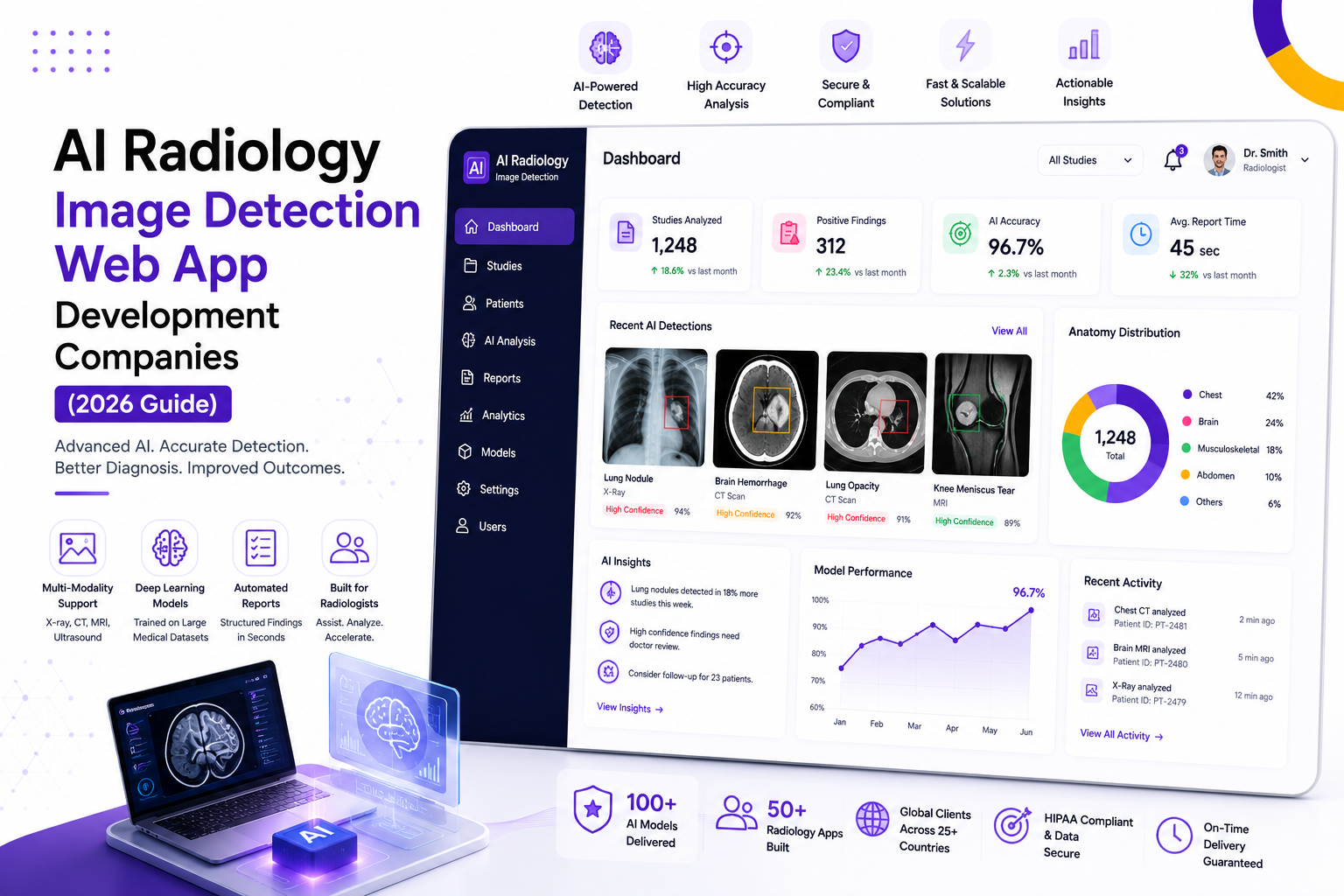

Somewhere in a hospital right now, a radiologist is staring at a scan that could change someone's life, and they have only a few minutes to read it properly. That kind of pressure is exactly what is driving one of the fastest growing corners of health tech today. Hospitals, diagnostic labs, and health tech startups are racing to build smarter imaging tools, and that race has created real demand for AI Radiology Image Detection Web App Development Companies that actually understand both software and medicine. This is not a space where you can hire any generic app developer and hope for the best. Building a platform that can spot a tumor on an MRI or flag a fracture on an X-ray means combining machine learning, medical imaging standards like DICOM, cloud infrastructure, and strict healthcare compliance, all inside one working web application. If you are a founder or a hospital decision maker trying to figure out who can actually pull this off, you are in the right place. Below is a practical, no fluff list of companies worth shortlisting in 2026, based on what they specialize in, who they serve best, and what makes each one genuinely different from the next.
What to Look For Before You Hire
A polished website and a long client logo wall do not tell you much on their own. What actually matters is whether a company has handled medical image data before, whether they understand formats like DICOM and standards like HL7 and FHIR, and whether they know the difference between a model that performs well in a research paper and one that holds up in a real clinical workflow. It also helps to check their comfort level with compliance frameworks like HIPAA and GDPR, since a radiology app that mishandles patient data is a liability, not a product. It is also worth asking how a company thinks about false positives and false negatives, since those tradeoffs matter more in medicine than in almost any other software category. A tool that misses too many findings is dangerous, but one that flags everything as suspicious just trains radiologists to ignore it. Finally, pay attention to how a company communicates during the sales conversation itself. If they cannot explain their process in plain English before you sign anything, that pattern usually continues after the contract is signed too, and you end up managing a black box instead of a partnership.
Why 2026 Is a Turning Point for Radiology AI
Imaging backlogs have been growing for years because there simply are not enough radiologists to keep up with demand, and that gap is now pushing hospitals to actively budget for AI assisted tools instead of just experimenting with them on the side. Cloud infrastructure has also matured enough that even smaller health tech teams can now afford to process and store large volumes of imaging data without needing their own data center. Put those two things together, growing clinical need and cheaper infrastructure, and you get a real market opening for AI Radiology Image Detection Web App Development Companies that can move fast without cutting corners on accuracy or compliance. That is exactly why this list matters more in 2026 than it would have even two or three years ago. There is also a quieter shift happening on the regulatory side. Agencies that once treated AI diagnostic tools with heavy suspicion have started publishing clearer approval pathways, which reduces some of the uncertainty that used to scare away smaller development teams from even attempting this kind of project. That predictability is drawing in more specialized vendors, which is good news if you are shopping around, since it means the pool of companies worth talking to has genuinely grown.
15 Industry-Leading AI Radiology Image Detection Web App Development Companies
1. Hourly Developers
Hourly Developers sits at the top of this list for a reason. The company has been in the game for over two decades, and what makes them stand out is flexibility. Instead of locking you into a rigid contract, they let you hire developers hourly, part time, or full time, which is genuinely useful when you are still figuring out the exact scope of your radiology imaging tool. Their team works across React, Node.js, Python, and Laravel, and they have handled projects that involve integrating AI models into web dashboards, building DICOM compatible viewers, and connecting apps to hospital PACS systems. For founders building an MVP, this pay-as-you-go model means you are not burning cash on a bloated in-house team before you even know if your product works. Another thing worth mentioning is how they scale engagements as a project grows. Many clients start small, testing a single feature like an upload and preview workflow for scans, before expanding into a full detection pipeline once the concept is validated. That gradual, low commitment approach lowers the risk considerably for a founder who is not yet sure how the product will evolve. Clients often mention their transparent communication and the way developers explain technical decisions in plain language, which matters when you are not a technical founder yourself and need to justify spending decisions to investors or a hospital board.
2. Backend Development Company
Most companies on this list handle both the front end and back end of an application. This one deliberately does not. Backend Development Company focuses only on server side architecture, and for a radiology imaging platform, that focus actually pays off. Processing and storing thousands of large medical image files, running AI inference at scale, and keeping everything secure is a backend heavy problem. Their team specializes in API architecture, database engineering, and cloud infrastructure, and they are a smart pick if you already have a frontend team or an AI model built and just need someone to build the engine underneath it. They have supported over 200 teams with scalable backend systems, and their structured discovery process means you get a clear architecture plan, including how data flows from upload to inference to storage, before a single line of code gets written. That upfront clarity tends to prevent the kind of expensive rework that happens when a team builds first and thinks about scale later. If your bottleneck is reliability under heavy image processing loads, or you are worried about what happens to performance once you are handling scans from dozens of clinics at once, this specialist is worth a serious conversation.
3. HireFullStackDeveloperIndia
This one is built for founders who want a single team to own the entire build, front end, back end, and everything in between. HireFullStackDeveloperIndia works across MEAN, MERN, and LAMP stacks, and offers over 200 developers you can hire on an hourly, part time, or full time basis. What makes them a solid fit here is their experience combining traditional web development with AI integration work, so you are not stuck coordinating between three different vendors for your frontend, backend, and machine learning pieces. Based in India, they typically offer more competitive pricing without a noticeable drop in code quality, and their team has worked across JavaScript frameworks, PHP, Python, and Microsoft technologies, along with cloud storage setups suited to handling large imaging files. For startups that want speed and cost efficiency without babysitting multiple contractors, and would rather have one accountable partner than juggle several vendor relationships, this is a practical option worth shortlisting early in your search.
4. HireAIDevelopers
As the name suggests, this company lives and breathes artificial intelligence, which makes them a natural fit for anything involving image recognition and deep learning. HireAIDevelopers has a team of more than 180 AI professionals who have delivered over 120 AI projects, and their specialties read like a checklist for radiology detection tools: deep learning, computer vision, visual search, and generative AI. If the hardest part of your project is training and fine tuning the actual detection model that spots anomalies in scans, this is where their strength lies. They also work on natural language processing, useful if your platform needs to auto generate radiology reports alongside image analysis rather than just flag a finding and leave the interpretation entirely to the clinician. Clients highlight their high retention rate and the way their engineers explain complex AI concepts without burying founders in jargon, which is a genuinely underrated quality when you are trying to raise funding and need to describe your technology clearly to non technical investors.
5. ScienceSoft
ScienceSoft has been working in healthcare IT since 2005, and medical imaging is one of their core specialties rather than a side offering. They build custom software for CT, MRI, PET, ultrasound, X-ray, and mammography image analysis, and have real experience creating CNN based tools that can localize abnormalities such as brain tumors on MRI scans. What sets them apart is their depth on the compliance side. HIPAA, GDPR, and HL7 and FHIR interoperability are handled as a matter of course, not as an afterthought. They also build full radiology information systems, not just the AI layer, which means they understand how a detection feature actually fits into a radiologist's daily worklist rather than existing as a bolt-on tool nobody opens. If you are building for hospitals or diagnostic centers rather than a pure consumer app, this regulatory fluency and workflow awareness can save you months of back and forth with legal and compliance teams later in the project.
6. Softweb Solutions
Softweb Solutions works at the intersection of AI, machine learning, and IoT, and that combination is genuinely useful in radiology, where imaging hardware and software need to talk to each other seamlessly. Their team builds computer vision models trained on medical datasets and has experience with the data engineering pipelines needed to move large volumes of imaging data reliably, from the moment a scan leaves the machine to the moment a finding lands in front of a clinician. They tend to work well with mid sized health tech companies that already have some technical infrastructure in place and need a partner to build the intelligence layer on top of it, rather than starting completely from scratch on both the software and the AI at once. That makes them a sensible pick if your biggest gap is specifically on the modeling and data pipeline side.
7. Intellectsoft
Intellectsoft has built a reputation in healthcare software more broadly, covering EHR and EMR systems, telehealth platforms, and medical imaging applications. Their strength is in stitching together complex healthcare ecosystems, so if your radiology app needs to plug into an existing hospital record system rather than exist as a standalone tool, their experience with healthcare interoperability is a genuine advantage worth factoring into your decision. They also bring blockchain expertise to the table for organizations concerned about secure, tamper proof medical data sharing between facilities, which is becoming a bigger conversation as imaging data increasingly moves across hospital networks and even across borders for second opinion consultations. For larger organizations juggling several legacy systems at once, that ecosystem level thinking tends to matter more than raw AI horsepower.
8. Arkenea
Arkenea focuses specifically on health tech startups, and their process is built around helping founders go from idea to a working product quickly. They handle both patient facing and clinician facing applications, and their telehealth integration experience is useful if your radiology tool needs to support remote consultations between patients and radiologists rather than operating purely inside a hospital's four walls. For early stage founders who need a partner that understands startup pacing and tight budgets, rather than an enterprise vendor used to slower timelines and bigger retainers, Arkenea tends to be a comfortable and approachable fit. Their team is also used to helping non technical founders prioritize a feature roadmap, which can be genuinely valuable if you have a strong clinical vision but limited engineering background of your own.
9. OSP Labs
OSP Labs specializes almost entirely in custom healthcare software, and radiology information systems along with PACS integration sit squarely in their wheelhouse. Their team is well versed in HL7 and FHIR standards, which govern how medical data moves between systems, and they have experience building imaging analytics tools that layer AI insights on top of existing radiology workflows rather than replacing them entirely. This makes them a good option for hospitals that want to modernize what they already have instead of ripping everything out and starting over from zero, which tends to be a slower and far more expensive path than most administrators anticipate. If your priority is minimizing disruption to an already busy radiology department while still adding meaningful AI capability, their incremental approach is worth exploring.
10. LeewayHertz
LeewayHertz has built a strong name in AI development generally, with particular strength in generative AI and computer vision. Their healthcare portfolio includes AI solutions built for diagnostic support, and they have experience integrating large language models into clinical workflows, which is increasingly relevant as radiology platforms start pairing image detection with automated reporting rather than treating the two as separate products. If your vision for the product includes more advanced AI features down the line, not just detection but also predictive insights and natural language summaries that a radiologist can quickly review and sign off on, their broader AI capabilities give you room to grow the product without switching vendors later in its lifecycle.
11. Matellio
Matellio positions itself as a custom software and AI development partner for startups building their first product, and their MVP focused approach suits founders who want to test a radiology detection concept in the market before investing in a fully featured platform. They work across healthcare and several other industries, which means their engineers bring a broader product mindset rather than a narrowly medical one. That outside perspective can be genuinely helpful when you need creative problem solving on the user experience side of a clinical tool, since radiologists and hospital administrators are not always the easiest users to design for, and a team that has solved similar usability puzzles in other industries sometimes spots issues a purely healthcare focused team might miss.
12. ValueCoders
ValueCoders is a broader custom software outsourcing company with dedicated development teams and a track record across many industries, including healthcare. Their appeal is largely about cost efficiency and flexibility, since they let you scale a dedicated offshore team up or down as your project evolves, without the overhead of a long term hiring commitment. For companies that need general web and app development support around a radiology platform, things like admin dashboards, patient portals, billing modules, or internal reporting tools, alongside a more specialized AI vendor handling the detection model itself, ValueCoders can fill that gap affordably and without a lengthy onboarding process eating into your timeline.
13. Chetu
Chetu builds custom software across a wide range of industries, and healthcare, including medical imaging and DICOM based systems, is one of their established verticals. Their scale means they can staff larger, more complex projects with specialists in specific technologies, which is useful if your radiology platform has unusual technical requirements that a smaller boutique agency might struggle to cover. They tend to work well with organizations that already have a fairly detailed technical specification and need a sizable team to execute it on a defined timeline, rather than startups still exploring what the product should look like. If you already know exactly what you are building and just need the horsepower to get it done, their scale becomes a genuine advantage rather than overkill.
14. Biz4Group
Biz4Group combines AI development with general web and app development services, and their healthcare work includes computer vision and predictive analytics projects. They are known for being approachable for founders who are new to AI and need guidance translating a business idea into a technically sound product roadmap, rather than just execution. If you are still shaping exactly what your platform should do, their consultative approach can help sharpen the concept before development even starts, which saves rework later when requirements would otherwise shift mid-build. That early strategy conversation is often worth more than people expect, especially for first time health tech founders navigating an unfamiliar regulatory landscape.
15. Binariks
Binariks focuses on healthcare software engineering, with medical imaging and interoperability as recurring themes in their project work. They build cloud based healthcare platforms and have experience with the kind of secure, scalable infrastructure that imaging heavy applications require, including the storage and retrieval systems needed to keep large scan archives fast and accessible. Their healthcare specific focus, combined with genuine cloud engineering strength, makes them a solid option for organizations planning to scale a radiology platform across multiple hospitals or regions rather than a single facility, where infrastructure decisions made early on tend to determine how smoothly that later expansion actually goes.
So, Which One Is Actually Right for You?
Here is the thing nobody tells you upfront. The best AI Radiology Image Detection Web App Development Company for a Series A startup chasing speed to market looks nothing like the best fit for a hospital network that needs years of compliance documentation before anyone signs off. So before you reach out to anyone on this list, it might be worth sitting with a few honest questions instead of jumping straight to outreach emails. Do you actually need a team that lives and breathes AI, or do you need rock solid backend engineering because your model already works and your infrastructure keeps crashing under load? Are you optimizing for the lowest possible cost right now, or for a partner who will still be around in three years when regulations shift again? Would your team benefit more from a company that owns the entire build end to end, or from a specialist you slot in alongside a team you already have? And maybe the biggest question of all, are you building something radiologists will trust enough to actually use every single day, or something that just looks impressive in a demo? There is no universal right answer here, and honestly, that is probably a good thing. It means the company you end up choosing should feel less like picking a name off a list and more like finding the team whose priorities happen to genuinely match yours. Take your time with that decision. The right partner will still be there next week.