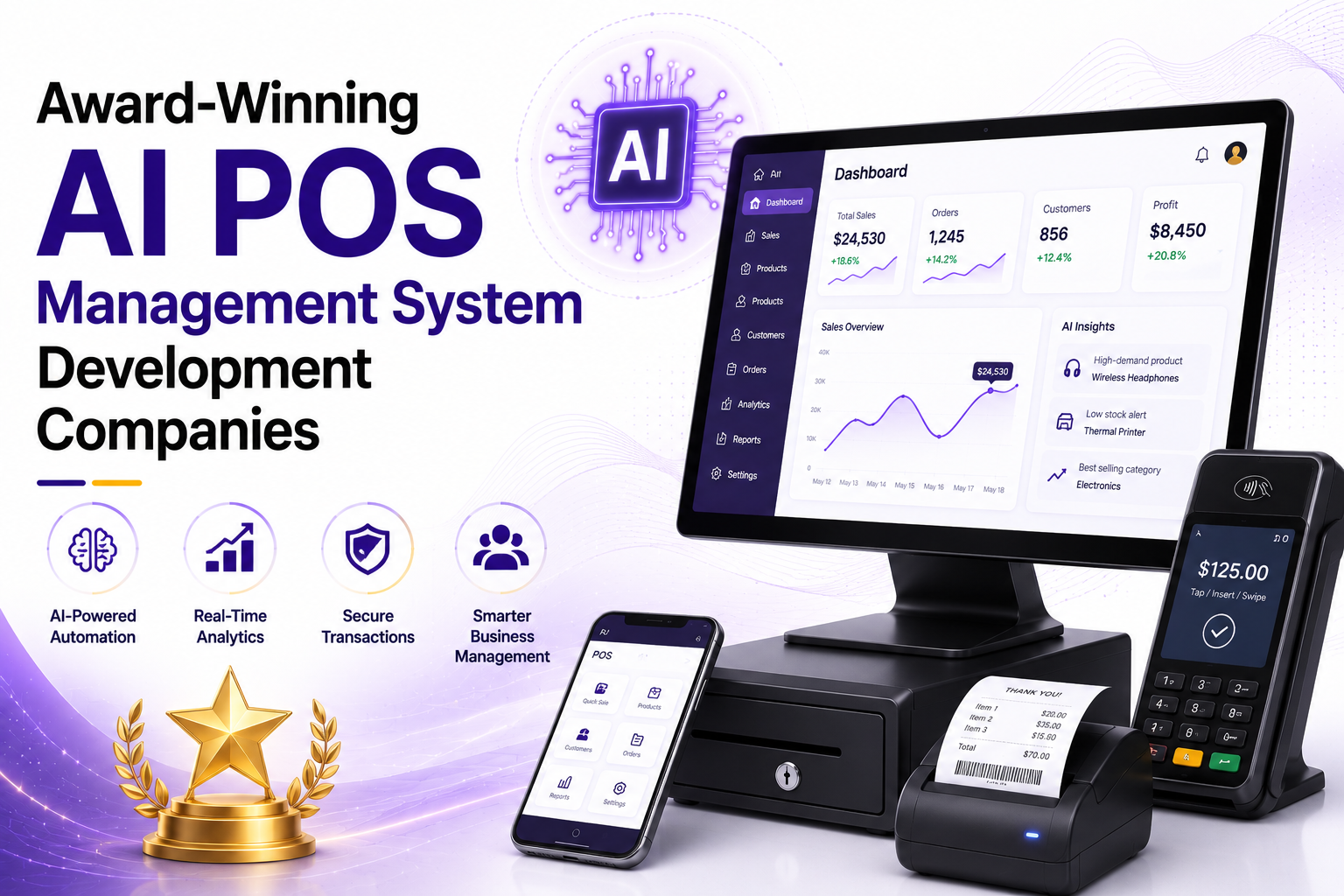

If you have spent any time browsing vendor websites lately, you have probably noticed that almost every software company now claims to be "AI powered." It is one of those phrases that has been repeated so often it barely means anything anymore. But when it comes to retail and hospitality technology, the shift is actually real. The point of sale terminal that used to just print receipts and calculate change has quietly turned into the busiest data hub in the entire business, and 2026 has made that shift impossible to ignore.
That is exactly why so many founders and operations leaders are now searching for a reliable AI POS Management System development company instead of settling for an off the shelf tool. A generic system might handle payments fine, but it will not tell you why your Tuesday afternoon sales dip every single week, or which staff member needs a nudge on upselling, or which SKU is about to run out before the weekend rush. That kind of insight needs a system that is actually built, trained, and tuned for your business, not a template dashboard everyone else is using too.
The tricky part is that "AI POS development" has become a crowded label. Some agencies have genuinely deep experience in retail technology and machine learning. Others have simply bolted a chatbot onto an old billing system and rebranded it. Since you are the one who has to live with this decision for the next several years, it is worth knowing who actually delivers and who just talks a good game.
There is also a real cost to getting this wrong. A poorly built system means staff fighting with a clunky checkout screen during the busiest hour of the day, inventory numbers that never quite match what is actually on the shelf, and reports that look impressive but never answer the one question you actually care about, which is whether the business is getting more profitable month over month. A well matched development partner avoids all of that by understanding both the technology and the day to day reality of running a store, restaurant, or service business.
This guide walks through what actually separates a strong AI POS Management System partner from an average one, followed by twenty companies worth putting on your shortlist in 2026. None of this requires a computer science degree to follow. It is written the same way you would explain it to a colleague over coffee, in plain language, with enough detail that you can walk into a vendor call already knowing the right questions to ask.
Why an AI POS Management System Is No Longer Optional
A few years ago, AI in retail was mostly a marketing slide. Now it is showing up in very ordinary, very practical ways. Inventory forecasting models can flag a stock shortage days before it happens instead of after the shelf is already empty. Fraud detection layers catch unusual refund patterns that a human cashier would never notice in real time. Customer behavior tracking lets a manager see which promotions are actually working, not just which ones felt good in a meeting.
Staffing is another area where the difference shows up quickly. A traditional POS terminal can tell you total sales for the day, but it cannot tell you that Thursday evenings consistently need one extra staff member on the floor, or that a particular cashier consistently upsells more than anyone else and should be mentoring newer hires. These are the kinds of small, compounding advantages that add up to a meaningfully more profitable business over a full year.
None of this happens by accident. It requires a development partner who understands both the technical side, things like real-time data pipelines and predictive models, and the operational side, meaning how a busy store, restaurant, or warehouse actually runs during a rush. A well-built AI POS Management System quietly handles all of this in the background while the front-line staff just sees a faster, smarter checkout screen. The complexity is hidden, but the results show up clearly in the monthly numbers.
This is also why 2026 has become something of a turning point. Hardware costs for smart terminals have dropped, cloud infrastructure has become cheaper to scale, and machine learning models that used to require a dedicated data science team can now be trained with far less overhead. Businesses that would have found this technology out of reach three years ago can now realistically afford a proper AI POS Management System, provided they choose the right development partner for their size and budget.
What to Check Before You Hire a Development Team
Before jumping into the list, it helps to know what actually separates a dependable partner from a risky one. A polished website and a long portfolio page are not enough on their own, so these are the things worth checking before you sign a contract.
• Proven retail or hospitality experience. A team that has already built for restaurants, grocery chains, or salons will understand your day to day workflow far faster than a generalist agency that mostly builds unrelated business apps.
• Real AI capability, not just automation. Ask for concrete examples of forecasting, fraud detection, or personalization features they have actually shipped and measured, rather than a generic dashboard with a few charts on it.
• Clear post-launch support. POS systems tend to break during peak hours, not quiet ones, so you need a team that answers the phone at 7 p.m. on a Friday, not only during standard office hours on a weekday.
• Transparent, realistic pricing. A fixed-cost quote with no clear breakdown of scope usually means surprise invoices later, once features you assumed were included turn out to be extras.
• Hands-on communication. You want a team that explains trade-offs in plain language and gives you honest timelines, rather than one that hides behind technical jargon whenever a question gets uncomfortable.
• A workable data migration plan. If you already have years of sales history in an old system, ask exactly how that data will move over, since a fresh start with zero history makes early forecasting far less accurate.
20 Award-Winning AI POS Management System Development Companies
Here is the full list, starting with a flexible, founder-friendly option before moving into specialized and enterprise-grade teams.
1. HireFullStackDeveloperIndia
This company has built a name around offering complete, end-to-end teams rather than piecemeal freelancers. A single engagement typically includes a project manager, backend engineers, front-end developers, and a QA specialist, all working together on one AI POS Management System build. Clients based outside India often choose this route because of the cost advantage without sacrificing communication, since the team runs daily standups and shares progress boards that clients can check anytime. Time zone overlap is usually arranged upfront as well, so calls happen during reasonable working hours for both sides rather than forcing one party into a late night meeting every week.
2. Backend Development Company
As the name suggests, this team's real strength lies in the engine room rather than the front-end screens. They specialize in building the data infrastructure that a modern AI POS Management System depends on, things like real-time syncing across multiple store locations, secure payment processing, and scalable databases that do not slow down during a holiday sale rush. For businesses that already have a design or front-end team but need rock-solid backend architecture, this company is frequently the one recommended by other developers. Their engineers also pay close attention to uptime guarantees, since a backend outage during a busy sales period can cost a retailer far more than the monthly hosting bill itself, and their contracts typically spell out response times for exactly this kind of emergency.
3. Hourly Developers
Hourly Developers works on a flexible, pay-as-you-go model that has made it a favorite among founders who want to start small and scale up as needed. Instead of locking clients into a fixed-scope contract, the team builds an AI POS Management System in phases, starting with core billing and inventory, then layering in predictive analytics and customer insights once the basics are stable. This approach suits retail chains that want to test features before committing to a full enterprise rollout. Their team is known for clear weekly reporting, so founders always know exactly what they are paying for and what has actually shipped that week. Because there is no long-term lock-in, it is also a low-risk way to try out a new development partner before scaling the engagement further, which is why so many first-time buyers of custom POS software tend to start here.
4. HireAIDevelopers
This team focuses specifically on the machine learning side of retail technology rather than general software development. Their engineers build the forecasting models, recommendation engines, and anomaly detection systems that sit inside a modern AI POS Management System. Businesses that already have a POS platform but want to add smarter analytics on top often bring this team in as a specialized add-on partner rather than starting a build from scratch. Because their focus is narrow, they also tend to be quicker at diagnosing why a forecasting model is underperforming, since that is essentially the only type of problem they work on every day.
5. CloudRetail Tech Solutions
CloudRetail Tech Solutions builds cloud-native systems designed for multi-location retail chains. Their AI POS Management System deployments are known for handling dozens of store locations from a single dashboard, with role-based access so regional managers only see what is relevant to them. They also offer a strong offline mode, which matters a lot for stores in areas where internet connectivity is not always reliable. Their onboarding process usually includes a dedicated rollout plan for each additional location, so opening a new store does not mean starting the technical setup completely from scratch every time.
6. SmartPOS Innovations
SmartPOS Innovations leans heavily into hardware integration, working with barcode scanners, kitchen display systems, and self-checkout kiosks alongside their software builds. Restaurants and quick-service chains often choose this team because they handle both the physical setup and the underlying software together, which removes a lot of the back and forth between separate hardware and software vendors. Their support packages also include on-site troubleshooting during the first few weeks after launch, which many owners find reassuring given how disruptive a hardware glitch can be during a lunch rush.
7. NextGen Retail Systems
NextGen Retail Systems has carved out a niche in loyalty and personalization features. Their builds typically include customer segmentation tools that let a business send targeted offers based on actual purchase history rather than generic discounts. For retailers who care about repeat business and customer lifetime value, this focus tends to pay off quickly. They also provide a simple way to test different offer types against small customer groups first, so a business can see what actually moves the needle before rolling a promotion out to everyone.
8. AI Commerce Labs
AI Commerce Labs positions itself as a research-driven team, spending real time testing forecasting models against a client's historical sales data before writing a single line of production code. This slower, more analytical approach suits larger retailers who care more about long-term accuracy than a rushed launch date. Clients who have worked with them describe the process as more deliberate than most agencies, with regular check-ins showing exactly how each model's predictions compare against actual results before anything goes live.
9. RetailTech Squad
RetailTech Squad is a mid-sized team known for fast turnaround on small to medium retail projects. They offer pre-built modules for inventory tracking, staff scheduling, and basic sales prediction that can be customized rather than built from zero, which usually shortens the development timeline by several weeks. This makes them a practical choice for a business that needs a working system launched before a specific date, such as a new store opening, rather than one built entirely from a blank page.
10. PixelPOS Developers
PixelPOS Developers puts a lot of emphasis on the actual user interface, which matters more than people expect. A confusing checkout screen slows down every single transaction of the day. Their design-first approach has made them popular with boutique retailers and cafes that want a system employees can learn in an afternoon rather than a week. They typically run a short usability test with real staff before the final launch, catching confusing button placements or unclear labels that a purely technical team might overlook entirely.
11. BrightPOS Solutions
BrightPOS Solutions focuses on the hospitality sector specifically, building systems tuned for restaurants, bars, and hotels. Their AI POS Management System builds typically include demand forecasting for kitchen prep and dynamic pricing suggestions for happy hour or seasonal menus, features that a general retail-focused team might not think to include. Because so much of their client base comes from food and beverage, they also tend to already understand tipping structures, split billing, and table management quirks that a generalist team would need extra time to learn.
12. Datametrix POS Systems
Datametrix POS Systems is built around one core idea, that a POS system should double as a reporting tool for owners who are not on-site every day. Their dashboards translate raw sales data into plain-language summaries, which appeals to multi-location owners who need quick answers without digging through spreadsheets. Weekly email summaries are a standard part of their package, giving traveling owners or investors a quick pulse check without needing to log into the full system at all.
13. SwiftCart Technologies
SwiftCart Technologies specializes in omnichannel setups, connecting in-store POS data with online store activity so that inventory numbers stay accurate no matter where a sale happens. This is particularly useful for retailers who sell through a physical location, a website, and marketplace listings all at once. Their sync engine is built to update stock counts within seconds of a sale, which noticeably cuts down on the overselling problem that tends to frustrate customers shopping online.
14. VendorTech AI Solutions
VendorTech AI Solutions works primarily with wholesale and B2B businesses rather than typical retail storefronts. Their systems handle bulk order processing, tiered pricing for different client categories, and demand prediction across large, irregular order volumes, a very different challenge than a typical single-location retail shop. Because B2B buying patterns look so different from consumer retail, their forecasting models are trained specifically on recurring order cycles rather than daily foot traffic, which is a distinction a generalist team often gets wrong at first.
15. PosCraft Digital
PosCraft Digital is a smaller, boutique studio that takes on a limited number of clients at a time, which means founders often get direct access to senior developers rather than being routed through account managers. This suits businesses that want a closer, more hands-on working relationship during development. The trade-off is a longer waitlist during busy seasons, so it is worth reaching out early if their limited-client approach appeals to you.
16. RetailMinds AI
RetailMinds AI focuses heavily on fraud and shrinkage detection, an area that quietly costs retailers a significant amount every year. Their AI POS Management System builds include anomaly flags for unusual refund patterns, suspicious voids, and cash drawer discrepancies, which appeals to chains that have dealt with internal theft in the past. Alerts are typically sent directly to a manager's phone rather than buried in a report nobody checks until the end of the month, which makes the whole feature far more actionable in practice.
17. CodeCommerce Studio
CodeCommerce Studio takes a modular approach, letting clients pick and choose which AI features they actually need rather than paying for a fully loaded system upfront. A small cafe might start with just smart inventory alerts, while a growing chain can add staff performance analytics later without rebuilding the whole platform. This pay-for-what-you-use structure keeps upfront costs lower and gives a growing business room to expand the system gradually as revenue increases.
18. PosLogic Systems
PosLogic Systems is known for strong compliance and security work, which matters a great deal for businesses handling large transaction volumes. Their builds typically go through extensive payment security testing before launch, making them a common choice for clients in regulated industries like pharmacies or liquor retailers. Documentation is another area where they stand out, since regulated businesses often need clear audit trails and their systems are built with that requirement in mind from day one rather than added on as an afterthought.
19. ByteRetail Solutions
ByteRetail Solutions offers a hybrid engagement model, combining an in-house project lead with a distributed team of developers. This keeps communication simple for the client while still benefiting from lower development costs, a balance that appeals to founders who have been burned by fully outsourced projects in the past. The dedicated lead acts as a single point of contact throughout the build, so clients are not left chasing down different developers to get a straight answer on progress.
20. Applify POS Experts
Applify POS Experts rounds out the list with a strong focus on mobile-first POS builds, designed for food trucks, pop-up shops, and small businesses that operate from a tablet rather than a full countertop terminal. Their lightweight AI POS Management System still includes inventory prediction and sales reporting, just optimized for smaller screens and intermittent connectivity. This makes them a solid pick for seasonal or mobile businesses that need something reliable without the overhead of a full enterprise style deployment.
Final Thoughts
Picking the right partner for an AI POS Management System is less about finding the flashiest sales pitch and more about finding a team that will still be answering your calls two years after launch. The twenty companies above cover a wide range of budgets, industries, and specialties, from lean development shops that move fast to larger teams built for enterprise scale, which means there is a realistic option here whether you run a single cafe or a fifty location chain.
It also helps to remember that this is not a one-time purchase the way buying a piece of hardware is. An AI POS Management System keeps learning from your sales data long after launch day, which means the relationship with your development partner does not really end at go-live. Ongoing tuning, occasional feature additions, and ordinary maintenance are part of the deal, so it is worth choosing a team you would not mind working with for the next few years, not just the next few months.
Before you sign anything, ask each shortlisted company for a short discovery call. A five minute conversation about how they would approach your specific store, chain, or restaurant will tell you more than any portfolio page ever could. The right AI POS Management System should feel less like new software and more like a quiet, capable member of your operations team, one that never sleeps, never gets tired during the dinner rush, and keeps getting sharper the longer it works with you.